

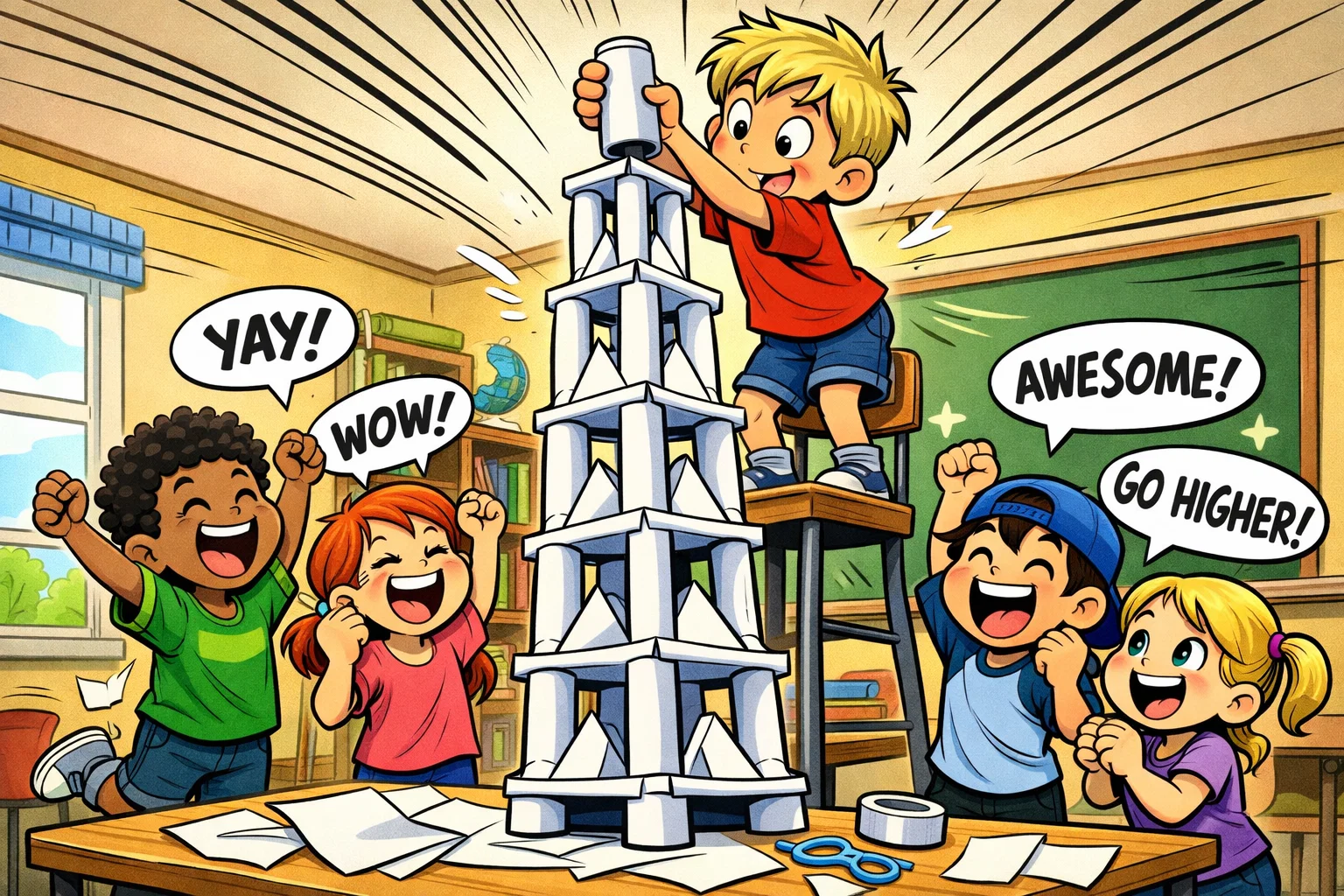
Building towers is one of the most natural forms of play for children. Whether they use wooden blocks, plastic cups, or simple paper, the act of stacking one object on top of another creates an immediate lesson in physics. A construction challenge goes beyond simple play by introducing constraints and specific goals, such as achieving maximum height or surviving a simulated earthquake. When kids build something with their own hands, they move from being passive consumers of technology to active creators.
Essential Core Principles of Tower Building
Every child starts with the same question: how high can I stack this before it falls? To build towers that defy gravity, one must look at the science of structural dynamics.
Structural Stability and Base Design
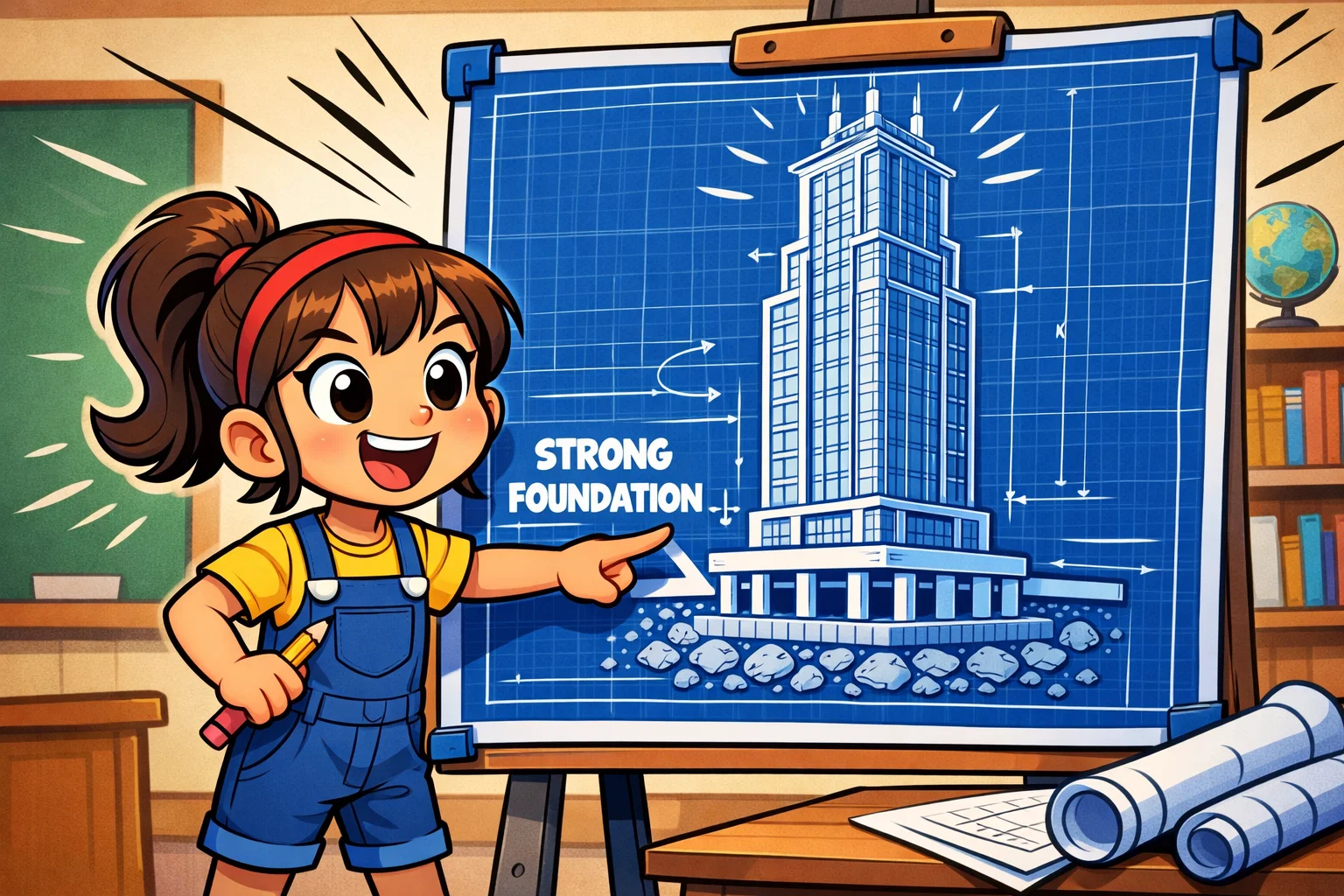
The most important part of any structure is the part you often don’t see: the foundation. A stable building must have a reliable base that can support the much weight of the upper levels. In engineering, the foundation performs several key functions:
- Distributing the total weight of the structure over a large surface area.
- Preventing sinking or tilting of the building in soft soil.
- Providing a rigid anchor to counteract lateral loads.
- Creating a low center of gravity for the entire model.
In engineering, a large footprint is essential for stability. This distributes the overturning moment—the force trying to tip the model over—across a wider area. When kids build structures, encouraging them to widen the base often solves the problem of a wobbly construction immediately.
Strength of Shapes and Cross Sections
Not all shapes are created equal in the world of construction. While squares and rectangles are common, they are susceptible to shear forces. When pushed from the side, a rectangle tends to collapse into a parallelogram. The triangle is the hero of tower building. Because the length of its three sides fixes its shape, it is inherently rigid. This is why you see triangles in the Eiffel Tower and massive bridges. Using folding paper to create triangular prisms is a key strategy for a stronger building.
Forces at Play: Compression and Tension
Every tower is constantly fighting two main forces: compression and tension. Compression is a pushing force that squashes materials together, while tension is a pulling force that stretches them. A successful construction stem challenge requires materials that can handle both. For example, a paper towel roll handles compression well when standing vertically but can fold under tension. Balancing these forces is what allows a skyscraper to remain standing during high winds or seismic shifts.
Load Distribution During Tower Challenge
Load distribution refers to how the weight of the structure is moved down to the ground. In a model to stabilize against movement, engineers use a tapered top. By keeping the top levels light and the bottom levels heavy, the center of gravity remains low. This prevents the building from becoming “top-heavy,” which is a leading cause of collapse during a building challenge.
Engineering Design Process for Kids
The engineering design process is a cyclical framework that professionals use to solve complex problems. It encourages a growth mindset by framing “failure” as a data point for improvement.
Step 1: Ask – What is Earthquake Challenge at Home?
The first step is identifying the problem. In this case, the tower must stand on a moving surface. Students must ask: What are the limited materials? How much time do I have? How tall must the structure be? Identifying these constraints early prevents wasted effort later in the engineering activity.
Step 2: Imagine – Brainstorming Stable Solutions
Before touching any building materials, kids will make a mental or physical list of ideas. This is the time to think about different materials and how they might be used. You can discuss the following options:
- Using tightly rolled paper tubes for vertical supports.
- Creating a wide base from interwoven strips of paper.
- Applying accordion folding to give rigidity to flat sheets.
- Placing the heaviest element of the structure as low as possible.
Could we roll the printer paper into tubes? Should we use stacking paper methods or interlocking joints? There are no wrong answers in the “Imagine” phase.
Step 3: Plan – Choosing and Detailing Design
Planning involves picking the best idea and sketching it. Drawing a plan helps kids visualize the height and stability of their construction. It also allows them to predict where the weak points might be. For older kids, this might involve calculating the number of sheets of paper needed to reach a specific goal.
Step 4: Create – Building Shake-Proof Tallest Tower
Now the real fun begins. Using the plan as a guide, kids build their structure. They might use paper and tape, or perhaps construction paper for more rigidity. During this phase, they will realize that rolling paper into tight cylinders makes it much stronger than simple folding paper techniques.
Step 5: Test – Does It Survive Shake Table?
Testing is the moment of truth. The tower is placed on a DIY shake table to simulate an earthquake. This test measures how the model reacts to transient lateral loads. If the construction stays upright, it has passed the initial stability test. If it falls, it provides vital information for the final step.
Step 6: Improve – What Could Build Better?
This is the most critical phase of the engineering design process. Why did the tower fail? Did the joints snap? Was the base too narrow? Professional engineers spend years in this phase. According to a study published in the Journal of STEM Education, hands-on STEM activities that emphasize iterative testing lead to a significant increase in student self-efficacy and a stronger “STEM identity,” helping children see themselves as capable problem-solvers.
| Structural Feature | Physical Principle | Mechanism |
| Cross-Bracing | Triangulation | Converts shear forces into axial tension/compression |
| Large Footprint | Base Moment | Distributes overturning forces over a wider area |
| Tapered Design | Center of Gravity | Reduces inertial forces at higher elevations |
| Base Isolation | Decoupling | Minimizes transfer of energy from ground to structure |
Building Materials for Tower Stability Experiments
The choice of building materials dictates the success of the experiment. Different materials offer various levels of ductility and rigidity.
Basic and Readily Available Materials for Beginners
For a simple paper tower, you only need printer paper and masking tape. Index card sets are also excellent because they are thicker and hold their shape better when folded. These simple supplies allow every child to participate without needing expensive kits.
Intermediate and Wacky Supplies for STEM Activities
To make the challenge harder, introduce items like spaghetti, marshmallows, or toothpicks. Spaghetti is an excellent material for teaching about brittle failure—it is strong but snaps if bent. Marshmallows act as viscoelastic dampers, absorbing energy at the joints of the construction. Key advantages of such materials include:
- Clear demonstration of brittleness and flexibility.
- Ability to easily change the configuration of joints.
- Low cost and accessibility for large groups of children.
- Safety when the structure breaks during tests.
Recycling Bin Options: Tubes, Boxes, and Containers
Never underestimate the power of a paper towel roll or toilet paper tubes. These pre-formed cylinders are incredibly strong under compression. Empty cereal boxes can be cut into “gussets” to reinforce the corners of a structure, demonstrating how different materials can work together.
Power of Constraint: Using Limited Materials
Professional engineering is always bound by budgets and resources. By limiting the number of straws or sheets of paper, you encourage your child to be more resourceful. This constraint prevents them from simply using a “brute force” approach (like using a whole roll of tape) and instead forces them to rely on geometry and balance.
Classic Tower Stem Challenge Ideas
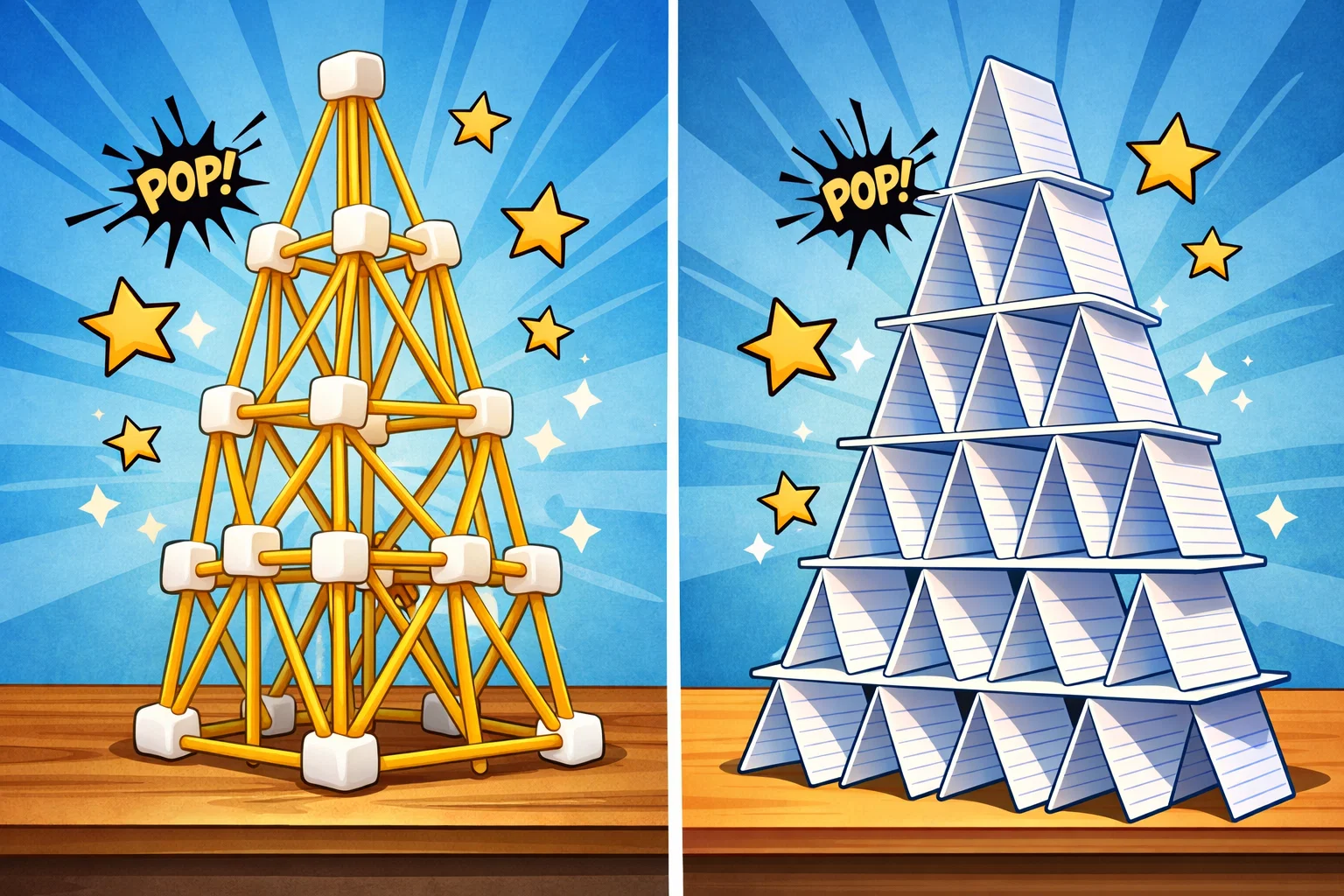
There are several “gold standard” activities that educators use to teach these concepts.
Paper Tower and Tape Experiment
This is the ultimate test of folding paper techniques. The goal is usually to build the tallest tower using only 10 sheets of paper and 12 inches of tape. Kids learn that rolling paper into cylinders or folding them into L-shapes provides the vertical strength needed to reach high.
Spaghetti and Marshmallow Stability Test
In this skyscraper challenge, the soft marshmallows allow the structure to sway. It is a great way to talk about “drift”—the amount a building moves at the top. If the marshmallows are too fresh, the model might “creep” or lean over time, introducing the concept of material fatigue.
Index Card and Paper Clip Structure
Using only index cards and paper clips, kids must build a construction that can support a heavy object like a book. This exercise teaches the following skills:
- Precise alignment of vertical elements to prevent loss of stability.
- Finding the optimal step between supports to hold weight.
- Using paper clips as mechanical connectors without glue.
Setting Up DIY Shake Table for Earthquake Tests
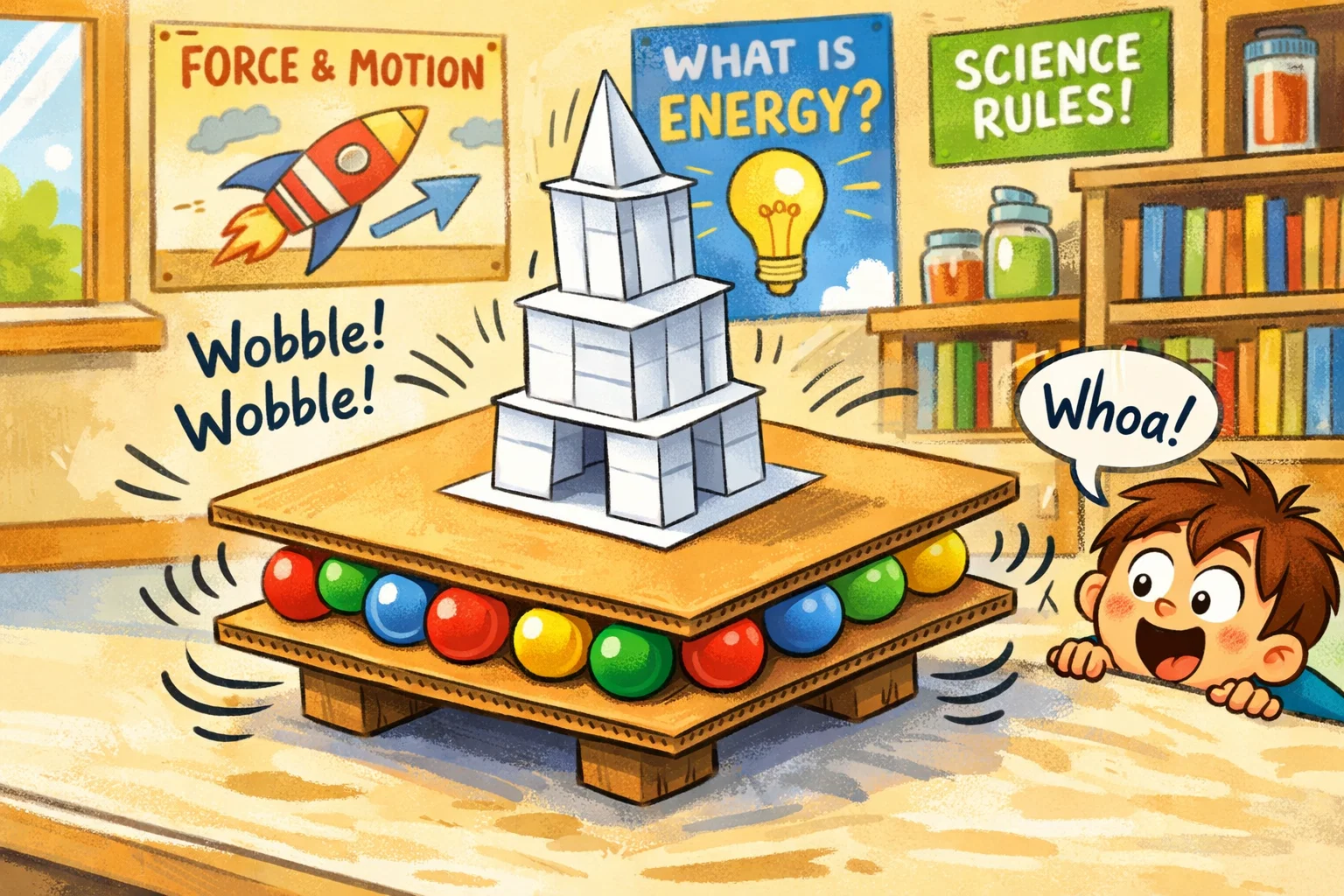
To truly test a tower to stabilize, you need a way to simulate ground motion.
Wooden Blocks and Shake Table Basics
A simple shake table can be made using two pieces of cardboard and some bouncy balls. The balls act as base isolators, allowing the top “ground” layer to move independently of the bottom layer. This replicates how real seismic waves, specifically S-waves, move the ground side-to-side.
Jenga Blocks and Pendulum Testing
If you don’t have a shake table, you can use a pendulum—a heavy weight on a string—to strike the base of the construction. This provides a repeatable “impact” force. Observations in classroom settings suggest that students who use repeatable testing methods develop a more sophisticated grasp of “Natural Frequency”—the specific speed at which a building starts to wobble uncontrollably.
Simulating Seismic Waves at Home
Real earthquakes aren’t just one movement; they are a series of waves. P-waves push and pull, while S-waves shake side-to-side. By varying the speed at which you shake your DIY table, you can demonstrate resonance. Research into 21st‑century learning highlights that these types of simulations are vital. Recent studies in STEM education journals report that students taught with virtual or experiential physics simulations show significantly higher post‑test performance and concept retention than those taught with traditional lecture‑only approaches, particularly on difficult modern physics topics.
Advanced Tower Challenge for Future Engineers
Once the basics are mastered, it is time to increase the complexity for older kids.
Weight-Bearing Tower with Specific Loads
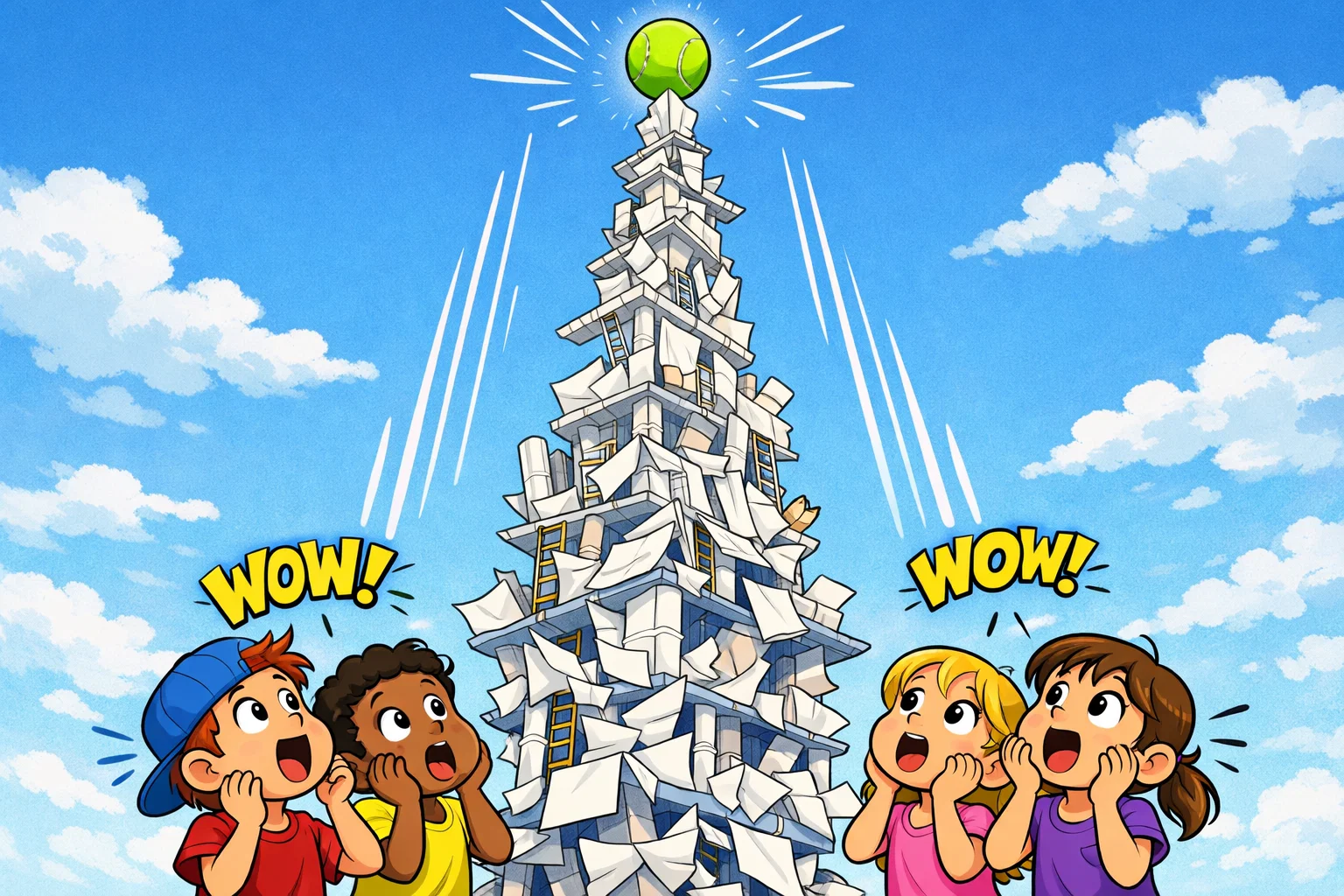
The building must stand while holding a tennis ball or a cup of sand at the very top. This significantly raises the center of gravity and increases the inertial forces during a shake test. It mimics the challenge of building a water tower or a skyscraper with a heavy rooftop garden.
Wind Resistance vs. Earthquake Stability
While earthquake-proof buildings need to be somewhat flexible (ductile), wind-resistant buildings often need more stiffness. Balancing these two requirements is a major part of modern civil engineering. You can use a hair dryer to simulate wind while the shake table provides the “earthquake.”
Aesthetics and Design: STEAM Integration
Engineering isn’t just about math; it’s about art and human experience. Encourage your child to think about how people would move inside their construction. Adding windows or a decorative “skin” to the paper model adds weight and complexity, making the stability challenge even more realistic.
Building Techniques: Transforming Flat into Formidable
How do you turn a flat sheet of paper into a pillar? It all comes down to technique.
Brainstorming and Sketching: Power of Pencil
A pencil is the most important engineering tool. By sketching designs first, kids can identify where they might need more support. This mirrors the professional practice of “performance-based engineering,” where the goal is to predict behavior before the first stone is laid.
Structural Reinforcement Methods
Cross-bracing is the most effective way to reinforce a wobbly tower. By adding diagonal members to a square frame, you create triangles that prevent the frame from “racking” or leaning. Another method is the use of “sleeves”—sliding one paper tube inside another to double the thickness and strength.
Testing and Iteration: Engineer Mantra
“Fail early and fail often” is a common saying in design labs. If a structure falls during a small shake, it is a success because it revealed a weakness that can be fixed. This iterative process is how we got the safe buildings we live in today.
Beyond Build: Reflection and Extension STEM Activities
The learning shouldn’t stop when the shake table stops moving.
Deep Dive with Discussion Questions
After the challenge, ask your child:
- Which part of the tower broke first?
- Did the height of the model make it harder to stabilize?
- If you had unlimited materials, what would you change?
- How did the change in vibration frequency affect the stability of the top?
- Why did triangular elements prove to be stronger than rectangular ones?
Documenting and Sharing Designs
Encourage your child to take photos or videos of their building during the earthquake test. Slow-motion video is particularly helpful for seeing exactly how a structure begins to fail. Documenting the process helps build a “portfolio” of their engineering journey.
Connecting Towers to Real World Engineering
Talk about the 2015 earthquake in Nepal or the famous “tuned mass damper” (a giant golden ball) inside the Taipei 101 skyscraper. These real-world examples show that the construction challenge is far more than just a fun activity; it is a simulation of the work that keeps millions of people safe every day.