

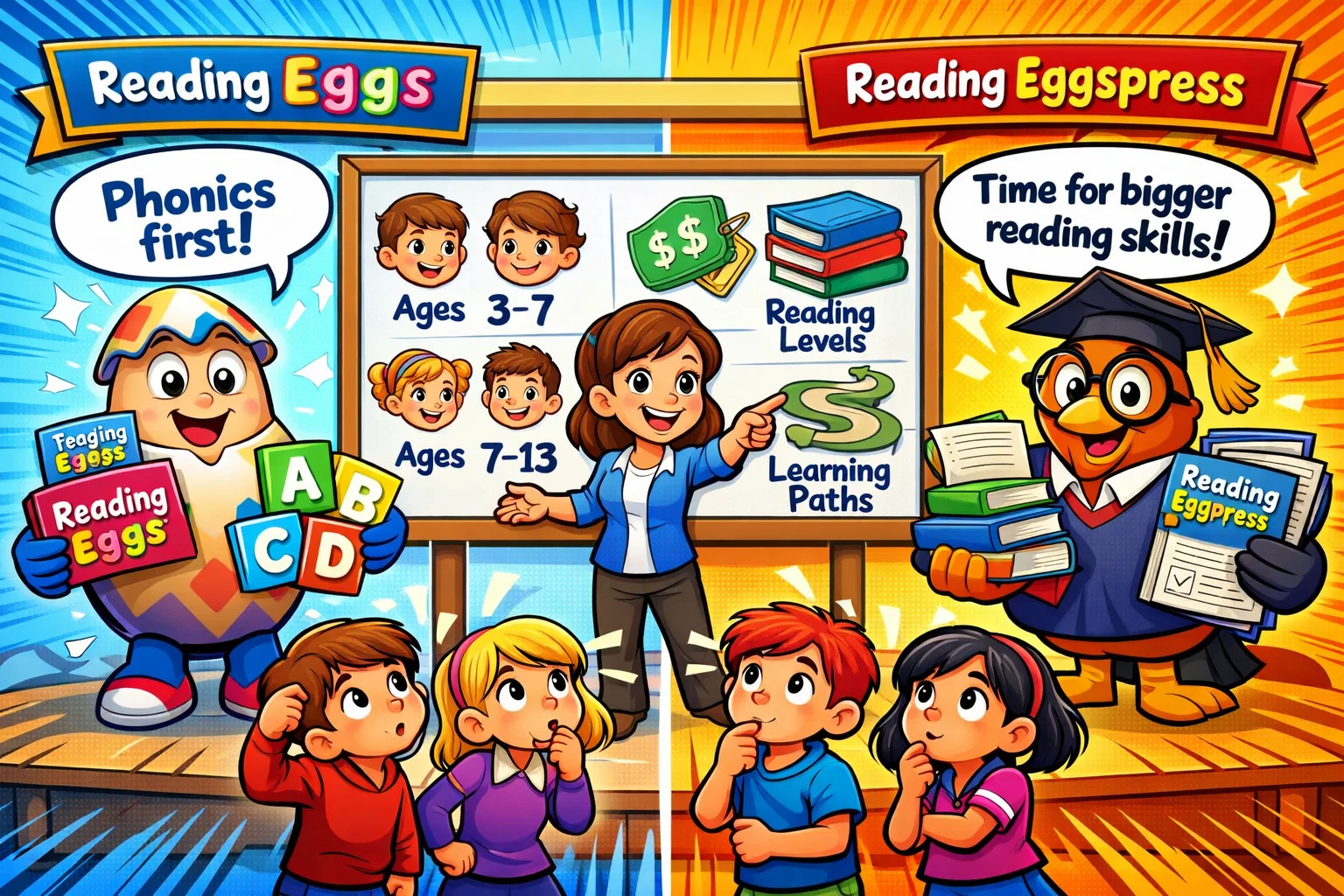
Choosing the right digital tools to support a child’s literacy development can be challenging for parents and educators. Both platforms, developed by Blake eLearning, are designed to help students build essential literacy skills through interactive lessons. While they share a similar visual style and are often bundled together, they serve different developmental stages in reading education.
This comparison provides a neutral, in-depth look at how both platforms function, their unique focuses, and how they cater to different age groups. Understanding the structural differences between these two programs helps families choose the option that best supports their child’s reading development.
Overview of Reading Eggs and Reading Eggspress
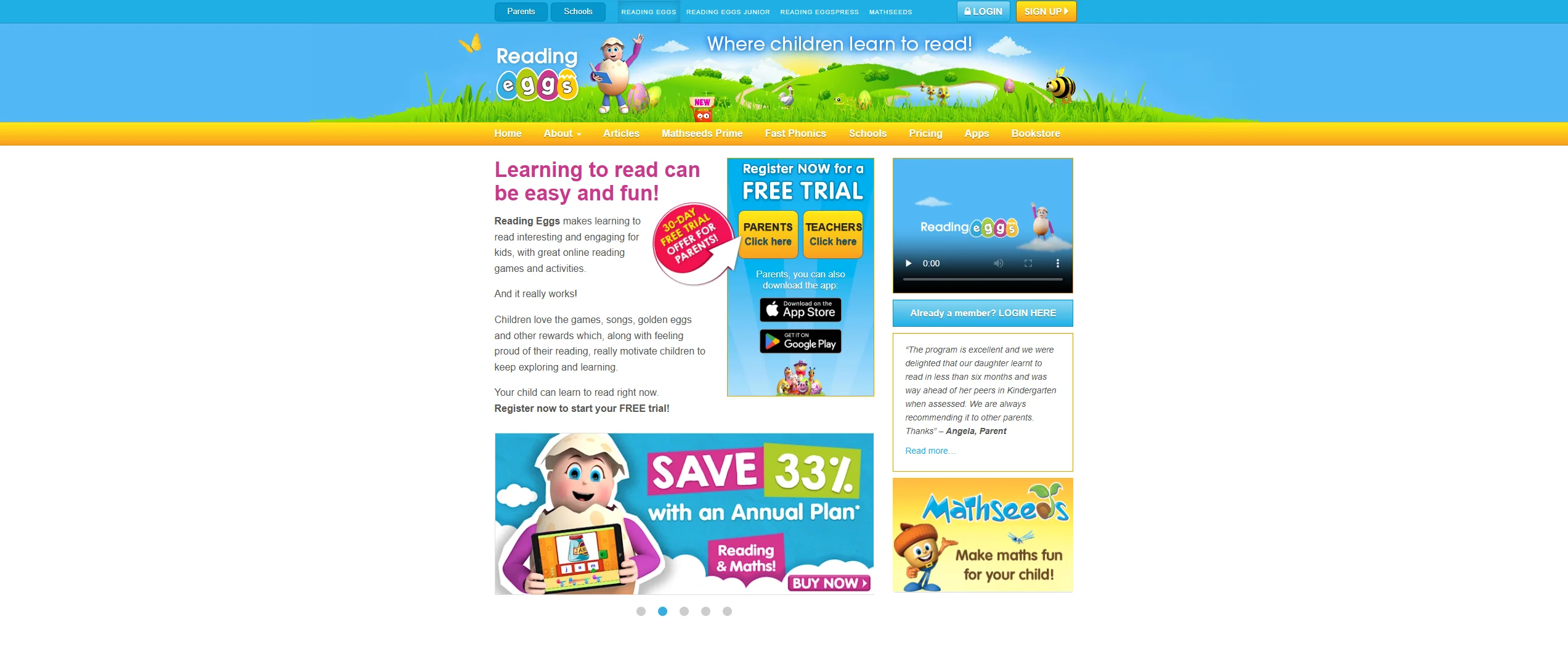
These programs are designed to support reading development from early letter sounds to more advanced comprehension skills. Families often compare them because they are part of the same platform ecosystem; a single subscription usually provides access to both programs, although the user experience changes significantly as students progress.
The primary reason for the two-tier system is the shift in educational needs that occurs around second or third grade. While a younger child needs heavy interaction and repetition to decode words, an older reader requires a more sophisticated interface to engage with nonfiction and complex narratives. By dividing the curriculum into two programs, the developers aim to keep the learning experience age-appropriate.
What the Reading Eggs Program Includes
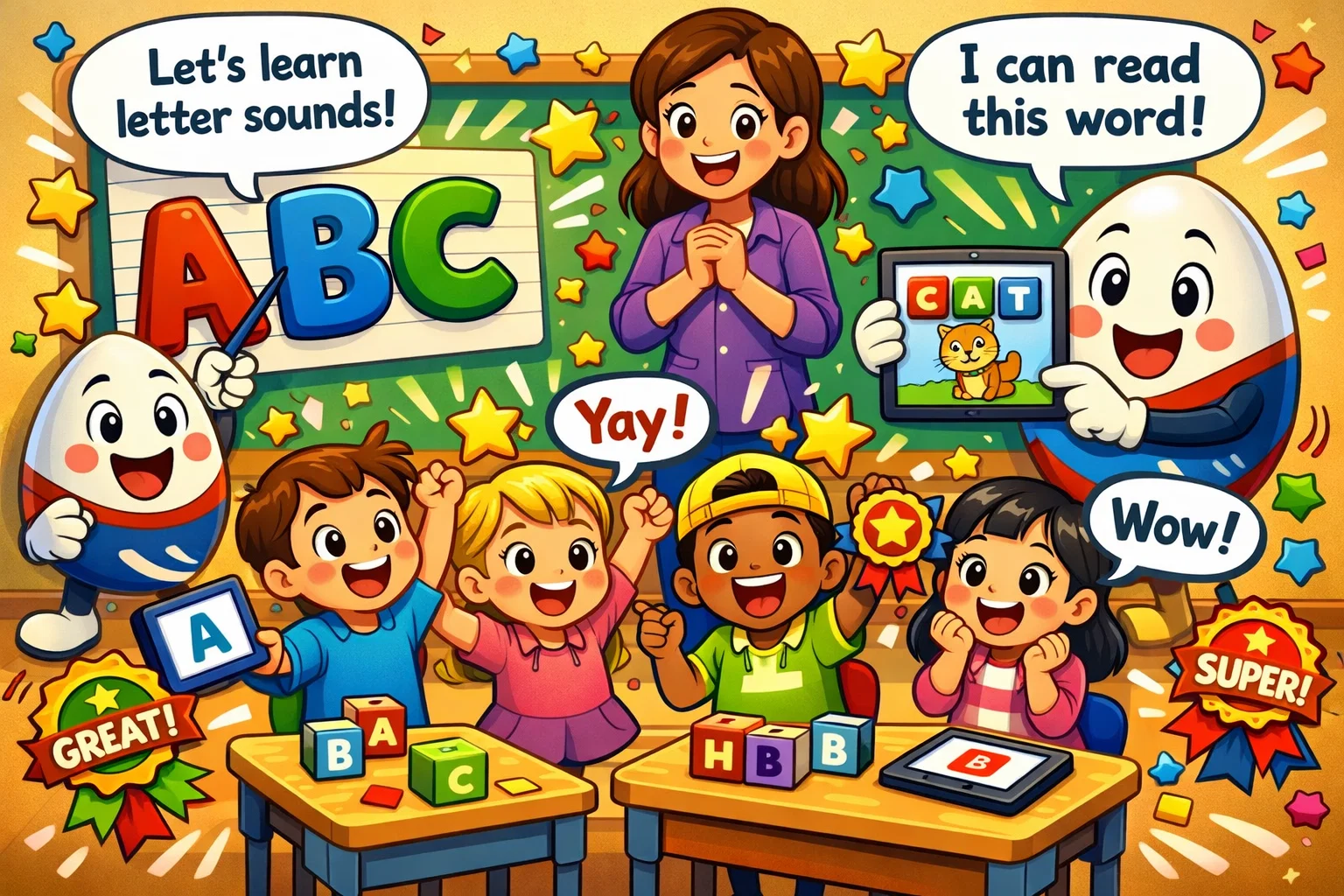
This is the foundational online reading program designed for children who are just beginning to learn to read. It is based on synthetic phonics, an instructional method that teaches children to link letters (graphemes) to sounds (phonemes) and blend them to read words.
- Structured Learning Path: The core Reading Eggs program includes more than 120 lessons organized across multiple maps, guiding beginners from early phonics skills to a basic second-grade reading level.
- Gamified Lessons: Each session is framed as an animation-rich journey where children earn golden eggs as rewards.
- The Rewards System: Students can use their “eggs” to buy accessories for their avatar or decorate their digital “house,” which keeps engagement high through positive reinforcement.
- Placement Test: To ensure a student doesn’t start at a level that is too easy or too hard, the system begins with a placement test to calibrate the starting point.
What the Reading Eggspress Program Includes
This platform picks up where the initial lessons leave off. It is tailored for students who have mastered the basics of decoding and are ready to tackle fluency and deep comprehension.
- The Library: One of its main features is a digital library with thousands of fiction and nonfiction titles, with some sources suggesting the collection exceeds 4,000 books.
- Comprehension Gym: This area focuses on comprehension strategies through hundreds of structured activities and lessons that include quizzes to verify understanding.
- Vocabulary and Usage: Lessons move beyond simple definitions to explore words in context, helping students understand nuance and academic language.
- Stadium and Mall: Competitive elements allow students to practice spelling and grammar in the “Stadium,” where their scores are compared with other players in leaderboard-style competitions.
Key Differences in Learning Focus
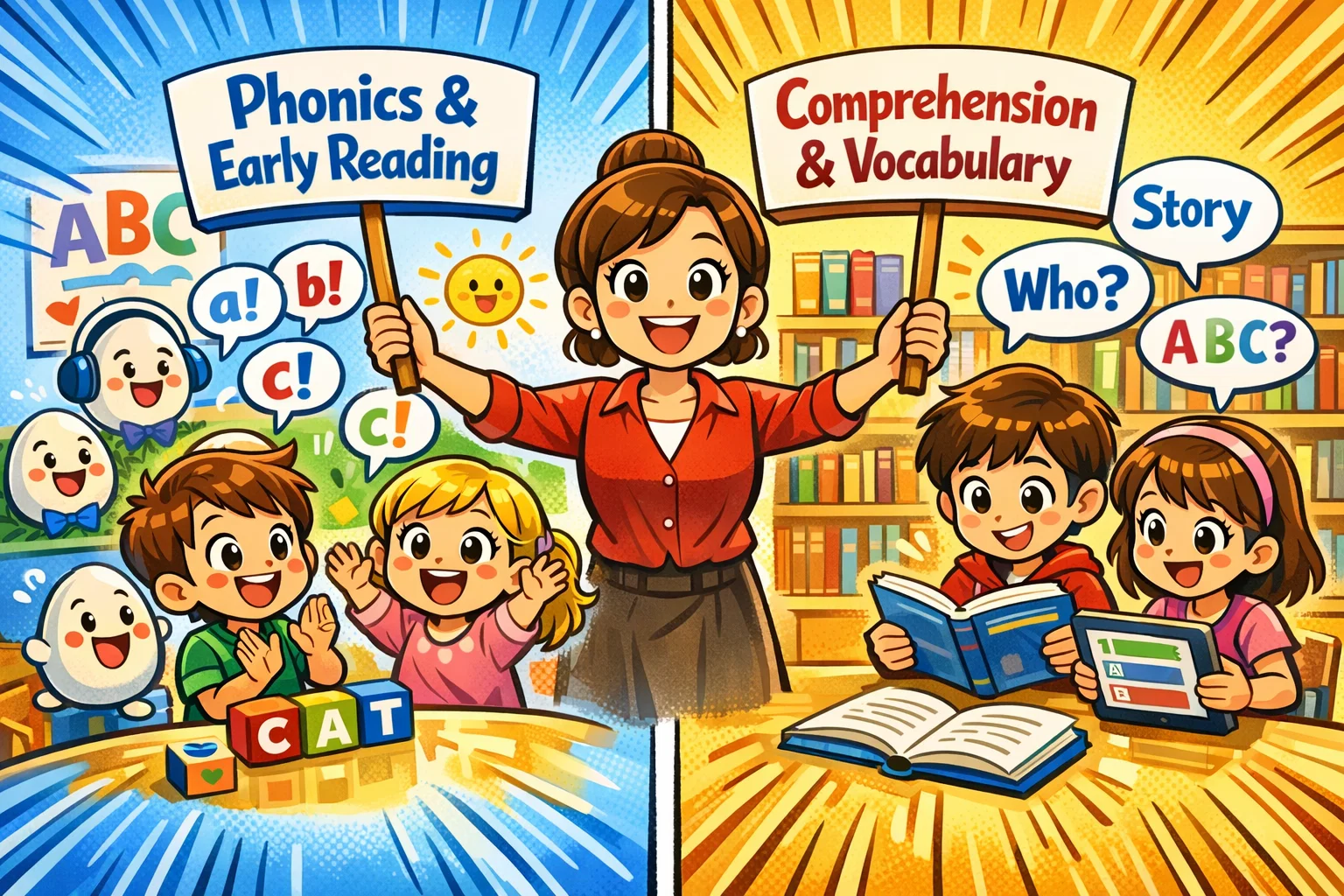
The shift between the two platforms represents the transition from “learning to decode” to “decoding to learn.”
| Feature | Reading Eggs | Reading Eggspress |
| Primary Goal | Letter sounds, blending, and sight words | Fluency, analysis, and stamina |
| Instructional Base | Phonics and Phonemic awareness | Literacy and Inferential thinking |
| Content Type | Short sentences and simple stories | Full-length books and complex articles |
| Assessment | End-of-map tests on basic decoding | Lexile-level assessments and deep quizzes |
How Both Platforms Fit Within the Same Learning Ecosystem
A key advantage of this ecosystem is the continuity between the programs. Both programs are part of the Reading Eggs suite, meaning a child’s avatar and earned rewards often carry over. As a student completes the final maps of the primary program, the system naturally nudges them toward the advanced modules. This seamless integration allows homeschool families to maintain a consistent curriculum for years without having to learn a new interface.
Target Age Range and Skill Levels
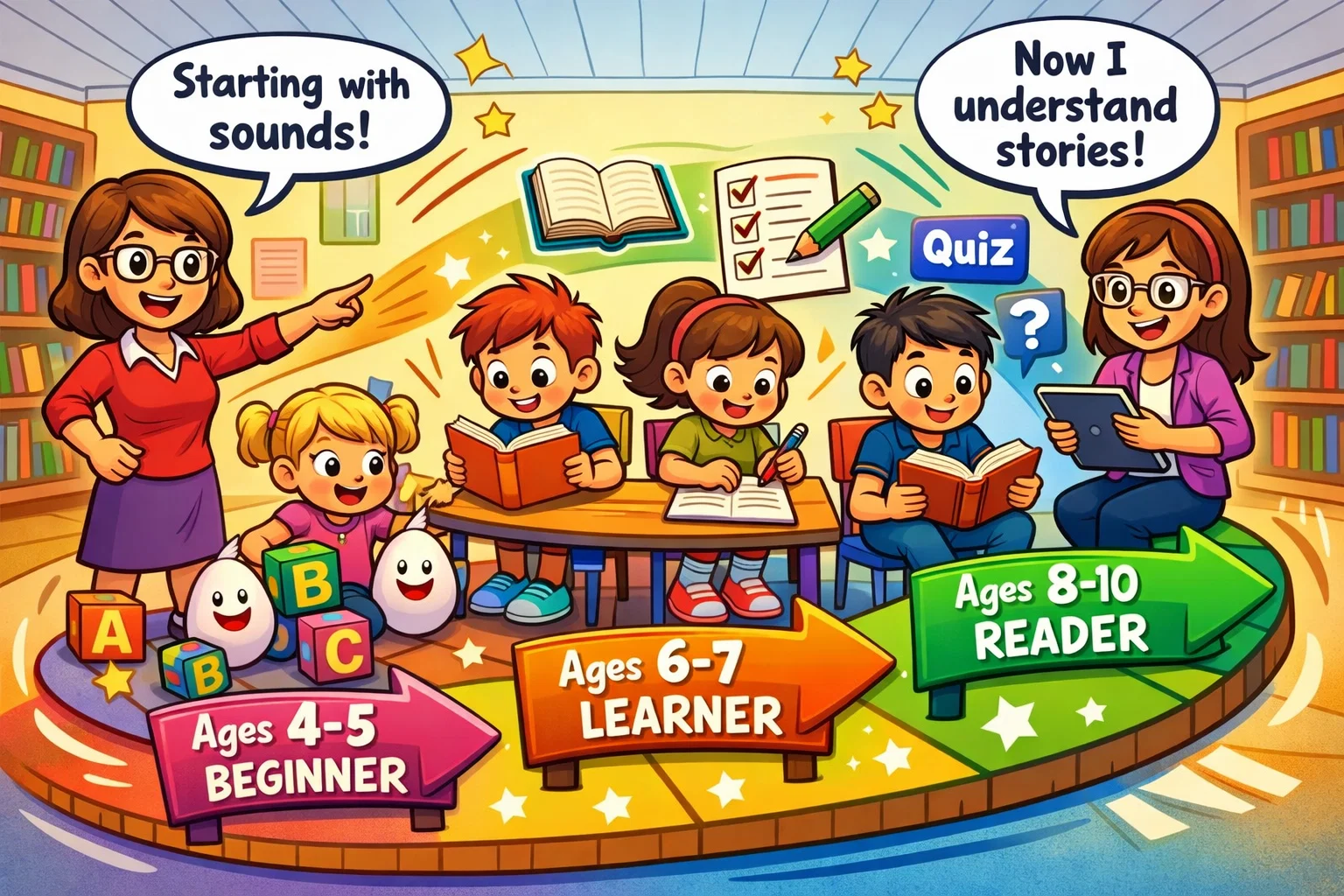
Choosing the program that matches a child’s reading level is often more important than relying strictly on age.
Age Range Best Suited for Reading Eggs
Generally, this program targets children aged 2 to 7. It begins with “Junior” (for toddlers) and moves into the main lessons. It is ideal for a younger child who is still learning to recognize the alphabet or struggling with phonics skills.
Age Range Best Suited for Reading Eggspress
This platform is designed for children aged 7 to 13. At this stage, the student should be able to read independently but may need help with comprehension lessons or expanding their vocabulary and usage.
Skill Level Progression Between Both Programs
The transition typically occurs when a student reaches a level equivalent to a mid-to-late 2nd grade. A learner is ready for the next step when they no longer need to sound out every word and can instead focus on the meaning of a paragraph.
Suitability for Different Learning Speeds
Both programs are highly adaptive. If an older student has gaps in their phonics knowledge, they can still use the foundational levels without feeling “babied.” Conversely, a gifted 6-year-old can jump into the library if their skills are sufficiently advanced.
Curriculum Structure and Learning Approach
The curriculum focuses on key literacy skills such as phonemic awareness, phonics, fluency, vocabulary, and comprehension.
Phonics and Early Literacy System in Reading Eggs
The phonics approach here is highly sequential. Children are not overwhelmed; they learn a few sounds, immediately apply them to read words, and then see those words in a digital book. This “synthetic” method ensures that phonics lessons lead directly to functional skills.
Comprehension and Vocabulary Development in Eggspress
In the advanced program, the focus shifts to comprehension lessons. Students learn to identify the “main idea,” “compare and contrast,” and “draw inferences.” Each book in the library ends with a quiz, ensuring that screen time is productive.
Gamification Elements and Motivation Tools
Both programs keep kids engaged through a “collectible” economy.
- Rewards: Earn golden eggs to spend in the plaza.
- Competition: The “Stadium” offers a safe way to compete in literacy-based games.
- Identity: Customizing an avatar provides a sense of ownership over the learning process.
Lesson Progression and Skill Tracking
Parents receive detailed progress reports via email. These reports highlight which activities were completed and where the student might be struggling. This data is invaluable for identifying if a child needs printable worksheets for extra offline practice.
Learning Experience and Interface for Children
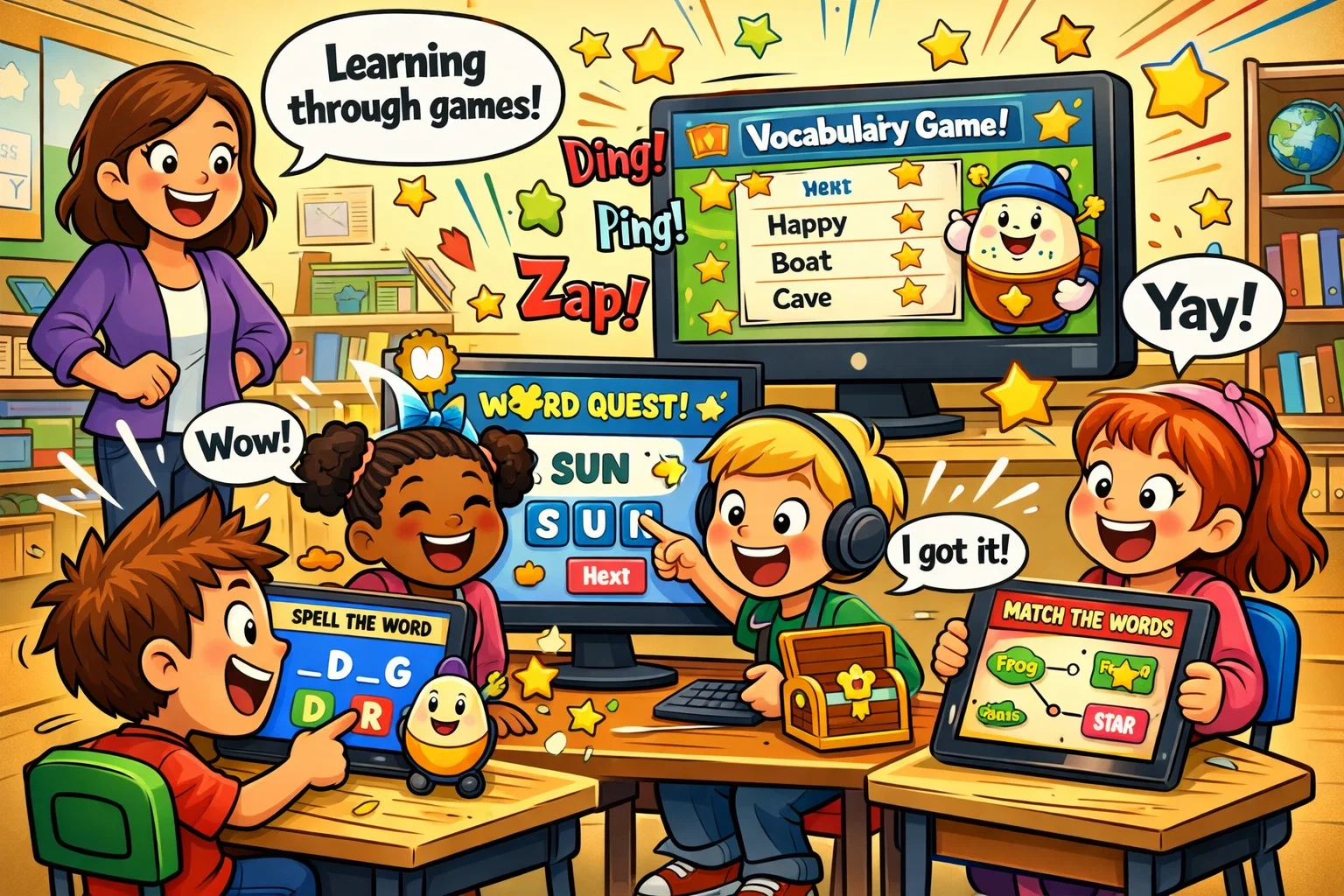
Visual Design and Game Mechanics
The early program is bright, colorful, and features catchy songs—perfect for the attention spans of 5-year-olds. The advanced version adopts a slightly more “mature” aesthetic, looking more like a digital world or a strategy game, which appeals to pre-teens.
Ease of Navigation for Young Learners
The interface is designed for independence. Even a younger child can navigate the “map” with minimal parental intervention. This is a significant benefit for busy parents who need an online reading program that doesn’t require constant tech support.
Accessibility Across Devices
The Reading Eggs app is available on iOS and Android, and the web version works seamlessly on most browsers. This allows children to switch between a tablet on the couch and a desktop computer at a desk without losing progress.
Educational Value and Literacy Skill Development
Alignment With School Curriculum
The programs are designed to reinforce what is taught in classrooms. Many schools use these tools as a supplement to their primary curriculum because the lessons are built around widely recognized literacy frameworks such as the five pillars of reading.
Role of Independent Practice
Fluency often improves when children practice reading regularly on their own. By providing a digital library of fiction and nonfiction titles, the system encourages children to find books they enjoy, which can support long-term reading development.
Pricing Plans and Subscription Options
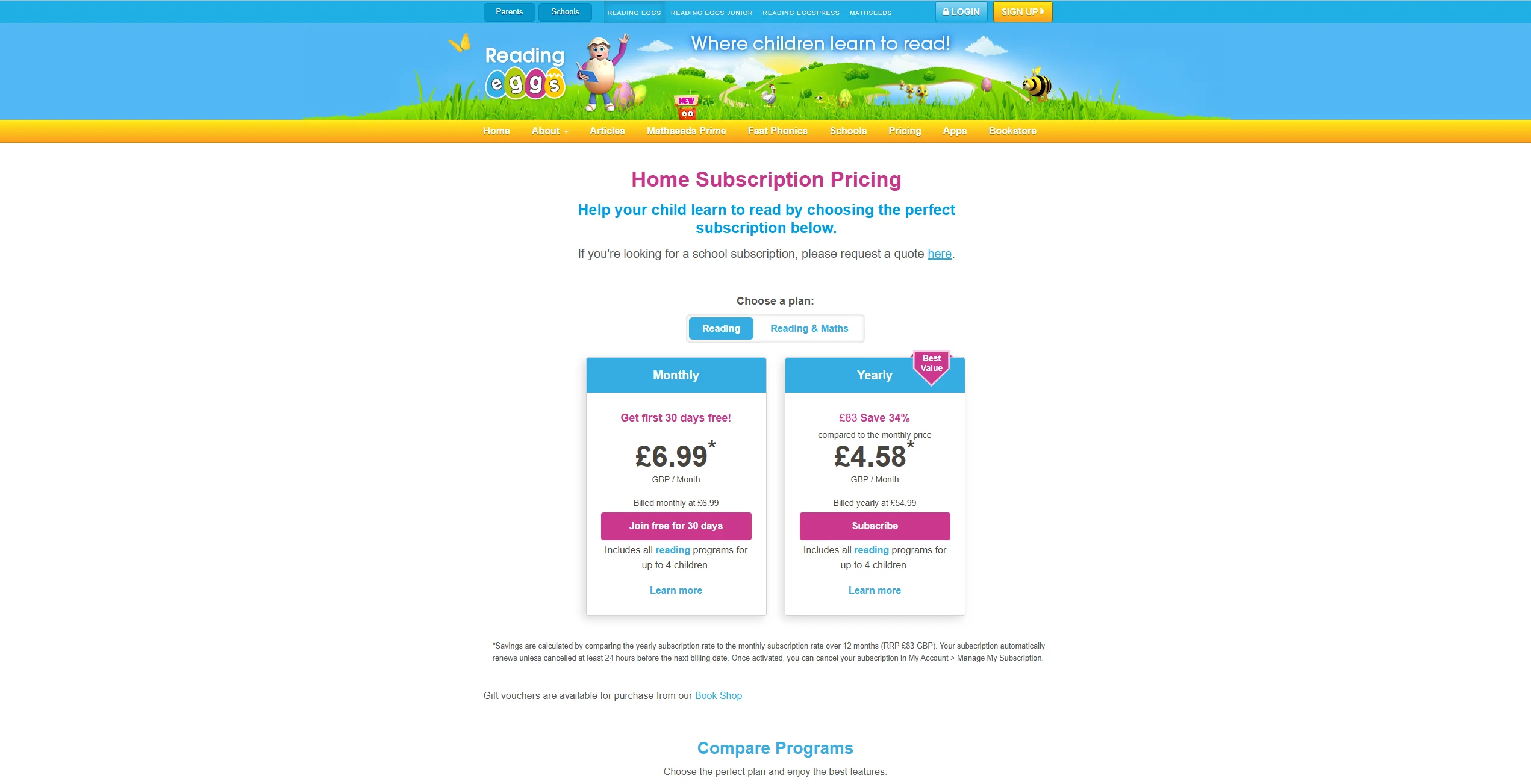
One of the most appealing aspects of this ecosystem is the 30-day free trial. This allows families to decide whether the program is a good fit before committing to a subscription.
| Plan Type | Estimated Price (USD) | What’s Included |
| Monthly Subscription | Monthly subscription typically starts at about $9.99 per month for the reading programs, while bundles that include Mathseeds and additional features usually cost around $13.99 per month. | All literacy apps, Mathseeds, Fast Phonics |
| Annual Subscription | Annual subscriptions usually start at about $69.99 per year for the core reading programs, with expanded bundles that include Mathseeds priced at around $99.99 per year. | Full suite (Best value for long-term use) |
| Family Plan | Varies | A single subscription typically allows multiple child profiles (usually up to four), enabling families with several children to use the same account without purchasing separate subscriptions. |
Pros and Limitations of Each Program
Advantages of Reading Eggs
- Excellent phonics instruction for beginners.
- Designed to keep many children engaged while practicing reading skills.
- Includes Mathseeds (math program) in most bundles.
Advantages of Reading Eggspress
- Massive digital library with diverse genres.
- Deep focus on comprehension strategies that are often missed in other apps.
- Effective for older readers up to age 13.
Possible Limitations
- Primary Level: Can become repetitive for students who master sounds quickly.
- Advanced Level: The volume of text in the “Gym” can be intimidating for students with a short attention span.
When Children Transition Between Programs
The transition isn’t just about finishing the 120 lessons; it’s about readiness. Students are generally ready to move to more advanced texts once they can read simple chapter books with good accuracy and explain the main events of the story.
Signs of Readiness:
- Completion of Map 12 in the early program.
- High scores on the final placement test or end-of-map quiz.
- A desire for longer stories rather than short interactive games.
Alternatives to These Platforms
While Reading Eggs is one of the top choices, other platforms like Hooked on Phonics offer a more traditional, linear approach. Programs like ABCmouse are better suited for general early childhood education, whereas this suite is a specialized comprehensive reading tool. For older children focusing strictly on fluency, ReadTheory is a strong alternative.