

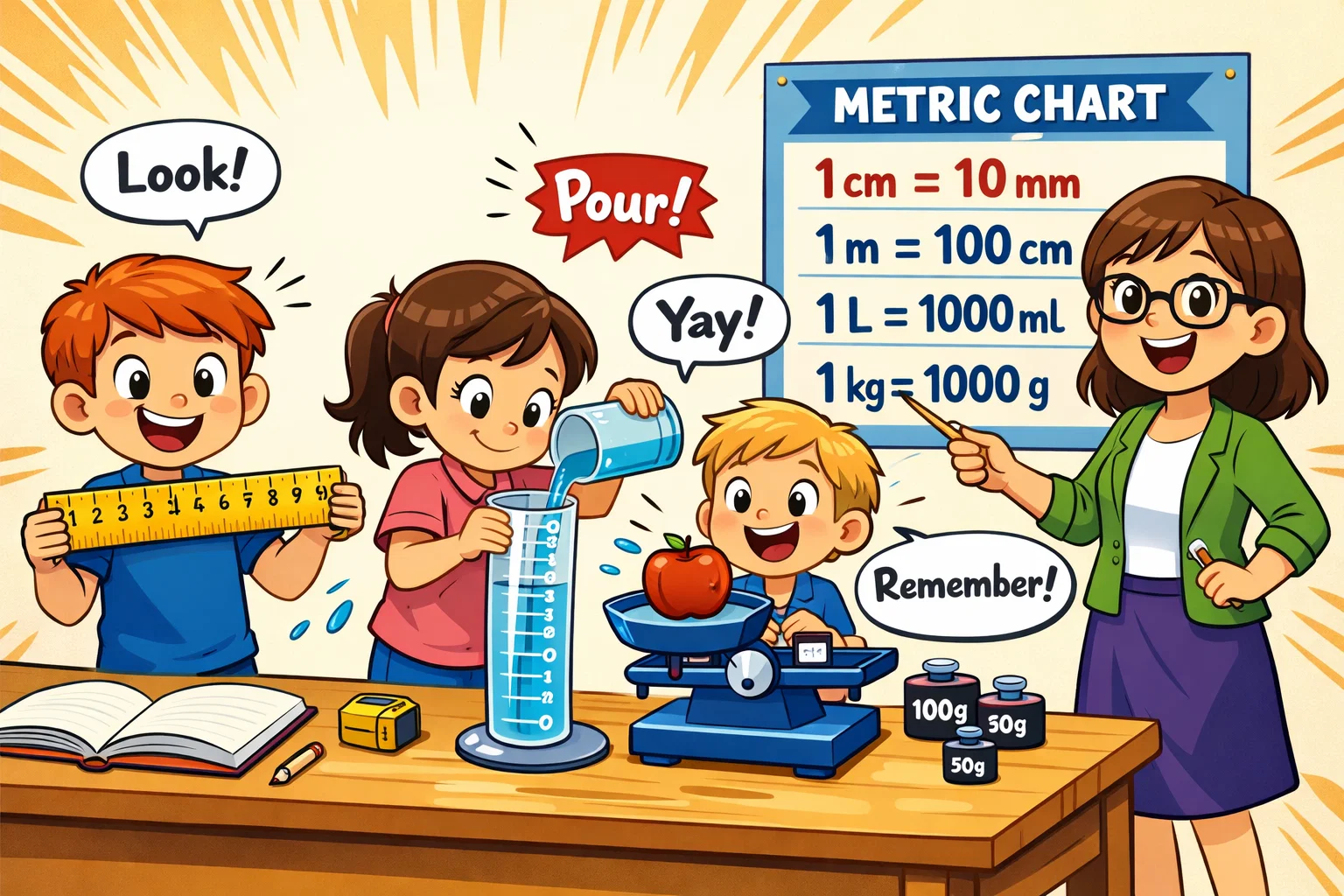
Teaching the metric system is more than just a maths lesson; it is the fundamental language of global science. For elementary students and middle schoolers alike, understanding how to measure the length of a leaf or the mass used in a chemistry experiment provides a bridge between abstract numbers and physical reality. When kids see that a centimeter or a gram represents a tangible part of their world, they move from rote memorization to scientific literacy.
This guide provides a comprehensive roadmap for educators and parents to introduce fun hands-on measurement activities. By moving away from static worksheet drills and toward hands-on learning, you can help students learn the precision required for scientific inquiry. Whether you are navigating a science classroom or a homeschool kitchen, these measurement strategies ensure that every measurement taken is a step toward mastery.
Measurement Role in Science Learning for Kids
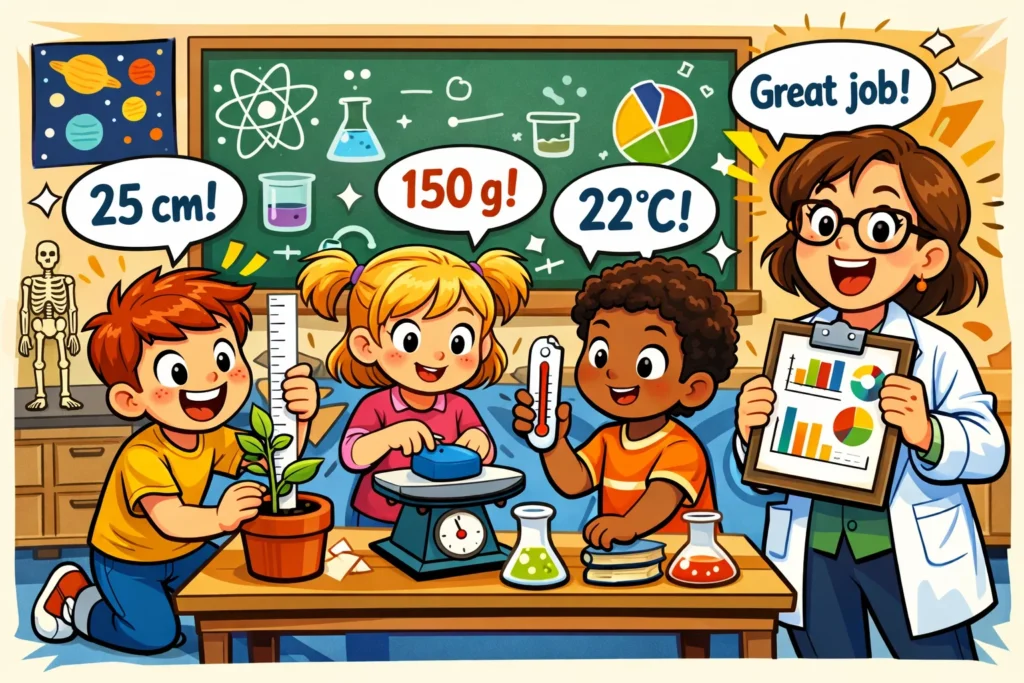
In science, data is essential. Without accurate measurement, an experiment becomes little more than observation. For elementary students, learning to use the metric system allows them to quantify their curiosity. It transforms a statement like “the plant grew a lot” into “the plant grew 4 centimeters,” which is the basis of evidence-based reasoning.
Measurement as Foundation of Scientific Experiments
Scientific reproducibility depends heavily on the use of standard units. If a scientist in France uses the metric system and a student in Chicago uses imperial units, communicating results becomes a hurdle. By teaching the metric system early, we prepare children to participate in the global scientific community. Measuring length, mass, volume, and temperature allows students to use data to prove or disprove their hypotheses.
Real-World Science Connections
From the middle school science lab to engineering firms, the metric system is used almost universally. Kids see these units in action when they look at nutrition labels (grams), medicine dosages (milliliters), or weather reports (Celsius). Engaging in measurement activities helps them realize that measurement concepts are not confined to a textbook but are essential for tasks ranging from baking cakes to understanding climate change.
Metric Measurement vs Daily Estimation
While estimation is a valuable life skill, science classes require the precision of an actual measurement. Visual estimates are subjective; a “handful” of sand varies by the size of the hand. Using a measurement tool like a metric ruler or a graduated cylinder ensures that science students produce reliable, objective data that can be compared across different groups.
Metric System Basics for Kids
The system of measurement used in science is designed for simplicity, based on powers of ten. This decimal-based structure makes the metric system much easier to use for children to grasp than the fractional complexities of the imperial system.
Core Metric Units Used in Science
To understand the metric system, students must first meet the “base” units:
- Meter (m): The standard for length.
- Gram (g): The standard for mass.
- Liter (L): The standard for volume.
- Degrees Celsius (°C): The standard unit for temperature.
Metric Prefixes Made Simple
The beauty of metric units lies in the prefixes. A fun way to teach this is through a “staircase” model. Metric prefixes like kilo- (1,000), centi- (1/100), and milli- (1/1,000) tell you exactly how large or small the unit is. For example, a centimetre is one hundredth of a metre. Using colored water in containers of different sizes can visually demonstrate these scales.
Metric Tools Used in Science Class
To correctly measure, students need the right measuring tool. Common items include:
- Metric Ruler/Measuring Tape: For length and distance.
- Graduated Cylinder: For liquid volume.
- Balance scale or triple beam balance: To measure mass.
- Thermometer: For thermal energy.
Standard and Non-Standard Measurement in Science
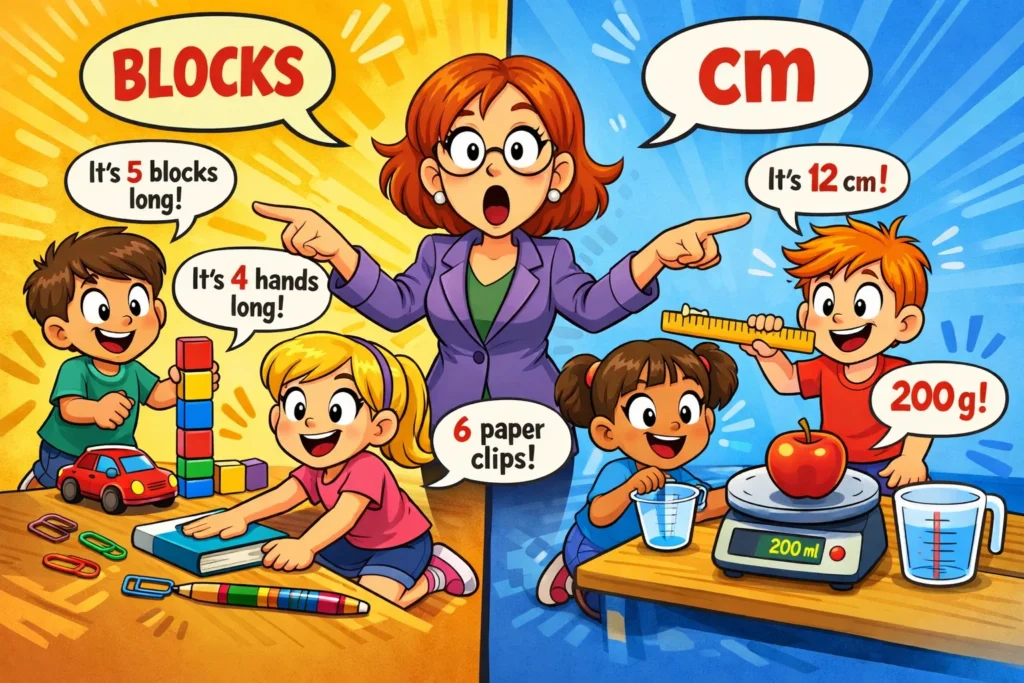
Before diving into metric measurements, younger children often benefit from non-standard measurement. This builds the concept of measurement without the pressure of reading complex scales.
Non-Standard Measurement Activities
Give students items like paper clips, LEGO bricks, or even their own footsteps to measure the length of a desk. These measuring activities teach the “start-to-finish” principle of using everyday objects as a reference point.
Transition to Metric Units
Once students understand that “10 paper clips” equals a length, you can teach your students that paper clips vary in size, but a centimeter is always the same. This creates a “need” for standard measurement tools like a ruler.
Accuracy and Consistency in Measurement
In a science classroom, inconsistency leads to “failed” experiments. If one group uses inches and another uses centimeters, the data is incomparable. Teaching the metric system emphasizes that a system of units must be universal for science to be valid.
Teaching Metric Measurement Through Hands-On Activities
The answer lies in hands-on engagement. Passive learning rarely leads to lasting understanding when it comes to spatial awareness and physical quantities.
Inquiry-Based Measurement Tasks
Instead of giving the answer, ask a question: “How many grams does a single penny weigh?” Allow students to use a balance scale to find out. This inquiry-based approach makes measurement feel like a mystery to be solved.
Play-Based Measurement Learning
Turn practice measuring into a game. A “Metric Scavenger Hunt” where students must find something that is exactly 12 centimeters long or has a mass of 50 grams is an engaging way to build familiarity.
Cross-Curricular Science Integration
Measurement skills overlap with many subjects:
- Physics: Measuring the distance a toy car travels.
- Biology: Tracking the height of a seedling.
- Chemistry: Measuring colored water to observe displacement.
Hands-On Metric Measurement Activities for Kids
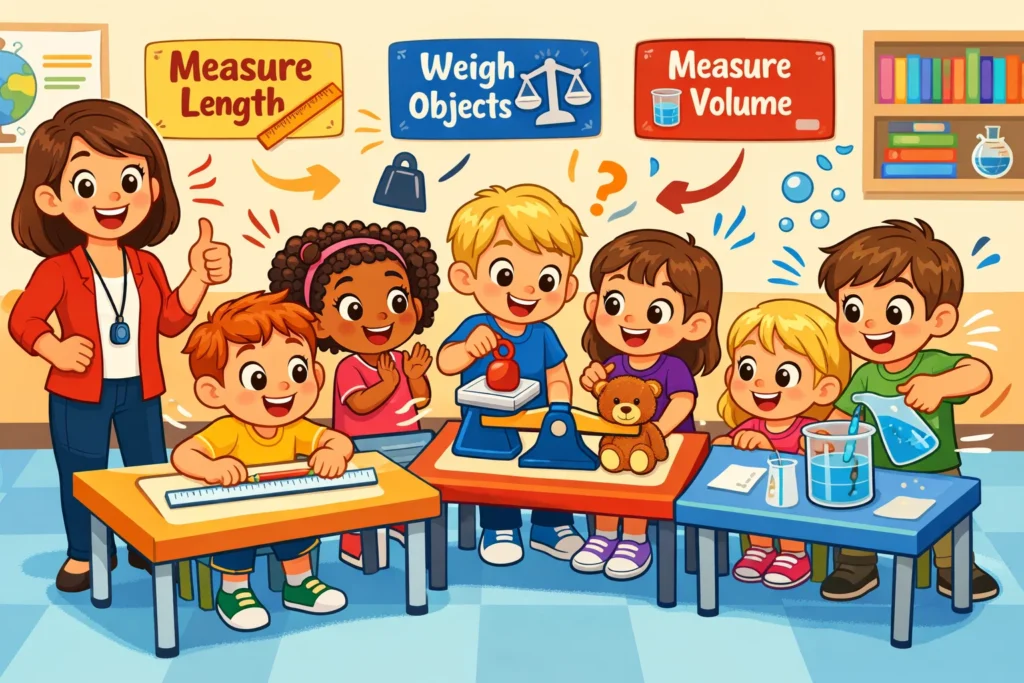
Here are some fun hands-on measurement activities that align with lesson plans for various ages.
| Activity Name | Tool Used | Objective |
| The Great Room Leap | Measuring Tape | Measure jump distance in metres or centimetres |
| Penny Mass Challenge | Triple Beam Balance | Find the mass of 10 vs 20 pennies |
| Volume Displacement | Graduated Cylinder | Measure volume of irregular objects |
| Ice Melt Race | Thermometer | Track temperature changes over time |
Measuring Length and Height
Have students learn to measure the length of various objects around the classroom. Start with a metric ruler for small items and move to a meter stick or measuring tape for the height of the door.
Measuring Mass and Weight
Using a balance scale or a triple beam balance is a rite of passage in middle school science. Allow students to practice by comparing the mass of a dry sponge versus a wet one. This demonstrates that mass can change even if the object looks the same size.
Measuring Volume and Capacity
Use graduated cylinders and colored water. Give students a set of different containers and ask them to predict which holds more before they perform the actual measurement.
Metric Measurement Activities Using Science Tools
Precision is a learned habit. Teaching practice suggests that the more time students spend with science tools, the more comfortable they become.
Centimeter Ruler Activities
The most common error is starting at the edge of the ruler rather than at the “0” mark. Activities help correct this by asking students to measure using both the edge and the zero mark to see the discrepancy.
Graduated Cylinder Experiments
Teach science students about the meniscus—the curve at the top of the liquid. Learning to read at the bottom of the curve is essential for metric measurements in chemistry.
Balance Scale and Mass Stations
Set up stations where middle schoolers must measure mass of different objects like rocks, feathers, and marbles. This helps them learn the metric difference between mass and size.
Engineering and STEM Metric Challenges
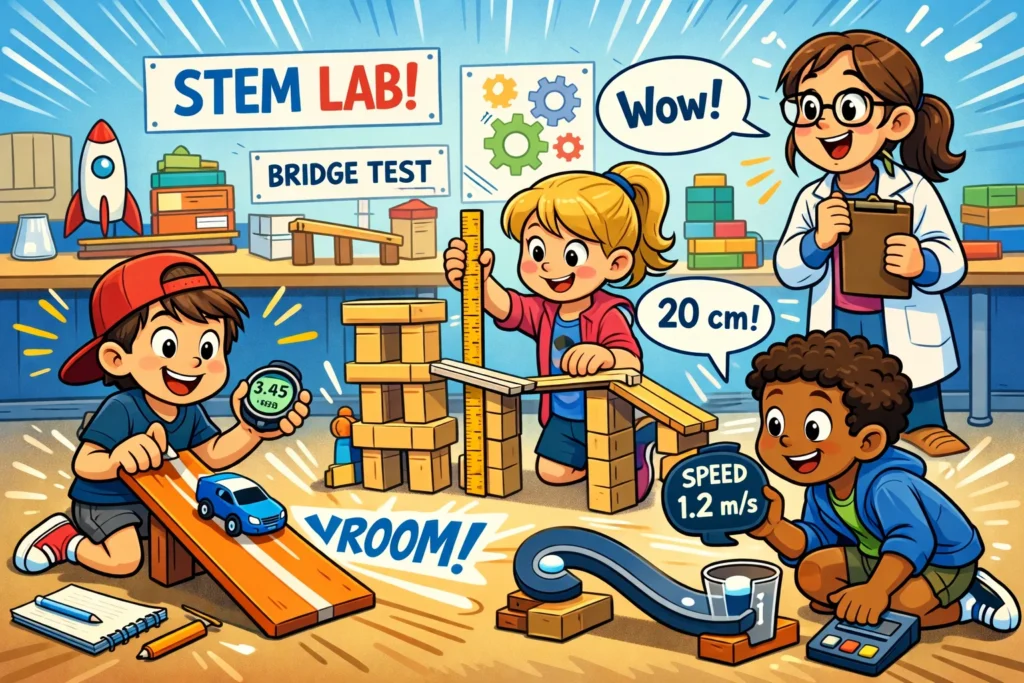
Science becomes more concrete when kids have to build something. STEM challenges are a fun way to apply measurement units.
Distance and Speed Challenges
Set up a ramp and a stopwatch. Have students measure the length of the ramp and time how long it takes a car to reach the bottom. This introduces the concept of measurement in relation to time and speed.
Area and Perimeter Science Builds
Using centimeter graph paper, have students design a “Space Station” garden. They must calculate the area to ensure enough oxygen-producing plants can fit.
Data Collection and Analysis Tasks
Many measurement activities end with a list of numbers. Teach students to take every measurement and put it into a table to find the average. This helps students understand the “why” behind the mathematics.
Common Measurement Mistakes Kids Make
Even with the best lesson plans, errors occur. Recognizing these is part of the learning process.
- Confusing Size with Mass: Older kids often think a large balloon is “heavier” than a small lead fishing weight. Hands-on activities with a balance scale debunk this quickly.
- Inconsistent Techniques: Moving a ruler while measuring length is common. Allow them to practice steadying their tools.
- Mixing Units: A student might record “10.5” without specifying if it is centimeters or millimeters. Always insist on the unit!
Assessment and Progress Tracking
How do you know if your measurement activities are working?
Observation-Based Assessment
Watch how a student handles a measurement tool. Do they align the ruler correctly? Do they eye the graduated cylinder at level? These observations are often more telling than a written test.
Worksheets and Measurement Logs
While hands-on is best, a worksheet can serve as a log for data. Use tables where students record their “Estimate” vs. “Actual Measurement.”
Skill Progression by Age
- Ages 5-7: Focus on non-standard measurement and basic centimeter use.
- Ages 8-10: Introduction to grams, liters, and metric prefixes.
- Ages 11-14: Complex measurement using triple beam balances and calculating density.
Curriculum Alignment and Science Standards
Most science classroom activities are designed to meet national science standards. Measurement is a “cross-cutting concept,” meaning it applies to every branch of science. Whether it’s physical science or biology, the metric system is the required standard.
Materials and Preparation for Metric Activities
You don’t need a high-tech lab to teach students to use the metric system.
- Household Items: Rice (for mass), water, bottles, coins, and string.
- Essential Equipment: Metric rulers, measuring tape, and a kitchen scale if a balance scale isn’t available.
- Safety: Always supervise older kids and younger ones when using glass graduated cylinders or small objects that could be choking hazards.
Activity Extensions and Difficulty Scaling
Simplifying Activities for Younger Kids
Focus on “longer vs. shorter” or “heavier vs. lighter.” Use colored water to make volume measurement more visual and exciting.
Increasing Complexity for Older Students
Challenge middle schoolers to convert between metric units (e.g., how many milligrams are in one gram?). Have them measure using the metric system to find the density of an object (Density = Mass / Volume).
Frequently Asked Questions About Metric Measurement Activities
While measurement can feel complex, you can start as early as age 5 with non-standard units. Most kids are ready for a metric ruler by age 7.
You don’t need expensive gear. A simple metric ruler and a plastic graduated cylinder can cover 90% of elementary students’ needs.
The key is to make learning fun. Use “Gross Science” (measuring the length of a fake “snake”) or “Kitchen Science” (measuring grams of sugar for a recipe) to keep them hooked.
“Measurement is the first step that leads to control and eventually to improvement.” — H. James Harrington