


Choosing the right educational app for children can feel like a full-time job. With the “edutainment” market projected to grow significantly by 2026, parents often find themselves choosing between two major apps: Lingokids and Duolingo ABC. Both platforms aim to be among the best learning apps, yet they serve fundamentally different purposes. One acts as a broad “playlearning” universe, while the other provides laser-focused literacy tools.
This guide offers a neutral comparison designed to support your child’s educational journey. The goal of this guide is not to pick a winner, but to provide structured insights that help you decide which learning environment aligns with your child’s personality, age, and learning goals. Whether you are looking for a free option that works well or a comprehensive English learning path, this comparison reviews the key differences.
Quick Comparison: Key Differences

The primary distinction lies in their scope. Duolingo ABC is a specialized learning app designed to help children aged roughly 3–8 master phonics and early reading skills. It is entirely free to download and contains no ads, following the philanthropic mission of its parent company.
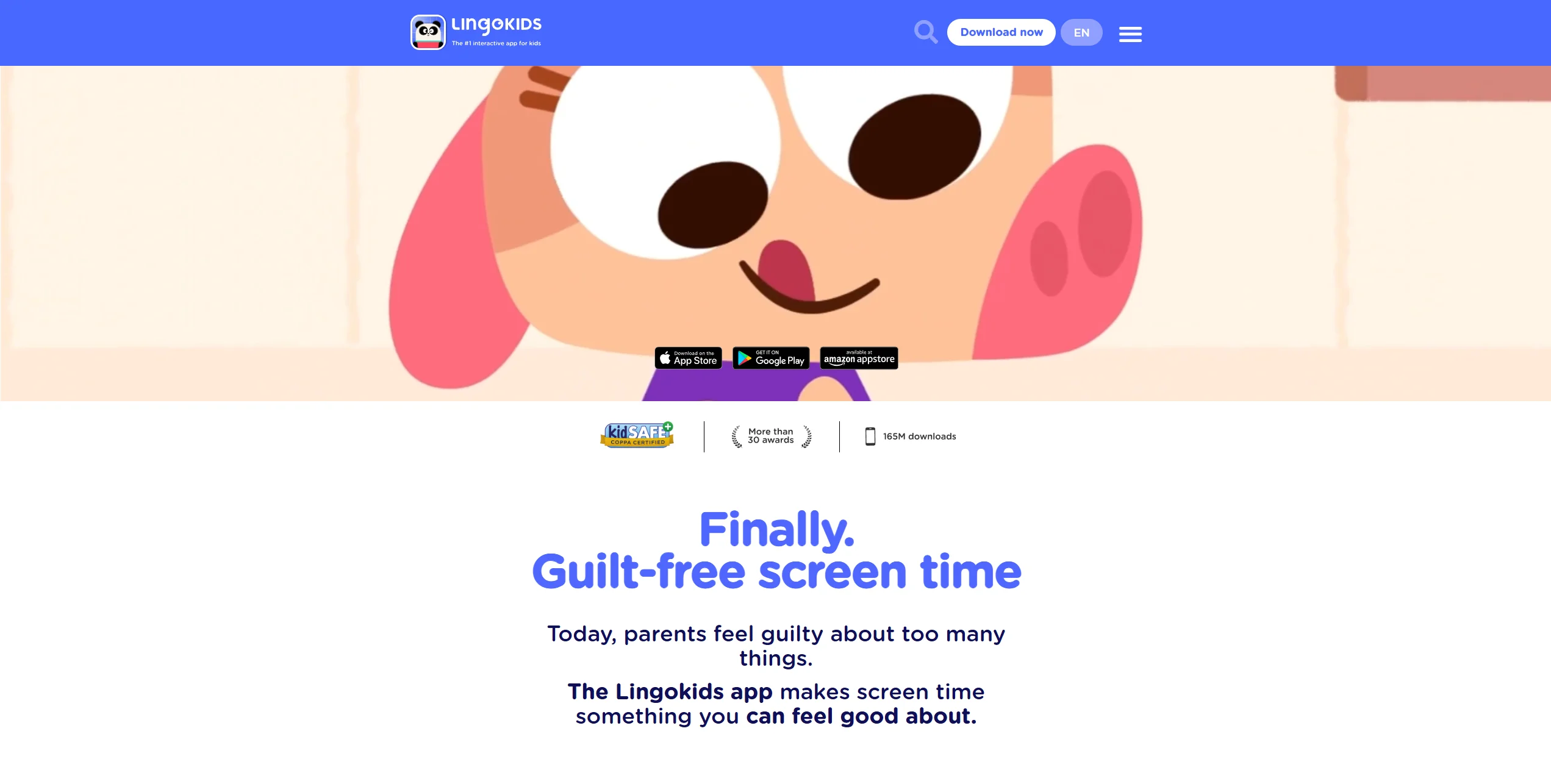
In contrast, Lingokids is a multi-subject educational app for children that uses a “Playlearning™” methodology. While excellent at facilitating English learning, it also incorporates problem-solving, STEM, and social-emotional learning. Unlike Duolingo ABC, Lingokids operates on a freemium model, where the most robust learning path features require a subscription.
Learning Focus Snapshot

- Duolingo ABC: Prioritizes literacy. It builds from letter sounds to sight words and eventually reading full stories. It is widely considered one of the best English learning apps for children who are ready to begin decoding text.
- Lingokids: Takes a broader approach. It is a fantastic language learning tool to aid non-native speakers (ESL), focusing on English words, conversational phrases, and basic life skills through interactive games.
Engagement Style Snapshot
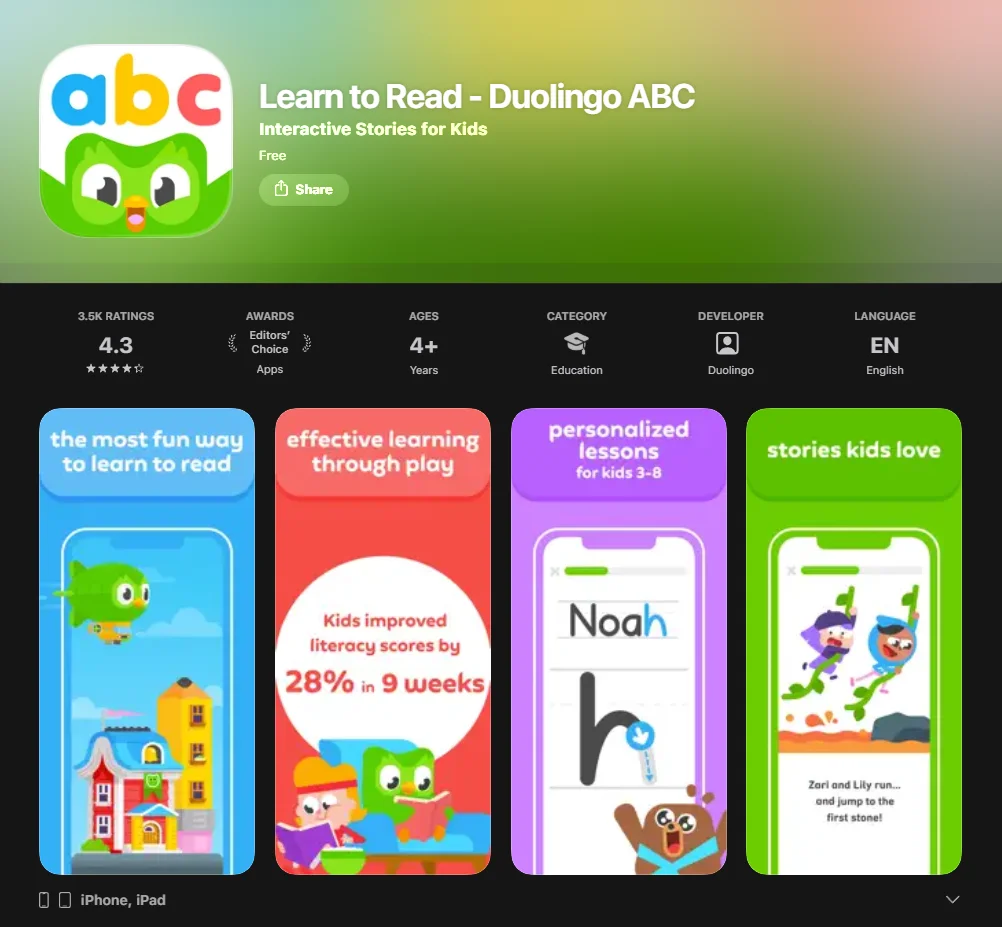
- Duolingo ABC: Uses the classic Duolingo gamification—streaks, stars, and an adorable cast of characters like Duo the Owl and Foof the Cat. The fast pacing makes it a good app for younger children by providing quick, achievable tasks.
- Lingokids: Features high-production-value songs, videos, and educational games. It feels more like a “digital playground.” Through partnerships with companies such as Disney and Oxford University Press, characters like Billy and Cowy help drive the experience.
Parent Experience Snapshot
Both apps offer a parental dashboard, but depth varies. Duolingo ABC keeps it simple with a progress map. Lingokids provides more detailed reports, showing exactly which learning activities your child completed and suggesting “offline” activities to help children reinforce what they learned on-screen.
Which Kids Benefit Most?
Every learner is unique. Many educators agree that the most effective learning app is usually the one that matches a child’s developmental stage and learning style.
Ages 2–4 Fit
Lingokids is often more accessible to the toddler and early preschool crowd. Its focus on early language exposure through music and repetitive interactive learning suits children not yet ready to tackle formal phonics. Duolingo ABC can be used by advanced three-year-olds, but the focus on tracing and decoding may require significant adult assistance for children closer to age two.
Ages 4–6 Fit
This is the “sweet spot” to utilize both apps. Preschoolers and Kindergarteners are usually ready to follow the structured learning paths found in Duolingo ABC. Meanwhile, Lingokids keeps them engaged with broader themes like “The Universe” or “Healthy Habits.”
Ages 6–8 Fit
Older kids may begin to outgrow the simplicity of Lingokids unless they use it specifically to improve language learning (ESL). However, Duolingo ABC remains relevant until a child becomes a confident, fluent reader (typically around 2nd grade).
Kids with Short Attention Span
If your child is easily distracted, Duolingo ABC’s 2–5 minute lessons are ideal. Lingokids also uses short bursts of play, but the “open-world” feel of its library can sometimes lead to “app-hopping” where a child starts many activities without finishing them.
Kids Learning English as a Second Language
To support your child’s English learning, Lingokids is frequently cited as the superior tool to facilitate early learning. It emphasizes English words in context, whereas Duolingo ABC assumes the child already understands the words and simply needs to learn how to read them.
Learning Approach and Curriculum
| Feature | Duolingo ABC | Lingokids |
| Primary Goal | Literacy & Phonics | Global Skills (English, Math, SEL) |
| Methodology | Systematic Phonics | Playlearning™ (Game-based) |
| Speaking Practice | Listen-and-repeat pronunciation activities with audio guidance | Repeat-after-me prompts |
| Repetition | High (Spaced repetition) | Moderate (Thematic) |
| Curriculum Depth | Focused on Reading | 650+ Learning Objectives |
Phonics and Early Reading
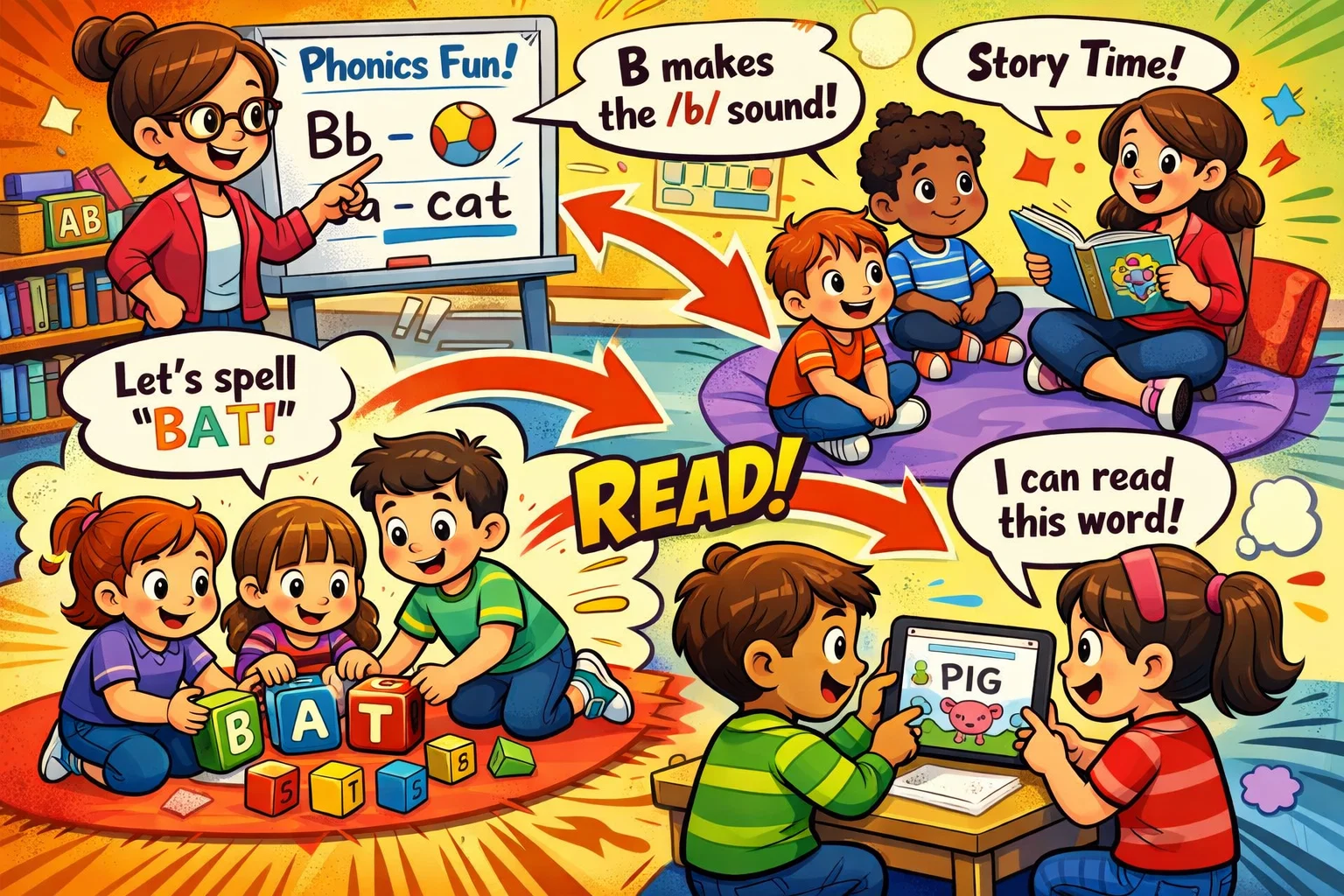
Duolingo ABC focuses on the science of reading. It uses a bottom-up approach: sounds and words, then sentences. Lingokids teaches reading more through “sight recognition” and immersion in stories, which is less technical but can be more “fun” to engage reluctant readers.
Vocabulary Growth
Lingokids wins on sheer volume. It introduces thousands of English words across categories like science, cooking, and emotions. Duolingo ABC’s vocabulary is tailored specifically to words that are easy to decode phonetically.
Progression and Difficulty Pacing
Both apps are designed for children to move at a learning pace that suits them individually. Duolingo ABC is more linear; you generally have to finish one level to unlock the next. Lingokids allows more exploration, though its “daily path” offers a suggested sequence.
Content Variety and Daily Routine
A typical session in Duolingo ABC involves tracing letters, matching sounds, and reading “decodable” books. It’s highly effective but can feel “academic” after 15 minutes.
Lingokids offers more variety. In one session, a child might sing a song about washing hands, play a problem-solving game with Spiderman, and watch a video about the solar system. This variety makes it one of the more engaging learning apps for children who enjoy frequent changes in activity.
Interactive media that encourages active participation may help children remember information more effectively.
Motivation Mechanics: Rewards and Streaks
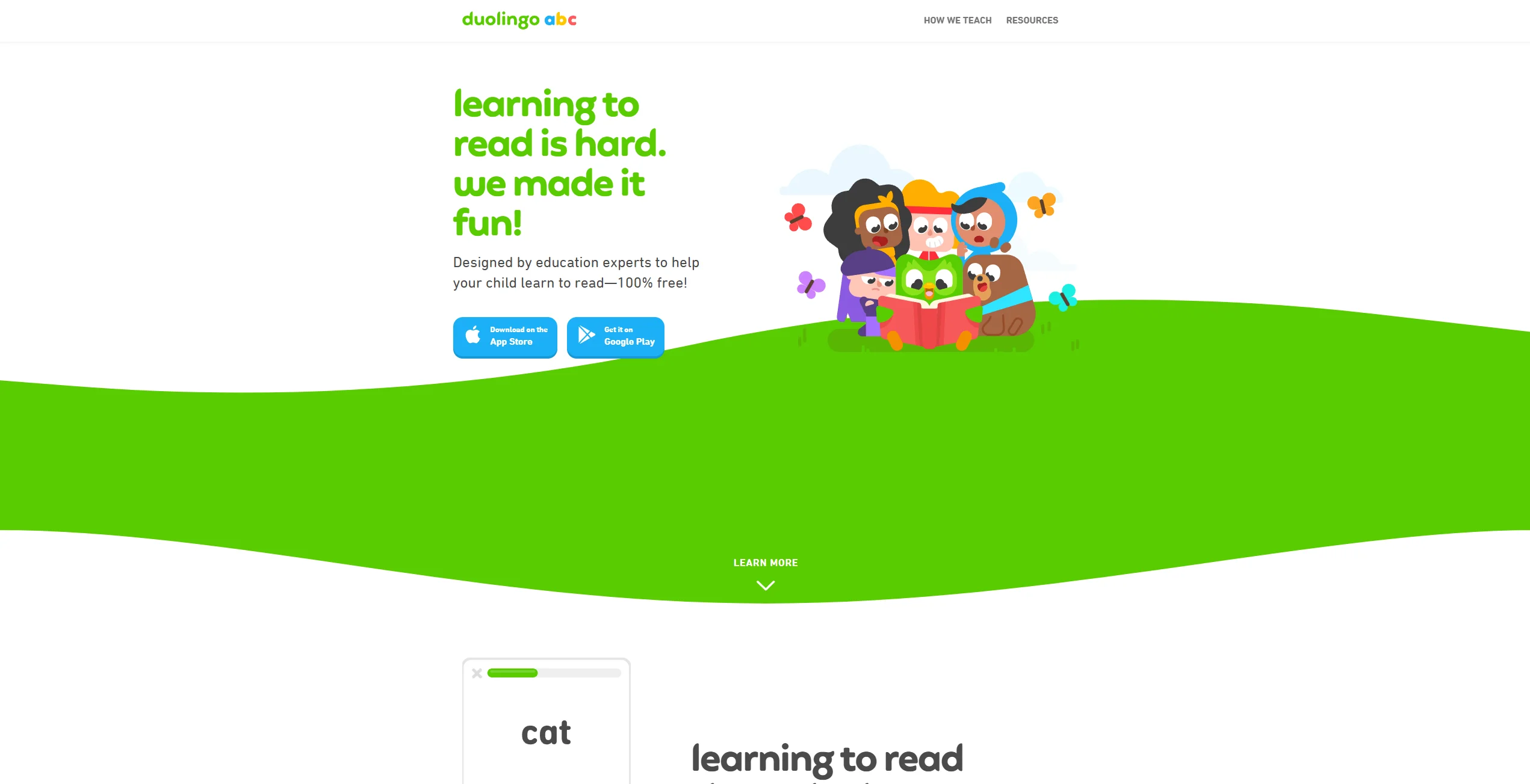
Duolingo ABC uses a “streak” system to encourage a daily learning journey. Kids earn “badges” and can see their progress on a colorful map. Lingokids uses stars and “stickers,” which kids can use to decorate in-game items. Both systems effectively ensure kids love returning to the app.
Safety and Kid-Friendly Design

To protect children in 2026, digital safety is non-negotiable. Both are generally considered safe apps for children, but their structures differ:
- Ads and Purchase Pressure: Duolingo ABC is completely free—no ads, no “pro” version to buy. Lingokids is ad-free, but the free version regularly promotes upgrading to the Lingokids Plus subscription to unlock unlimited access.
- Privacy: Both are COPPA certified. They do not have social features where children can talk to strangers.
- Offline Use: Lingokids Plus (paid) allows offline use, which is a lifesaver during travel. Duolingo ABC also offers offline capabilities to access many of its lessons.
Learning Apps For Kids: Pricing and Value Comparison
This is often the deciding factor.
The Cost Breakdown
| App | Free Version | Paid Version | Price (Approx.) |
| Duolingo ABC | 100% Full Access | N/A | $0 (Always) |
| Lingokids | Limited daily access to selected activities | Unlimited Access (Lingokids Plus) | $14.99/mo or typically around $71–$89/yr depending on region and promotions |
Free Access: What’s Included?
Duolingo ABC is the best free option on the market. There are no “locked” levels. Lingokids Basic is fairly limited; after a small number of free activities, the app may prompt users to return the next day or upgrade to Lingokids Plus. While this is great to limit screen time, it can be frustrating if your child is on a roll.
Family Sharing
Lingokids Plus allows multiple child profiles (usually up to 3), making it a high-value choice to assist families with multiple children aged 2 to 8. Duolingo ABC also supports multiple profiles on one device, all for free.
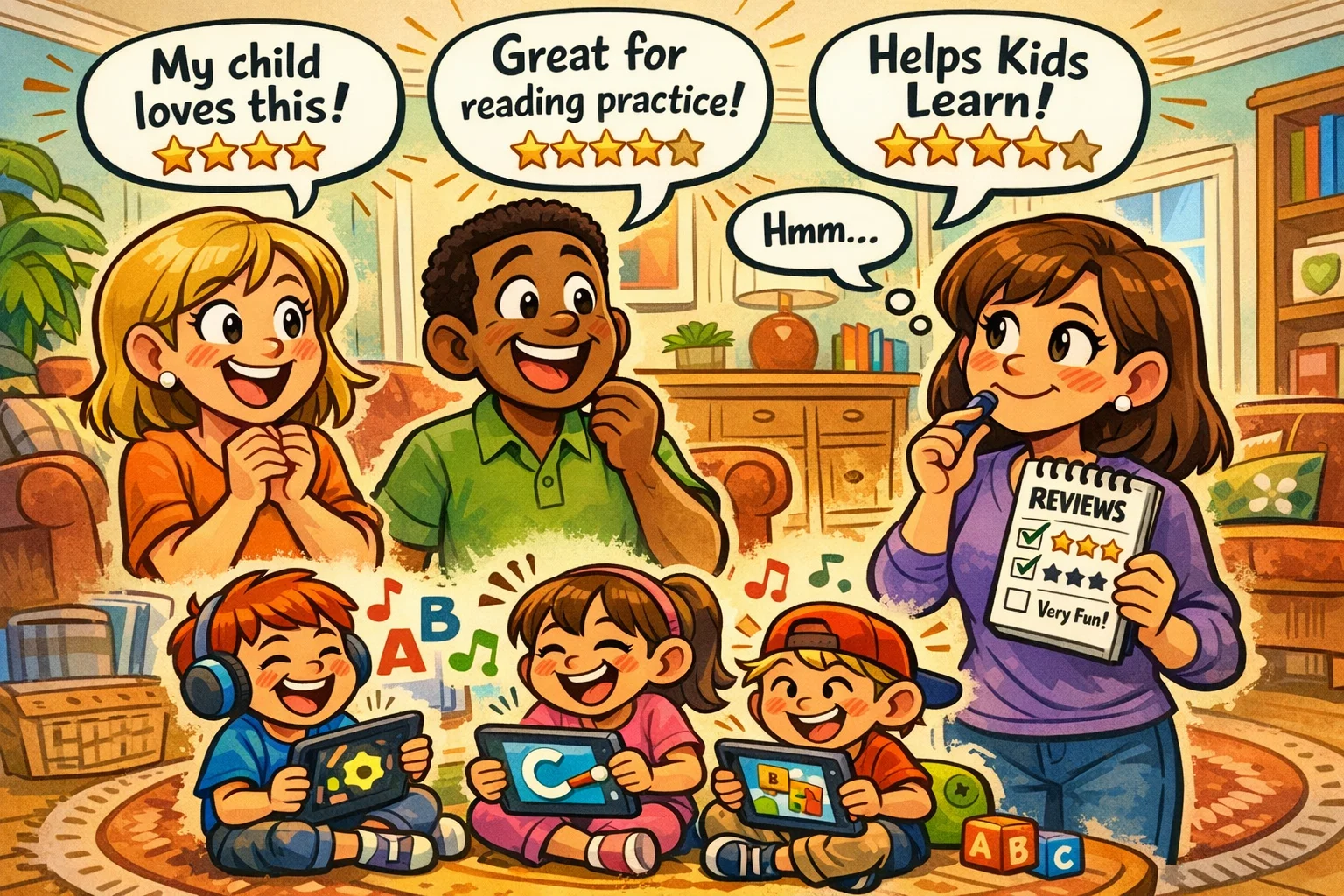
Real Parent Feedback: Common Patterns
What Parents Praise Most
- Duolingo ABC: Some parents report that the app helps children progress from learning letters to reading short sentences within a relatively short period of time.
- Lingokids: Parents often note that the songs are engaging and that the app introduces children to topics such as empathy, recycling, and other everyday concepts.
Complaints Parents Mention
- Duolingo ABC: Some parents find the voice recognition occasionally “glitchy,” failing to pick up a child’s voice correctly.
- Lingokids: The most common complaint is the price. Many feel $15/month is steep compared to other educational apps for children like PBS Kids (free) or Khan Academy Kids (free).
Common Mistakes Parents Make
Even the best learning app is only as good as the routine surrounding it.
- The “Digital Nanny” Expectation: No app should replace parent interaction. Co-viewing—sitting with your child and asking “What did the owl do?”—doubles the educational value.
- Too Much Screen Time: Many pediatric guidelines suggest limiting screen time for children aged 2–5 to about one hour per day. If a child spends 3 hours on a learning app, the “learning” often turns into passive tapping.
- Wrong Age Choice: If your 7-year-old is doing basic letter tracing on Lingokids, they are bored. If your 3-year-old struggles with Duolingo ABC, they are frustrated. Monitor progress to ensure the challenge remains “just right.”
Recommended Combinations for Families
You don’t have to choose just one! Here are some “power pairings” to assist kids in 2026:
- The Budget Combo: Duolingo ABC (to read) + Khan Academy Kids (to practice math/logic) + PBS Kids (to learn social skills). Total cost: $0.
- The Premium Combo: Lingokids Plus + Epic! (to access a digital library). This provides a comprehensive learning environment covering every subject.
- The Focused Literacy Combo: Duolingo ABC to maintain daily practice + physical phonics flashcards to provide offline reinforcement.
Bottom Line: Choosing Between Lingokids and Duolingo ABC
In 2026, the right app for your child depends on your specific learning needs.
Choose Lingokids if:
- Your child is a toddler or preschooler (ages 2–4).
- English is a second language to your family.
- You want an app covering more than just reading (math, science, SEL).
- Your child loves high-energy music and a variety of activities.
Choose Duolingo ABC if:
- Your primary goal is to help your child learn to read.
- You are on a budget and want a completely free tool.
- Your child (ages 4–7) prefers a clear, structured learning path.
- You want to avoid the “subscription fatigue” of modern apps.
Choose Both if:
You want to use Duolingo ABC as the “main course” to teach reading and Lingokids Basic (the free version) as a “dessert” providing 10–15 minutes of fun, varied play.