

Choosing the right digital tools for young learners can feel like navigating a labyrinth. Child development experts are often asked if there is a ‘gold standard’ for screen time—an app that balances high-quality pedagogy with a secure, engaging environment. Khan Academy Kids consistently rises to the top of that list. Developed by the creators of the regular Khan Academy and the team at Duck Duck Moose, a pioneer in educational apps for children, this learning app is specifically designed to support the developmental milestone of children during their most formative years.
This review explores how Sal Khan and his team created a mobile app that isn’t just a collection of games, but a comprehensive educational platform. Whether you’re looking for an early learning supplement or a robust math program for a 2nd grade student, this completely free resource offers an adaptive learning path that respects each child’s unique learning style. Let’s dive into why Khan Academy Kids stands out in a crowded market of apps for kids.
Key Features of Khan Academy Kids
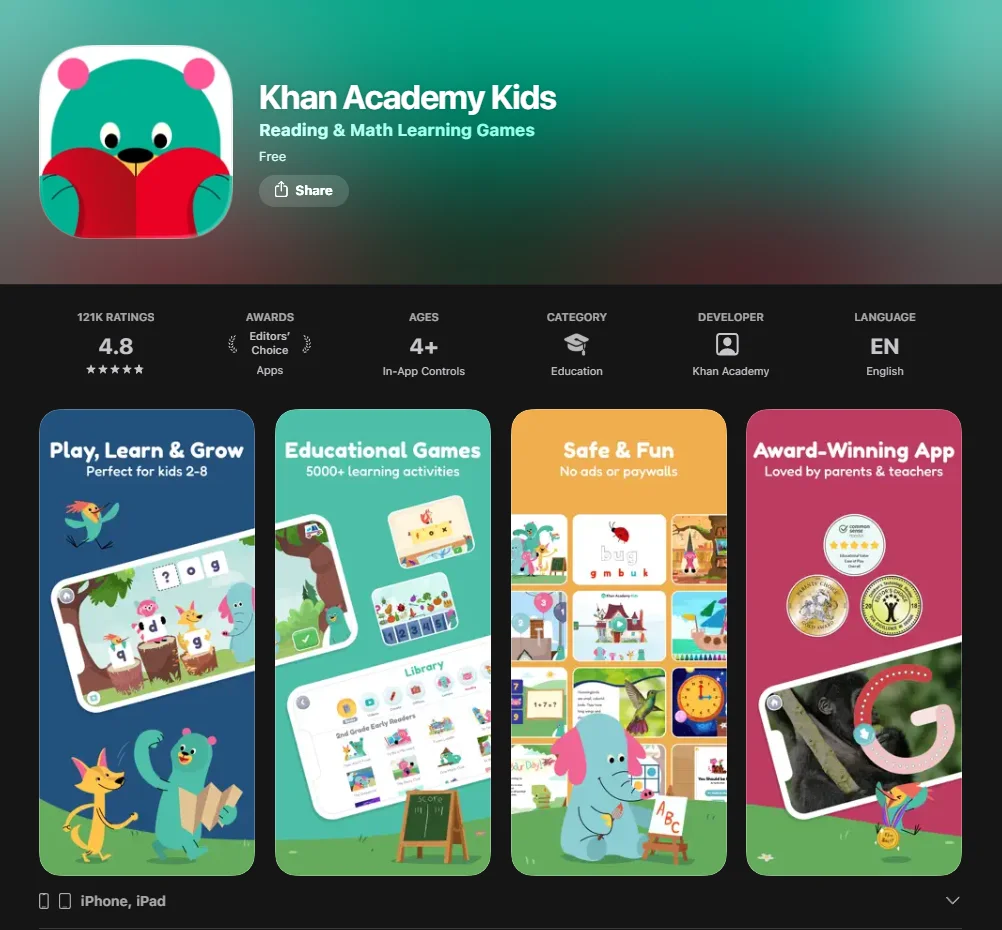
The app offers a multi-sensory learning experience that goes far beyond simple flashcards. It is a holistic educational content ecosystem that adapts to the user. One of the standout features of Khan Academy Kids is its use of charming animal characters—like Kodi the Bear and Ollo the Dingo—who guide children through various interactive activities.
Age-appropriate Content for Early Learners
The app includes a vast library of resources tailored for children aged 2 to 8, covering pre-K, kindergarten, 1st grade, and 2nd grade. Since every child develops at their own pace, the educational resources are organized by developmental level rather than just age. This ensures that early literacy and foundational skills are introduced when the child is cognitively ready, not just because they’ve reached a certain age.
Interactive Lessons and Gamification
To keep kids engaged, the app utilizes a gamified approach. As children complete video lessons and activities, they earn rewards like clothing for their characters or a new badge for their collection. This isn’t just about fun; it’s about positive reinforcement. This self-paced reward system encourages independent learning, allowing children to feel a sense of control over their educational journey.
Educational Scope and Subject Variety
Khan Academy Kids offers a surprisingly wide range of subjects. While many learning methods focus solely on “the basics,” this educational app provides a range of educational materials including:
- Reading and Math: From phonics to complex math concepts.
- Language Arts: Writing, vocabulary, and grammar.
- Social-Emotional Learning: Sharing, empathy, and self-regulation.
- Creative Play: Drawing, coloring, and storytelling.
| Subject Area | Focus Skills | Target Age |
| Early Literacy | Phonics, Letter Recognition, Blending | 2–5 Years |
| Math Skills | Counting, Addition, Geometry, Logic | 2–8 Years |
| Social-Emotional | Empathy, Relationship Skills, Self-Regulation | 2–8 Years |
| Reading | Reading Comprehension, Vocabulary | 5–8 Years |
Safety Features and Parental Controls
In an era where digital privacy is a major concern, many parents are rightfully cautious. Khan Academy’s commitment to being completely free and private is perhaps its most “parent-friendly” feature.
Privacy and Data Security for Kids
Khan Academy Kids’ privacy policy is robust. The app complies with COPPA (Children’s Online Privacy Protection Act). Unlike other online learning platforms, it doesn’t track or sell student data for commercial purposes. Since Khan Academy is free and non-profit, their motive is education for anyone, anywhere, rather than data harvesting.
Parental Control Features
The app offers a parent section that provides progress reports, but it does not include extensive customization features like selecting specific math tutoring modules or setting personalized reading levels. The parent tools are more focused on reviewing progress rather than providing highly customizable learning paths.
Safe and Ad-Free Environment
One of the biggest cons of Khan Academy competitors is the “freemium” model, where kids are interrupted by ads. Khan Academy Kids is a free app with no ads. There are no “pay-to-win” mechanics or hidden in-app purchases. This creates a focused, “calm” learning platform where children aren’t being marketed to while they try to master math concepts.
Educational Benefits for Children
The learning experience provided by the app is rooted in the latest research in child development. It isn’t just about memorization; it’s about building a framework for lifelong learning.
Promotes Independent Learning
Because of the adaptive learning path, children can use Khan Academy without constant adult intervention. The app’s interface is intuitive, using icons and voice-over instructions. This fosters a sense of competence; when a child successfully navigates a lesson on their own, it builds the confidence necessary for self-directed learning in later school years.
Supports Social-Emotional Learning
Unique among many apps for kids, Khan Academy Kids offers robust social-emotional learning (SEL). While the app includes social-emotional learning elements, there are no direct references or scientific studies from CASEL that explicitly back up these claims in the context of Khan Academy Kids.
Social-emotional skills are the foundation upon which academic learning is built. If a child cannot focus or manage frustration, the best math lesson in the world won’t land.
Encourages Curiosity and Exploration
The library section of the app allows kids to go off the adaptive path and explore topics like dinosaurs, space, or habitats. This provides a free space for them to follow their interests, which help children see learning as an adventure rather than a chore.
How Khan Academy Kids Compares to Other Educational Apps
When looking at the App Store, the options are overwhelming. However, Khan Academy Kids stands in a category of its own for several reasons.
Khan Academy Kids vs. Other Learning Apps
Most “free” apps are actually “trial” versions or are filled with ads. Other high-quality apps often require a monthly subscription. Furthermore, the collaboration with Duck Duck Moose (pioneers in the kids app space) ensures that the UI is perfectly calibrated for small fingers and developing brains.
Free vs. Paid Educational Apps
It is a common misconception that “you get what you pay for.” In this case, it’s free, but the quality rivals or exceeds paid platforms like ABCmouse or Reading Eggs. Because it is funded by grants and donations (from organizations like the Bill & Melinda Gates Foundation), it can provide a free world-class education that is accessible to families regardless of their income.
Reviews from Parents and Educators
The reviews from parents and the feedback from the teaching community highlight the app’s real-world impact.
Parent Testimonials
Many users have reported that children show significant improvements in their vocabulary, often surpassing what they learn in preschool, while enjoying the app’s playful characters.
Many parents appreciate that the app provides a safe, ad-free environment, allowing children to explore without exposure to unwanted content.
Educator Insights on Effectiveness
Teachers often recommend Khan Academy Kids as a supplement to classroom instruction. Educators note that the math program aligns well with Common Core standards, making it easier for children to transition between mobile app play and schoolwork. Many teachers use the app in “station rotation” models to provide personalized learning to students who might be at different levels in the same classroom.
Is Khan Academy Kids Right for Your Child?
Deciding whether to use the app depends on your child’s learning needs and your family’s approach to technology.
Age-Appropriate Learning Pathways
The app is most effective when it aligns with the child’s developmental stage. For a toddler, the focus is on “Learning to Trace” and “Shapes.” For a 7-year-old, the focus shifts to ‘Reading to Learn’ and ‘Advanced Addition.’ The personalized learning engine ensures that the difficulty level is “just right”—challenging enough to prevent boredom but easy enough to prevent frustration.
Suitable for Diverse Learning Styles
- Visual Learners: Benefit from engaging video lessons and animations.
- Auditory Learners: Guided by the clear, encouraging narration of the animal characters.
- Kinesthetic Learners: Engage with the touch-and-drag interactive activities.
Explore More Educational Apps for Kids
While Khan Academy Kids offers a comprehensive experience, you might want to supplement it with other tools as your child grows.
Top Educational Apps for Toddlers
- PBS Kids Games: Great for familiar characters and basic logic.
- Sago Mini World: Excellent for creative, open-ended play.
Apps for Kids Learning Math and Science
- DragonBox Numbers: Fantastic for deep math concepts and number sense.
- Toca Lab: Elements: A fun way to introduce chemistry through exploration.
Conclusion: Why Khan Academy Kids is a Safe, Effective Choice for Children
In summary, Khan Academy Kids is more than just a learning app; it is a gift to the global community of parents and educators. By providing a completely free, ad-free, and high-quality educational platform, it levels the playing field for young learners everywhere. It succeeds because it doesn’t just teach math skills and early literacy; it nurtures the whole child by incorporating social-emotional learning and fostering self-directed learning.
If you are looking to make learning a positive, regular learning habit in your household, this app is an essential tool. It ensures your child is ready for school and, more importantly, ready for a lifetime of curiosity.