

If you’re looking for a structured, research-backed way to help your child learn to read, you’ve probably encountered Reading Eggs. With millions of users worldwide and a collection of awards, it’s one of the most talked-about online literacy programs available today. But does it truly deliver on its promises — and is it genuinely safe for young learners?
This review provides a comprehensive and balanced overview of the Reading Eggs app, covering its educational value, safety features, and how it benefits children at various stages of their literacy journey. We’ll examine pricing, comparisons with competing apps, homeschool suitability, and real parent feedback — so you can make an informed decision before signing up.
What is Reading Eggs?
Overview of Reading Eggs App
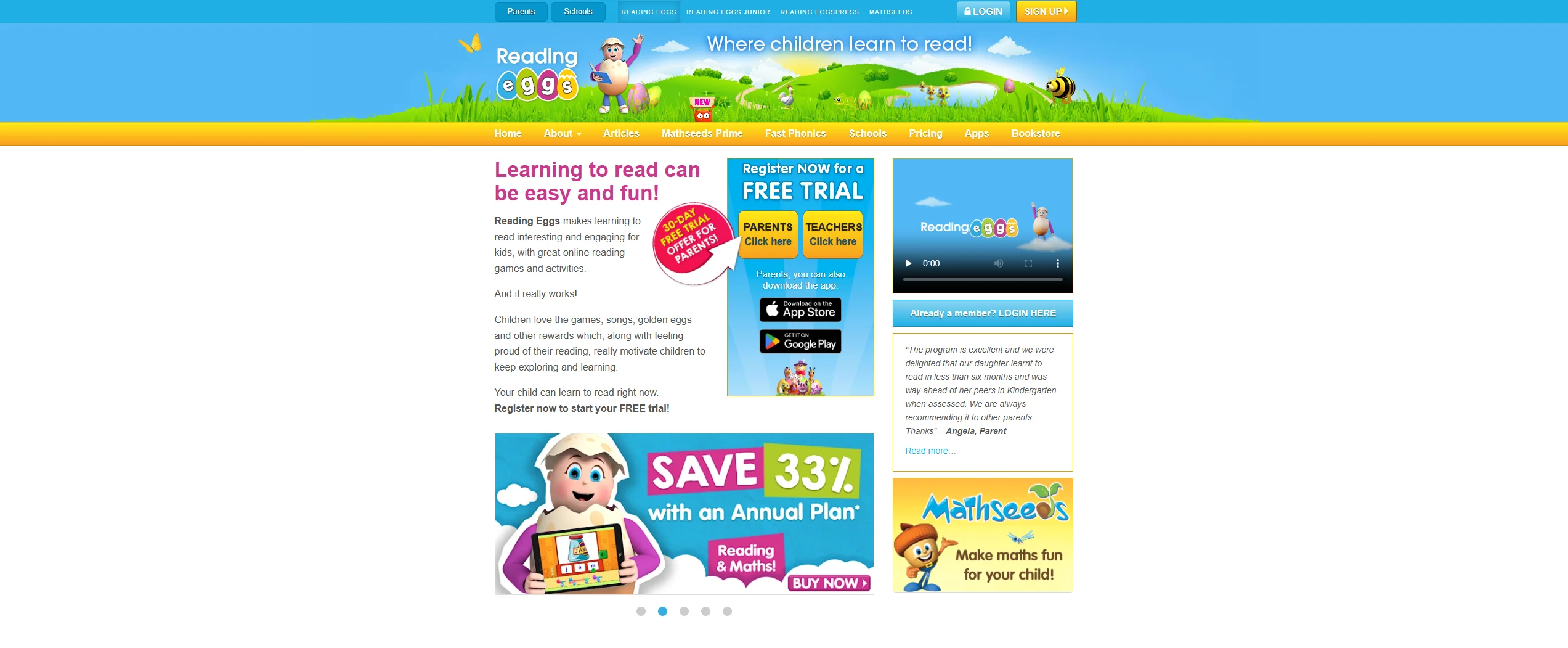
Reading Eggs is an online reading program designed to teach children how to read through interactive games, animated lessons, and a structured phonics-based curriculum. The platform caters to children aged 2 to 13, covering everything from basic letter sounds to advanced comprehension and vocabulary work. It’s built on the science of reading — an evidence-based framework that prioritizes phonemic awareness, phonics, fluency, vocabulary, and comprehension as the five foundational pillars of literacy.
The platform includes several distinct components under one subscription:
- Reading Eggs Junior – for children aged 2–4, focusing on foundational pre-literacy skills like letter recognition and basic phonics
- Reading Eggs – the core program for ages 3–7, covering early phonics through to basic fluency
- Reading Eggspress – for more advanced learners aged 7–13, targeting comprehension, vocabulary, and fluency
- Fast Phonics – a focused strand dedicated to phonics skills with a direct, structured instructional approach
- Mathseeds – a companion numeracy program included in most subscription plans
Together, these modules make Reading Eggs one of the more comprehensive learn-to-read platforms available for home and school use. The breadth of age coverage is genuinely unusual — most competing apps either serve only young beginners or only upper primary students, not both within the same subscription.
Who Developed Reading Eggs and Why
Reading Eggs was created by Blake eLearning, an Australian educational publishing company with decades of experience in developing literacy curricula. The program was developed in close collaboration with experienced teachers, child psychologists, and literacy experts. Their goal was clear: to take what works in classroom phonics instruction and make it accessible, engaging, and self-paced for children learning at home or in school.
The team drew heavily from a robust body of research, including findings from the National Reading Panel (US) and the Rose Report (UK), both of which emphasize systematic phonics as the most effective method for teaching children to decode text. The app has received multiple awards, including the Academics’ Choice Award, and is endorsed by several educational organizations. However, it’s important to note that awards like these may be based on popularity and recommendations, rather than strict scientific criteria. This doesn’t necessarily mean the program outperforms all competitors. It has also been adopted by thousands of schools as a supplementary literacy tool, reflecting the confidence educators place in its curriculum design.
How the App Works
When a child first uses Reading Eggs, they take a placement test that determines their current level and places them appropriately within the curriculum — so a child who already knows their letter sounds won’t be bored reviewing the alphabet, and a child who is just starting out won’t be overwhelmed.
The core learning process works as follows:
- A child enters their personal “map” — a visual journey through numbered lessons
- Each lesson includes a mix of animated instruction, interactive games, and skill-practice activities
- Completing lessons earns golden eggs and other rewards, redeemable in a virtual world called the Treehouse
- After completing a set of lessons, children take a quiz to confirm understanding before progressing
- Parents receive regular updates through a parent dashboard displaying progress, time spent, and skills mastered
The interface is colorful, intuitive, and deliberately designed so that young children can navigate it independently after just a session or two. Audio instructions mean that children who aren’t yet reading independently can still understand what each activity is asking them to do — a small but important design detail.
Is Reading Eggs Good for Kids?
Educational Value of Reading Eggs
The short answer is yes — it provides genuine educational value, particularly for children in the early stages of literacy development. The program is grounded in systematic phonics instruction, which the science of reading consistently identifies as the most effective way to develop decoding skills in young learners.
Each lesson explicitly teaches letter-sound relationships (phonemes), builds phonemic awareness, and progressively introduces more complex word patterns. Alongside phonics, the curriculum incorporates:
- Sight words — high-frequency words children need to recognize instantly, such as “the,” “said,” and “was”
- Vocabulary development through context-rich illustrated stories
- Fluency practice via repeated and guided reading activities
- Comprehension quizzes and deeper analytical activities within Reading Eggspress
A 2012 study published in the Australasian Journal of Early Childhood supports the effectiveness of Reading Eggs in phonological awareness and word recognition. However, it is important to note that more recent research in reading instruction may offer updated insights into the program’s effectiveness. While the research landscape has expanded considerably since then, the app’s alignment with current best practice in phonics instruction keeps it educationally relevant. Independent analyses by literacy researchers have consistently praised its adherence to structured literacy principles.
Suitable Age Groups for Reading Eggs
| Component | Age Range | Focus Area |
| Reading Eggs Junior | 2–4 years | Pre-literacy, letter recognition |
| Reading Eggs | 3–7 years | Phonics, sight words, early fluency |
| Reading Eggspress | 7–13 years | Comprehension, vocabulary, fluency |
| Fast Phonics | 5–10 years | Targeted phonics instruction |
While the age ranges are guidelines, some children may find it challenging to move into more advanced sections without prior foundational skills. The placement test helps, but there might still be difficulties if a child transitions to more complex material too soon. The placement test handles much of this calibration automatically.
How It Supports Early Literacy Skills
The program builds literacy step by step. For the youngest learners, it starts with phonemic awareness — the ability to hear and manipulate individual sounds in spoken words — before introducing the written phonics code. This mirrors the sequence that research consistently recommends: oral sound awareness first, then mapping those sounds onto letters.
Core literacy skills developed through the app include:
- Decoding — using letter-sound knowledge to work out unfamiliar words
- Sight word recognition — instant identification of common high-frequency words
- Phonics fluency — progressing from deliberate, effortful decoding to smooth, automatic word recognition
- Reading comprehension — actively understanding, interpreting, and responding to texts
What makes the approach effective is the built-in repetition. Children encounter the same sounds and words across multiple activity formats — a song, a drag-and-drop game, a short story, a quiz — which consolidates learning without feeling like drilling. The variety keeps engagement high while the repetition does the instructional heavy lifting.
Is Reading Eggs Safe for Kids?
Privacy and Security Features
Reading Eggs prioritizes child safety and data privacy. The platform complies with major international regulations including COPPA (Children’s Online Privacy Protection Act) in the US and the Australian Privacy Act. Children don’t need to provide any personal information beyond a first name and age to use the app — there’s no email address, no location data, and no public profile.
All accounts are created and managed by parents or educators, not by children directly. This means a child cannot independently sign up, change account settings, or access external websites from within the app. The environment is completely closed and parent-controlled.
Parental Controls Available
The parent dashboard is one of the platform’s most practically useful features. From a single interface, parents can:
- Monitor completed lessons and track time spent per session
- Review quiz scores and comprehension results by skill area
- Set daily usage time limits for each child
- Manage multiple child profiles under one subscription
- Download printable worksheets to extend learning offline
- View detailed skill reports showing exactly what each child has mastered
For homeschooling families in particular, this level of visibility is genuinely valuable — not just for keeping children on track, but for demonstrating educational progress if documentation is ever required.
Is Reading Eggs Free of Inappropriate Content?
Yes — comprehensively so. The app contains no third-party advertisements, no external links that children can access, and no user-generated content of any kind. Every story, game, character, and animated sequence is produced in-house by the Reading Eggs team. The tone is warm and child-friendly, featuring talking animals, colorful illustrated worlds, and gentle storylines suitable for young learners.
There are no accidental in-app purchases within a child’s account, and no social or chat features that could expose children to contact with strangers. For parents who are conscious of online safety, this is one of the more secure children’s platforms available.
Benefits of Reading Eggs for Kids
Engaging and Fun Learning Experience
One of the most consistent observations in parent reviews of Reading Eggs is that children genuinely want to open the app. The reward system — earning golden eggs, unlocking Treehouse decorations, and receiving animated congratulations — draws on what we know about children’s motivation without resorting to empty gamification. The rewards feel earned because they follow actual lesson completion and quiz performance, not just time spent on screen.
A parent from the Homeschool Review Crew observed: “What surprised me most was that my son asked to do his lessons. I didn’t have to push him at all — it kept him motivated from the very first week.” This kind of self-directed engagement is particularly valuable in early literacy, because children who approach the task willingly tend to practise more often and, as a result, develop their skills more quickly.
The games and interactive activities are designed to make learning enjoyable without displacing the actual instruction. The balance between entertainment and education is, for the most part, well-maintained throughout the program.
Structured and Adaptive Curriculum
The self-paced structure is one of Reading Eggs’ key practical advantages. Unlike a classroom where all children move forward together, the app allows each child to spend as long as needed on difficult concepts and to advance quickly through material already understood.
The initial placement test ensures every child starts at the right point, and the sequential lesson design means no skills are accidentally skipped. Concepts are introduced in a logical, cumulative order — consonant sounds before blends, simple three-letter words before longer word families — mirroring what a well-trained literacy teacher would do, broken into manageable daily sessions of around 15–20 minutes.
For parents without a formal teaching background, this structure is particularly reassuring. You don’t need to plan lessons or sequence the curriculum yourself — the app does that work, and the parent dashboard lets you see exactly where your child is in the sequence at any given time.
Progress Tracking for Parents
The dashboard provides more granular detail than most competing platforms. Parents can access:
- Lesson completion rates and total time per session
- Quiz results organized by skill category
- Level progress shown visually over time
- Printable certificates generated when children complete each stage
- Skill gap reports highlighting areas that may need additional attention
For homeschooling families who need to document their child’s educational development, these reports function as a reliable ongoing record. The printable worksheets complement the on-screen work and give children something tangible to take away from each learning session — a small but meaningful way to bridge digital and hands-on learning.
How Does Reading Eggs Compare to Other Educational Apps?
Reading Eggs vs ABCmouse
| Feature | Reading Eggs | ABCmouse |
| Primary Focus | Literacy and phonics | Broad early learning |
| Age Range | 2–13 years | 2–8 years |
| Phonics Depth | Systematic, structured | Light, activity-based |
| Comprehension Tools | Yes (Eggspress) | Limited |
| Math Component | Yes (Mathseeds) | Yes |
| Approximate Annual Price | ~$84/year | ~$96/year |
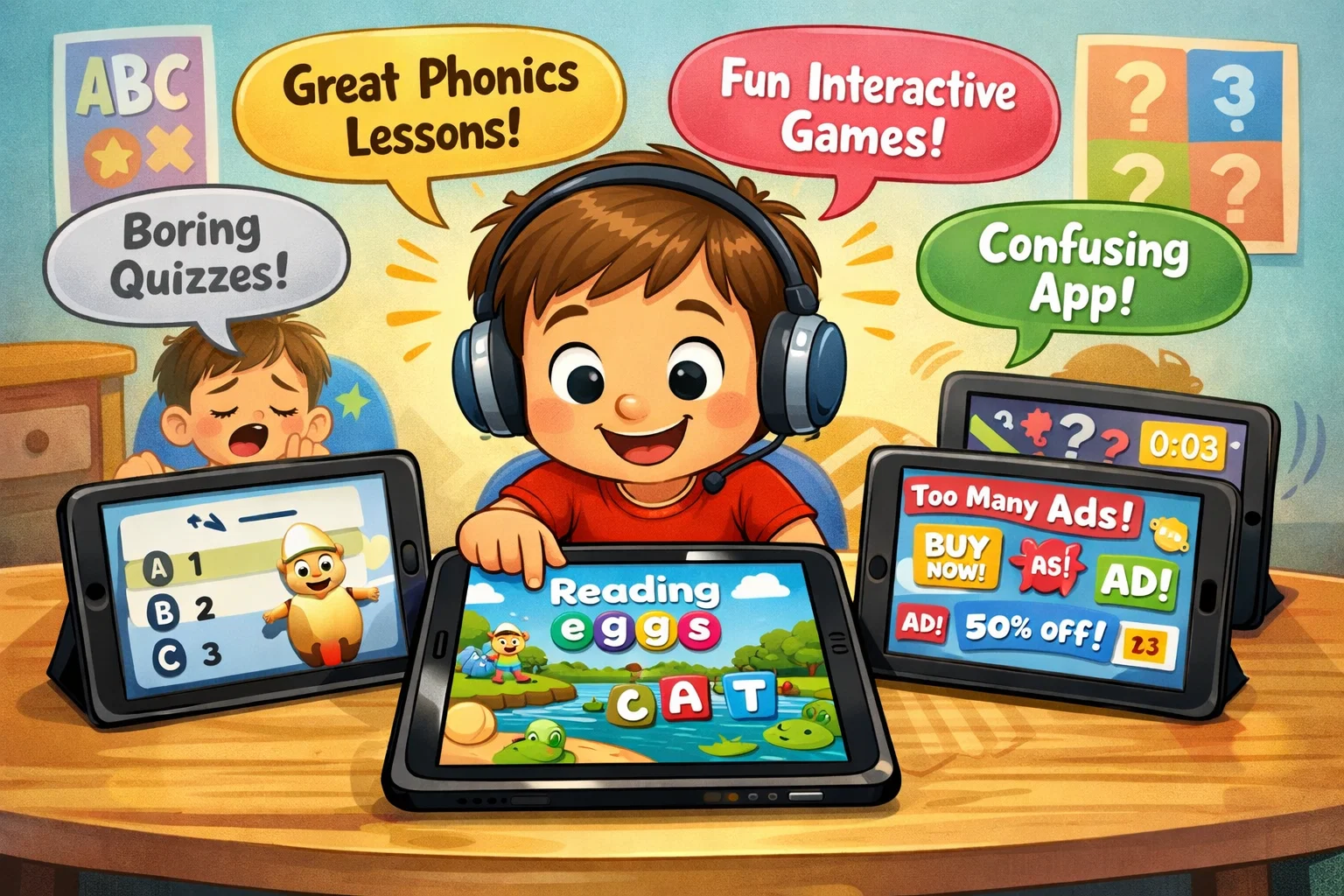
ABCmouse covers a wider range of subjects — including art, science, music, and math — alongside literacy, making it more of a general early learning hub. Reading Eggs, by contrast, goes deeper on literacy specifically. If your primary goal is to teach your child to read using a structured phonics approach, Reading Eggs offers a more focused and rigorous curriculum. ABCmouse may suit families who want a wider digital learning experience for younger children who aren’t yet primarily focused on literacy.
Reading Eggs vs Epic!
Epic! functions as a digital library, giving children access to thousands of books, audiobooks, and educational videos. It’s excellent for building a love of literature and exposing young people to diverse stories and topics. However, it doesn’t teach children to read — there’s no phonics instruction, no structured lesson sequence, and no systematic skill-building built into the experience.
The two platforms actually serve complementary purposes: Reading Eggs develops the foundational skills needed to decode and understand text, while Epic! provides the books and content to practise with once those skills are in place. Many families use both simultaneously, particularly once children reach the Eggspress stage and need more extended texts to build fluency and comprehension.
Is Reading Eggs Better Than Other Reading Apps?
For structured, systematic phonics instruction in the early years, it stands among the stronger digital options currently available. The curriculum’s alignment with science of reading principles, the depth of its phonics scope and sequence, and the quality of its parent-facing tools give it a meaningful edge over many competitors.
That said, it isn’t the only strong option. Programs like All About Reading, Hooked on Phonics, and Starfall each have genuine strengths depending on a child’s age, learning style, and specific needs. Where Reading Eggs particularly distinguishes itself is in the combination of structured instruction, gamified engagement, multi-age coverage, and a consistently clean, safe environment. Few apps serve a 3-year-old and a 12-year-old effectively within the same subscription.
Pricing: How Much Does Reading Eggs Cost?

Free Trial Availability
Reading Eggs offers a 30-day free trial that requires no credit card at signup — making it one of the more genuinely accessible trials in the educational app space. The full 30-day free trial includes access to all components: the core program, Reading Eggspress, Fast Phonics, and Mathseeds. This is enough time to complete a meaningful number of lessons and get a real sense of whether the curriculum suits your child’s current level and learning style.
Subscription Plans and Costs
| Plan | Approximate Price | What’s Included |
| 1 Child – Monthly | ~$9.99/month | All program components |
| 1 Child – Annual | ~$84/year (~$7/month) | All components, better value |
| Family Plan | ~$119/year | Up to 4 children, all components |
The family plan represents strong value for households with multiple children. At roughly $30 per additional child annually compared to a single-child subscription, the Reading Eggs cost becomes much more manageable — particularly when weighed against the price of physical reading curricula, tutoring sessions, or supplementary workbook series.
Is Reading Eggs Worth the Price?
At approximately $7 per month on the annual plan, the subscription offers solid value relative to what it provides. A teacher-designed literacy curriculum with daily interactive lessons, structured phonics progression, comprehension quizzes, printable worksheets, and detailed progress tracking would cost considerably more if sourced through physical materials or private tutoring.
The honest caveat is that value is entirely dependent on how consistently the app is used. Children who engage for even 15 minutes a day are likely to show meaningful improvement in their literacy skills within a few weeks. Families who subscribe and rarely log in will reasonably feel it isn’t worth the cost. The 30-day free trial is the most sensible way to test engagement before committing to an annual plan.
Reading Eggs for Homeschooling: Is It a Good Choice?
Using Reading Eggs for Independent Learning
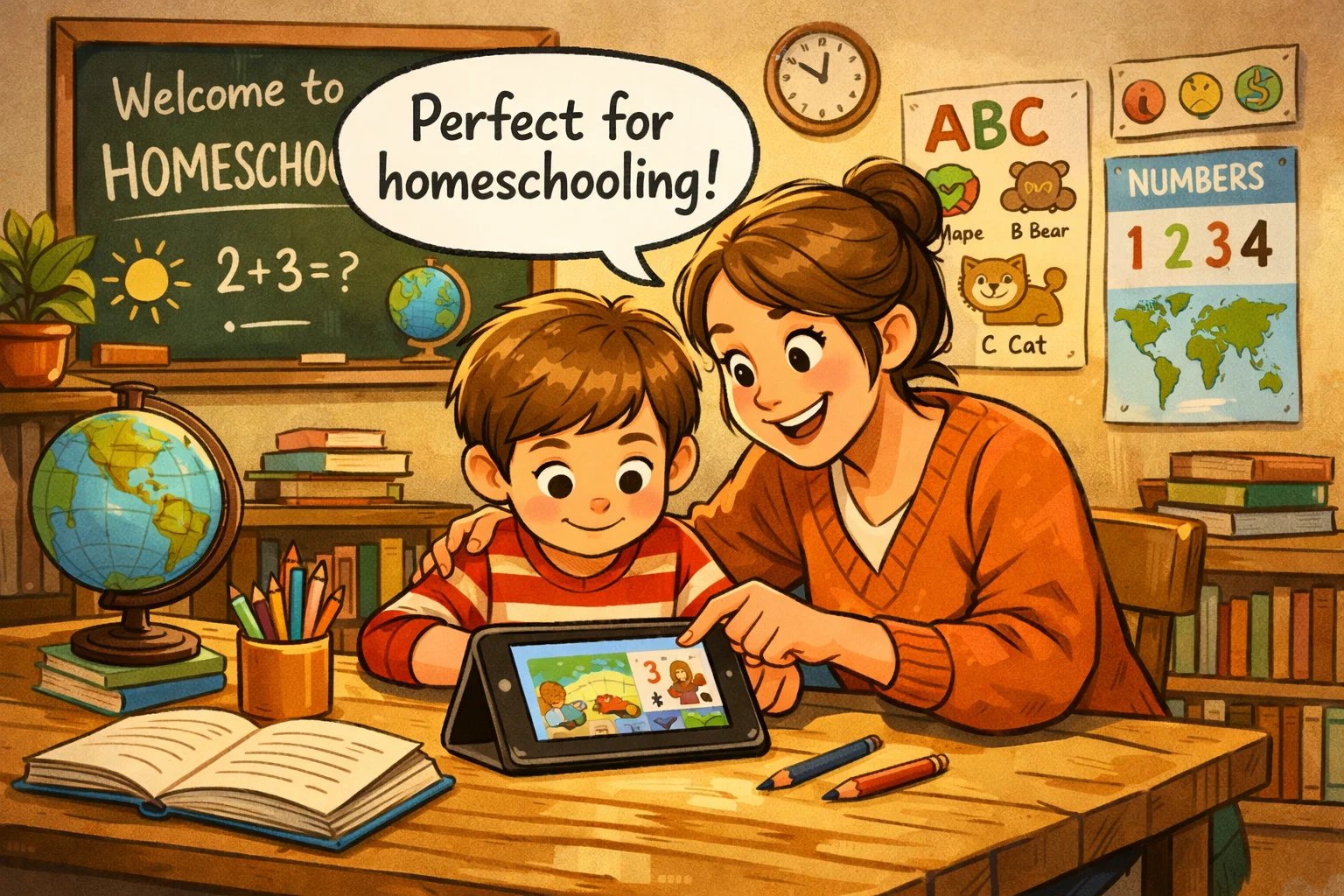
For homeschooling families, one of the most practical aspects of the platform is how independently children can use it. Once a child understands how to navigate the app — typically after one or two supervised sessions — they can work through lessons on their own. This gives parents genuine flexibility to attend to other subjects or siblings while knowing their child is engaged in structured, sequenced literacy work.
The placement test at the outset means children start at the right level without requiring a formal assessment from the parent. The lesson sequence then ensures a logical, cumulative progression of skills — something that can be harder to guarantee in more informal homeschool approaches to literacy, where gaps sometimes develop unnoticed.
The self-paced format also accommodates the natural variability in how children learn. A child who grasps phonics quickly can accelerate through lessons, while one who needs more repetition can revisit activities without any sense of falling behind. This is one area where a digital program genuinely outperforms a fixed curriculum workbook.
How Reading Eggs Can Complement Homeschool Lessons
The app works best as one component of a broader literacy approach rather than the sole resource. In a homeschool context, it pairs naturally with:
- Read-aloud sessions using physical books to build vocabulary and listening comprehension alongside phonics skills
- Handwriting practice to reinforce letter formation in parallel with letter-sound learning
- Decodable books and readers that give children real text to apply their developing phonics knowledge
- Library visits or digital libraries like Epic! for exposure to a wide range of stories and topics
- Offline phonics activities such as letter tiles, word sorts, or hands-on sorting games
Several homeschool communities, including contributors to the Homeschool Review Crew, have noted that the platform integrates smoothly into broader curricula without demanding significant additional planning from parents. The printable worksheets are frequently highlighted as a practical bridge between screen-based lessons and hands-on work — useful for children who benefit from writing and manipulating materials as part of their learning process.
Final Thoughts: Is Reading Eggs Good and Safe for Kids?
Final Assessment of Reading Eggs
Reading Eggs is a well-designed, evidence-based literacy program that delivers genuine educational value for children aged 2–13. Its systematic phonics approach, structured lesson sequence, and engaging reward system combine to create an environment that children often return to willingly — which, in early literacy development, matters enormously.
Key strengths:
- Curriculum grounded in the science of reading, with a clear and logical phonics scope and sequence
- Wide age coverage, from pre-literacy foundations through to upper primary comprehension
- Clean, safe, completely ad-free environment with no inappropriate content
- Detailed parent dashboard with skill reports, progress tracking, and printable resources
- Genuinely motivating for most children — engagement tends to be self-sustaining after the first few sessions
- Strong value, especially on the annual family plan
Potential limitations:
- Some children may find the format repetitive after several months of consistent use
- Reading Eggspress, the older-learner component, receives less consistently enthusiastic feedback than the core early program
- As with any digital tool, it works best as part of a broader literacy routine — not as the only approach to developing a child’s skills
Should Parents Choose Reading Eggs for Their Kids?
If you’re looking for a structured, self-paced online literacy program grounded in phonics research and designed to keep children genuinely motivated, Reading Eggs is a strong and well-supported choice. It’s particularly well-suited to children in the pre-reading and early reading stages (roughly ages 3–7), to homeschooling families who need a reliable independent resource with clear documentation, and to parents who want transparency into exactly what their child is learning and how far they’ve progressed.
The 30-day free trial removes the financial risk entirely. Start there, observe how your child responds over the first week or two, and use the parent dashboard to assess whether the pacing and level feel right. Thanks to Reading Eggs’ structured design, most families have a clear sense within the trial period of whether it’s going to be a lasting part of their child’s literacy development.