

Welcome to a modern approach to teaching and learning. For many years, classrooms focused on teachers delivering information while students simply absorbed and recalled it. Today, the most effective learning environments place student curiosity and questioning at the center. This shift moves education from passive reception to active exploration, where students become investigators, problem-solvers, and creators of knowledge.
This guide offers a clear, practical introduction to inquiry-based learning—a student-centered approach that builds process skills, strengthens critical thinking, and supports deeper understanding. It outlines the core principles, types, and phases of inquiry, and provides concrete classroom examples and ready-to-use strategies. Whether teaching kindergarten science or high school history, educators will find actionable ways to design inquiry-based activities that spark engagement and foster a lifelong love of learning.
Inquiry-Based Learning Definition and Core Principles

In simple terms, inquiry-based learning is an educational philosophy and method where students are actively involved in the discovery process. Instead of being told what to think, they are encouraged to ask questions, investigate, and build their own understanding. It’s about learning through exploration and experience, mirroring how real-world scientists, historians, and thinkers solve problems.
The central principles that underpin this dynamic learning method include:
- Curiosity as the Catalyst: The process begins with something genuinely interesting to the learner, often a puzzling observation or a compelling question that sparks the need to know more.
- Questioning: Teach students to form their own inquiry questions rather than simply answering the teacher’s. This elevates them from passive recipients to active seekers.
- Exploration and Investigation: Students actively investigate topics using hands-on methods, such as science experiments, gathering data, reading diverse sources, or conducting interviews.
- Reflection and Synthesis: The process includes documenting ideas, analyzing findings, and reflecting on how their thinking has changed.
Key Features of Inquiry-Based Learning
A true inquiry-based classroom distinguishes itself through several essential characteristics:
- Student-Driven Questions: Lessons revolve around questions formulated by the students themselves or open-ended questions posed by the teacher that require genuine investigation, not just a simple lookup.
- Hands-On Exploration: Learning is tangible. Engaging in hands-on activities, experiments, and direct interaction with the subject matter is preferred over lectures.
- Collaboration: Working together is key. Students often engage in peer dialogue, group analysis, and cooperative learning method strategies to solve problems.
- Authentic Assessment: Evaluation focuses on the process, critical thinking, and the ability to apply knowledge, not just memorization. Students may present their findings in various ways, such as models, presentations, or debates.
Role of Teacher in Inquiry-Based Learning
The teacher’s role shifts fundamentally from a “sage on the stage” to a facilitator or “guide on the side.” Teachers create a safe, stimulating environment and guide the inquiry process rather than directing it.
Key actions teachers take include:
- Posing Open-Ended Questions: They initiate the inquiry cycle with questions that have multiple potential answers or require complex investigation.
- Scaffolding the Learning: They provide students with the necessary tools, resources, and mini-lessons (scaffolds) to conduct their investigation without giving away the answer. For example, a teacher might give students clues about where to find necessary information.
- Encouraging Metacognition: They prompt students to think about their learning methods and reflect on their conclusions.
- Connecting Learning: They help students explore connections between their findings and broader concepts or real-world issues, helping them achieve a deeper learning and understanding of the subject.
Role of Students in Inquiry-Based Learning
In this model, students take ownership of their learning. They are not passive receivers but active creators of knowledge.
- Active Participation: Students initiate discussions, design their research methods, and investigate topics that genuinely interest them.
- Developing Critical Thinking: By working through complex problems and analyzing conflicting data, students develop strong critical thinking skills and higher-order thinking abilities.
- Taking Ownership: They take ownership of the entire process—from formulating the inquiry question to presenting their findings and reflecting on the learning outcomes.
- Problem-Solving: Students are continuously refining their problem-solving abilities as they encounter and overcome obstacles during their investigation.
Types of Inquiry-Based Learning
The amount of structure the teacher provides determines the type of inquiry being used. Educators often use a continuum, moving students to explore with increasing independence as they gain skills.
| Type of Inquiry | Teacher’s Role | Student Role | Ideal Application |
| Confirmation Inquiry | Provides questions, procedure, and expected outcome. | Confirms results using the given procedure. | Introducing a new concept or ensuring proper technique (the least student-directed form of inquiry). |
| Structured Inquiry | Provides the question and the procedure/materials. | Collects and interprets data to form conclusions. | Early stages of implementing inquiry-based, focusing on data analysis. |
| Guided Inquiry | Provides the central question. | Designs the procedure and collects/interprets data. | Building independent research and design skills. |
| Open Inquiry | Facilitates and mentors. | Formulates the question, designs, investigates, and concludes. | Advanced students, culminating projects, or genuine scientific/historical exploration. |
Structured Inquiry
In structured inquiry, the teacher is heavily involved in setting the initial parameters. Students are given a specific problem or inquiry question and a detailed, step-by-step procedure to follow, often with specific materials. However, the focus remains on the students’ analysis and interpretation of the data they collect. This is an excellent bridge for students new to the inquiry-based approach, allowing them to practice observation and data analysis skills within a safe framework.
Guided Inquiry
Guided inquiry offers greater freedom. The teacher defines the general inquiry question or area of study, but students are responsible for choosing their own methods, materials, and research design. This empowers students to explore different methodologies. For example at this stage, a history teacher might ask students to investigate, “What led to the rise of civilizations along the Nile River?” The students then decide what primary sources, maps, or digital tools to use.
Open Inquiry
Open inquiry is the most complex and rewarding type of learning. Here, the students are in complete control of the inquiry process. They formulate their own questions, design all procedures, investigate using self-selected resources, and present their findings. This requires high levels of self-management, critical thinking, and prior knowledge. This is the hallmark of independent problem-solving and is often reserved for capstone projects or high-level science experiments.
Problem-Based and Project-Based Inquiry
The inquiry-based approach naturally integrates with problem-based learning (PBL) and project-based learning (PjBL).
- Problem-Based Learning: Focuses on solving a real-world, complex, ill-structured problem (e.g., “How can we reduce plastic waste in our school cafeteria?”). The inquiry cycle is used to research solutions, test hypotheses, and justify a proposed intervention.
- Project-Based Learning: Centers on creating a tangible product or presentation in response to a driving question (e.g., “Design a sustainable shelter for a climate-vulnerable region.”). Both approaches engage students in deeper learning by adding relevance and purpose.
Phases of Inquiry Process
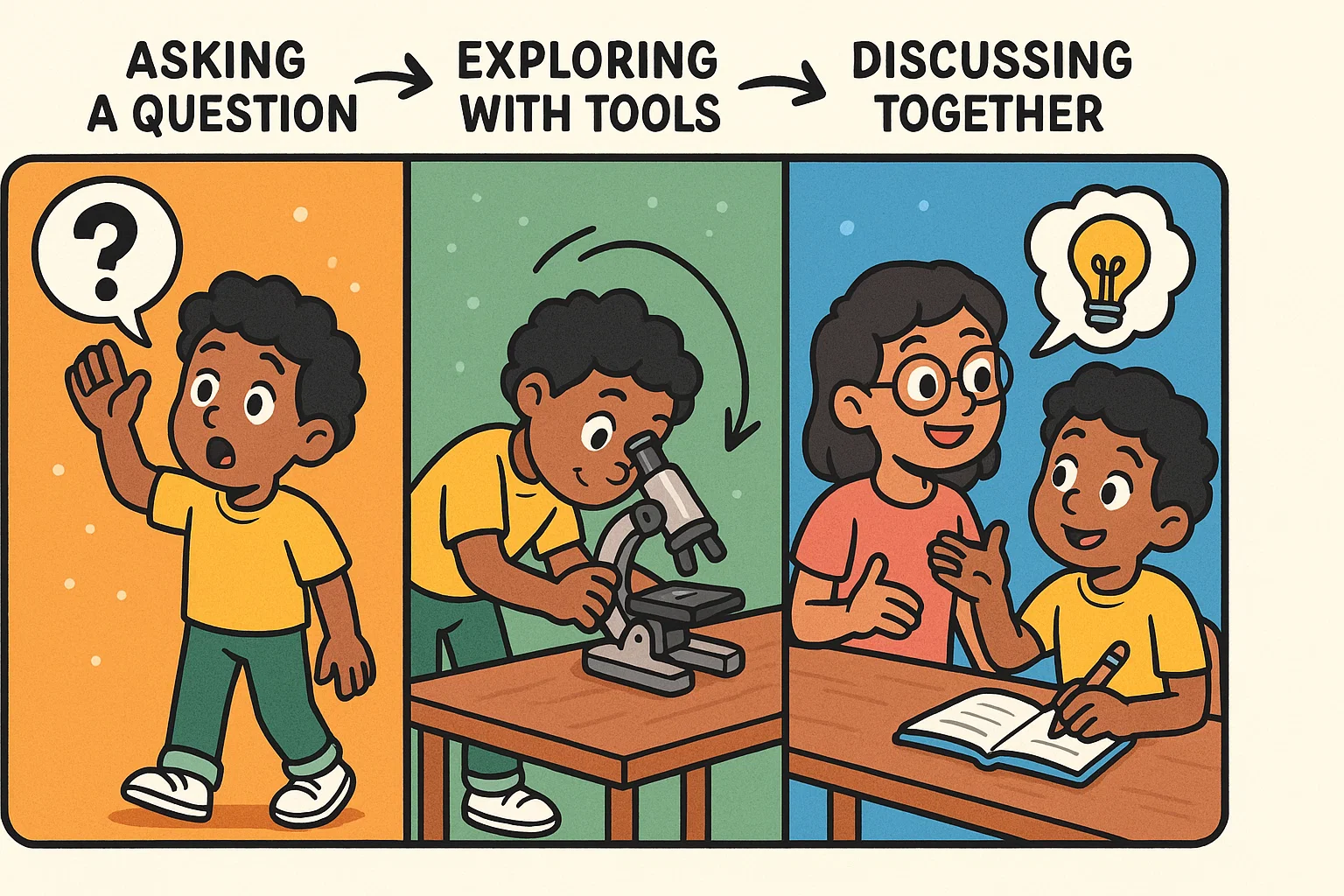
The inquiry cycle is a dynamic, non-linear process that takes students from initial wonder to informed conclusion. The steps of inquiry-based learning are iterative, meaning students may loop back to an earlier stage as their investigation evolves.
Question Formulation
Every meaningful inquiry starts with a strong question. Lessons begin by sparking curiosity—a video, a strange object, a current event, or a simple observation. Teachers encourage students to move beyond simple recall questions to those that are open-ended, testable, and require critical thinking.
- Prompting Curiosity: Use statements like, “I wonder what would happen if…” or “Why do you think this is?”
- Refining the Inquiry Question: Help students narrow broad interests into specific, focused, and answerable research questions.
Investigation and Research
This is the hands-on phase where students learn to be data collectors and analysts.
- Active Data Collection: This might involve designing and conducting science experiments (e.g., studying the impact of light on plant growth), analyzing historical documents, conducting surveys, or going on a field study.
- Information Gathering: Students learn to use reliable sources, distinguish primary from secondary data, and take detailed notes. This helps students develop essential research skills.
Discussion and Collaboration
Learning is social, and sharing insights accelerates understanding. Cooperative learning strategies are vital here.
- Group Analysis: Students work together to make sense of the data, compare findings, and challenge assumptions.
- Peer Dialogue: Structured classroom debates or Socratic seminars allow students to articulate their reasoning, defend their conclusions, and consider alternative viewpoints, further honing their critical thinking skills.
Reflection and Presentation
This final phase brings the learning process to a meaningful close.
- Synthesizing Findings: Students summarize their journey, connect their findings back to the original inquiry question, and reflect on the unexpected turns and challenges.
- Presentation: Students present their findings to an authentic audience (classmates, parents, community members) through various mediums—a presentation, a documentary, a written report, or a constructed model. This crucial step helps students take ownership and solidify their understanding of the subject.
Inquiry-Based Learning Examples in the Classroom
The versatility of the inquiry-based approach means it can be applied to virtually every subject and grade level. These inquiry-based activities move beyond theory to provide concrete classroom ideas.
Science Experiments
Inquiry-based science is the most intuitive application. Examples include experiments where students are given a challenge (e.g., “Design a water filter that produces the clearest water”) rather than a set procedure.
- Testing Plant Growth: Students choose their own variables—soil type, amount of water, music, or exposure to different colored light—and design the experiment, collect data, and draw conclusions.
- Chemical Reactions: Instead of a lab manual, students are given a variety of household chemicals and a safety guide, and the inquiry question is, “Which combinations produce a heat-generating reaction?”
Classroom Debates
Structured classroom debates on ethical, historical, or scientific issues foster critical thinking and communication.
- Ethical Dilemmas: A biology class debates the ethics of gene editing. Students must investigate the science, the philosophical implications, and the legal arguments.
- Historical Interpretation: A history class debates which factor (economic, social, or political) was the primary cause of a revolution. Students must gather and analyze evidence to support their claims.
Field Trips and Real-World Exploration
Learning beyond the four walls of the classroom creates authentic learning experiences.
- Museum Inquiry: Instead of a tour, ask students to use a museum visit to answer a specific inquiry question like, “How did daily life change in our town between 1850 and 1950, based only on the artifacts displayed?”
- Nature Walks and Observation: For younger learners, a nature walk can spark questions about biodiversity, leading to an inquiry activity like building a classification system for local insects or plants.
Artifact or Object Analysis
Using physical objects sparks immediate curiosity.
- Historical Artifacts: Students investigate a replica of an ancient tool or a letter from a historical figure, forming hypotheses about its use, origin, and significance. This is a powerful inquiry-based strategy in social studies.
Jigsaw Learning
Jigsaw learning is a cooperative learning method where the class is divided into “expert groups” that research one part of a complex topic.
- Becoming the Expert: If the topic is the solar system, one group researches Mars, another Jupiter, etc. They then return to their “home group” to teach their peers. This forces students to learn the content deeply enough to instruct others.
Question Development Activities
Before research begins, it’s crucial to spend time practicing how to ask good questions.
- The Question Sort: Students are given a topic and generate as many questions as possible, then sort them into categories: factual (recall), investigative (researchable), and evaluative (opinion/ethical).
Concept Mapping
Concept mapping is a visual inquiry-based strategy that helps students develop a conceptual understanding of the subject.
- Organizing Relationships: Students visually map the relationships between ideas, theories, or historical events, showing connections and hierarchies. This is a powerful tool for analysis and synthesis.
Construction and Design Tasks
These tasks are inquiry-based learning examples that apply math concepts and science principles.
- Engineering Projects: Examples include designing a bridge out of limited materials to withstand a certain load, or building a simple machine to lift a heavy object. The inquiry question is solved through design and testing.
Reflective Journals and Portfolios
Reflective journals allow students to document their learning process, insights, and challenges encountered during the inquiry cycle. This metacognitive practice helps students articulate their critical thinking.
Interdisciplinary Inquiries
Some of the most powerful inquiry-based learning experiences cross subject boundaries.
- Geometry in Architecture: Examples include having students combine math concepts (geometry, ratios) with art and history to explore design principles by analyzing or recreating famous architectural structures. This provides a holistic learning experience.
Inquiry-Based Learning in Early Childhood
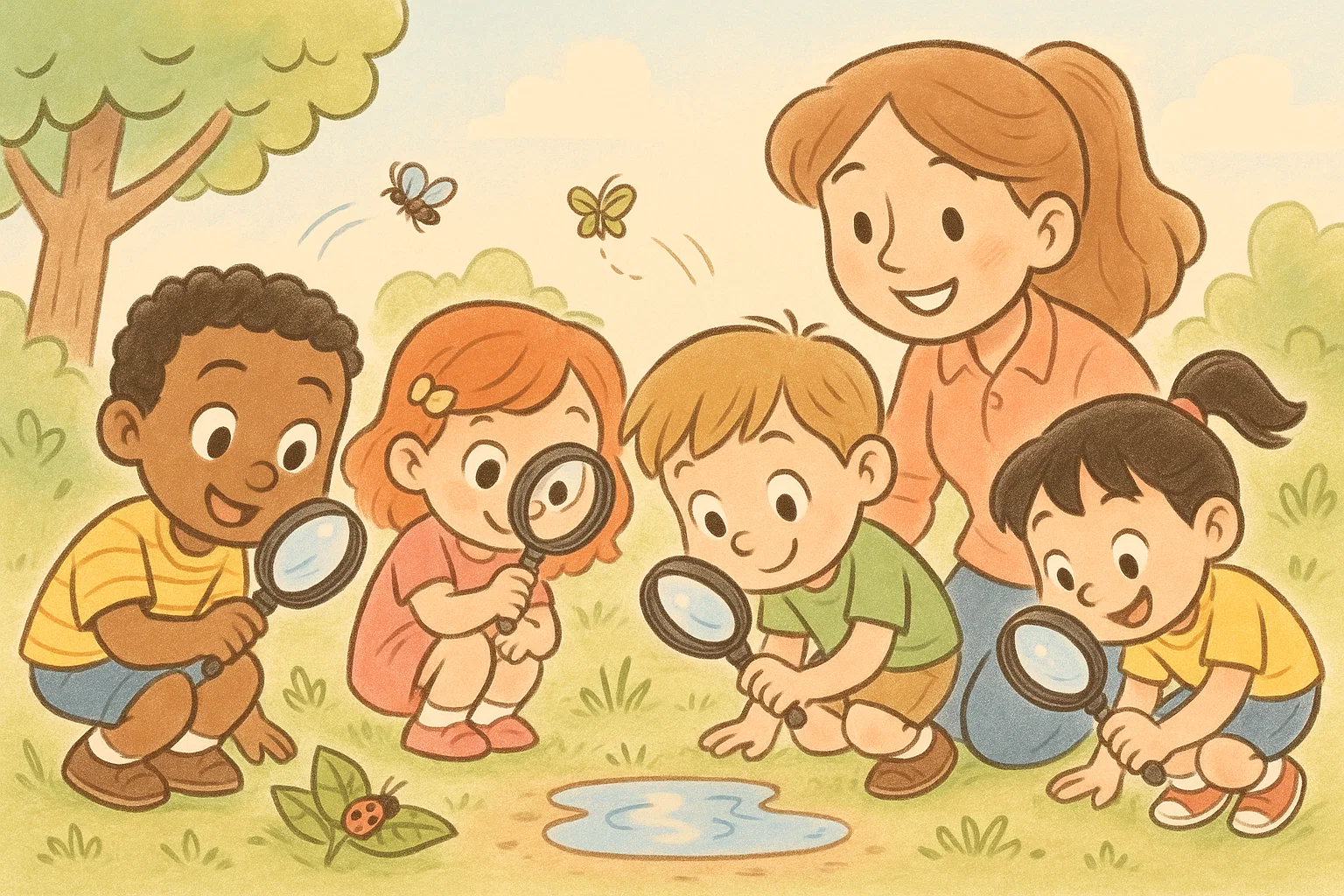
For young children, the inquiry-based approach is less about structured research and more about play-based learning. The foundation is built on natural curiosity and hands-on exploration.
Nature Walks and Outdoor Exploration
- Forming Questions: Simply observing an ant trail or the way water runs down a slope can lead to questions like, “Where are the ants going?” or “Why does the water go faster here?” These observations become simple inquiry-based learning activities for kids.
- Investigating Weather: Observing and recording weather changes daily, leading to an inquiry question like, “Which day was the windiest and why?”
Sensory and Material Exploration
Activities where children examine textures, weights, and properties of materials.
- Water Play: Providing different containers, funnels, and objects allows children to explore volume, displacement, and concepts of floating and sinking—a foundational inquiry activity in physics.
- Building with Loose Parts: Using natural materials like rocks, sticks, and fabric allows children to explore design and engineering concepts without specific instructions.
Role-Play and Imaginative Inquiry
Children explore social roles, emotional scenarios, and real-world jobs through dramatic play.
- The Vet’s Office: Children acting as vets and pet owners work together to solve a pet’s health ‘problem,’ asking questions, forming hypotheses, and problem-solving within the imaginative context.
Inquiry-Based Learning in Secondary and Higher Education
The inquiry-based approach scales effectively, moving to more complex, abstract, and discipline-specific learning experiences for older learners.
STEM Project Investigations
These projects often use open inquiry to address complex, real-world issues.
- Environmental Projects: Designing a working prototype for a community compost system or analyzing local water quality using chemistry principles. Students investigate real data and propose viable solutions.
- Robotics and Coding: Students use an inquiry question (e.g., “How can we program a robot to navigate a complex maze?”) to drive their design, coding, and testing process.
Social Studies and Humanities Research
Inquiry-based strategies deepen the analysis of history and culture.
- Analyzing Historical Sources: Instead of reading a textbook summary, students are given a selection of primary sources with contradictory accounts of the same event. The inquiry question is, “Which account is most reliable and why?”
- Ethical Dilemmas: Students investigate a complex ethical dilemma (e.g., freedom vs. security) by reading philosophy, case law, and contemporary news, leading to a structured classroom debate.
Business or Marketing Scenarios
Problem-based learning is highly effective in business and economics.
- Case Studies: “The Bakery and the Marketer” scenario might ask students to analyze a small business’s struggling sales figures (the problem) and investigate through market research to propose a problem-solving marketing strategy. The students take on the role of consultants.
Benefits of Inquiry-Based Learning
The shift to inquiry-based learning is supported by the science of learning and provides numerous advantages over traditional instruction.
Improved Critical Thinking and Problem-Solving
When students are challenged to design their own procedures and analyze complex data, they naturally build critical thinking skills. This helps students develop the ability to evaluate information, distinguish reliable sources, and formulate logical arguments—skills vital for all aspects of lifelong learning.
Many studies show that students engaged in inquiry-based activities often outperform their peers on measures of critical thinking and problem-solving, suggesting an advantage in applying knowledge rather than simply recalling it.
Increased Motivation and Engagement
When the learning process is driven by the student’s own inquiry question, motivation soars. Giving students the opportunity to take ownership of their learning and explore science, history, or math concepts that genuinely interest them transforms a tedious task into a compelling challenge. These learning experiences engage students deeply because the work has personal relevance.
Deeper Knowledge Retention
Learning through self-directed discovery creates stronger neural pathways. When students learn through a hands-on process of struggling with data and forming conclusions, they internalize the understanding of the subject far more effectively than through passive listening. This helps students achieve true deeper learning that is retained long-term.
Collaboration and Communication Skills
Inquiry-based learning includes a strong emphasis on teamwork. Activities like classroom debates and jigsaw learning require students to effectively communicate complex ideas, respectfully challenge peers, and cooperate to solve a problem. This fosters essential social and professional skills.
Strategies for Implementing Inquiry-Based Learning
If you are a teacher looking to implement inquiry-based learning, here are practical tips to transition your classroom effectively.
Start with Simple Questions
Don’t jump straight to open inquiry. Start with a structured inquiry activity built around a single, compelling question that you guide students through. This initial success builds confidence in the students developing abilities needed for later, more complex investigations. Encourage students to start small and gradually move toward greater autonomy.
Design Open-Ended Tasks
When creating prompts, avoid questions with single, known answers. Instead, design tasks that allow students to reach multiple valid learning outcomes through different pathways.
- Example Prompt: Instead of ‘What temperature does water boil at?’ ask, ‘How does adding salt change the boiling point of water? Design an experiment to find out.’ This shifts the focus from a single factual answer to the process of investigation.
Provide Resources and Scaffolding
A key principle of the inquiry-based approach is to support, not supply.
- Resource Library: Give students access to a variety of print, digital, and physical resources.
- Skill Mini-Lessons: Teach specific skills only when students realize they need them (e.g., “Now that we have data, we need a quick lesson on creating a scatter plot to visualize our findings.”). This is effective just-in-time instruction.
Foster Reflection and Self-Assessment
Reflection is the bridge between a hands-on activity and a deeper understanding of the subject.
- The “I Used to Think… Now I Think…” Routine: Ask students to complete this sentence at the end of every inquiry activity to articulate how their thinking has evolved.
- Peer Feedback: Implement structured critique sessions where students develop the ability to give and receive constructive feedback on their research and presentation methods.
Encourage Classroom Dialogue
Make discussion a central component. Use Socratic questioning to guide the conversation without providing answers.
- Socratic Questioning Example: When a student states a conclusion, respond with questions such as, ‘What evidence leads you to believe that?’ or ‘Could you explain that idea in a different way for us?’ This pushes for higher-order thinking.
Common Challenges and How to Overcome Them

Implementing inquiry-based learning is not without its hurdles, but they are manageable with strategic planning.
Time Constraints and Curriculum Demands
Inquiry-based learning often takes more time because it follows the students’ pace.
- Solution: Focus on Interdisciplinary Inquiries. Combine science learning objectives with history or math concepts to make the most of your time. Use shorter, more structured inquiry activities for high-volume content and save open inquiry for major projects.
Classroom Management
The autonomy of inquiry-based activities can sometimes feel chaotic.
- Solution: Establish clear expectations for collaboration and movement before the inquiry activity begins. Use small group contracts, assign specific roles within the team, and teach students how to manage their time and resources effectively.
Assessing Inquiry Outcomes
Evaluating a unique, student-led investigation can be tricky compared to a multiple-choice test.
Solution: Shift assessment to the inquiry cycle itself. Evaluate:
- The Inquiry Question: Is it well-defined and researchable?
- The Process: Review reflective journals and observation notes of the student’s critical thinking and problem-solving.
- The Product/Presentation: Use rubrics that assess communication, evidence use, and depth of analysis rather than a single “right” answer.
Case Studies of Successful Inquiry-Based Learning
Primary School Science Inquiry Project
Context: A third-grade classroom was studying invertebrates.
The Inquiry: The teacher presented a terrarium with garden snails and asked, “Do snails prefer a specific type of food?”
The Process: Students formed hypotheses, designed small science experiments using different foods (lettuce, apple, carrot), built data tables, observed the snails, and graphed the results.
Success: The students developed not only an understanding of the subject matter (snail diet) but also essential skills in experimental design and data interpretation, making it a compelling example of inquiry-based learning.
Cross-Curricular Inquiry in High School
Context: A tenth-grade class combined history and literature.
The Inquiry: “Did Shakespeare accurately represent the nature of kingship and power dynamics in Macbeth based on historical records of the time?”
The Process: Students investigate Elizabethan and Jacobean political history (history) while performing close readings of the play (literature). The inquiry-based activities culminated in a formal classroom debate arguing for or against the play’s historical accuracy.
Success: This integrated project promoted higher-order thinking, allowing students to apply critical thinking skills across two distinct domains, demonstrating deep, interdisciplinary learning outcomes.
Digital Inquiry in Online Learning Environments
Context: A university-level ecology course conducted online.
The Inquiry: “How has climate change affected bird migration patterns in our regional flyway over the past 20 years?”
The Process: Students are given access to shared databases, online mapping tools, and citizen-science platforms. They collaborated remotely on a jigsaw learning model, each becoming an “expert” on a different dataset or species. They used video conferencing to present their findings.
Success: This demonstrated that inquiry-based strategies are highly effective in supporting collaborative, student-centered research even in a remote learning environment.