


Fostering a sense of curiosity in children often begins with the simplest of objects found around the home. A piece of cardboard leaned against a stack of books or a wooden plank resting on a porch step is not just a ramp; it is a fundamental scientific tool. By engaging in inclined plane experiments, kids can explore the invisible forces that shape the physical world. These activities provide a hands-on way to grasp how motion works and why some tasks require more effort than others.
Simple Science Experiments with Simple Machines: Inclined Plane

The concept of a simple machine might sound technical, but these devices are the building blocks of almost every complex piece of technology used today. At its core, an inclined plane is a flat surface set at an angle to help move loads from a lower level to a higher one.
Definition of Simple Machines
Simple machines are basic mechanical devices that change the magnitude or direction of a force. There are six classical types: the lever, wheel and axle, pulley, screw, wedge, and the inclined plane. These tools do not create energy; instead, they allow humans to perform work more efficiently by spreading the effort over a longer distance. For children, identifying these in a toy box or kitchen helps demystify the mechanical world.
Force and Motion Basics
When an object is placed on a slope, it interacts with gravity in a specific way. While gravity pulls everything straight down, the surface of the ramp pushes back. This interaction determines how fast a toy car zooms down or how much effort is needed to push a heavy box up. Understanding that a push or a pull is a force is the first step in physical science.
Role of Ramps in Daily Life
Ramps are everywhere, serving essential functions that often go unnoticed. Wheelchair ramps provide accessibility, while delivery ramps allow workers to move heavy crates into trucks. Even the winding roads on a steep mountain are essentially long, gradual inclined planes designed to make driving safer and easier for engines.
Experiment with Marble Ramps
One of the most accessible ways to start is with a marble and a grooved track. By changing the slope, children can observe how speed increases as the ramp gets steeper. This simple setup serves as an introduction to acceleration. It allows kids to see that the same marble behaves differently depending on the path provided.
Ramp and Inclined Plane Activities for Kids

Active inquiry is essential for deep learning. Rather than just reading about physics, children should be encouraged to build, test, and modify their own structures to see the results in real time.
DIY Cardboard Ramp Challenges
Using recycled materials like cereal boxes or shipping containers, kids can construct various slopes. A fun challenge involves trying to make a marble roll for the longest possible time or distance. This encourages them to think about how the height of the starting point influences the final outcome.
Vehicle Speed Tests on Slopes
Using toy cars of different sizes and weights provides excellent data. Does a heavy truck travel further than a light sports car? By marking the stopping point with tape, kids create a visual map of their results. This helps them understand that mass and gravity play significant roles in motion.
Comparing Friction on Different Surfaces
Friction is the “hidden” force that opposes motion. You can test this by covering your ramps with different materials:
- Aluminum foil (low friction)
- Sandpaper (high friction)
- Bubble wrap (uneven friction)
- Towel or cloth (high absorption of energy)
Angle of Inclination Observations
By using a pile of books to gradually increase the angle of a ramp, kids can find the “tipping point.” This is the specific angle where an object starts to slide on its own. It is a perfect moment to discuss how the parallel component of gravity eventually overcomes the friction holding the object in place.
Building Multi-Level Marble Runs
For a more complex project, kids can create a series of connected inclined planes. This requires careful alignment to ensure the marble transitions from one ramp to the next without losing too much momentum. It is an exercise in engineering and patience.
Research and Educational Context
The physics of the inclined plane centers on how gravitational force is distributed. When an object is on a slope, its weight (Fg = mg) is resolved into two main parts:
- Perpendicular Component (F_perpendicular = mg cos theta): This is balanced by the ramp’s surface (normal force).
- Parallel Component (F_parallel = mg sin theta): This is the force that pulls the object down the slope.
The Mechanical Advantage (MA) represents the trade-off between effort and distance. By moving an object over a longer distance (L) to reach a height (h), the required force is reduced (Ideal Mechanical Advantage = L/h). While the total work remains constant, the power needed decreases because the effort is spread over more time and space.
Science education leaders emphasize active inquiry over rote memorization: “The heart of science is fostering curiosity… Students should leave saying, ‘I didn’t know that!’” They promote “sense-making,” where students analyze data and build explanations.
Data supports this approach:
- Research in PNAS shows active learning cuts STEM achievement gaps by 33% in scores and 45% in passing rates.
- The U.S. Bureau of Labor Statistics projects STEM jobs will grow by 8.1% through 2034 — nearly 3x faster than non-STEM fields (2.7%).
Materials
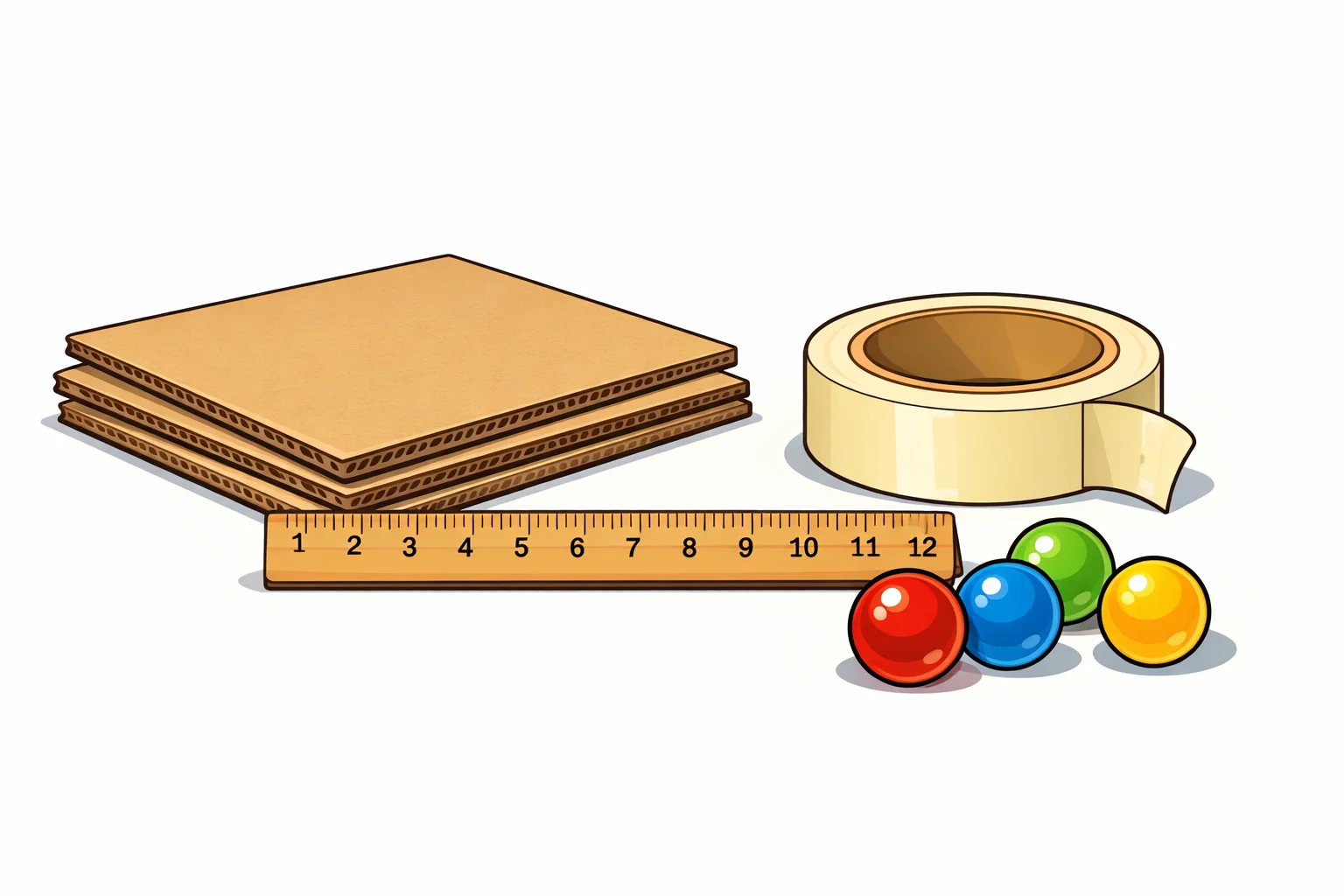
Preparation is key to a successful science session. Having the right tools organized beforehand prevents frustration and allows the focus to remain on the discovery process.
Essential Household Items
Most inclined plane experiments can be completed with items already in your recycling bin or pantry.
- Sturdy cardboard (from shipping boxes)
- Wooden planks or shelving pieces
- Plastic pipes or pool noodles (cut in half)
- Books or blocks for height adjustment
- Adhesives like masking tape or painters tape
Measuring Tools for Data Collection
To turn a fun activity into a formal experiment, precise measurement is necessary.
- Rulers or measuring tapes (to measure L and h)
- Stopwatches (a phone timer works well)
- Spring scales (to measure the effort force in grams or Newtons)
- Spirit levels (for initial horizontal calibration)
Safety Notes for Young Scientists
A critical safety observation in elementary settings involves “Duty of Care” and the prevention of physical hazards. The National Science Teaching Association (NSTA) identifies “physical safety” as a primary concern, recommending that students maintain a safe distance when launching projectiles down ramps and use barriers to prevent objects from rolling off tables. When working with heavier objects, ensure they are secured so they do not fall on feet.
Selecting Best Objects for Rolling
Not all objects are created equal for these tests. For clear results, use:
- Marbles or ball bearings (low friction)
- Toy cars with well-oiled axles
- Cylindrical cans (to observe rolling mass)
- “Tester eggs” (plastic eggs containing bouncy balls) instead of real eggs to provide a mess-free way to illustrate how a gentle ramp reduces impact force.
Procedure
Consistency is what separates a random activity from a scientific experiment. Following a set procedure ensures that the data collected is reliable.
| Step | Action | Purpose |
| 1 | Calibration | Use a spirit level to ensure the floor or table is perfectly flat. |
| 2 | Setup | Set the vertical height (h) and slope length (L). |
| 3 | Prediction | Have the child guess what will happen (Hypothesis). |
| 4 | Execution | Release the object without pushing it (to ensure gravity is the only force). |
| 5 | Measurement | Record the time or distance traveled. |
| 6 | Repetition | Perform five trials for each setup to ensure statistical accuracy. |
Step-by-Step Construction Instructions
Start by selecting a base height, such as a stack of three books. Lean a 30 cm ruler against the books. For a foundational understanding, a mechanical advantage ratio of 2:1 is recommended. This means if your vertical rise is 15 cm, your slope length should be exactly 30 cm. Secure the base of the ramp with tape so it does not slide during the test.
Setting Up Scientific Control Groups
In science, a control group is essential for comparison. If you are testing friction, your “control” should be the smooth, bare surface of the ramp. Every other test (adding carpet or foil) should be compared back to this original result. Only change one variable at a time — either the height, the length, or the surface — never all three at once.
Documenting Results and Observations
A common fail point in experiments involves erratic readings. For example, in the “Heave Ho!” rock-pulling experiment, students often jerk the spring scale, leading to unstable force readings. Encourage kids to pull slowly and steadily. Data is typically collected in 10 cm increments up to 50 cm. Recording these findings in a simple notebook allows kids to see patterns, such as how speed increases as the angle grows steeper.
Troubleshooting Common Experiment Issues
If the object keeps falling off the side, check the horizontal calibration with your spirit level. If the data seems inconsistent, ensure the object is being released from the exact same spot every time. For older students, if rolling speeds are too fast for manual stopwatches, utilize shallow angles between 1 degree and 15 degrees to ensure speeds are slow enough for accurate timing.