

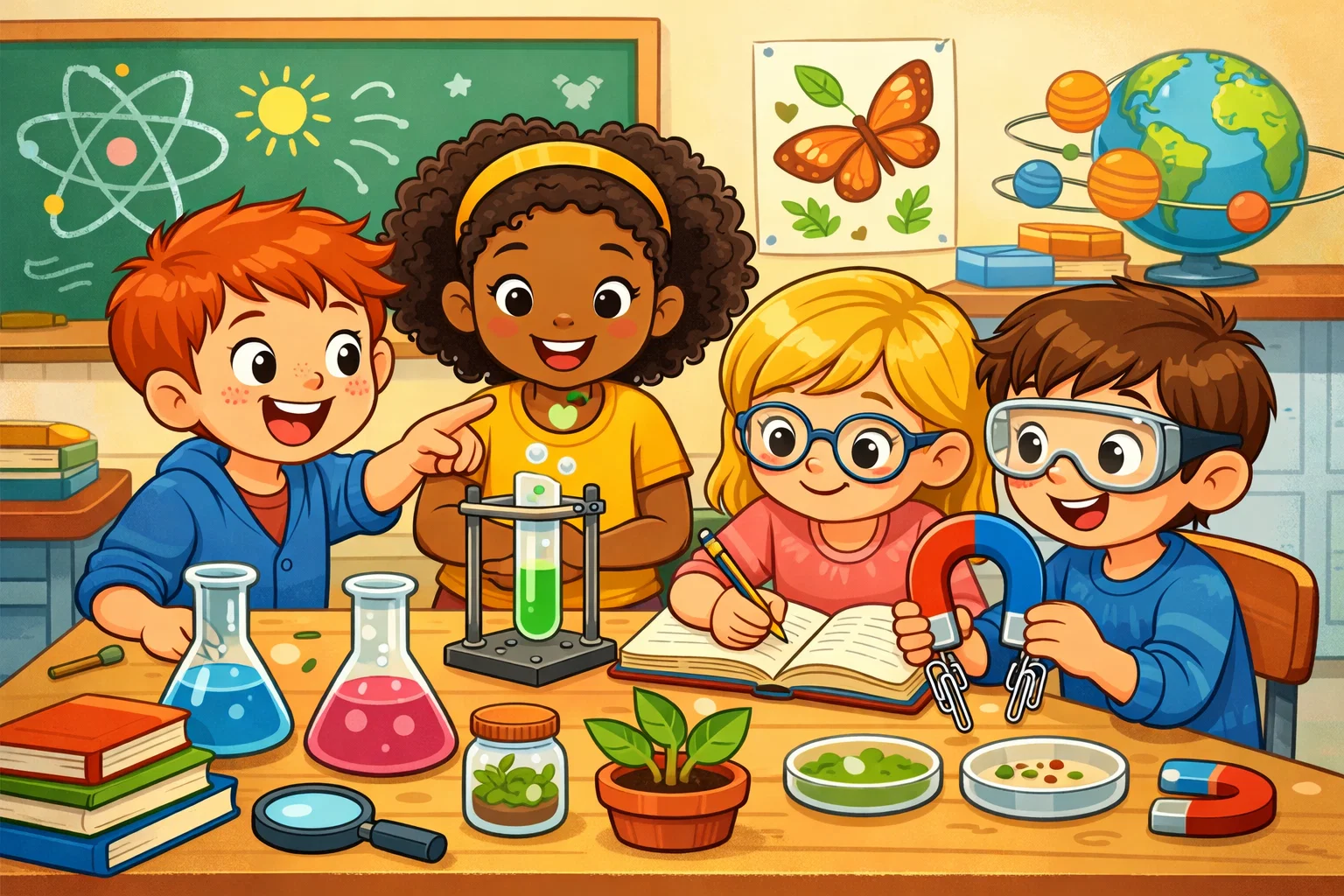
Teaching children how to form a scientific prediction turns their natural curiosity into a structured skill. At its core, this is an educated guess that can be tested through observation. In the world of young scientists, writing a prediction means asking, “What do I think will happen, and why?” and then designing a science experiment to find out the answer.
This guide is designed for parents, teachers, and curious students. We will cover the mechanics of forming a hypothesis, how to distinguish it from a random guess, and the specific steps required to learn how to write a statement that is truly testable. By the end of this article, you will have the tools to help kids think like scientists, develop critical thinking skills, and approach every science fair with confidence.
Hypothesis Meaning for Kids
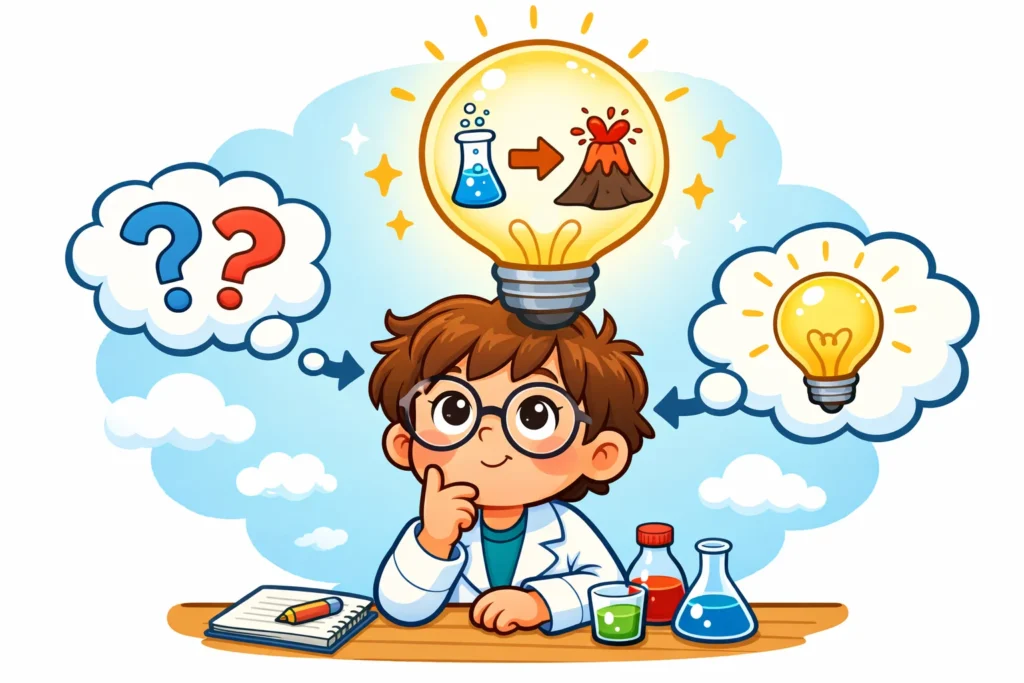
In simple terms, a hypothesis is what you think will happen in an experiment, based on what you already know. You can explain it to a child as “your idea of the answer to a science question, before you do the experiment.” It is a vital part of the scientific method because it gives the experiment a clear direction.
Instead of just playing with materials, making a prediction helps ensure that the child is looking for a specific outcome. For example, instead of just pouring water on seeds, a child might say, “I think seeds need water to grow.” This sets the stage for a testable hypothesis where they can actually measure the results.
Difference Between Guess and Hypothesis
It is important to distinguish between a “wild guess” and a scientific hypothesis.
- A Guess: Often random and not based on evidence. Example: “I think it will rain because I like umbrellas.”
- A Hypothesis: An educated prediction based on prior knowledge or observation. Example: “I think it will rain because the clouds are getting very dark and heavy.”
Hypothesis Role in Science Experiments
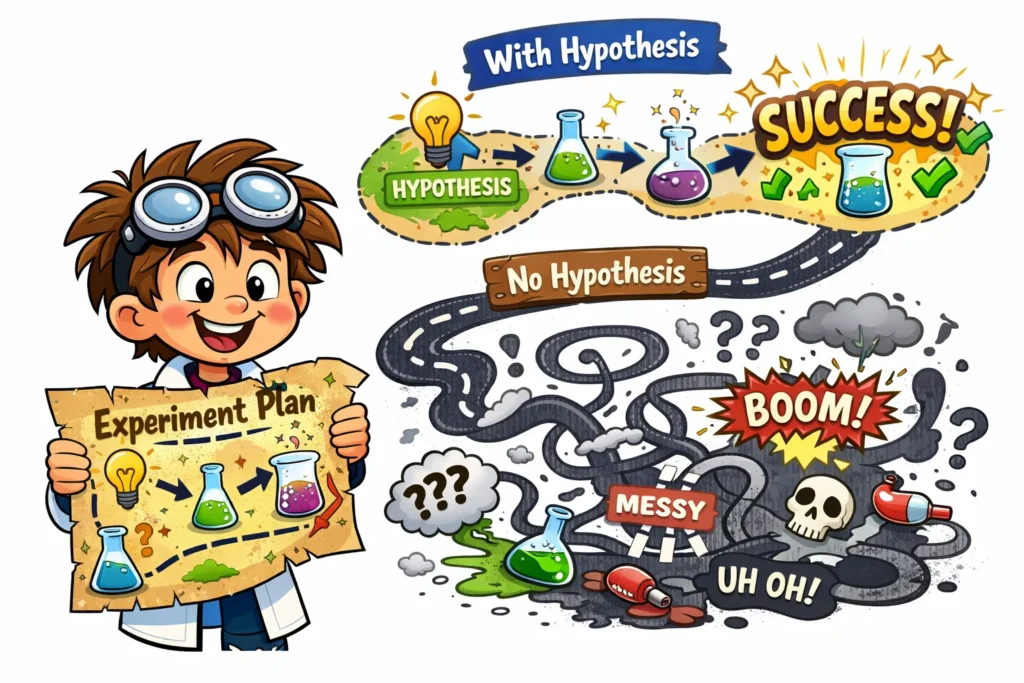
A prediction acts as a roadmap. It helps young scientists stay focused on one variable at a time. Without this statement, an activity is often just an observation rather than a true experiment. With one, it becomes a mission to prove or disprove an idea. This focus helps kids understand the concept of cause and effect – how changing one thing leads to a specific result.
Simple Hypothesis Definition for Young Learners
“This is a smart guess about what you think will happen and why you think it will happen.”
Scientific Method Steps for Kids
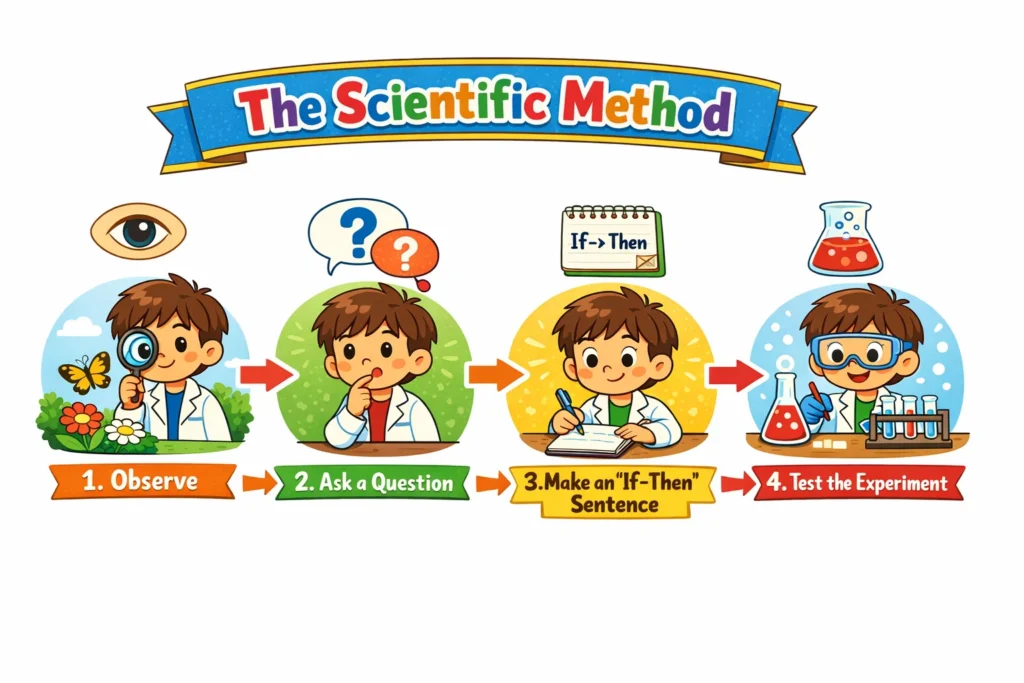
The scientific method is a series of steps that scientists use to explore the world. Formulating a hypothesis is a critical middle step in this process.
| Step | Action | Description |
| 1 | Observation | Noticing something interesting in the world. |
| 2 | Question | Asking “Why?” or “How?” about what you saw. |
| 3 | Hypothesis | Making a testable prediction about the answer. |
| 4 | Experiment | Testing the idea with a fair test. |
| 5 | Analysis | Looking at the data and notes. |
| 6 | Conclusion | Deciding if your guess was right or wrong. |
Observation Step in Experiments
Science starts when kids notice changes, patterns, or problems. This could be noticing that a paper towel brand is thicker than another, or seeing that salt water doesn’t freeze as fast as fresh water.
Question Formulation for Experiments
Observations naturally lead to questions. A good question for a science experiment should be specific. Instead of asking “How do plants grow?”, a child might ask, “Does the amount of water affect how tall a plant grows?”
Hypothesis Placement in Scientific Method
The prediction must be written before the experiment begins. This helps prevent “hindsight bias,” where we might feel like we knew the answer all along. By making a prediction first, kids learn the value of honesty in research.
Testing and Results Connection
Once the experiment to test the theory is done, the results are compared back to the original prediction. Whether the prediction based on your logic was correct or not doesn’t change the success of the experiment; the goal is simply to see whether your hypothesis matches reality.
Why Hypothesis Matters in Kids Science Experiments
Skill Development Through Hypothesis Writing
When a child learns to write a hypothesis, they are practicing logic. They begin identifying independent and dependent variables – the “if” and the “then.” This builds the foundation for algebraic thinking and complex problem-solving.
Confidence Building in Young Scientists
Predicting an outcome makes a child an active participant. Instead of just following a recipe (like a baking soda and vinegar volcano), they are testing their own ideas. This ownership makes the “Eureka!” moments much more satisfying.
Learning From Incorrect Hypotheses
In science, being “wrong” is just as good as being “right.” If a child’s prediction might be disproven, they have still learned something new. It teaches them that failure is just a different kind of data.
Types of Hypotheses for Kids
While scientists use many types of hypotheses, we can keep it simple for kids by focusing on these four:
- Simple Hypothesis: Predicts a relationship between two variables. Example: “If I give a plant more light, it will grow faster.”
- Directional Hypothesis: Predicts exactly how something will change (increase or decrease). Example: “Adding more salt will make the water take longer to freeze.”
- Non-Directional Hypothesis: Predicts a change will happen, but doesn’t say which way. Example: “The brand of paper towel will affect how much water is absorbed.”
- Null Hypothesis: Predicts that there will be no change at all. Example: “The color of the water will not change how fast the sugar dissolves.”
How to Write Hypothesis Step by Step
Step 1: Choose Experiment Topic
Start with a question that is testable. Avoid complex questions that can’t be measured, like “Why is the sky pretty?”. Instead, choose something you can see and count.
Step 2: Identify Variables
To write a strong hypothesis, you need to identify the variables in your hypothesis:
- Independent Variable: The thing you change (e.g., the amount of baking soda).
- Dependent Variable: The thing you measure (e.g., how high the foam grows).
Step 3: Use If-Then Format
One of the easiest ways to formulate a hypothesis is using the “If… then…” structure.
- If [I do this], then [this will happen].
Step 4: Check Testability
A good hypothesis must be observable. You must be able to conduct experiments that provide clear evidence. If you can’t measure it with a ruler, a timer, or your eyes, it’s hard to test!
Hypothesis Examples for Kids Science Experiments
Everyday Science Hypothesis Examples
- “If I leave an ice cube in the sun, then it will melt faster than one in the shade.”
- “If I use a darker crayon, then it will be harder to erase.”
Classroom Experiment Hypotheses
- “If we use different brands of paper towels, then Brand A will absorb more water than brand B.”
- “If we add salt water to the soil, then the plant will grow more slowly than the one with salt-free water.”
Home Science Experiment Hypotheses
- “If I put pieces of fruit in vinegar, then they will change color faster than in water.”
- “If I change the amount of baking soda in the reaction, then the bubbles will reach a higher point.”
Simple Science Experiments for Hypothesis Practice
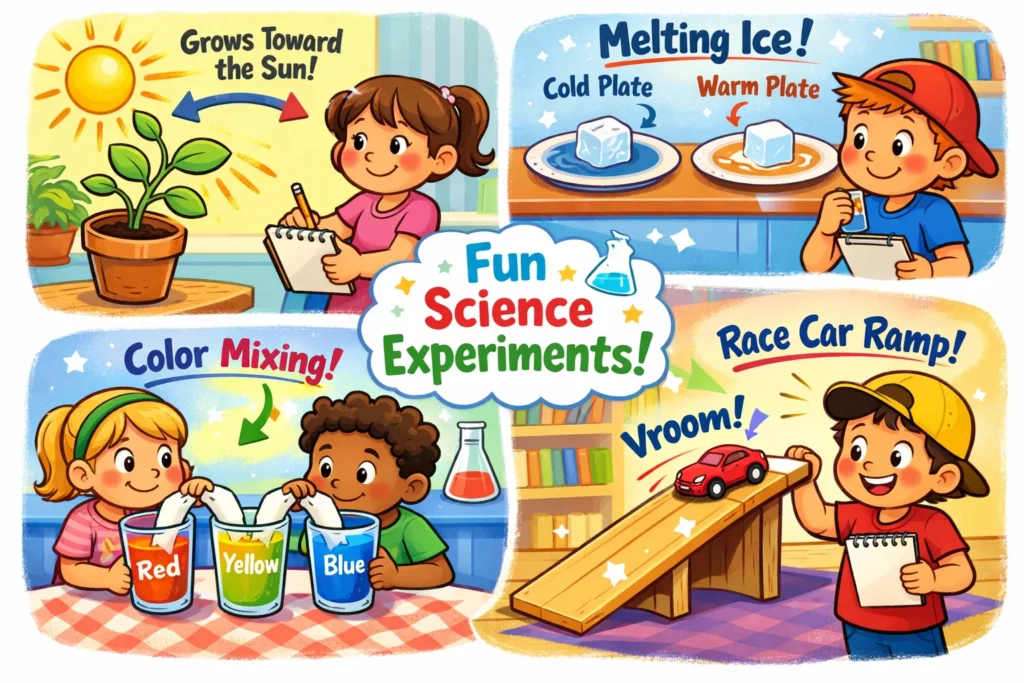
Plant Growth Experiments
The Question: What makes them grow the most?
Scientific Idea: “If I put the plant in a dark closet, then it will not grow as tall as the plant in the window.”
Variables: The independent variable is the light level; the dependent variable is the height.
Kitchen Science Experiments
The Question: Which liquid dissolves candy the fastest?
Prediction: “If I put the candy in warm water, then it will dissolve faster than in cold water.”
Observation: Use a timer to take notes on how long each takes.
Physics Experiments for Kids
The Question: Does the weight of a ball change how far it rolls?
Smart Guess: “If the ball is heavier, then it will roll further down the ramp because it has more momentum.”
Teaching Hypothesis Writing to Kids
Hypothesis Teaching Strategies
Don’t rush the “big words.” For preschoolers, use “I think… because…” For older kids, introduce scientific research terms. Gather information first by reading books or watching videos about the topic to ensure their theory is “educated.”
Activities for Practicing Hypothesis Skills
- The Mystery Box: Put an object in a box. Let kids shake it and make a guess (their prediction) about what’s inside based on the sound.
- Absorbency Race: Provide different paper towel brands and ask them to make a prediction on which wins.
Common Mistakes in Hypothesis Writing
- Confusing a Scientific Idea With a Question: This statement is a declaration, not a question. Instead of “Will it grow?”, write “It will grow.”
- Making the Statement Too Broad: “Plants like water” is too vague. “Plants given 100ml of water will grow taller than plants given 10ml” is specific.
- Writing Non-Testable Predictions: Avoid using words like “better” or “best” unless you define how to measure them.
Tracking Hypotheses and Results
Using science journals for kids is the best way to track progress. A simple table can help them compare what they expect to happen with what actually happened.
| Experiment | My Prediction | The Result | Was I Right? |
| Salt vs Sugar melting | Salt will melt ice faster. | Salt melted ice faster. | Yes! |
| Paper Towel Test | Brand A will absorb more water. | Brand B held more water. | No, but I learned why! |
FAQ About Hypothesis Writing for Kids
It is a “smart guess” or a “prediction” that you can check with an experiment.
Yes! A prediction based on your idea was correct only if the data supports it. If it’s wrong, you haven’t failed; the experiment shows you something new.
Kids can start making verbal predictions as young as 3 or 4. Formal “If-Then” writing usually starts around age 7 or 8 (2nd or 3rd grade).