

Eleven is a fantastic age! You’re transitioning from the elementary years into pre-teen life, and your brain is a sponge, ready to absorb incredible information about the universe. This stage is all about feeding that growing curiosity and providing a foundation of knowledge that will make learning exciting, not a chore. The world is full of amazing facts, and we’ve collected some of the most mind-blowing trivia for kids—perfect for impressing your friends, sparking curiosity, and making you the most interesting person in any room.
This article is designed to be a fun and cool journey through science, history, nature, and the sheer randomness of the world around us. These are not just any random fun facts; they are bite-sized pieces of knowledge selected to spark curiosity and encourage young minds to ask, “Why?” and “How?”. Get ready to have your mind blown with fun facts that turn learning into an adventure.
Science Fun Facts for 11 Year Olds
Science isn’t just about textbooks and equations; it’s about the wonder of discovery and the sheer, jaw-dropping scale of the universe. This section is designed to introduce fun, age-appropriate science facts for kids that are curiosity-driven and exciting for 11-year-olds. Get ready for some amazing facts that feel like secrets of the universe!
Body-Fact Surprises
The human body is an incredible machine, constantly working in ways you don’t even realize. Did you know that every cell in your body is a tiny factory? Here are some amazing facts about the human body that any 11-year-old would find cool.
- The Power of Your Heart: Your heart is a powerhouse! It generates enough pressure to squirt blood a staggering 30 feet. Imagine a two hearts pump blood scenario, and you might think that’s even more powerful—but one is more than enough. An average human heart will beat about 2.5 billion times during a lifetime.
- The Universe in Your Cells: You have more bacterial cells in your body than human ones! The ratio is estimated to be about 1.3 to 1 in favor of bacteria. This tiny ecosystem helps digest food and fight off illness.
- A Marathon of Saliva: Over a lifetime, a person produces enough saliva to fill two large swimming pools. That’s a random fun fact that might make you think twice before you swallow!
Space and Planet Oddities
Space is the ultimate frontier, a place of mind-boggling scale and unbelievable phenomena. Sharing weird and wonderful space facts for kids (planets in the solar system, stars, moons) is geared for this age, where big ideas start to click.
- The Hottest Planet: It may surprise you that Mercury, the closest planet to the sun, is not the hottest. That title belongs to Venus. It’s so hot, in fact, that it’s five times hotter than the temperature needed to boil water on Earth. Its thick atmosphere creates an extreme greenhouse effect, making it the planet in the solar system with the highest average surface temperature.
- The Speediest Giant: Jupiter is the fastest-spinning planet in our solar system. A day on Jupiter lasts only about 9.9 Earth hours! Imagine how quickly your birthday would come around if you lived there.
- Lightning on the Sun? A bolt of lightning on Earth can reach temperatures of up to 50,000 degrees Fahrenheit. But get this: The surface of the sun is only around 10,000 degrees Fahrenheit. The Sun’s corona can be hundreds of times hotter than its surface.
| Planetary Fun Fact | Detail | Why it’s Cool for 11-Year-Olds |
| The Diamond Planet | Scientists believe a planet called 55 Cancri e might have a surface made largely of graphite and diamond. | It’s like a giant, flying treasure chest! |
| No Gravity, No Tears | In space, astronauts cannot cry normally; the tears just stick to their eyes in a ball due to the lack of gravity. | It’s a surprising, little-known interesting fact about life in orbit around the sun. |
| Footprints Last Forever | On the Moon, there is no wind or water, so the footprints left by the Apollo astronauts will likely remain visible for millions of years. | A connection to history and a sense of permanence. |
International Space Station Facts
The International Space Station orbits Earth every 90 minutes, meaning astronauts see multiple sunrises and sunsets daily. Life there depends entirely on controlled systems because Earth’s atmosphere no longer protects them.
Objects float in microgravity, and even simple tasks like drinking water require special tools. Comparing conditions in space to life at the equator highlights how unique Earth’s environment truly is.
Earth and Nature Wonders
Our own planet is a marvel of geology and climate, full of surprising secrets hidden in plain sight. Here are geological, climatic, or ecosystem facts for kids to spark wonder.
- Everest’s Growth Spurt: Did you know that Everest is still growing? The powerful tectonic plates beneath it push it up by about 4 millimeters every year. It’s literally rising higher every year—about 4 millimeters annually!
- The Sound Barrier: Air may seem weightless, but a single cubic foot actually weighs about an ounce. This sounds small, but if you could gather all the air above the Earth, it would weigh about 5.5 quadrillion tons. That’s enough to blow your mind!
- The Speed of Rain: The fastest-recorded raindrop speed is about 18 miles per hour The smallest drops, called drizzle, fall much slower.
Animal Fun Facts for 11 Year Olds
The animal kingdom is packed with truly unbelievable creatures and behaviors. This section provides engaging animal facts—wild, weird, and cool—that appeal to pre-teens and make for great conversation starters.
Smart Animals & Survival Experts
Dolphins use signature whistles similar to names, allowing individuals to recognize one another. Elephants demonstrate strong memory and emotional awareness, even recognizing themselves in mirrors.
Reindeer migrate thousands of miles annually in search of food. Adaptation strategies like these help spark their curiosity about ecosystems and animal intelligence.
Mammal Marvels
Let’s dive into facts about mammals with a fun twist (size, behavior, records). Prepare for some serious fun facts for kids!
- Ancient Predator: Sharks have existed for over 450 million years—making them older than trees! The earliest shark species appeared in the oceans over 450 million years ago, while the first trees appeared around 350 million years ago. That’s an amazing, random, interesting tidbit!
- Whale Song Power: The call of a blue whale is the loudest sound made by any animal on Earth, louder than a jet engine! At 188 decibels, it can be heard over 500 miles away.
- Giraffe Neck-Sizing: Despite their super long necks, giraffes have the same number of neck vertebrae as humans: just seven! Their vertebrae are simply much, much longer.
Insect & Small-Creature Surprises
Sometimes the smallest creatures hold the biggest secrets. Highlight smaller creatures with big facts (abilities, life cycles) that kids love.
- Ant Power: An ant can lift 50 times its own body weight. If an 11-year-old could do that, they could lift a small car!
- Dragonfly Speed: Dragonflies are one of the world’s fastest insects and can fly up to 35 miles per hour. They also have nearly 360-degree vision, making them excellent hunters.
- A Sweet Discovery: There is one food that never spoils: honey! Incredibly, perfectly edible honey found in Ancient Egyptian tombs has been found, some of it over 3,000 years old. This is one of those amazing facts that shows nature’s brilliance.
Ocean and Aquatic Species
The ocean covers over 70% of the Earth’s surface and holds secrets far stranger than fiction. Here are some cool sea-creature facts for kids that an 11-year-old will remember.
- Octopus Brains: An octopus has nine brains! Well, sort of. It has one central brain and eight smaller “brains”—ganglia—in each of its eight arms, allowing each arm to act independently.
- Jellyfish Immortality: The Turritopsis dohrnii, or immortal jellyfish, can technically live forever. When it is old or injured, it can revert back to a younger state, essentially resetting its life cycle. That’s interesting science facts in action!
- Hummingbird Flight: Hummingbirds are the only birds that can fly backward. Their wings can rotate in a full circle, giving them incredible aerial agility.
Life at the South Pole
At the South Pole, emperor penguins survive one of the harshest climates on Earth. Males protect eggs and feeding cycles during freezing Antarctic winters while females travel long distances to find food sources.
Despite extreme cold, these birds form tight huddles to conserve heat. Survival strategies in Antarctica show how animals adapt to environments far from the equator.
History Fun Facts for 11 Year Olds
History doesn’t have to be a dull list of dates. This section presents historical facts that are surprising and often hilarious, tailored to the curious minds of 11-year-olds.
Ancient Civilization Oddities
Travel back in time to discover some ancient Egyptian oddities and other surprises from history.
- Roman Toothpaste: Ancient Egyptians and Romans had some peculiar ideas about hygiene. The Romans, for example, sometimes used human urine as mouthwash because the ammonia in it worked as a bleach to whiten teeth. It’s an odd piece of trivium that definitely blows your mind!
- Pharaoh’s Sweet Secret: To keep flies away from himself, Pharaoh Pepi II, the longest-reigning Pharaoh, reportedly had servants covered in honey to attract flies away from him. Talk about sticky situations!
- Spartan Lullabies: Spartan children were famously tough. It’s said that Spartan mothers bathed their children in wine (not water!) to test their hardiness and didn’t use lullabies—instead, they grew up hearing rousing marching songs.
The Largest Dinosaur Ever Discovered
The largest dinosaur ever discovered, Argentinosaurus, lived in what is now Argentina. Fossil discoveries in Argentina and Brazil continue to reveal prehistoric giants.
Some dinosaurs were covered in feathers, challenging early assumptions about reptile-like skin. Certain fossils are estimated to be hundreds of millions of years old — though life on Earth itself dates back over a billion years.
How Big Was It Compared to Everyday Objects?
To better understand scale:
- As long as a blue whale.
- Taller than a 10-story building when raising its neck.
- Its femur (thigh bone) measured about 8 feet (2.4 meters) long.
- A single vertebra could be larger than a human adult.
Such proportions required extremely strong bones structured like reinforced pillars to support body mass.
Famous People Pop-Facts
Everyone knows the big names, but do you know the little-known facts for kids about famous historical figures that appeal to kids?
- Cleopatra’s Signature Scent: Queen Cleopatra of Egypt was so obsessed with fragrances that she funded an entire factory to produce her unique perfumes. She even sailed on a boat with perfumed sails, announcing her arrival before she was even seen.
- Einstein’s Tongue: Albert Einstein famously stuck his tongue out at a photographer on his 72nd birthday. That photo is now one of the most iconic images of him.
- George Washington’s Teeth: George Washington, the first U.S. President, did not have wooden teeth. His dentures were actually made from a variety of materials, including ivory, gold, lead, and, sadly, human and animal teeth.
Weird Wars & Inventions
Unusual facts about wars, inventions, or historical events can be made fun for this age group. These are the trivia for kids that make them go “No way!”
- The Great Emu War: In 1932, the Australian military went to “war” against a large population of emus in Western Australia that were damaging crops. The military actually lost the “war” to the emus, who were surprisingly difficult targets.
- Ketchup as Medicine: In the 1830s, ketchup was sold as a medicine! A physician named Dr. John Cook Bennett claimed it could cure ailments like diarrhea and indigestion, leading to a temporary craze.
- The Original Alarm Clock: Ancient Greek philosopher Plato owned a large water clock that could generate a loud noise by forcing compressed air through a narrow opening when the water level was right. It was an early version of an alarm clock for his lectures.
Geography & World Fun Facts for 11 Year Olds
This section shares mind-blowing geographic and world facts for kids (countries, landscapes, phenomena) suitable for 11-year-olds, making the world seem bigger and more exciting.
Country and Continent Trivia
Facts about countries, populations, and borders that surprise kids, perfect for a little friendly trivium competition.
- The World’s Quietest Room: The quietest place on Earth is an anechoic chamber at Microsoft’s headquarters in Washington State, U.S. The background noise is so low (-20.35 dBA) that people can actually hear their own blood flowing!
- The Floating Country: The Netherlands is home to the world’s largest floating office building and has more bicycles than people. This is a great fun fact for discussing unique global cultures.
- Canada’s Coastline: Canada has the longest coastline of any country in the world, measuring 202,080 kilometers. If you walked along it, it would take you many, many years!
Natural Phenomenon Curiosities
Volcanoes, deserts, and unique landscapes with fun twists. These science facts for kids make nature truly amaze.
- Desert Ice: The Atacama Desert in Chile, one of the driest places on Earth, is so arid that in some areas, rain has never been recorded. However, it’s also a high-altitude desert where it can snow in the winter!
- The Largest Living Thing: The Pando is a massive colony of a single quaking aspen tree in Utah. All the trees are genetically identical and connected by a single, vast root system, making it the heaviest single organism on Earth.
- Blue Sunsets on Mars: During sunset, the Martian sky actually turns blue. This is due to how the smaller dust particles scatter the blue light more effectively than other colors.
City and Landmark Secrets
Facts about famous cities and monuments that 11-year-olds will enjoy sharing.
- Big Ben’s Name: “Big Ben” is often used to describe the clock tower in London, but Big Ben is actually the nickname for the Great Bell inside the tower. The tower itself was renamed the Elizabeth Tower in 2012.
- The Great Wall’s Length: The Great Wall of China is not visible from space with the naked eye, despite the common myth. However, its official length is about 21,196 kilometers (13,171 miles), making it one of the most incredible human-made structures.
- Paris’s Hidden Tunnels: Below the city of Paris lies a network of ancient limestone quarries that stretch for hundreds of miles, now known as the Catacombs. They house the remains of over six million people. A true random fun fact!
Food & Everyday Life Fun Facts for 11 Year Olds
Use relatable facts about food, household items, and everyday life that feel relevant and fun to kids at this age. These are the kinds of fun facts for kids you can share at the dinner table.
Food History & Weird Ingredients
Unusual facts about food origins, ingredients, and global treats.
- A Fruity Definition: Did you know that botanically speaking, a banana is a berry? Yes, a berry is defined as a fruit produced from a single ovary and generally contains several seeds. Cucumbers, tomatoes, and pumpkins are also botanically berries.
- Bubble Gum Mystery: Walter Diemer, who invented bubble gum, once forgot his original recipe—so later batches were recreated by experiment!
- Caffeine Power: Caffeine is the only drug that is naturally present in foods from all three major global food groups: coffee (beans), tea (leaves), and chocolate (cocoa seeds).
Household Item Surprises
Facts about everyday things (coins, furniture, toys) that seem strange or funny.
- The Original LEGO: LEGO is a contraction of the Danish phrase “leg godt,” which means “play well.” Coincidentally, in Latin, the word “lego” can mean “I put together.”
- The Longest Word: The longest word in the English language that can be typed using only the left hand is “stewardesses.”
- Pencil Power: A single pencil could draw a line about 35 miles long or write around 45,000 words.
Human-Life Statistics
Facts about how our bodies work, habits, and daily routines with fun angles.
- Sneeze Speed: A sneeze can travel out of your mouth at over 100 miles per hour! That’s faster than most cars drive on the highway.
- The Tongue’s Print: Just like fingerprints, every person’s tongue print is unique. This is a very cool and almost unbelievable amazing fact.
- Dream Time: It’s estimated that you spend about six years of your life dreaming! That’s a huge chunk of time spent in a completely imaginary world.
Tasty Food Facts That Surprise
Food history hides some truly unexpected stories. In the 1830s, ketchup was actually sold as medicine because a physician believed it could treat digestive problems. Today it’s just a condiment — but history makes it far more interesting.
Here’s another fun twist: chocolate was originally consumed as a bitter drink by ancient civilizations. And honey remains one of the only natural foods that never spoils, making it a remarkable long-term food source.
Random & Weird Fun Facts for 11 Year Olds
This is the “catch-all” section for truly random fun facts, weird, surprising facts that engage the “wow” factor for this age group. These are the ultimate random interesting tidbits.
Record-Breaking Stats
The biggest, fastest, longest, and weirdest records appropriate for 11-year-olds.
- The World’s Biggest Snowman: The record for the world’s tallest snowman, named “Olympia,” was 122 feet and 1 inch tall, built in Maine, U.S. That’s a snowman that could easily look over the top of a 10-story building!
- Fastest Running Speed: The fastest human running speed ever recorded was by Usain Bolt, reaching about 27.8 miles per hour during a short sprint.
- The Deepest Dive: The deepest any person has dived without any equipment (free diving) is 214 meters (702 feet), which is deeper than some of the world’s tallest buildings.
Gold Medals & World Records
Gold medals represent peak human performance. The fastest recorded sprint by a basketball player during official testing has reached speeds close to elite track athletes.
Every world record reflects years of training and discipline. Learning about record holders encourages goal setting and shows what dedication can achieve.
Unusual Science & Nature Surprises
Odd facts for kids from nature or science that are offbeat and memorable.
- Rain of Fish: In the small town of Yoro, Honduras, it is said that it rains fish once or twice a year. This phenomenon is scientifically explained by strong winds picking up fish from the ocean and dropping them inland.
- The Smell of Space: Astronauts who have returned from a spacewalk say that space smells like hot metal, seared steak, and welding fumes—a far cry from what you might imagine.
- Cows and Magnetism: Studies once suggested that when grazing or resting, cows tend to align themselves in a north-south direction, possibly in response to the Earth’s magnetic field but scientists still debate why! This interesting fact is a little bit of trivia for kids to amaze their science teacher.
Funny Historical or Cultural Oddities
Mix of weird facts from culture, history, or everyday life that kids love to share.
- Fear of Long Words: The fear of long words is called hippopotomonstrosesquippedaliophobia. The irony is a fun fact for kids in itself.
- Viking Helmets: Vikings never actually wore helmets with horns. This common image was popularized by an 1876 opera costume designer!
- The First Recorded Joke: The world’s oldest known joke dates back to 1900 BC and is a Sumerian proverb: “Something which has never occurred since time immemorial: a young woman did not fart in her husband’s lap.”
How to Share Fun Facts at Age 11
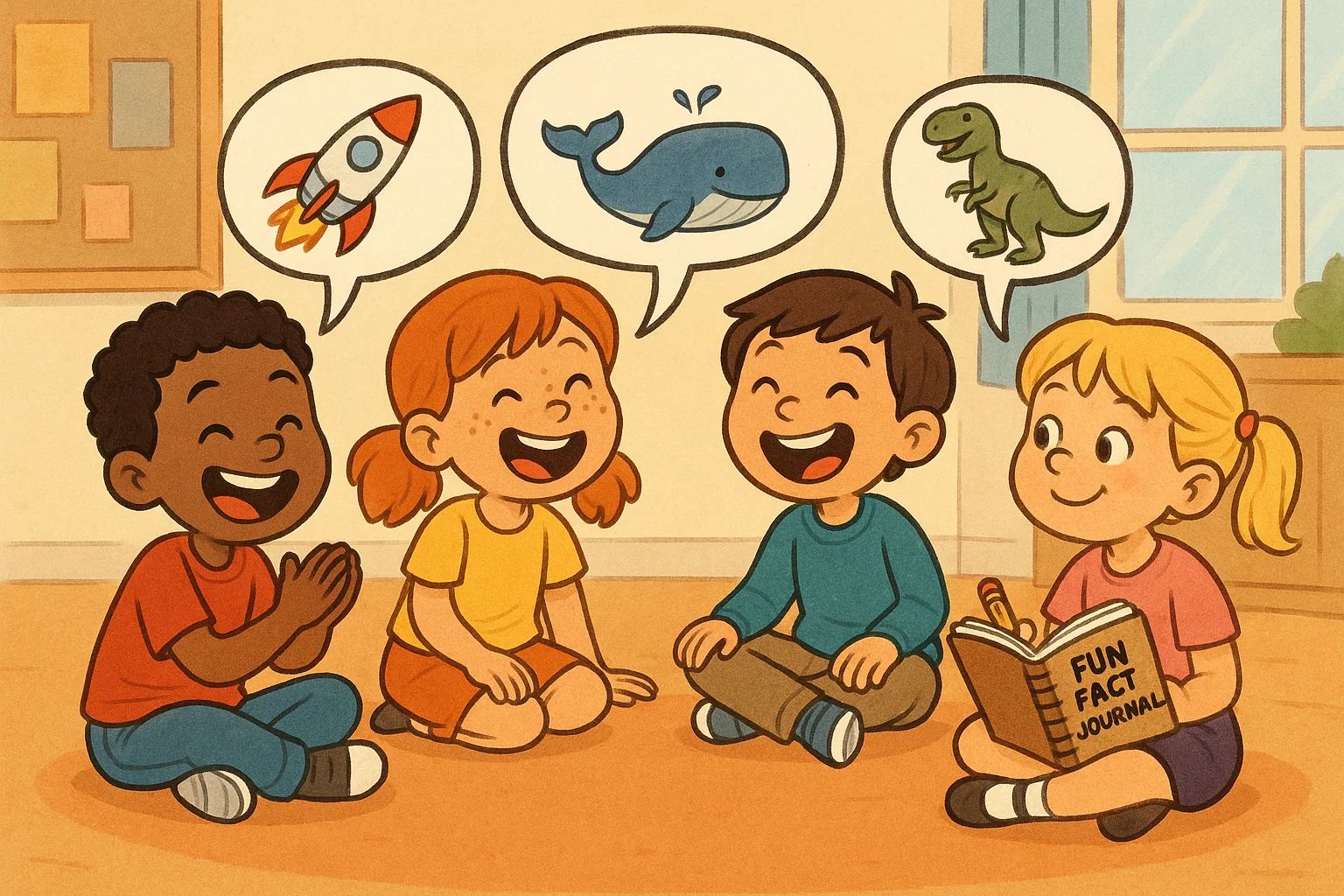
Knowing these fun and cool facts for kids is just the first step! The real fun comes in sharing them. This section provides tips, ideas, and ways an 11-year-old can use these facts—sharing in school, with friends, and at home.
Fact-of-the-Day Games
Making sharing a habit is easy when it’s fun. Describe simple ways to make learning fun facts a daily habit or game.
- “Impress Your Friends” Challenge: Each day, try to share one fact that you think will truly impress your friends. Keep score of who gets the biggest ‘Whoa!’ from your friends.
- Dinner Table Trivia: During family dinner, start a rotation where each person shares their favorite random facts of the day. This is a great way to practice speaking and listening.
- The Two-Minute Teacher: Challenge yourself to teach a sibling or parent one new fact and two related facts for kids about the topic in under two minutes. This strengthens your understanding and recall.
Create Own “Did You Know” Book
Guide them on collecting and presenting their own fun facts, which enhances learning retention and ownership.
- Digital or Physical: Start a small notebook or a simple document on your computer titled “My Book of Amazing Facts.”
- Categorize: Create sections like “Space Secrets,” “Shark Facts,” “Venus Wonders,” and “History Oddities” to keep everything organized.
- Cite Your Sources (Simple): Even at 11, it’s good practice to jot down where you learned the fact (e.g., “From the internet,” “From a book about animals”). This is the start of citable sources and building authority!
Use Fun Facts in Homework & Projects
Explain how these interesting facts can spice up school projects or presentations, turning an assignment into an opportunity to spark curiosity.
- The Hook: Start a history or science presentation with a mind-blowing fun fact to grab your audience’s attention immediately. For example, begin a report on the solar system with the fact that Jupiter is the fastest-spinning planet.
- Adding Context: If you’re writing a report about Egypt, mention the honey discovered in Ancient Egyptian tombs to show a deeper understanding of their culture and preservation techniques.
- The “Wow” Factor: Use one of these amazing facts as a footnote or a “Bonus Fact” on a poster board to show you’ve gone the extra mile in your research.
Why Fun Facts Matter at Age 11
Fun facts are more than just entertainment; they are crucial cognitive tools for a growing 11-year-old. They foster a love of learning and help build social confidence.
Boost Confidence in Talking
Knowing a few impressive fun facts to spark conversation helps kids feel more confident in sharing them with others.
- Conversation Starter: When meeting new people or joining a group, an interesting fact or piece of trivia for kids is the perfect icebreaker. Sharing the fact that sharks are older than trees is much more engaging than just talking about the weather.
- Establishing Expertise: Becoming the person who knows the cool facts subtly establishes a form of expertise and helps boost a child’s social standing among their peers, leading to greater self-esteem.
Trigger New Interests
How discovering a weird fun fact might spark a new hobby or interest.
- The Rabbit Hole Effect: Learning that the bolt of lightning is 5 times hotter than the surface of the sun might lead to a deep dive into meteorology, electrical engineering, or plasma physics. Even one random fun fact can spark a lifelong passion.
- Making Learning Fun: By associating new information with the “fun” factor, children start to see that all learning—even difficult subjects—has an exciting core, helping them to make learning an enjoyable lifelong habit.
Spice up Social Media & Lunch Time
How fun facts for kids make for good conversation with peers or age-appropriate posts online.
- Peer Connection: Sharing a funny ancient Egyptian fact or a piece of trivia for kids during lunch is a perfect way to engage with friends and show off your general knowledge.
- Content Creation: For 11-year-olds who are beginning to use age-appropriate platforms, creating a short video or post featuring a truly mind-blowing fact can be an early, positive introduction to content creation. Using these fun facts is a positive, educational way to interact with peers online. This is about building a positive digital footprint and using knowledge for engagement.