

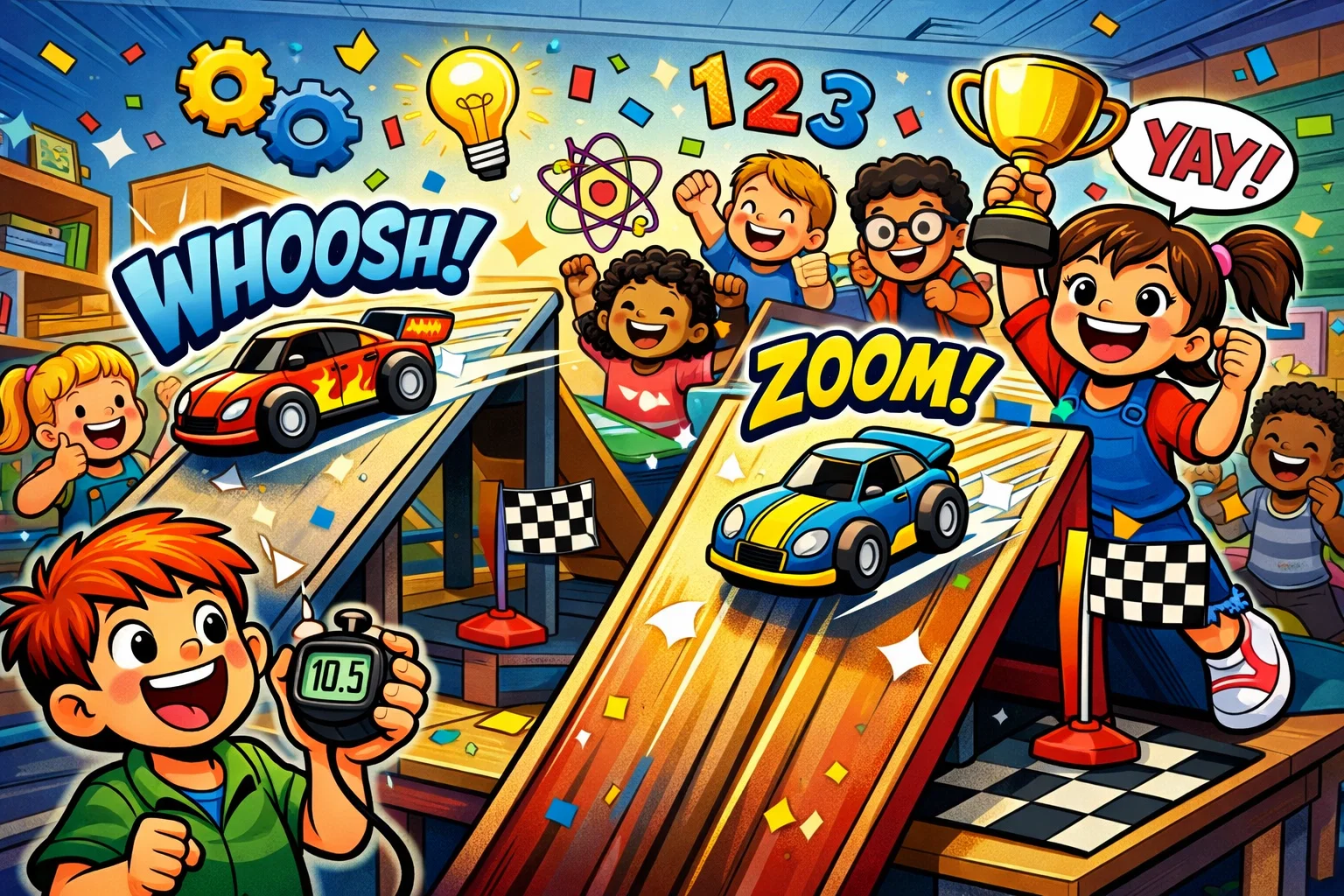
Is there anything more universally exciting for a child than the words, “Ready, set, go!”? The Fastest Ramp Racer Challenge is a classic childhood pastime that does more than just fill a rainy afternoon – it serves as a high-speed laboratory for young minds. By combining the natural thrill of car racing with foundational physics, children step into the role of little engineers, testing the limits of gravity, friction, and design.
Whether you are a parent looking for a high-energy screen-free activity or an educator seeking a hands-on STEM activity, ramp racing is the ultimate solution. It’s affordable, highly versatile, and can be adapted for everyone from a toddler to older kids. In this guide, we’ll explore how to build a car track that sparks creativity and turns your living room into a mini race track.
Introduction to Ramp Racer Challenge
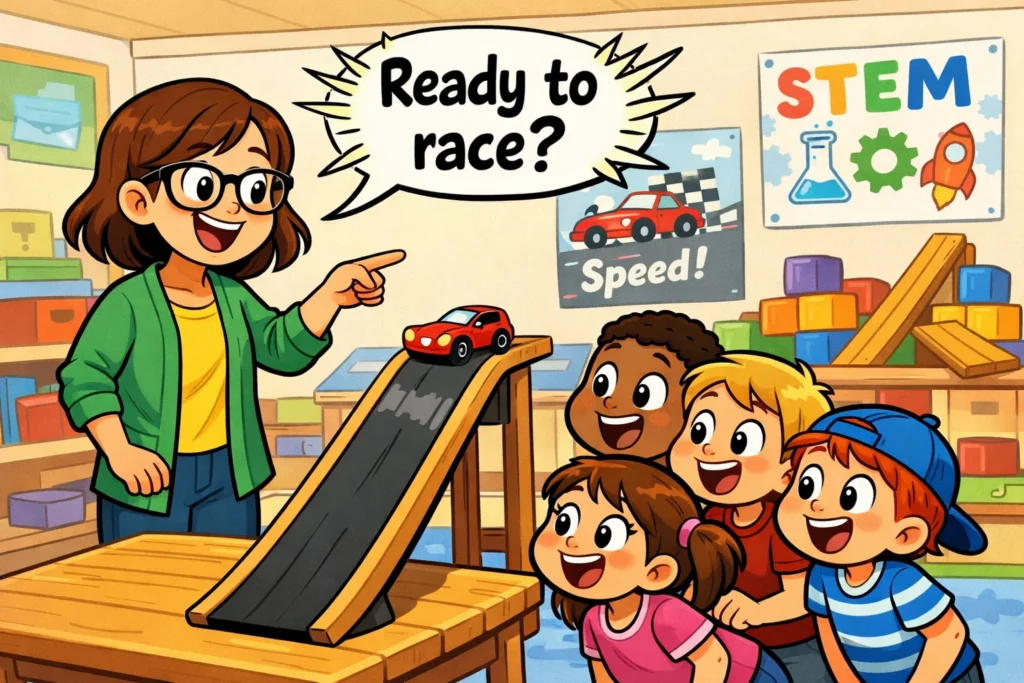
The Fastest Ramp Racer Challenge is an invitation to explore the world of motion. At its core, the challenge involves creating an incline and observing how different variables affect a toy car’s motion. It’s an exciting race car experience that rewards problem-solving and iterative design.
For young children, the goal might be as simple as seeing the car go from the starting point to the finish line. For young learners in elementary school, the challenge evolves into a complex science experiment where they must determine which car has the most streamlined shape or which surface provides the least resistance.
Ramp racing concept for kids
The concept is straightforward: use an inclined plank or cardboard box to create a path. Gravity pulls the car down, converting potential energy into kinetic energy. It’s a literal “downhill race,” where the steepest or smoothest path usually wins.
Speed challenges through play
Speed is a powerful motivator. By framing STEM learning as a “speed challenge,” kids remain focused. They aren’t just “doing science”; they are trying to beat their previous record or outpace a sibling’s race car. This playful competition fosters persistence.
STEM and STEAM learning through racing
This activity is a strong example of STEAM learning (Science, Technology, Engineering, Art, and Math).
- Science: Observing gravity and friction.
- Technology: Using a stopwatch to record data.
- Engineering: Building a secure and stable ramp.
- Art: Customizing the race car for visual flair.
- Math: Using a measuring tape to track distance.
Why Ramp Racing Activities Excite Kids
Children are natural explorers. They spend their days testing how the world works, and a car ramp provides instant, visual feedback.
Curiosity and experimentation
“What happens if I make a steeper ramp?” or “Will a lightweight car go faster than a heavy one?” This natural curiosity drives experimentation. Every time a car zooms down, the child is gathering data.
Screen-free active learning
In a world of tablets, hands-on play is vital. Building a race track involves moving, reaching, and adjusting. It is active learning that engages fine motor skills and spatial awareness without a single pixel in sight.
Motivation through competition
A bit of friendly car racing increases engagement. When a child sees their car lose a lane race, they don’t give up – they redesign! This builds emotional resilience and the drive to improve.
Skills Kids Build During Ramp Racer Challenges
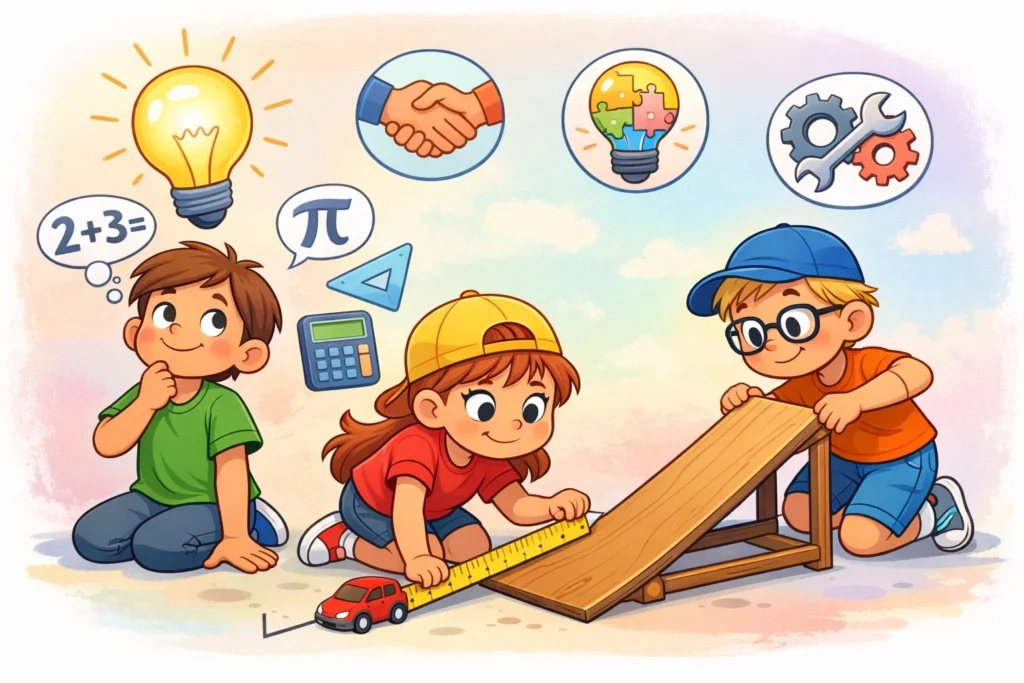
While it looks like simple playtime, your child is actually developing a sophisticated toolkit of STEM skills.
| Skill Category | Specific Development |
| Cognitive | Logical reasoning and predicting outcomes. |
| Physical | Fine motor skills through car placement and track assembly. |
| Social | Teamwork and taking turns during a safe, collision-free race. |
| Academic | Measurement, data recording, and physics vocabulary. |
Problem-solving and logic
When a car flies off the track or stops halfway, the child must diagnose the issue. Is the ramp too wobbly? Is the surface too rough? This is problem-solving in its purest form.
Early engineering thinking
By following the cycle of “Plan, Build, Test, Improve,” kids are practicing the engineering design process used by engineers and designers.
Math through measurement and timing
Using a measuring tape or stopwatch introduces real-world math. Children learn to compare numbers to find the fastest time or the longest distance, making comparison a core part of the fun.
Collaboration and communication
When multiple children aged 3 to 10 play together, they must negotiate. Who is the timer? Who releases the cars? This teamwork is essential for a successful group race.
Materials for Fast Ramp Racer Setup
You don’t need expensive kits to encourage children to learn. Most of the best ramp materials are household items.
- Ramp building materials: Cardboard boxes, wooden planks, old books, or PVC pipes.
- Toy cars and racers: Hot Wheels, Matchbox cars, or even a homemade vehicle built from LEGO.
- Timing and measuring tools: A stopwatch (or phone app) and a measuring tape.
- Decoration elements: Masking tape for lanes, markers, and stickers to design the ultimate race car.
Fastest Ramp Racer Activity Ideas
Gravity-powered ramp racer
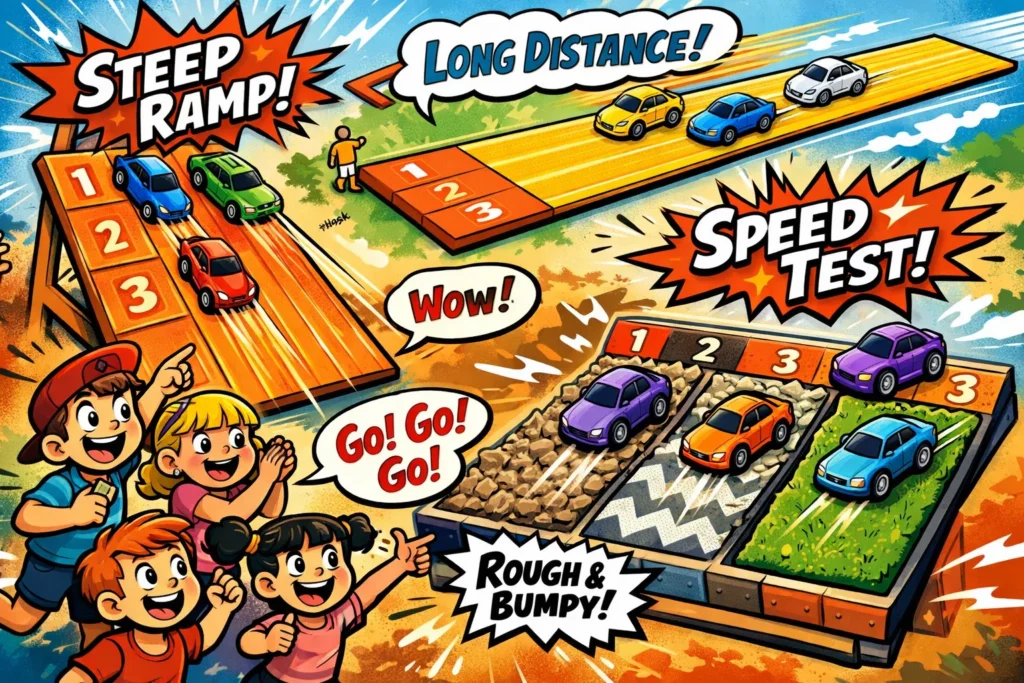
Start with a basic incline. Let the child explore how the car moves without being pushed. This teaches that gravity is a constant force pulling objects toward the ground.
Multiple ramp angle comparison
Set up two ramps: one shallow and one steeper ramp. Ask your child to predict which car will go faster. This is a classic physics lesson on potential energy.
Surface friction experiments
This is where STEM concepts get interesting. Cover one ramp with bubble wrap, another with a towel, and leave one smooth.
Observation: “Smooth surfaces usually create less friction, allowing the toy car to maintain its speed.”
Group and classroom ramp races
If you are an educator or hosting a homeschool group, set up a multi-lane race track. Use a cardboard box to create dividers so each car stays in its own lane.
Engineering Design Process in Ramp Racing
To foster a true innovator mindset, guide your child through these steps:
- Design and build phase: Sketch the track. Will it have a jump? A curve?
- Test and race phase: Let the car go! Watch closely for where it slows down.
- Redesign and optimize: If the car isn’t the fastest, what can we change? Maybe a steeper ramp or a more lightweight car?
- Recording results: Keep a simple chart or table to see which design worked best.
Ramp Track Setup and Testing Area
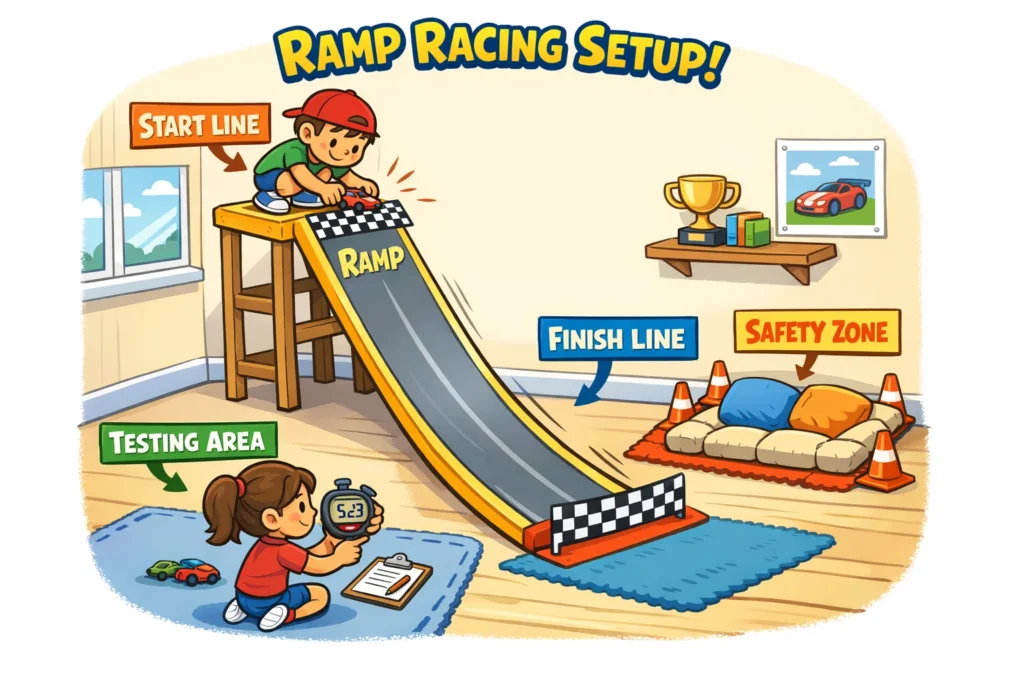
Indoor ramp racing setup
Hardwood or tile floors are the best surface for indoors. You can use a couch or a coffee table as the starting point for your ramp.
Outdoor ramp racing ideas
Take the playtime outdoors! Use a driveway or a playground slide. The rougher texture of pavement provides a great comparison to smooth indoor floors.
Finish line and safety zones
Always mark a clear finish line with tape. Ensure there is a “soft landing” zone (like a rug or pillow) to prevent a high-speed collision with the wall.
Extending Ramp Racer Fun Beyond Speed
- Themed ramp racing stories: Maybe the cars are delivering “supplies” to a mountain village! This adds imaginative play to the STEM learning.
- Team challenges: Assign roles like “Lead Engineer,” “Chief Timer,” and “Track Safety Officer.”
- Creative car customization: Use craft supplies to make a car look like a shark or a rocket. Does the extra “fin” slow the car down due to air resistance?
Safety Guidelines for Ramp Racer Challenges
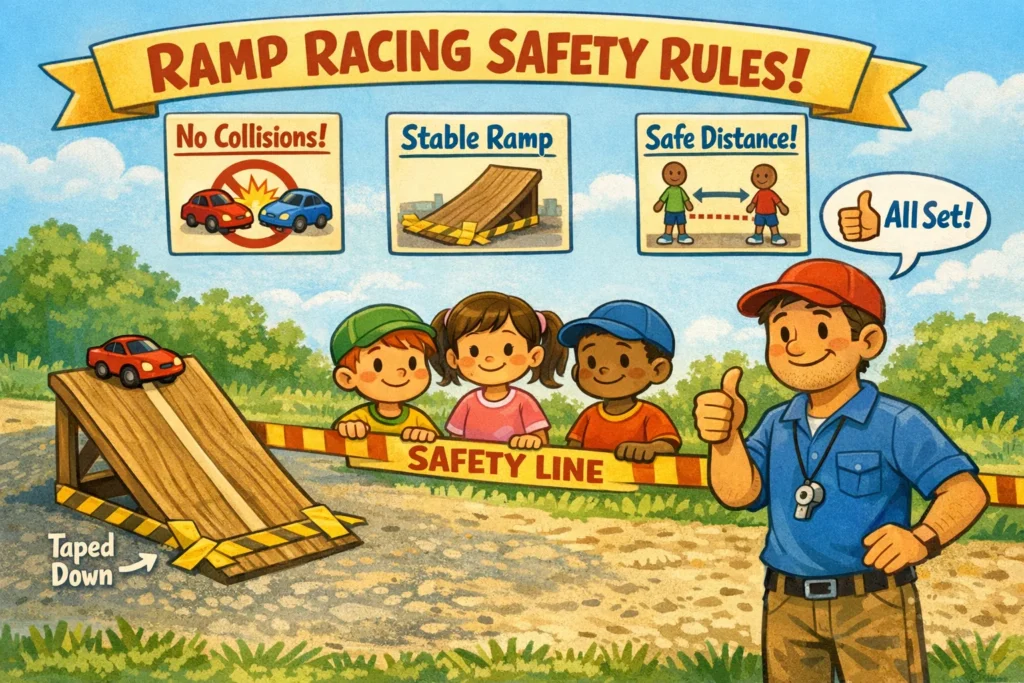
Safety is paramount when working with young children and building toys.
- Stable ramp construction: Ensure the ramp is secure at the top so it doesn’t slip and cause a fall.
- Safe racing distances: Ensure no one is standing directly at the finish line to avoid being hit by a zooming car.
- Age-appropriate supervision: Toddlers should use larger, chunky cars to avoid choking hazards, while older kids can handle small die-cast parts.
Ramp Racer Challenge for Home and Classroom Use
This activity is incredibly adaptable. For a birthday gift idea, you could even put together a “Ramp Racer Kit” with a few cars and a roll of “track” tape.
- For Home: Great for screen-free weekends or rainy days.
- For Schools: Perfect for teaching physics and measurement in a way that young learners will actually remember.
- For All Ages: Simplify for a toddler (focus on “fast/slow”) and adapt for older kids (focus on calculating velocity).
Get Started with Fast Ramp Racer Challenge Today
Ready to help your child become a speed expert? Start small!
- Find a long cardboard box or plank.
- Prop it up against a chair.
- Grab two different toy cars.
- Zoom!
Focus on making one change at a time. If you change the car and the ramp angle at the same time, you won’t know which factor made the difference. This is the heart of scientific inquiry.
Frequently Asked Questions
While it’s a favorite for preschoolers, kids aged 3 to 12 find different levels of enjoyment. Younger kids love the movement; older kids love the data.
Check for friction. Is the wheel stuck? Is the surface too “sticky” like carpet? Try increasing the incline to give gravity more of a head start.
Ask “Why?” and “What if?”.
“I noticed the blue car won. What if we add a heavy coin to the red car? Will that change the result?”
This encourages logic and comparison.