

In the rapidly evolving landscape of childhood education, digital literacy has moved from a “nice-to-have” to a fundamental pillar of early development. As parents and educators, we often find ourselves navigating a sea of screens, searching for that perfect balance between engagement and educational value. Two names frequently rise to the top of the recommendation lists: Epic and Bookflix. While both platforms aim to foster a love of reading, they offer different experiences tailored to various developmental stages.
Choosing the right digital reading platform isn’t just about the number of books, but also about how they are delivered and the reading habits they foster. Whether you seek a massive library to satisfy a voracious middle-grade reader or a structured, animated experience to jumpstart a preschooler’s literacy journey, understanding the nuances between these two heavyweights is essential. This guide breaks down everything from cost and content to user experience, helping you decide which service deserves a spot on your child’s device.
Overview of Epic and Bookflix
At their core, both Epic and Bookflix serve as kids’ digital libraries, but they operate with distinct philosophies. Epic (often called the “Netflix for books”) is a broad, consumer-facing giant. It’s a comprehensive reading app designed to provide unlimited access to a massive variety of content, including ebooks, audiobooks, and learning videos. The platform scales with a child, offering materials targeting everyone from toddlers to pre-teens.
Bookflix, developed by Scholastic, pairs animated fiction storybooks with nonfiction ebooks to promote early literacy. It is primarily used in schools and public libraries and is designed for PreK–Grade 3 children, bridging the gap between learning to read and reading to learn. This “thematic pairing” is specifically engineered to bridge the gap between imagination and real-world facts, making it a literacy intervention favorite among early childhood classrooms.
Key Features of Epic and Bookflix
When comparing these platforms, the reading experience is the primary differentiator. Epic focuses on exploration and volume, while Bookflix prioritizes guided comprehension and thematic learning.
Epic: What Makes it Unique?
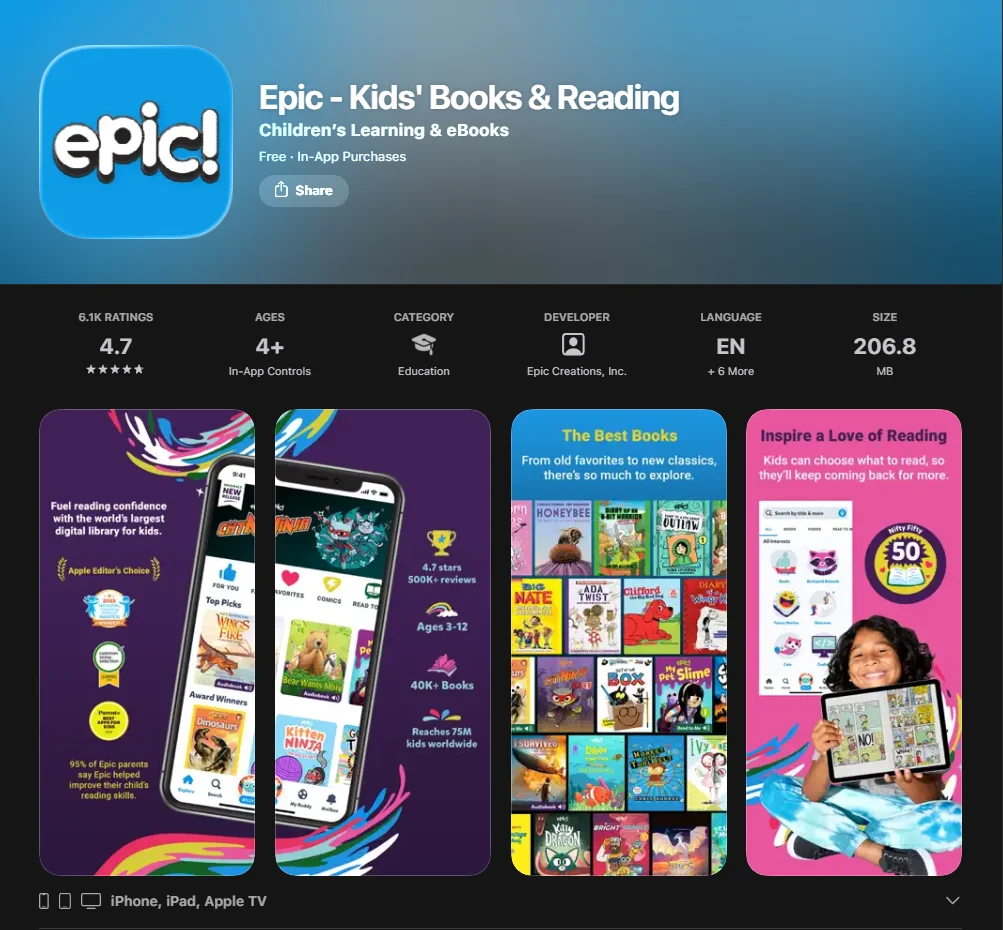
Epic offers 40,000+ titles, including ebooks, audiobooks, and educational videos, from top publishers like National Geographic and HarperCollins. Its gamified system rewards children for completing books and meeting reading goals.
- Engagement Tools: Children earn a badge or reward for reaching milestones, such as finishing a book or maintaining a daily reading habit.
- Interactive Support: The read-to-me feature is highly advanced, with word highlighting that helps younger children follow along.
- Diverse Formats: Epic’s library includes books in English, Spanish, French, Chinese and Gaelic to support readers from different backgrounds, in addition to Read‑To‑Me books and audiobooks.
- Assessment: Many books end with a quiz to check comprehension, providing data that teachers can review if the account is linked to a school.
Bookflix: Features and Offerings
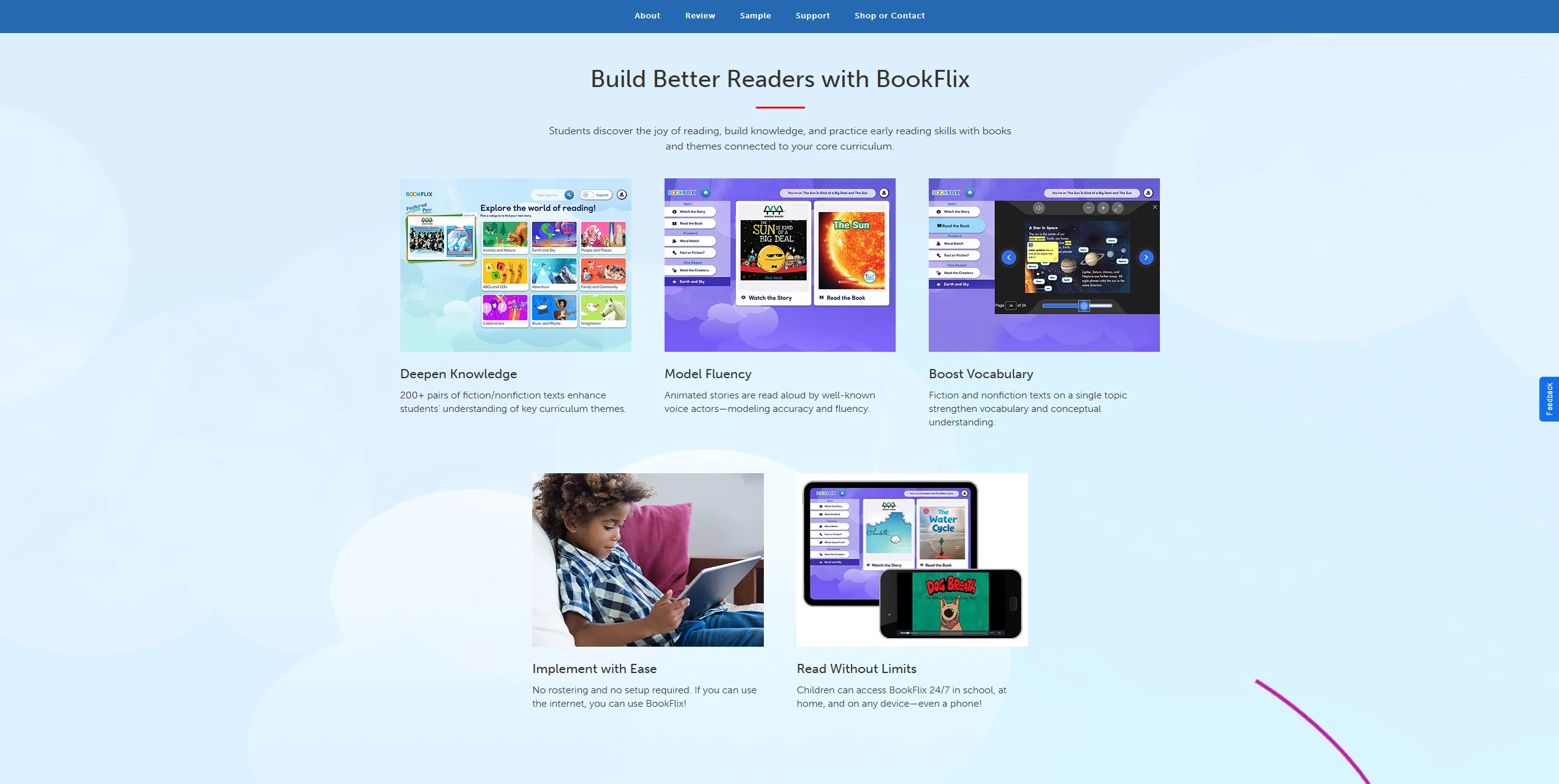
Bookflix pairs animated fiction storybooks with corresponding nonfiction ebooks across curriculum‑connected themes, with well over 140 paired texts designed to reinforce vocabulary and comprehension skills.
- Thematic Pairing: Each fiction video is paired with a nonfiction ebook to reinforce concepts. For example, a story about a rainy day might be paired with a science book about the water cycle.
- Bilingual Support: Bookflix offers support for English and Spanish paired texts, including more than 40 Spanish text pairs to support multilingual learners.
- Literacy Scaffolding: The read-to-me books in Bookflix use slower, more deliberate pacing, which research suggests may indicate better support for younger children who are still mastering phonics.
- Educational Games: Bookflix offers interactive activities like “Puzzlers” designed to reinforce literacy concepts through vocabulary and sequencing practices.
Cost Comparison: Epic vs Bookflix
Pricing is perhaps the most significant point of divergence. Epic is designed for individual family purchase, whereas Bookflix is traditionally a B2B (Business-to-Business) model.
Epic Subscription Costs
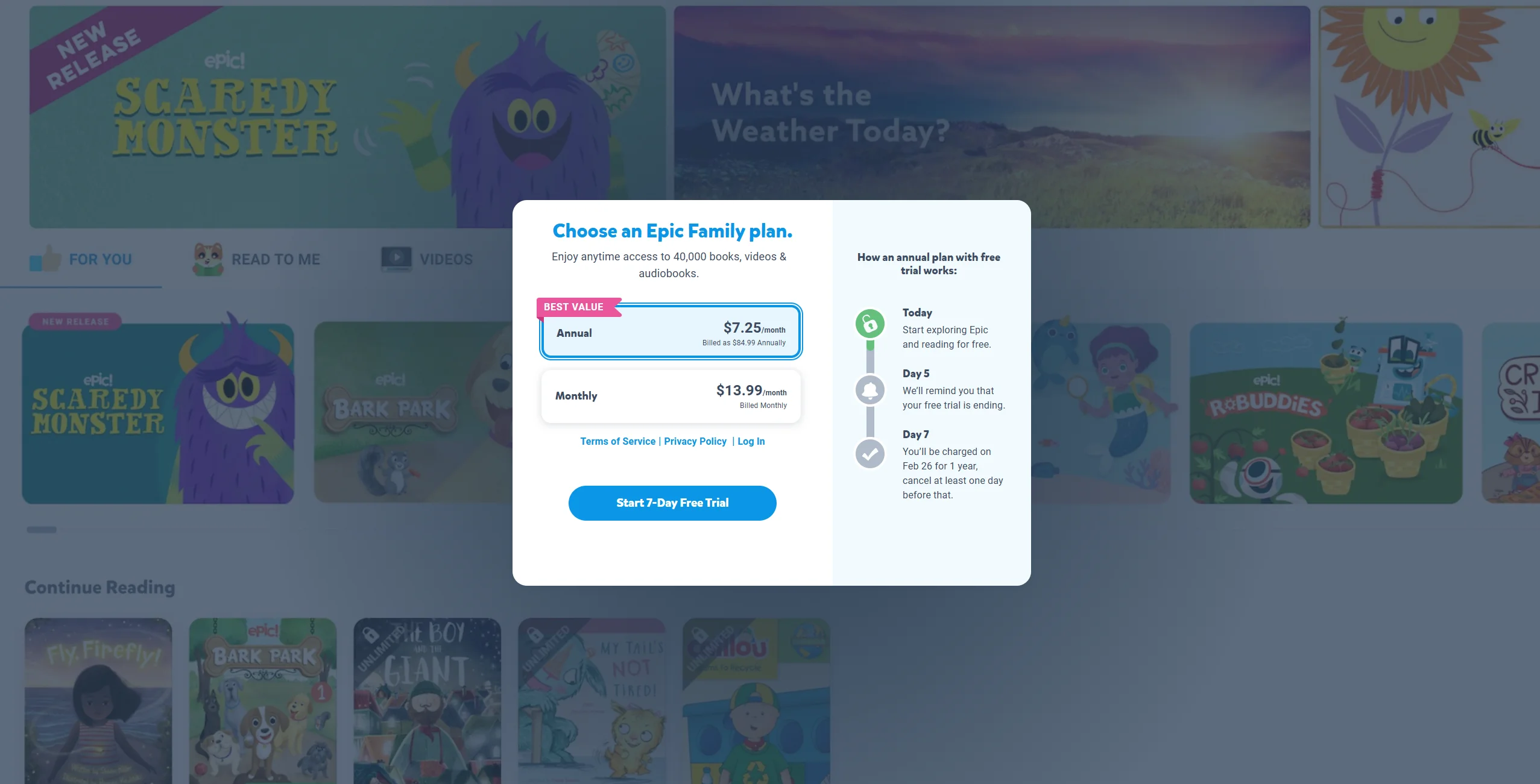
Epic offers a straightforward subscription model designed for family use.
| Plan Type | Price (Approx. 2026) | Best For |
| Epic Family (Monthly) | around $13.99 per month | Short-term testing |
| Epic Family (Annual) | about $84 per year | Long-term home savings |
| Epic School | It’s free | School-hour use (7am-4pm) |
Bookflix Pricing Structure
Bookflix is primarily licensed for schools and public libraries, and many families gain access at home through library portals rather than direct purchase.
- School/Library License: Typically costs between $600 to $1,000+ per year per building.
- Individual Access: Most parents use at home for free by logging in with a valid public library card or school-issued credentials.
Before you pay for any digital reading platform, check your local library’s website. Many provide free access to Bookflix, potentially saving you hundreds of dollars annually.
User Experience and Interface: Epic vs Bookflix
The app version of a platform can make or break a child’s interest. If the interface is too complex, the child gets frustrated; if it’s too simple, they get bored.
Epic: Ease of Use for Young Readers
Epic’s interface is vibrant and highly visual. On iOS and Android, children can easily browse through categories or search for books using keywords or their favorite characters.
- Personalization: The app uses algorithms to curate a “For You” section based on the child’s reading level and interests.
- Autonomy: It feels like a real library where a child can “wander” the virtual aisles. However, the sheer number of books can occasionally lead to decision fatigue.
Bookflix: Navigating the Platform
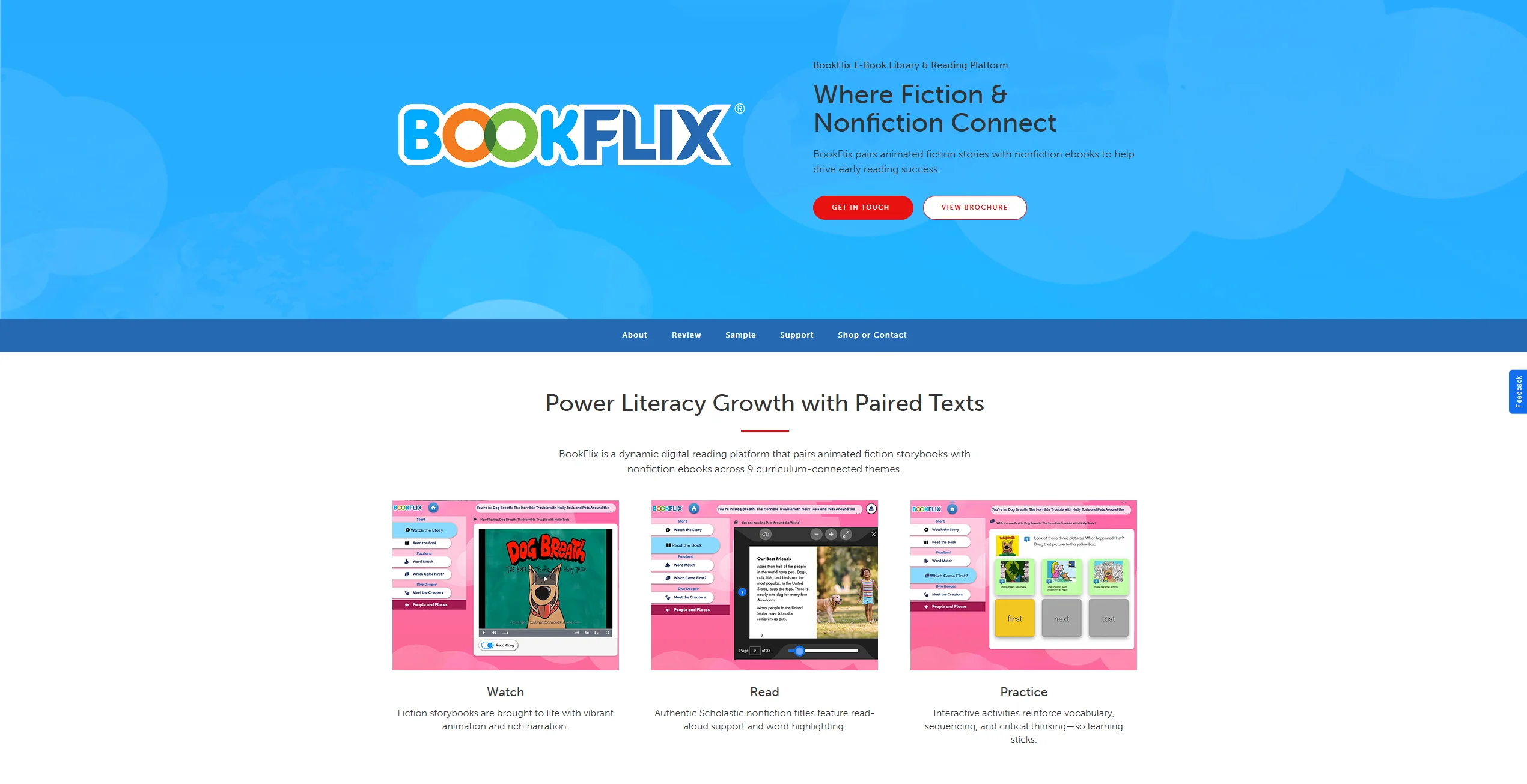
Bookflix has a more structured, “step-by-step” layout. It is web-based but performs well on tablets through browsers.
- Simplicity: There are no “rabbit holes.” A child picks a category (e.g., “Animals and Nature”), selects a pair, and follows the “Watch, Read, Play” sequence.
- Accessibility: The buttons are large and often accompanied by audio icons, making it very comfortable reading for kids who cannot yet read navigation text.
Educational Value of Epic and Bookflix
Both apps are “educational,” but they target different cognitive skills.
Epic: Fostering Reading and Learning
Epic excels in reading skills development through volume.
- Fluency: Frequent reading time with high-quality books improves word recognition.
- Knowledge Acquisition: Including learning videos and National Geographic content makes it a great tool for “interest-led” learning.
- Incentive: The reading challenges and badge system are effective for reluctant readers who need external motivation to stay excited about reading.
Bookflix: Building Literacy through Stories
Bookflix is rooted in the “Weston Woods” tradition of high-quality animation.
- Comprehension: By pairing fiction with nonfiction, it helps children differentiate between “make-believe” and “fact” from a very young age.
- Vocabulary: The “Spotlight Words” feature highlights key vocabulary in the text; when clicked, the app provides a narrated definition.
- Focus: Unlike platforms with thousands of high quality books, Bookflix’s limited selection of books ensures a child focuses on the specific learning objective.
Which App is More Suitable for Different Age Groups?
Age suitability should guide your final decision. A 10-year-old will likely outgrow Bookflix in a week, while a 3-year-old might find Epic’s interface overwhelming.
Epic: Best for Ages 4-12
Epic is the “all-in-one” solution. It offers everything from picture books for younger children to complex chapter books for pre-teens. Its ability to curate content based on reading level ensures that as a child grows, the reading materials remain challenging but attainable.
Bookflix: Ideal for Early Learners
Bookflix is a specialist for the Pre-K through 3rd-grade crowd. It is specifically designed for the “learning to read” phase rather than the “reading to learn” phase. The audio books and animated stories are perfect for children building the stamina to sit with a physical book.
Pros and Cons: Epic vs Bookflix
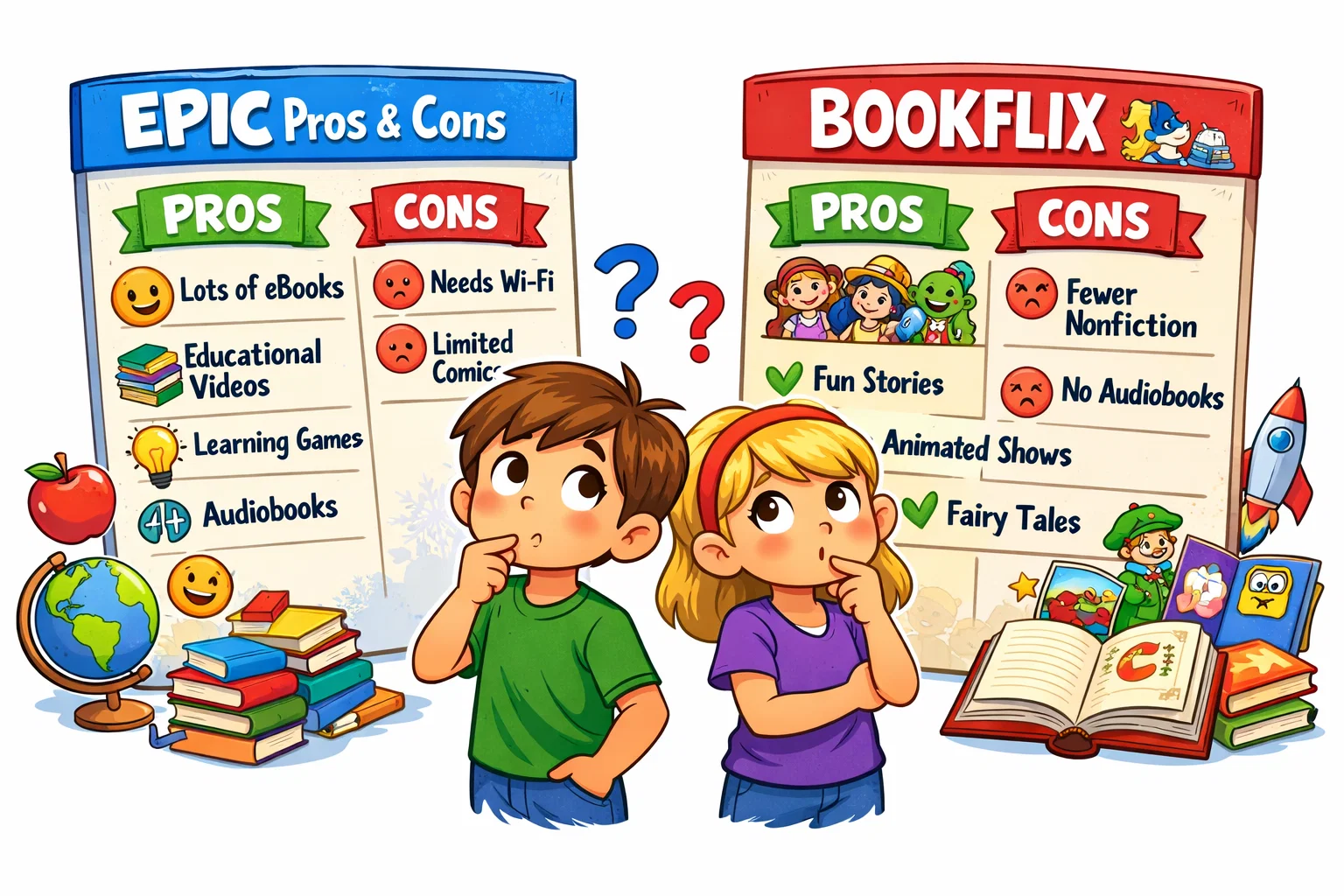
Epic’s Pros and Cons
Pros:
- Massive library of books (40,000+).
- Works offline (you can download books).
- Excellent ios and Android apps.
- Includes popular books and “Epic Originals.”
Cons:
- Requires a monthly/yearly paid subscription for full home access.
- Some content varies in quality; parents may need to curate more actively.
Bookflix’s Pros and Cons
Pros:
- Often free through libraries/schools.
- High-quality Scholastic/Weston Woods content.
- Excellent for bilingual books and ELL students.
- No distractions or “filler” content.
Cons:
- Limited number of books (around 280-300 total).
- The interface feels slightly dated compared to modern apps.
- Limited offline reading capabilities.