

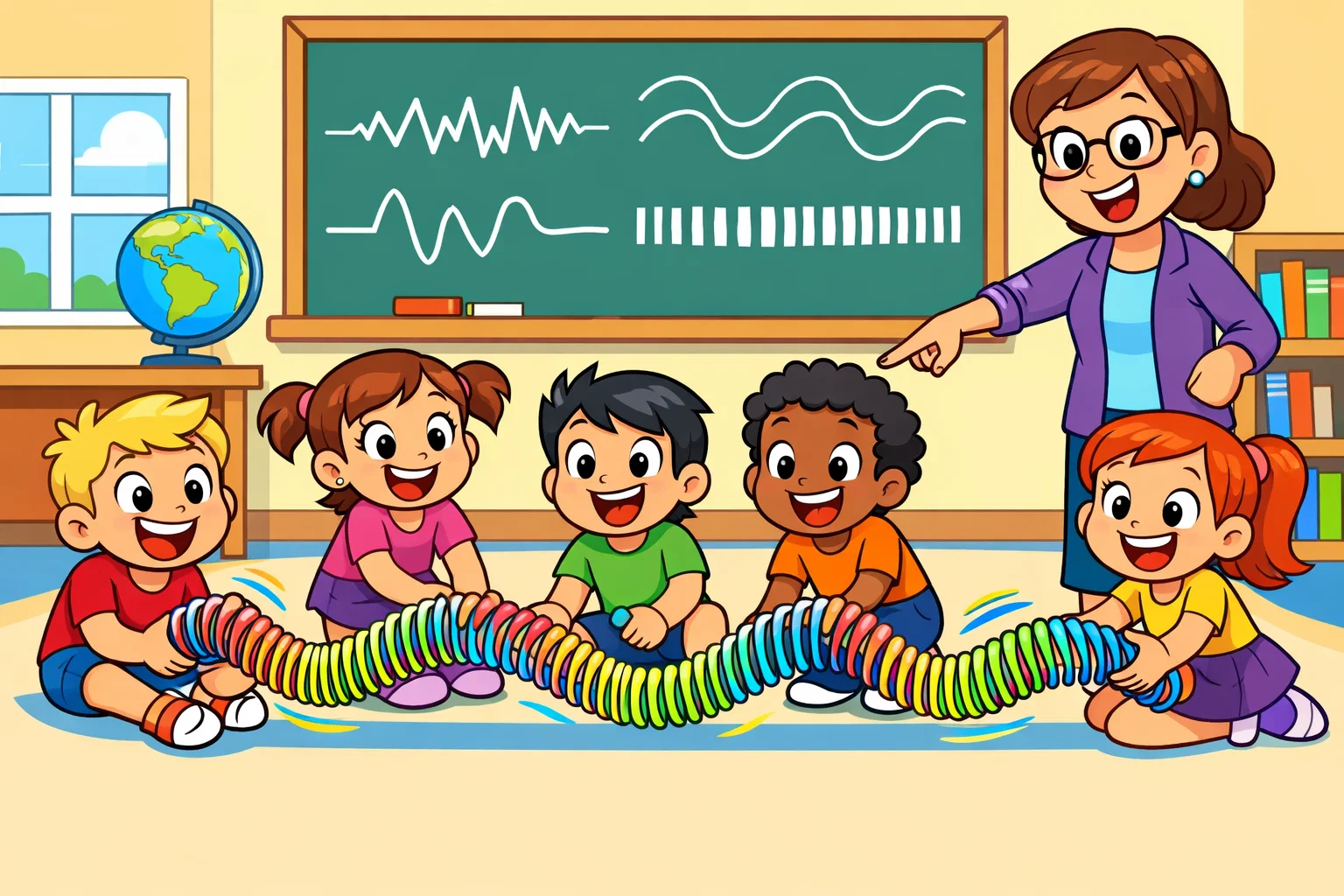
If you’ve ever felt the ground tremble or heard about the massive power of an earthquake, you know how mysterious and intimidating the Earth can be. For children, understanding these invisible forces is much easier when they can see them in action. Using a slinky provides a handy model to bridge the gap between complex geology and hands-on fun, allowing kids to visualize how earthquake waves travel through different types of materials.
This activity is specifically designed for elementary and middle school classrooms, as well as curious families at home. By using a seismic slinky, we can transform a simple toy into a sophisticated scientific tool. Students will learn how waves transmit energy from one point to another, helping students grasp why some earthquake waves cause a sharp jolt while others create a rolling motion that can be felt miles away.
Seismic Slinky Experiment Overview

The seismic slinky experiment is a staple in science education because it provides an immediate, tactile representation of wave propagation. While we cannot see the interior of the Earth or the microscopic shifts in rock layers, we can easily notice that a wave travels along the slinky with just a small flick of the wrist. This visual aid is crucial because the physics of the Earth are often too massive to comprehend without a scaled-down representation.
In professional seismology, researchers use complex sensors to track how various seismic waves move. In the classroom, we use the metal coils to show that an earthquake is not just a single, uniform shake, but a series of different kinds of waves that arrive at different times and move in unique ways. By observing these rhythmic patterns, students gain a deeper appreciation for the mechanics of our planet’s crust and the way energy migrates through solid matter.
Historical Context of Seismic Discovery
Before the invention of modern sensors, scientists struggled to understand the nature of underground movement. It wasn’t until the late 19th and early 20th centuries that researchers began to identify the different phases of a tremor. They noticed that certain energy signals traveled faster than others, leading to the classification of the primary and secondary pulses we study today. Using a spring to model these observations allows students to step into the shoes of these pioneering geologists.
What Seismic Waves Show in the Classroom
When an earthquake occurs, it releases vast amounts of energy that radiate in all directions from the earthquake’s focus. In a classroom setting, the tool demonstrates that while the metal coils move back and forth, they always return to their starting position. This helps kids understand that the wave is traveling, but the physical matter (the rock) is not being transported—only the kinetic energy is. This distinction between the medium and the energy surge is a fundamental concept in physics that applies to sound, light, and even ocean swells.
Why Slinky Works for Modeling
The secret lies in the physics of the spring. Because it is a loosely coiled helix, it has high elasticity. This allows it to demonstrate both compression (squeezing) and transverse (shear) motion. When you stretch the slinky 6 feet or more, the tension allows for a clear model of earthquake waves where the speed and shape of the pulse allow the human eye to follow how the wave travels along the slinky. The way the spring returns to its original shape after the disturbance passes is a perfect metaphor for the Earth’s tectonic elasticity, known as “elastic rebound.”
Materials Needed for Slinky Experiment
To run a successful modeling P and S waves session, you don’t need a lab full of expensive equipment. Most items are likely already in your storage closet!
| Item | Description | Purpose |
| Metal Slinky | Large, high-quality steel spring. | Best for showing seismic primary waves. |
| Smooth Floor | Tile or hardwood (carpet creates friction). | Allows the wave to travel freely. |
| Measuring Tape | To measure the distance of the stretch. | Ensures consistent wave characteristics. |
| Stopwatch | Digital timer or smartphone. | Measures how long each type of wave takes to travel. |
| Marking Tape | Painter’s tape or masking tape. | Marks the “epicenter” and the “station.” |
Slinky Toy Selection
While plastic versions are colorful, a metal slinky is far superior for earthquake modeling. Metal possesses a better “restoring force,” meaning it snaps back more effectively, making the compression wave much easier to observe. The weight of the metal also provides more momentum for the oscillation, ensuring the signal reaches the other end clearly. This added mass helps sustain the kinetic pulse over a longer distance, which is ideal for large classrooms where students in the back need to see the movement clearly.
Partner or Group Setup
This is a two-person job. One end of the slinky should be held firmly by a “stationary endpoint” (the receiver), while the other student acts as the “epicenter” (the source). Working in pairs encourages students to discuss the energy flow they see as the waves move between them. It also teaches the importance of a fixed point in scientific measurement. If the anchor point moves, the data regarding arrival times becomes unreliable—a great lesson in experimental control and reducing “noise” in data collection.
Experiment Procedure Using Slinky
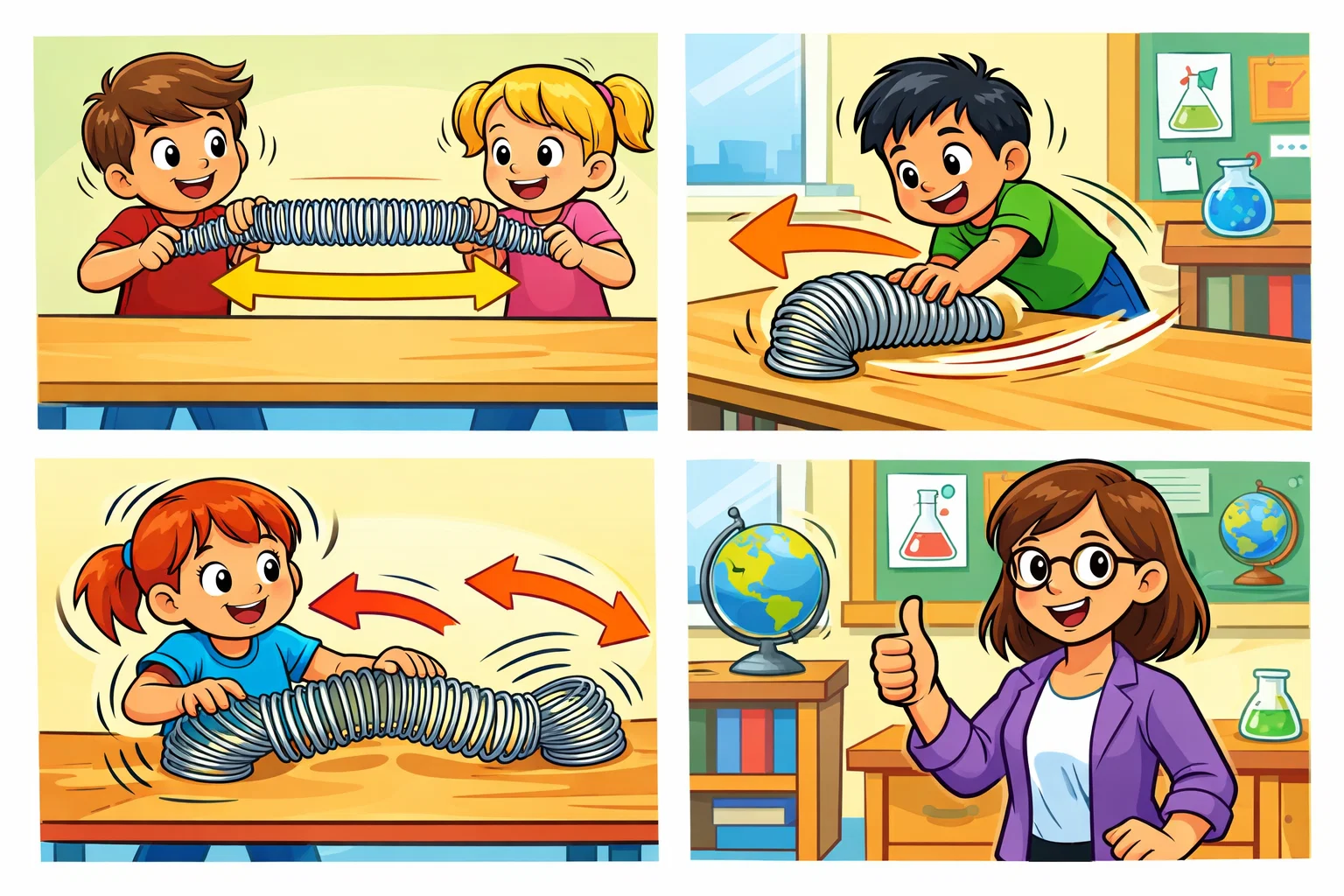
Ready to create some “quakes”? Follow these steps to use a slinky to demonstrate the different types of seismic motion.
Setup Instructions
- Find a partner and sit on a smooth floor.
- Stretch the slinky 6 feet apart. Do not overstretch, or you’ll ruin the spring’s elasticity!
- Keep the coils flat against the floor. This is crucial for modeling P and S waves accurately. If the spring is lifted, gravity will introduce unwanted variables into your data.
Longitudinal Pulse Creation (P Waves)
To create a longitudinal wave, one person should quickly push and pull the metal toward their partner.
- Action: Push the coils forward and pull them back once.
- Observation: You will see a compression (a bunching of rings) move toward your partner.
- Science: This is a primary wave. In a longitudinal wave, the material moves back and forth in the same direction as the energy pulse. This mimics how sound travels through the air or how a seismic jolt moves through the Earth’s dense crust.
Transverse Signal Creation (S Waves)
To model secondary waves (S waves), shake the slinky side-to-side (left to right) while holding the slinky at a constant tension.
- Action: Move your hand quickly to the left and back to the center.
- Observation: A “snake-like” hump will travel down the line.
- Science: This is a transverse wave. The motion of the coils is perpendicular to the direction the wave travels. This side-to-side displacement is what causes shear stress in buildings and infrastructure.
Expected Observations During Experiment
As the wave travels along the slinky, students should keep a sharp eye on how these different signals differ.
Coil Compression Movement
In the longitudinal wave, notice how the “pulse” is a zone of compression. The energy moves, but each individual coil only moves a few inches before returning to its original position. This is exactly how seismic primary waves travel through solid rock layers! It is a push-pull motion that effectively transfers energy through the density of the material. Students may notice that this specific kinetic disturbance moves much faster than the sideways wiggle.
Side Motion Travel Path
In the transverse wave, the energy moves toward your partner, but the spring itself moves perpendicular. It’s important to note that shear waves (S waves) cannot travel through liquids. This is one of the key observations that led scientists to conclude that the Earth’s outer core is liquid—P waves made it through, but S waves did not! This realization was one of the greatest leaps in geological history.
Energy Loss and Damping
You may notice that a wave travels strongly at first, but the amplitude gets smaller as it reaches the end of the slinky. This models how an earthquake is most destructive near the epicenter and fades as the waves move further away. This dissipation of energy is due to friction against the floor and the natural damping of the metal spring. It explains why people hundreds of miles away might only feel a slight sway while those at the source experience a catastrophe.
Seismic Signal Types Modeled with Slinky
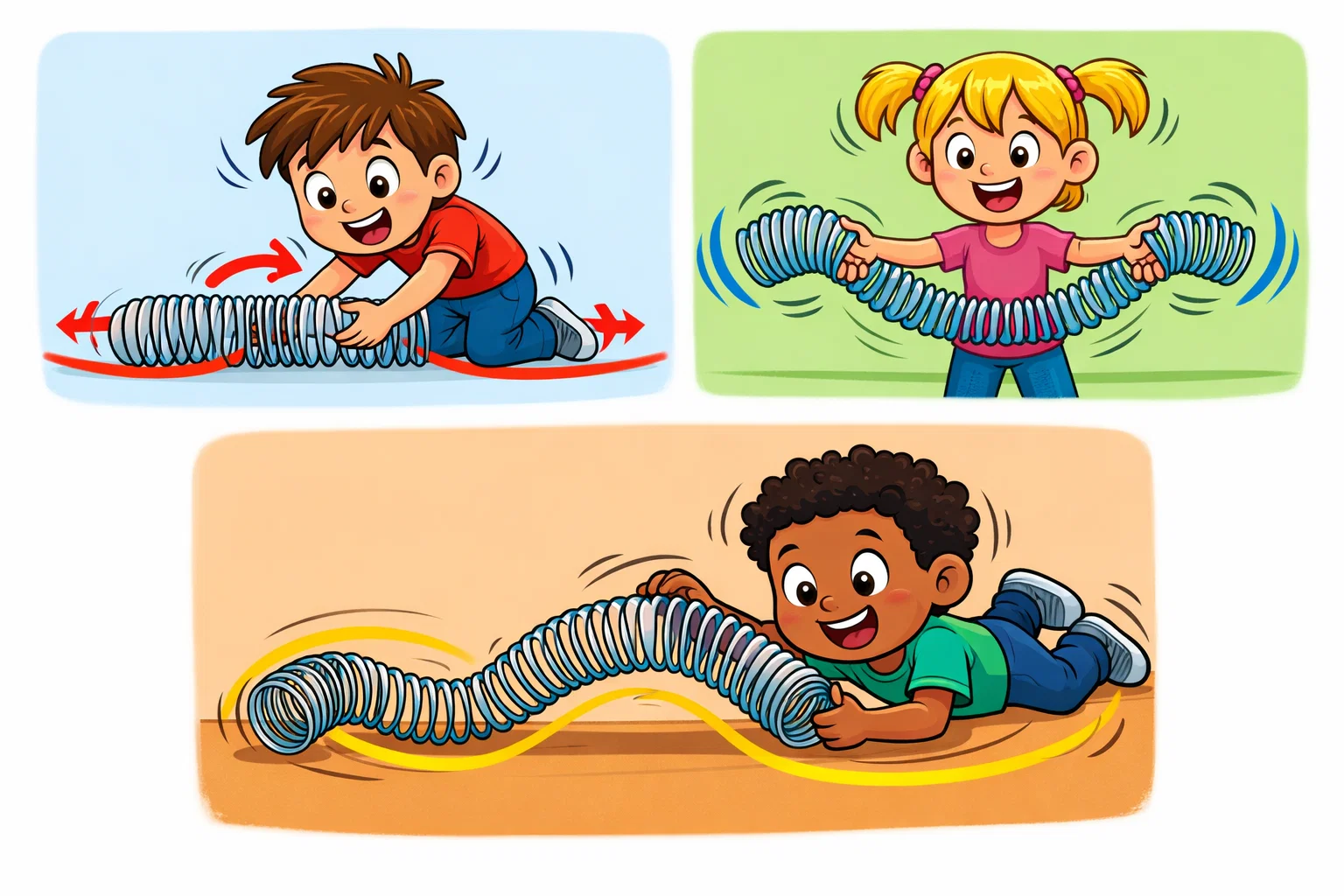
Earthquakes produce different types of seismic waves that fall into two main categories: body waves and surface waves. Understanding the distinction is vital for anyone interested in geology or civil engineering.
Body Oscillations (P and S)
Primary waves, or P waves, are the fastest. They are the “first arrivals” at a seismic station.
- Wave type: Compression wave.
- Speed: The fastest of all seismic signals, capable of passing through the core.
- Movement: Push-pull action.
- Travels through: Solids, liquids, and gases.
Secondary waves, or S waves, arrive after the initial jolt. These waves travel through solid rock and move at right angles to the direction of travel.
- Commonly known as body waves (along with P types).
- Movement: Side-to-side or up-and-down.
- Fun Fact: These are the waves that make you feel like you’re on a swaying boat during a quake.
Surface Disturbance Behavior
When the internal body waves reach the surface of the earth, they transform into surface waves. These are the slowest seismic waves, but they are the most destructive because they interact directly with building foundations.
- Love Wave: Moves the ground side-to-side horizontally in a horizontal side-to-side motion. It is often responsible for the shearing of pipelines and underground cables.
- Rayleigh Signal: Creates a rolling motion. Rayleigh waves transmit energy in a way that can knock buildings off their foundations. Their complex circular motion is what causes the most structural failure in urban areas.
Mathematical Extension: Calculating Velocity
For older students, the slinky offers a chance to apply basic algebra to Earth science. You can calculate the speed of the seismic signal using the following formula:
v=d/t
Where:
- v — velocity of the wave (speed of the pulse)
- d — distance the wave travels (for example, the length of the stretched spring, such as 6 feet or 2 meters)
- t — time measured with a stopwatch
By running five trials for both the longitudinal oscillation and the transverse movement, students can find the average speed for each. They can mathematically demonstrate that the P-signal is consistently faster than the S-signal, mirroring real-world seismic data. This data collection process is essential for learning how scientists analyze earth tremors in real time.
Advanced Geologic Concepts

To further enrich the lesson, teachers can introduce concepts like refraction and reflection. When a rhythmic pulse hits a different medium (like moving from the spring to a heavier object), part of the energy reflects back while the rest continues at a different speed.
Elastic Rebound Theory
This theory explains how energy is stored in rocks. Imagine stretching the slinky until it’s very tight. If you let go, it snaps back. In the Earth, tectonic plates are constantly pushing against each other. They build up stress (potential energy) until the rocks finally break along a fault line, releasing that energy as the earthquake oscillation we feel on the surface.
Seismic Shadow Zones
One of the most fascinating aspects of P and S signals is how they interact with the Earth’s core. Because S-pulses cannot travel through liquid, they leave a “shadow zone” on the opposite side of the planet from an earthquake. By mapping these zones, scientists were able to calculate the size of the Earth’s liquid outer core without ever seeing it.
Key Science Concepts Demonstrated
Using a slinky makes these complex concepts more approachable! By visualizing these invisible forces, we demystify the natural world.
Restoring Force
Why does the spring go back to its shape? That’s the restoring force. On the Earth, rocks are elastic to a point. They bend until they break (the earthquake), and then the seismic wave carries that energy away as the rocks “snap” into a new position.
Energy Transfer
A common mistake kids make is thinking the coils are moving all the way to the partner. Clarify that the waves transmit energy, not matter. If you tied a piece of red string to one coil, the string would move back and forth but stay in the same general spot. This proves that the disturbance moves through the medium without permanently displacing the material.
Discontinuity Effects
If you have a student “pinch” the middle of the spring, it acts as a different type of wave barrier. This shows how energy pulses change speed or reflect when they hit different layers of the Earth. These reflections are how we “see” the Earth’s internal layers.
Vocabulary List for Kids
Keep these terms handy for your science journals!
- Seismic Wave: A vibration that travels through the Earth, carrying energy released during an earthquake.
- Compression: The part of a longitudinal wave where the coils (or rocks) are pushed together.
- Vibration: A rapid back-and-forth motion that starts a seismic signal.
- Slinky: A pre-compressed helical spring toy that acts as a perfect model of earthquake oscillation.
- Epicenter: The point on the Earth’s surface directly above where the earthquake starts.
- Amplitude: The height or “strength” of the disturbance.
Real-World Connections to Science Careers
Learning about P and S waves isn’t just for tests; it’s a career path!
Earthquake Research Applications
Seismologists use these exact principles to locate epicenters. By measuring the difference between p and s arrival times, they can triangulate exactly where the Earth moved. The time delay between the fast primary signal and the slower secondary vibration is the key to measuring distance.
Engineering and Safety Uses
Civil engineers study surface ground motion to build skyscrapers that can sway without breaking. They use dampers—massive weights or hydraulic systems—that act a bit like a spring to absorb the energy of the quake.
Science Career Exploration
Early exposure to waves in the classroom can spark an interest in geophysics, environmental science, or even acoustics! Understanding vibration is the first step toward careers in music production, aerospace engineering, or medical imaging.
Safety Tips for Kids and Teachers
- Safe Handling of Slinky: Never let go of a fully stretched spring! It can snap back and cause injury or a nasty tangle.
- Classroom Space Management: Ensure students are spaced out so they don’t accidentally shake the slinky into a classmate’s face.
- Supervision: Always have an adult supervise the pull the slinky phase to ensure the toy isn’t permanently deformed.