

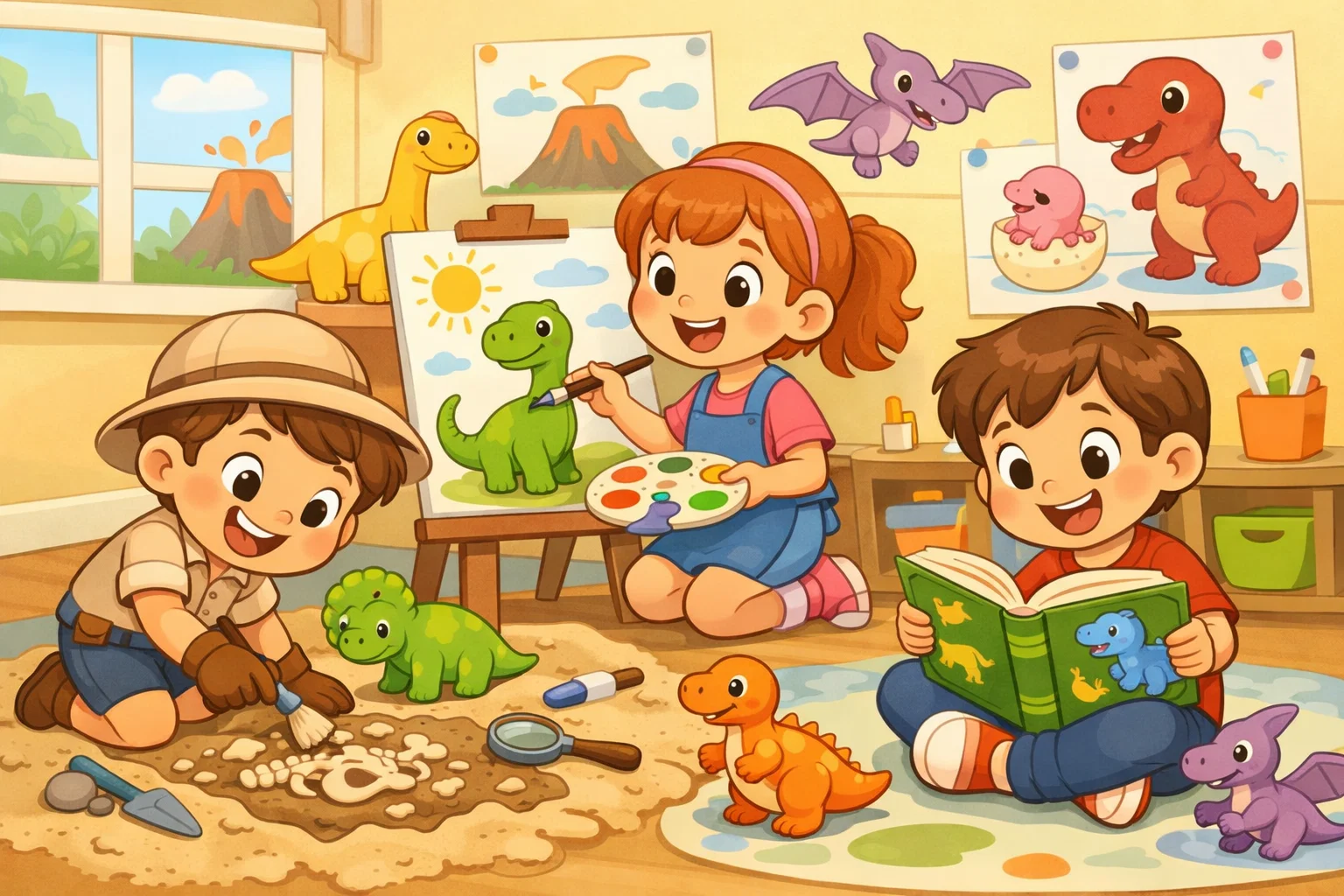
Children’s fascination with prehistoric creatures often seems hardwired into their development. From toddlers stomping around making roaring sounds to preschoolers reciting complex species names with surprising accuracy, these ancient giants capture young imaginations like few other topics can. Dinosaur activities for kids tap into this natural curiosity while delivering powerful educational benefits across multiple developmental domains — from fine motor skills and early literacy to scientific thinking and creative expression.
Whether you’re a parent looking for engaging activities for toddlers at home or an educator planning themed activities for your classroom, prehistoric play offers endless possibilities. The beauty of these activities lies in their versatility: they work beautifully for different age groups, adapt easily to various learning environments, and require minimal specialized materials. This guide explores diverse dinosaur crafts and activities that combine playful learning with hands-on engagement, ensuring kids of all ages can dive into prehistoric fun.
Dinosaur Sensory Play Activities
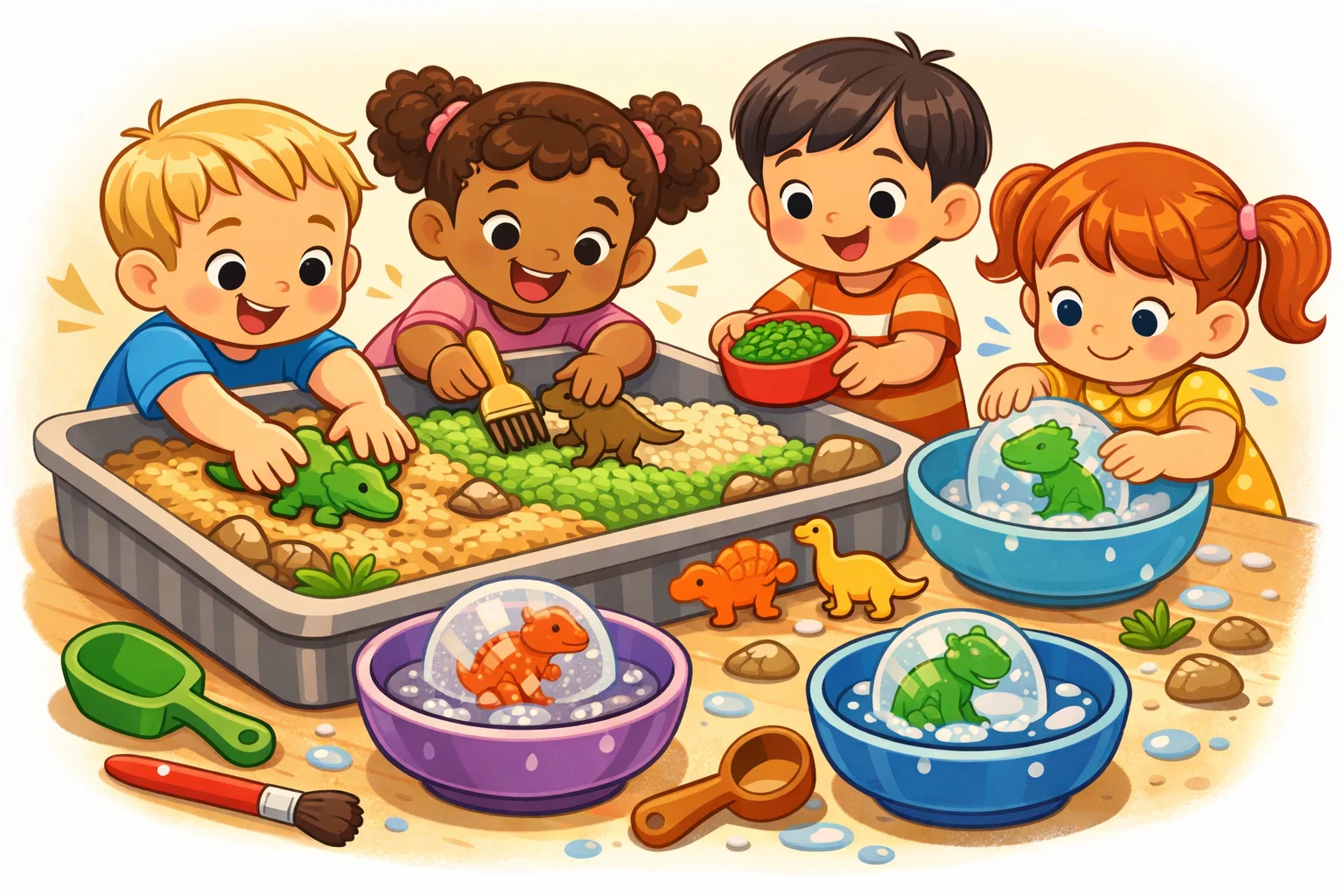
Sensory experiences form the foundation of early childhood learning, and dinosaur-themed activities provide rich opportunities for tactile exploration. When toddlers and preschoolers engage their senses through themed play, they’re not just having fun — they’re building neural pathways that support cognitive development, emotional regulation, and body awareness.
Sensory play activities help strengthen observational skills and encourage children to explore how things work through hands-on experience. These setups invite open-ended investigation where children control the pace and direction of their learning.
Dinosaur Sensory Bins and Trays
Creating a dinosaur sensory bin is perfect for toddlers and preschoolers who learn best through touch and manipulation. Start with a large container or tray as your base, then fill it with materials that mimic prehistoric environments:
Materials to include:
- Base materials: kinetic sand, rice, dried lentils, shredded paper, or small pebbles
- Prehistoric figures in various sizes
- Natural elements like moss, twigs, small rocks, and artificial plants
- Excavation tools: small brushes, tweezers, scoops, and magnifying glasses
- Optional additions: small containers for sorting, mini eggs, or volcano structures
The sensory exploration possibilities expand when you theme your bins seasonally or rotate materials every few weeks. A “swamp” bin might use green-dyed rice with water beads, while a “desert” version could feature sand and small cacti replicas. For younger toddlers, keep pieces larger to avoid choking hazards and supervise closely.
Cleanup tip: Place a large sheet or shower curtain under the sensory bin to catch spills, making cleanup significantly easier.
Dinosaur Dig and Fossil Excavation
Excavation activities turn children into young paleontologists, developing patience and concentration alongside fine motor skills. These dinosaur dig experiences can range from simple to complex depending on age and interest level.
For basic excavation, bury small toys in a container filled with sand or soil. Provide brushes, spoons, and small shovels for careful digging. Older kids appreciate the challenge of chiseling fossils from plaster or digging frozen specimens from ice blocks.
Creating plaster fossils:
- Mix plaster of Paris according to package directions
- Press toy figures into the mixture before it sets completely
- Remove the toys once the plaster has partially hardened, leaving impressions
- Allow to dry completely (24-48 hours)
- Hide the hardened fossils in sand for excavation
This activity teaches cause and effect, introduces basic scientific methodology, and requires sustained attention—all valuable skills for preschoolers transitioning to more structured learning environments.
Frozen Dinosaur Eggs Activities
Freezing prehistoric figures inside balloons creates “eggs” that require problem-solving skills to open. Kids will love the challenge of freeing their ancient friends using various melting strategies.
How to create frozen eggs:
- Place a small toy inside a balloon
- Fill the balloon with water using a funnel
- Tie securely and freeze overnight
- Remove the balloon covering to reveal the ice egg
Children can melt their eggs using warm water, salt, eyedroppers, spray bottles, or simply time and patience. This activity combines sensory play with basic chemistry concepts as kids observe state changes from solid to liquid. Even toddlers enjoy the sensory experience of cold ice under supervision and watching their creature slowly emerge.
Mud Kitchen Dinosaur Play
Outdoor play spaces become prehistoric landscapes when you add a mud kitchen setup. This messy, nature-based learning activity gives your kids opportunities for imaginative storytelling while engaging multiple senses.
Set up a dedicated outdoor area with:
- Old pots, pans, and kitchen utensils
- Water source (buckets or hose access)
- Mud or soil
- Natural loose parts: leaves, flowers, sticks, stones
- Large prehistoric figures
- Optional: food coloring for “lava” or themed soup
Children naturally incorporate gross motor movements as they dig, stir, pour, and transport materials. The unstructured nature of mud kitchen play supports creative thinking and allows kids to direct their own learning journey.
Dinosaur Art and Craft Activities
Creative expression through prehistoric art strengthens hand-eye coordination while allowing children to communicate ideas visually. These crafts for kids range from simple, toddler-appropriate activities to more complex builds for older children.
Dinosaur Fossil Crafts
Making salt dough dinosaur fossils combines artistic expression with scientific concepts. This classic activity remains popular because it’s simple, affordable, and produces keepsakes children treasure.
Basic salt dough recipe:
- 2 cups all-purpose flour
- 1 cup salt
- 1 cup water
Mix ingredients until a dough forms, then knead until smooth. Children can press their favorite dinosaur toys into flattened dough portions to create impressions. Alternatively, shape the dough into “bones” or create textured surfaces by pressing various objects into the surface.
Allow the fossils to air-dry for 2–3 days or bake at 200°F for 2-3 hours until hardened. Once dry, kids can paint their creations with watercolors or acrylics. These salt dough dinosaur fossils make wonderful gifts or classroom display pieces.
Dinosaur Painting and Printing
Process-oriented art experiences value creation over final products, allowing children to explore materials without pressure to produce something specific. Themed painting activities offer multiple entry points for different skill levels.
Painting activity ideas:
- Footprint painting: Attach cut-out construction paper feet to children’s shoes for stomping through paint
- Toy printing: Dip figures in paint and press onto paper to create textured prints
- Sponge stamping: Cut sponges into prehistoric shapes for easy stamping
- Cotton ball painting: Use cotton balls as stampers to create textured silhouettes
- Watercolor resist: Draw creatures with white crayon, then paint over with watercolor
These activities develop fine motor skills while introducing art concepts like texture, pattern, and color mixing. These activities are perfect for toddlers and preschoolers, focusing on the sensory experience rather than creating perfect representations.
Dinosaur Paper Crafts
Construction paper, cardboard, and recycled materials transform into colorful creations with minimal supplies. Paper crafts offer excellent opportunities for scissor practice, gluing skills, and following multi-step directions.
Simple craft ideas:
| Craft Type | Materials Needed | Skills Developed |
| Paper plate creatures | Paper plates, paint, googly eyes, construction paper | Cutting, gluing, color recognition |
| Cardboard dinosaur craft | Cardboard boxes, scissors, paint, markers | 3D thinking, structural planning |
| Egg carton figures | Egg cartons, paint, pipe cleaners, pom poms | Recycling awareness, creativity |
| Paper bag puppets | Paper bags, markers, colored paper, glue | Storytelling, dramatic play |
| Toilet roll creatures | Cardboard tubes, paint, construction paper | Fine motor coordination, patience |
These easy dinosaur crafts require supervision for younger children using scissors but offer satisfying results that encourage pride in accomplishment.
Dinosaur Handprint and Scratch Art
Handprint crafts create meaningful keepsakes while introducing children to the concept that art can be personal and representational. A handprint can become a long-necked Brachiosaurus or a fierce T-Rex with simple additions.
Scratch art introduces different sensory textures and the element of surprise. Cover paper with crayon in various themed colors, coat with black paint or crayon, then provide wooden sticks for scratching away the top layer to reveal colors underneath. This technique fascinates preschoolers who enjoy the discovery aspect of revealing hidden designs.
Dinosaur Science Activities
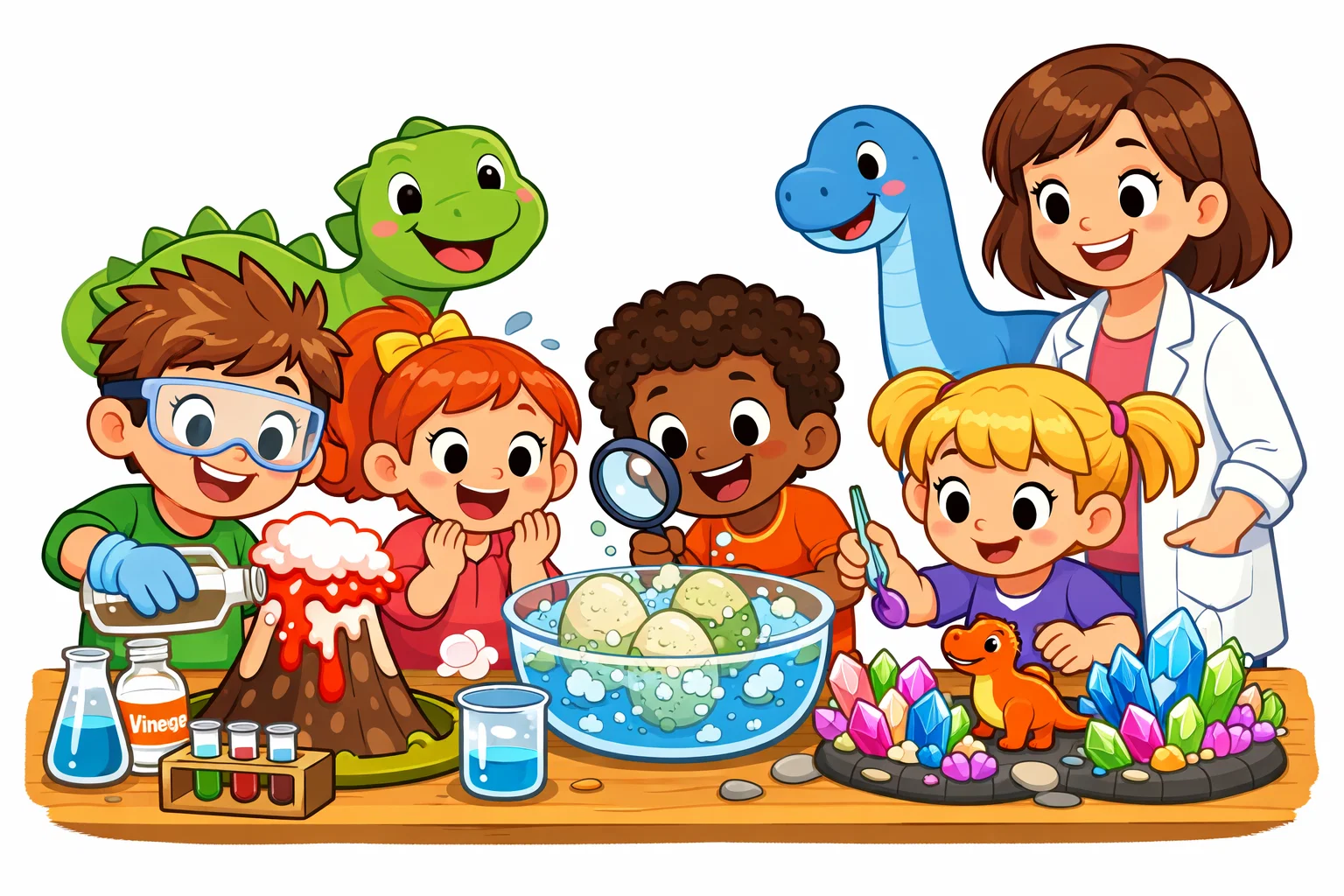
Simple science experiments linked to prehistoric themes introduce cause-and-effect thinking and encourage hypothesis formation. These educational dinosaur activities demonstrate that learning can be spectacular and memorable.
Volcano Eruption Experiments
No theme feels complete without addressing the volcanic activity that characterized parts of the prehistoric era. Baking soda and vinegar volcanoes remain popular because they deliver dramatic, repeatable results.
Basic volcano setup:
- Build a volcano shape using clay, playdough, or papier-mâché around a small container
- Place the volcano in a tray to contain overflow
- Add 2-3 tablespoons baking soda to the container
- Pour in several drops of dish soap and food coloring
- Pour vinegar to trigger the “eruption”
Kids love experimenting with different vinegar amounts, trying various colors, or adding glitter for “lava rocks.” This activity introduces basic chemistry concepts—specifically, acid-base reactions—in an age-appropriate, exciting format. Always supervise closely and discuss general experiment safety (even though this version stays cool).
Dinosaur Egg Hatching Experiments
Create fizzy hatching dinosaur eggs that combine artistic creation with chemical reactions. These engage curiosity and observational skills as children watch their eggs dissolve.
Creating hatching eggs:
- Mix 2 cups baking soda with enough water to form a moldable paste
- Add food coloring if desired
- Shape mixture around small toys
- Allow to dry completely (overnight or longer)
- Place in vinegar or citric acid solution to “hatch”
The fizzing reaction reveals the hidden creature slowly, teaching patience and the scientific method. Children can predict how long hatching will take, observe the process, and discuss what they notice.
Dinosaur Salt Crystal Experiments
Growing crystals introduces concepts of saturation, evaporation, and crystal formation. While this activity requires patience, the results fascinate children and provide beautiful decorative items.
Create a supersaturated salt solution by dissolving salt in very hot water until no more will dissolve. Place pipe cleaners shaped like bones or simplified silhouettes into the solution. Over several days, crystals will form on the pipe cleaners as water evaporates.
This amazing dinosaur science project works well as a long-term classroom observation where children can document daily changes through drawings or simple notes.
Prehistoric Teeth and Bones Exploration
Understanding that different species had different teeth based on their diets introduces classification and comparative analysis. Provide pictures or replicas showing carnivore teeth (sharp, pointed) versus herbivore teeth (flat, grinding surfaces).
Children can sort toy figures into groups based on teeth types, create charts showing characteristics, or match dinosaur names to appropriate teeth styles. This activity naturally integrates with literacy activities as children read dinosaur books to research their favorite dinosaur and identify whether it was a meat-eater or plant-eater.
Dinosaur Math Activities
Mathematical thinking develops naturally through playful learning activities that incorporate counting, sorting, measuring, and pattern recognition. Themed math removes abstraction by providing concrete, engaging manipulatives.
Dinosaur Counting and Sorting
Basic number concepts become accessible when children count and manipulate three-dimensional figures. These activities scale easily from simple one-to-one correspondence for toddlers to more complex operations for preschoolers.
Counting activity variations:
- Count figures into groups by number
- Create number lines using toys
- Match numeral cards to corresponding quantities
- Use counters for simple addition and subtraction
- Play “More or Less” games comparing groups
Sorting activities introduce classification and set theory concepts. Children might sort by:
- Size (large versus small figures)
- Color (if using colored dinosaur toys)
- Type (carnivore versus herbivore)
- Number of legs (two-legged versus four-legged)
- Habitat (land, sea, or air)
These activities also support language development as children explain their sorting rationale and discuss the attributes they’re using for categorization.
Dinosaur Measuring Activities
Measurement activities transform abstract number concepts into concrete comparisons. Create footprints in various sizes and have children measure using non-standard units (blocks, paperclips, toys) before introducing standard rulers.
Measurement exploration ideas:
- Measure and compare bones (real or drawn)
- Create height charts comparing species
- Estimate then measure how many toys fit in various containers
- Measure footprint spacing to determine stride length
- Compare children’s height to actual prehistoric dimensions
Older preschoolers and early primary-aged children enjoy the challenge of converting between measurement systems or calculating how many of them would equal one creature’s height. These comparisons make prehistoric scale tangible and memorable.
Dinosaur Graphing and Matching
Simple graphing activities introduce data collection and visual representation of information. Create a class graph of favorite choices, graph colors in a toy collection, or document findings from an excavation.
Pattern activities might include:
- Creating ABAB patterns with two types
- Extending existing patterns
- Creating patterns using attributes (big-small-big-small)
- Matching pairs in memory games
- Sequencing by size or number
These mathematical concepts appear in many early years learning frameworks as foundational skills for later academic success.
Dinosaur Literacy and Story Activities
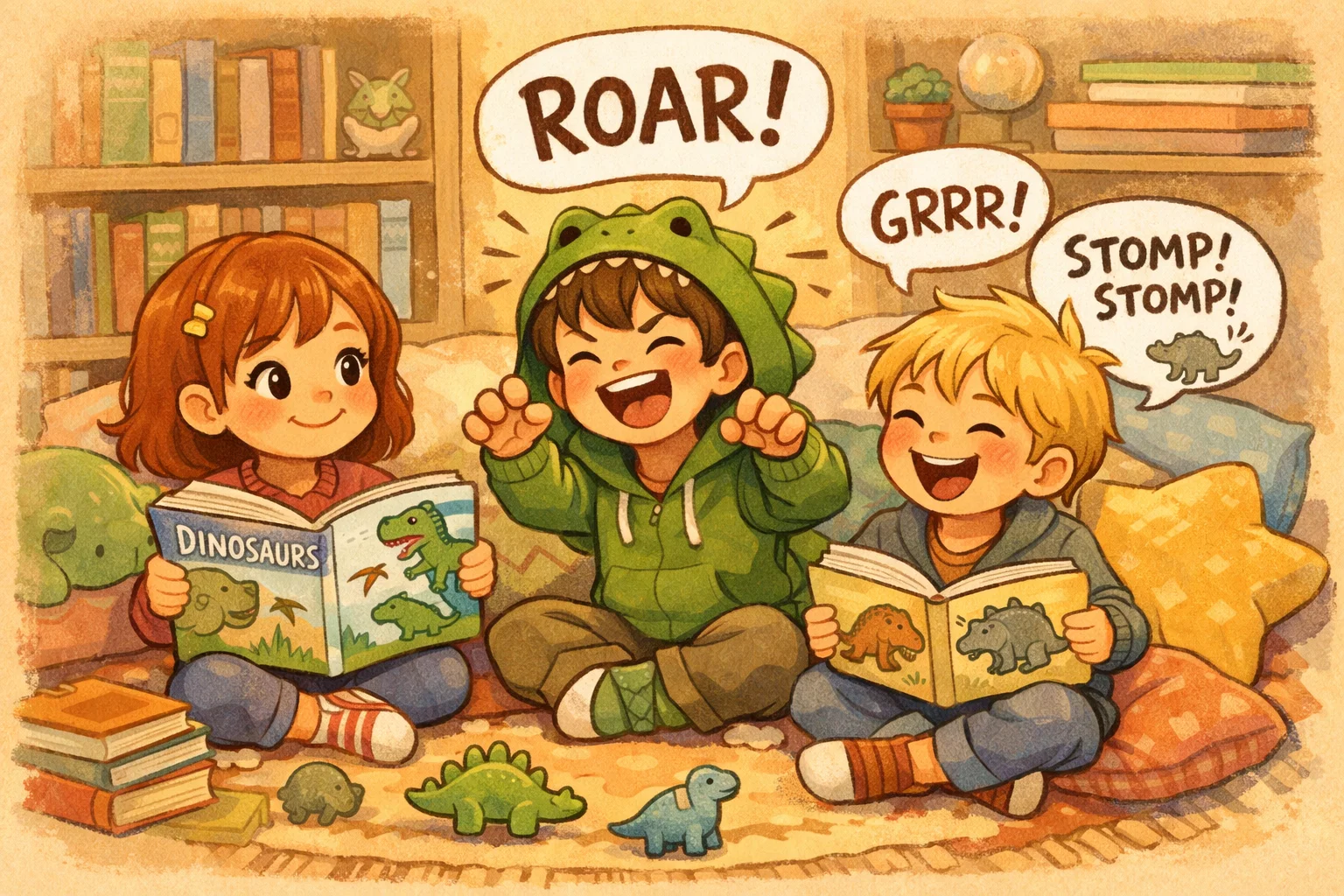
Language development flourishes when children engage with topics that genuinely interest them. Dinosaur books, songs, and storytelling activities naturally build vocabulary, comprehension, and communication skills.
Dinosaur Story Time and Book Play
Reading dinosaur books regularly exposes children to rich vocabulary, story structure, and information text features. The diversity of available books means you can find options for every reading level and interest.
Recommended book categories:
- Fiction narratives featuring prehistoric characters
- Non-fiction fact books with photographs or illustrations
- Rhyming stories that support phonological awareness
- Interactive books with flaps, textures, or sound buttons
- Wordless picture books encouraging oral storytelling
After reading, extend learning by acting out story scenes, creating story maps, discussing new vocabulary words, or inviting children to retell the story using their own toys. These activities strengthen comprehension and allow children to demonstrate understanding through multiple modalities.
Dinosaur Letter and Name Activities
Alphabet activities gain appeal when prehistoric creatures are involved. Create sets of dinosaur alphabet cards matching letters to names (A for Allosaurus, B for Brachiosaurus). Children can practice letter recognition, letter sounds, and alphabetical order.
Name and letter activity ideas:
- Build names using letter tiles alongside figures
- Match uppercase and lowercase letters on eggs
- Create alphabet books
- Trace letters in sand-filled sensory bins
- Use printable dinosaur letter mats for playdough letter formation
These literacy activities support pre-reading skills while maintaining the playful context that keeps young learners engaged. Even toddlers benefit from exposure to letter shapes in low-pressure, play-based contexts.
Dinosaur Songs, Rhymes, and Movement
Music and movement activities support language development, memory, and rhythm awareness. Traditional songs adapted with themed lyrics or purpose-written songs help children remember information through melody and repetition.
Popular song themes include:
- Counting songs featuring different species
- Movement songs encouraging stomps and actions
- Rhyming songs that build phonological awareness
- Call-and-response songs supporting listening skills
Combining literacy with physical movement creates multi-sensory learning experiences that particularly benefit kinesthetic learners who process information best through physical activity.
Dinosaur Fine Motor and Gross Motor Activities
Physical development happens alongside cognitive growth, and dinosaur activities for kids can target both small and large muscle groups essential for overall coordination.
Dinosaur Stomp and Dance Activities
Gross motor activities release energy while building strength, balance, and spatial awareness. Stomping games invite children to move like various creatures—taking heavy T-Rex steps, stretching tall like a Brachiosaurus, or flying like a Pterodactyl.
Create movement cards with different pictures and corresponding actions. Children draw a card and perform the movement, supporting both physical development and reading readiness as they connect symbols to actions.
Freeze dance with themed music encourages listening skills and impulse control as children must stop moving when the music stops. These activities work beautifully for both individual and group play.
Playdough Dinosaur Activities
Dinosaur play dough activities strengthen the small muscles in hands and fingers that children need for writing and self-care tasks. Provide cookie cutters, rolling pins, plastic knives, and toys alongside playdough.
Playdough activity variations:
- Roll “eggs” for nests
- Create bones by rolling long snake shapes
- Use cookie cutters to make shapes
- Build three-dimensional creatures using various colors
- Press figures into playdough to create fossil impressions
The resistance of playdough helps build hand strength more effectively than many other fine motor activities, making it valuable for preschool dinosaur skill development.
Dinosaur Puzzle and Jigsaw Play
Puzzles develop problem-solving abilities, spatial reasoning, and concentration. Start with simple 4-6 piece puzzles for young toddlers and gradually increase complexity as skills develop.
Puzzle play teaches persistence, as children must continue trying different approaches when pieces don’t fit initially. The clear completion point (finished puzzle) provides satisfaction and accomplishment that motivates continued effort.
Dinosaur Pretend and Small World Play
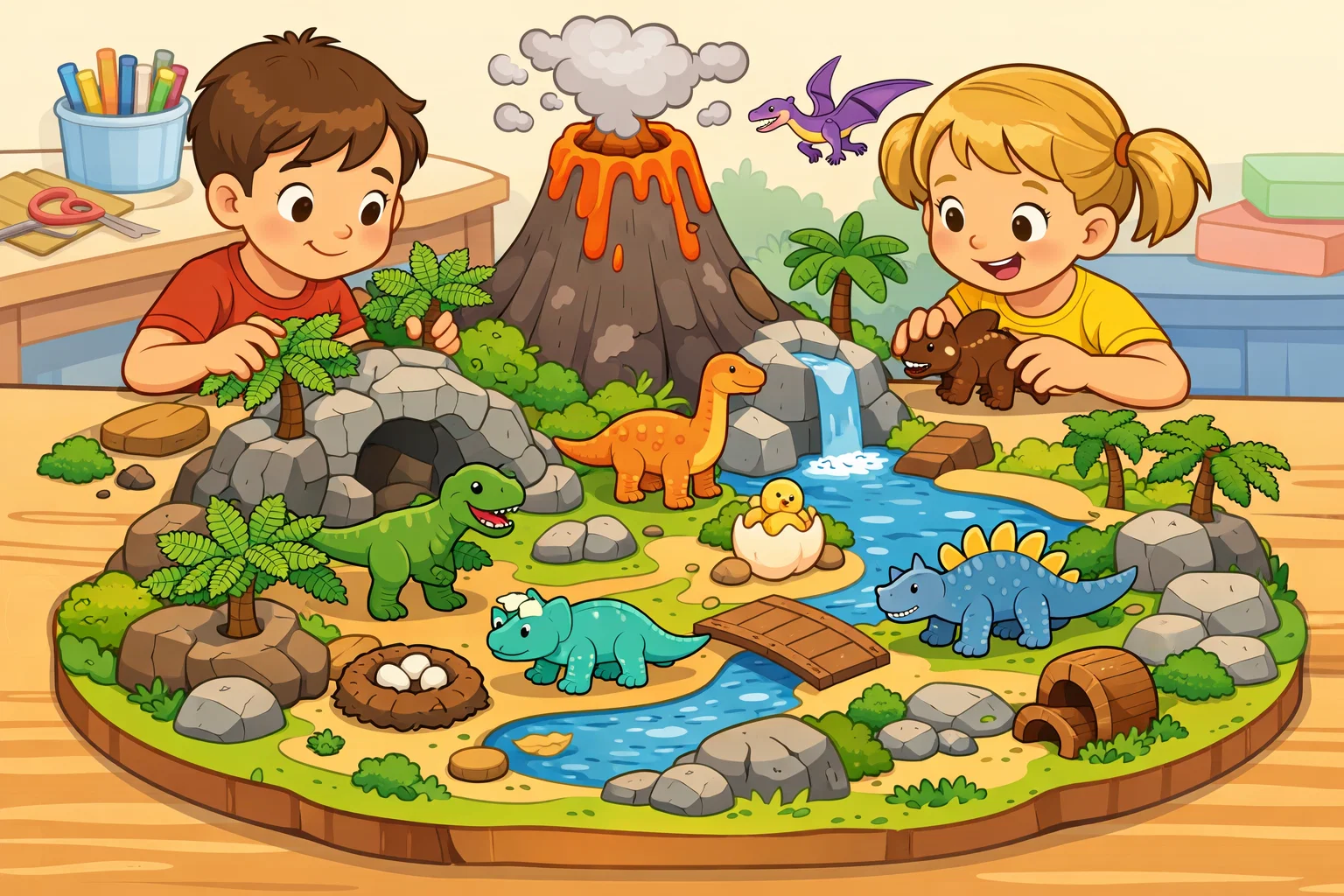
Imaginative play develops abstract thinking, narrative skills, and social understanding as children create and act out scenarios with their figures.
Small World Dinosaur Landscapes
Creating mini environments invites children to design, arrange, and manipulate their prehistoric worlds. Use shallow trays or containers as the base and provide diverse materials:
Small world materials:
- Natural items: rocks, moss, twigs, bark, pinecones
- Blue fabric or paper for water
- Sand or soil for different terrain
- Artificial plants or pressed flowers
- Figures of various sizes
- Optional additions: mini trees, caves (rocks), volcanoes
Children determine the layout, create habitats appropriate for different species, and develop stories about interactions between creatures. This open-ended dinosaur play encourages extended play sessions and supports executive function development.
Dinosaur Discovery Shelves
Discovery or exploration shelves present curated collections of materials that invite independent investigation. A themed shelf might include:
- Fossil replicas or stones
- Magnifying glass
- Reference books
- Small figures
- Images of different dinosaurs
- Natural materials
- Simple tools (tweezers, scoops)
Rotate materials every 1-2 weeks to maintain interest. This setup supports child-led learning as children choose which materials to explore and how to use them.
Loose Parts Dinosaur Play
Loose parts are materials without a predetermined purpose that children can manipulate, combine, and use creatively. Providing loose parts alongside toys expands play possibilities exponentially.
Valuable loose parts for prehistoric play include:
- Wooden blocks and planks
- Fabric pieces for nests or caves
- Shells, stones, and natural items
- Cardboard tubes and boxes
- Ribbon and string
- Bottle caps and buttons
This type of open-ended play particularly supports creativity and imagination development as there are no “right” ways to use the materials—only possibilities children discover through experimentation.
Dinosaur Outdoor Activities
Taking themed activities outside adds fresh air, vitamin D, and opportunities for larger-scale play that isn’t feasible indoors.
Dinosaur Hunt Games
Scavenger hunts combine physical activity with problem-solving and reading skills. Create a list of items to find (using pictures for non-readers) related to prehistoric themes:
- Items in different colors representing various species
- Natural materials creatures might have encountered
- Hidden toys around the yard
- Objects matching specific shapes or sizes
For literacy-focused hunts, hide letter cards that spell dinosaur names or create clue-based hunts where children must read directions to find the next location.
Dinosaur Footprint Activities
Outdoor painting with DIY dinosaur feet encourages gross motor movement and creative expression without worrying about mess. Cut large foot shapes from sturdy cardboard, attach them to children’s shoes with elastic, then let kids stomp through washable paint on large paper or directly on pavement.
Chalk activities offer another low-mess option. Draw footprints on pavement and have children follow the trail, jump from print to print, or measure distances between tracks.
Museum and Library Dinosaur Visits
Real-world experiences cement classroom learning and introduce children to community resources. Museum visits allow children to see bones and reconstructions at actual size, making the scale of these creatures tangible.
Prepare for visits by:
- Reading books about what to expect at museums
- Discussing observation skills and what to look for
- Bringing clipboards for simple drawings or notes
- Planning post-visit extension activities
Library visits introduce children to the wealth of resources available and teach valuable research skills. Even young preschoolers can learn to locate books in the children’s section.
Dinosaur Activities by Age Group
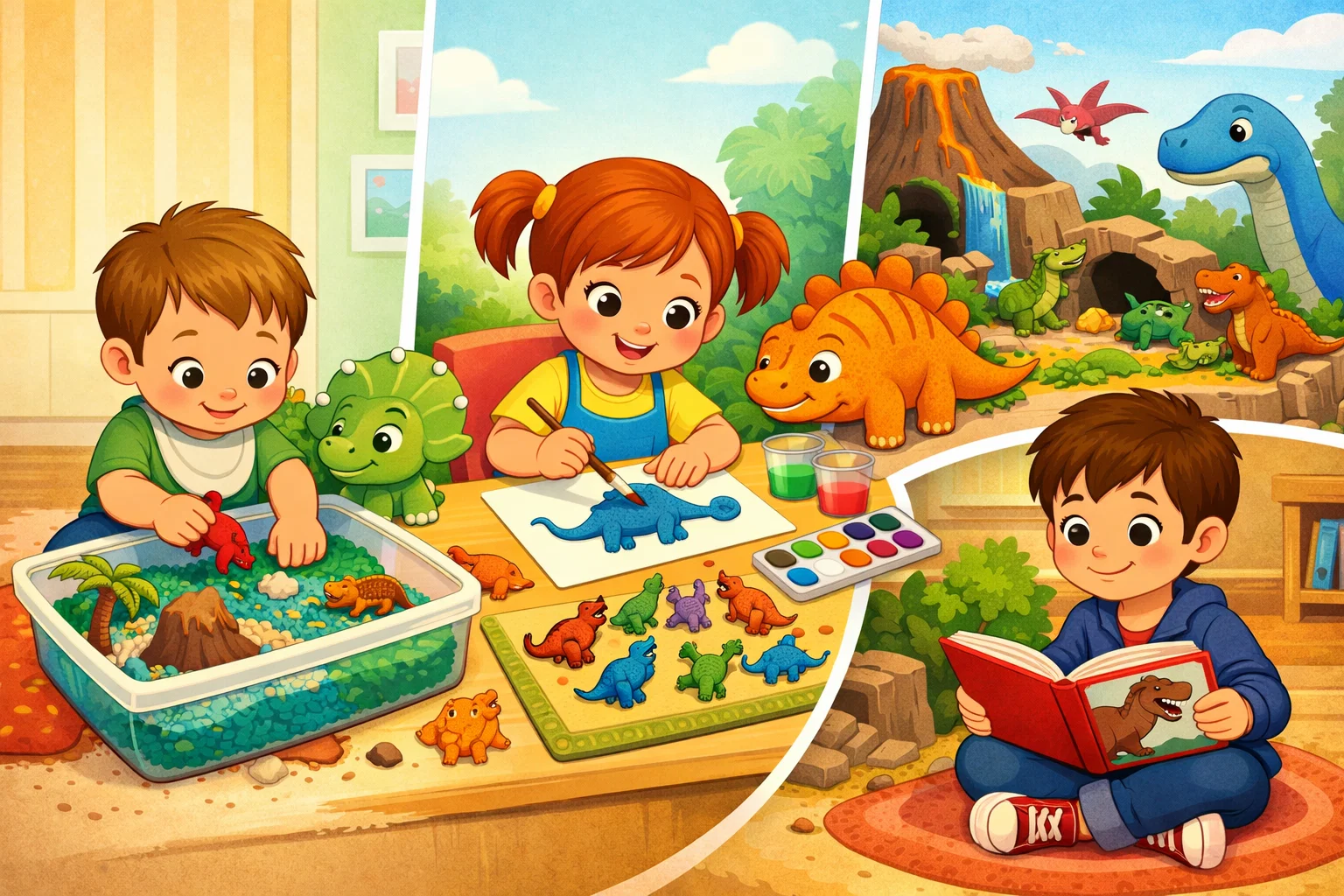
Matching activities to developmental capabilities ensures engagement without frustration. Here’s guidance for age-appropriate experiences.
Dinosaur Activities for Toddlers
Toddlers (ages 1-3) benefit most from sensory-rich experiences with minimal complexity. Focus on:
Recommended activities:
- Large toys for safe mouthing and exploration
- Simple sensory bins with larger pieces
- Basic color sorting with colored dinosaur figures
- Songs with simple movements
- Large-scale painting and marking
- Board books featuring prehistoric creatures
- Simple matching games
Supervision remains essential as toddlers explore through touch and sometimes taste. Choose materials carefully to avoid choking hazards, and expect shorter attention spans requiring quick transitions between activities.
Dinosaur Activities for Preschoolers
Preschoolers (ages 3-5) handle more complex activities involving multiple steps, finer motor control, and beginning academic concepts:
Appropriate activities:
- Detailed crafts requiring cutting and gluing
- Counting and simple math games
- Letter recognition and name-building activities
- Multi-step science experiments
- Detailed small world setups
- Chapter books about prehistoric life
- Cooperative play scenarios
Preschool journal activities might include drawing favorite dinosaurs, dictating facts they’ve learned, or creating simple alphabet pages.
Dinosaur Activities for Early Years and EYFS
Early Years Foundation Stage (EYFS) frameworks emphasize learning through play across specific developmental areas. Themed activities support EYFS goals including:
| EYFS Area | Activity Examples |
| Communication & Language | Story retelling, vocabulary building, songs |
| Physical Development | Gross motor stomping, fine motor crafts |
| Personal, Social & Emotional | Sharing toys, collaborative projects |
| Literacy | Letter activities, book exploration, mark-making |
| Mathematics | Counting, sorting, measuring, patterns |
| Understanding the World | Science experiments, museum visits, habitats |
| Expressive Arts & Design | Art projects, music, imaginative play |
These frameworks recognize that children learn holistically, with activities often supporting multiple developmental areas simultaneously.
Educational Benefits of Dinosaur Activities
Understanding the “why” behind activities helps parents and educators choose and adapt experiences purposefully.
Creativity and Imagination Development
Open-ended play without prescribed outcomes supports divergent thinking—the ability to generate multiple solutions or approaches. When children create their own worlds or invent stories about prehistoric creatures, they practice the creative problem-solving valued across domains.
Imaginative play supports emotional regulation by giving children opportunities to manage scenarios and work through problems in safe, low-stakes environments.
Fine Motor and Coordination Skills
Many crafts and activities specifically target the small muscle development necessary for writing, buttoning, and other daily tasks. Activities like:
- Using tweezers or tongs to pick up figures
- Rolling playdough into shapes
- Cutting paper along lines
- Gluing small pieces precisely
- Painting with various tools
These experiences build the hand-eye coordination and finger strength that children need for increasing independence and academic readiness.
Early Learning Through Play
Play-based learning aligns with how young brains naturally process and retain information. When children engage with math concepts through toys rather than abstract worksheets, they build concrete understanding that transfers to more formal learning contexts.
Guided play approaches often lead to stronger learning outcomes than purely unstructured play or rigid, instruction-led activities, as they balance adult support with child-led exploration.
Tips for Setting Up Dinosaur Activities at Home or Classroom
Successful activity implementation depends on thoughtful preparation and realistic expectations.
Simple Materials and Setup
Most fun dinosaur activities require minimal investment. Build your collection gradually:
Essential materials:
- Set of dinosaur figures (various sizes helpful)
- Basic craft supplies (construction paper, glue, scissors, paint)
- Sensory bin container
- Playdough (homemade or store-bought)
- Several reference books
Nice-to-have additions:
- Printable dinosaur resources (many available free online)
- Specialty items like fossil replicas
- Themed decorations
- Additional sensory materials
Organize materials in clear containers with labels and pictures to support independent cleanup. Preparing activity materials in advance reduces setup stress and allows more time for actual play.
Safety and Supervision Tips
Age-appropriate supervision helps ensure safety without limiting exploration:
- Choking hazards: Keep small pieces away from children under 3
- Paint safety: Use non-toxic, washable paints; supervise to prevent ingestion
- Sharp tools: Provide child-safe scissors and supervise cutting activities
- Sensory materials: Monitor children with sensory processing differences who may be overwhelmed
- Chemical experiments: Adult supervision required for all science activities
Create contained spaces for messy activities using large plastic tablecloths, shower curtains, or outdoor areas. This reduces anxiety about mess and allows children to explore freely.
Activity Rotation and Engagement
Maintaining interest over time requires thoughtful rotation of materials and activities:
Strategies for sustained engagement:
- Introduce 1-2 new activities weekly rather than overwhelming with everything at once
- Rotate materials in and out of availability every 2-3 weeks
- Follow children’s interests—if they love excavation, expand with additional dig activities
- Combine favorites in new ways (sensory bin with alphabet letters)
- Document learning through photos to help children reflect on experiences
Notice when engagement wanes and refresh the activity by adding new elements, changing the context, or temporarily removing it to create novelty when reintroduced.