

Imagine a world where invisibility is not a comic book superpower, but a daily necessity for survival. In the wild, the rule of “eat or be eaten” shapes the appearance and behavior of countless creatures, from tiny insects to powerful predators. Research and classroom practice show that dry textbook facts are quickly forgotten, but when learning becomes hands-on, children’s engagement increases dramatically. The “Predator Game” is more than an afternoon activity — it is a structured scientific simulation that helps children understand natural selection and the importance of animal adaptations within ecosystems.
Designed for both home and classroom use, this project supports environmental science learning across a wide age range — from preschoolers discovering nature to older children capable of analyzing simple data. By taking on the roles of hunter and prey, participants gain a practical understanding of camouflage and survival strategies. The activity strengthens critical thinking, sharpens observation skills, and encourages children to see the outdoors through the lens of a field biologist.
Animal Camouflage Concept for Kids
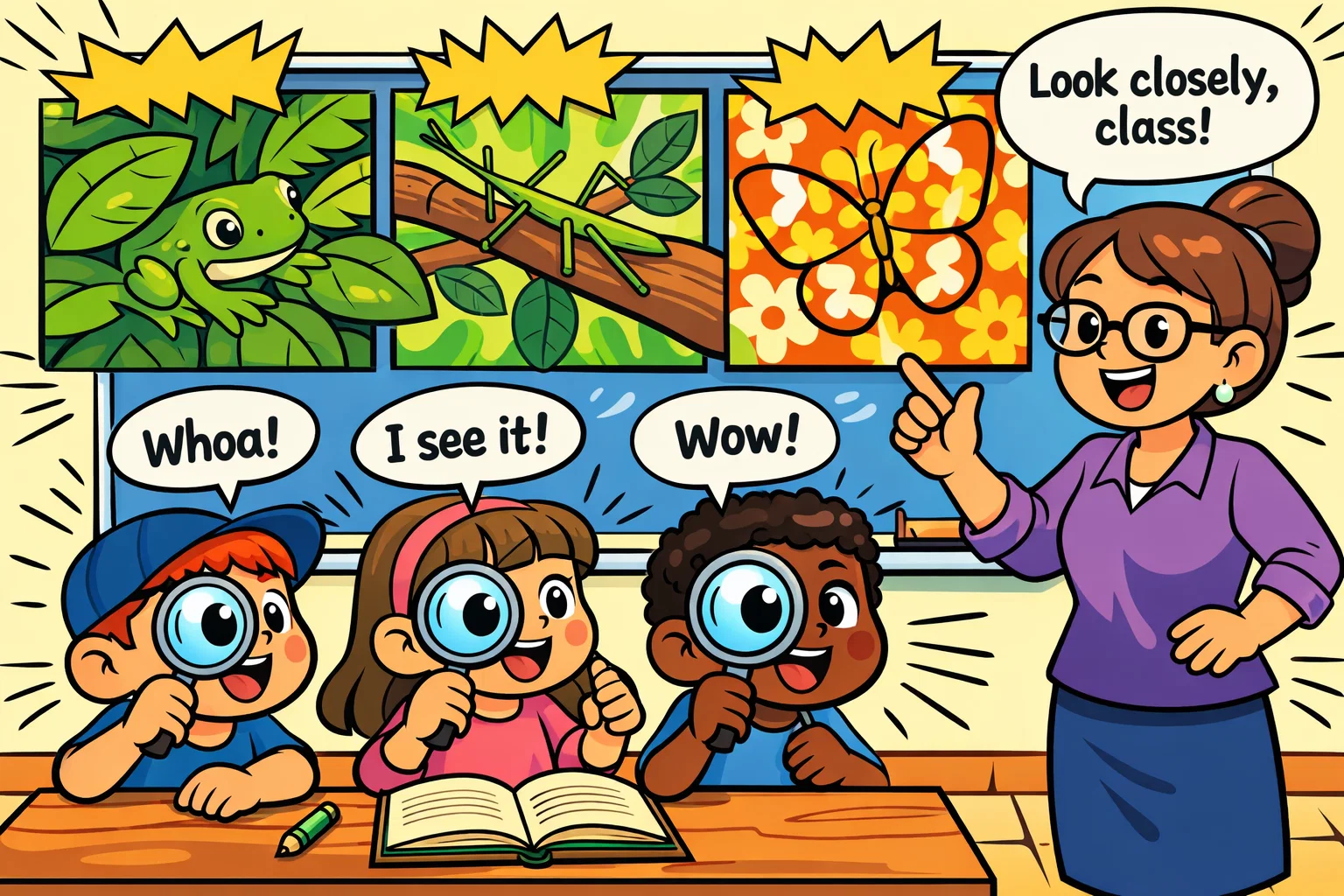
When we discuss camouflage with children, we are talking about nature’s ultimate game of hide and seek. In the animal kingdom, creatures do not have the luxury of changing clothes to suit their environment; instead, they have evolved over millions of years to possess fur, feathers, or scales that act as a permanent disguise. To make this concept relatable, an animal’s body can be described as its own specialized “invisibility cloak.” This biological trait is what scientists call an adaptation, which is a specific characteristic that increases an organism’s chances of survival and reproduction in its specific habitat.
In the context of our experiment, camouflage means much more than just matching a color. It is about the tactical use of light, shadow, and geometry to deceive the eyes of a predator. Many animals use camouflage to disappear against the bark of a tree or the dappled light of a jungle floor. By participating in this fun science activity, children are not just playing; they are simulating the pressure of predation. They will begin to understand that if an animal can match their surroundings perfectly, it is less likely to be detected, thereby increasing its chances of surviving long enough to pass on those traits.
Camouflage Meaning in Nature
In the wild, animal camouflage is a diverse and multifaceted toolkit. It isn’t limited to a single method; rather, it involves a combination of concealing coloration, disruptive patterns, and even behavioral shifts. For instance, a frog might not only be the same shade of green as the moss it sits on but might also have a bumpy texture that mimics the moss’s surface. This is a profound example of how living things utilize every resource available to them – color, shape, and texture – to avoid being eaten.
Some animals take this a step further by using disruptive coloration. Think of a zebra’s stripe or a leopard’s spots; these patterns work by breaking up the visual outline of the animal. When a predator looks at a herd of zebras, the overlapping stripes make it difficult to tell where one individual ends and another begins. This confusion is a powerful defense mechanism that we will replicate using construction paper and various fabric scraps during our game.
Predator Prey Relationship
The relationship between predators and prey is a constant evolutionary arms race. While prey animals are busy perfecting their disguise, predators are simultaneously developing better ways to see through those defenses. Predators such as hawks and foxes rely heavily on detecting movement and visual contrast. If a caterpillar is bright yellow on a brown branch, the contrast makes it an easy target. However, if that same worm looks exactly like a leaf or a twig, the predator’s brain might simply filter it out as part of the background.
During our camouflage activities, it is essential to highlight that predators also use these tactics. A lion doesn’t just run at its prey; it uses the tall, golden grass of the savannah to blend in while it stalks. This dual-sided nature of animal camouflage helps children understand the balance of an ecosystem. Without successful prey, predators starve; without successful predators, prey populations explode and exhaust their food sources. This game demonstrates that delicate balance in a clear, hands-on way.
Visual Perception Role
Human and animal vision is specialized to detect “breaks” in the environment. Our brains are naturally attracted to edges, movement, and high-contrast colors. Camouflage works by exploiting the weaknesses in this visual processing. When an animal’s coloration matches its background, the “edges” of its body disappear, and it becomes a part of the background to the observer. This is why staying perfectly still is often the most important part of a good hiding strategy; movement is the one thing that even the best disguise cannot always hide.
In this experiment, different lighting conditions and backgrounds are explored and backgrounds affect how we perceive objects. A bright red butterfly is easy to spot on a green lawn, but if you move that same butterfly to a bush with red flowers, it suddenly becomes a challenge to find. This shift in visual perception is exactly what animals experience in the wild as they move through different parts of their habitat.
Predator Game Learning Goals
The primary objective of this environmental science activity is to move beyond rote memorization and into the realm of active discovery. By engaging in exploring camouflage, children develop a deep, intuitive grasp of biological principles that are often difficult to convey through text alone. The activity targets a “Level 3” depth of knowledge, where students don’t just identify camouflage but can explain its function and predict how changes in the environment might affect an organism’s survival.
| Learning Category | Specific Skill Developed | Real-World Application |
| Scientific Inquiry | Formulating hypotheses about which colors will survive. | Understanding the scientific method and data collection. |
| Mathematics | Calculating survival rates and comparing ratios. | Data analysis and statistical reasoning in STEM. |
| Ecology | Linking physical traits to environmental fitness. | Awareness of biodiversity and conservation efforts. |
| Fine Motor Skills | Using tweezers and a magnifying glass for precision. | Development of hand-eye coordination in younger kids. |
Observation Skills Development
Through this game, children learn to observe the world with the precision of a scientist. Instead of seeing a “brown bug,” they will start to notice the specific shades of umber and sienna that allow a moth to hide on an oak tree. Encouraging children to look for these nuances sharpens their focus and teaches them that in science, the smallest details often hold the most significant answers. This practice of “active looking” is a transferable skill that benefits them in reading, art, and mathematics.
Critical Thinking Through Play
As the game progresses, you should encourage children to analyze the results of each round. If the “predator” caught all the blue butterflies but none of the green ones, ask them why. This leads to high-level critical thinking: “If we moved this game to a sandy beach, which butterflies would survive then?” This type of inquiry encourages children to think about variables and cause-and-effect, which are fundamental components of engineering design and scientific logic.
Nature Science Connection
Ultimately, we want to bridge the gap between the “lab” (your living room or classroom) and the natural world. After playing the predator game, a simple walk in the park becomes an opportunity for discovery. Your child might stop to point out a mimic – perhaps a hoverfly that looks like a wasp – or notice how the fur of a squirrel matches the bark of the trees. This connection fosters a lifelong appreciation for biology and the complex beauty of living organisms.
Supplies for Animal Camouflage Experiment
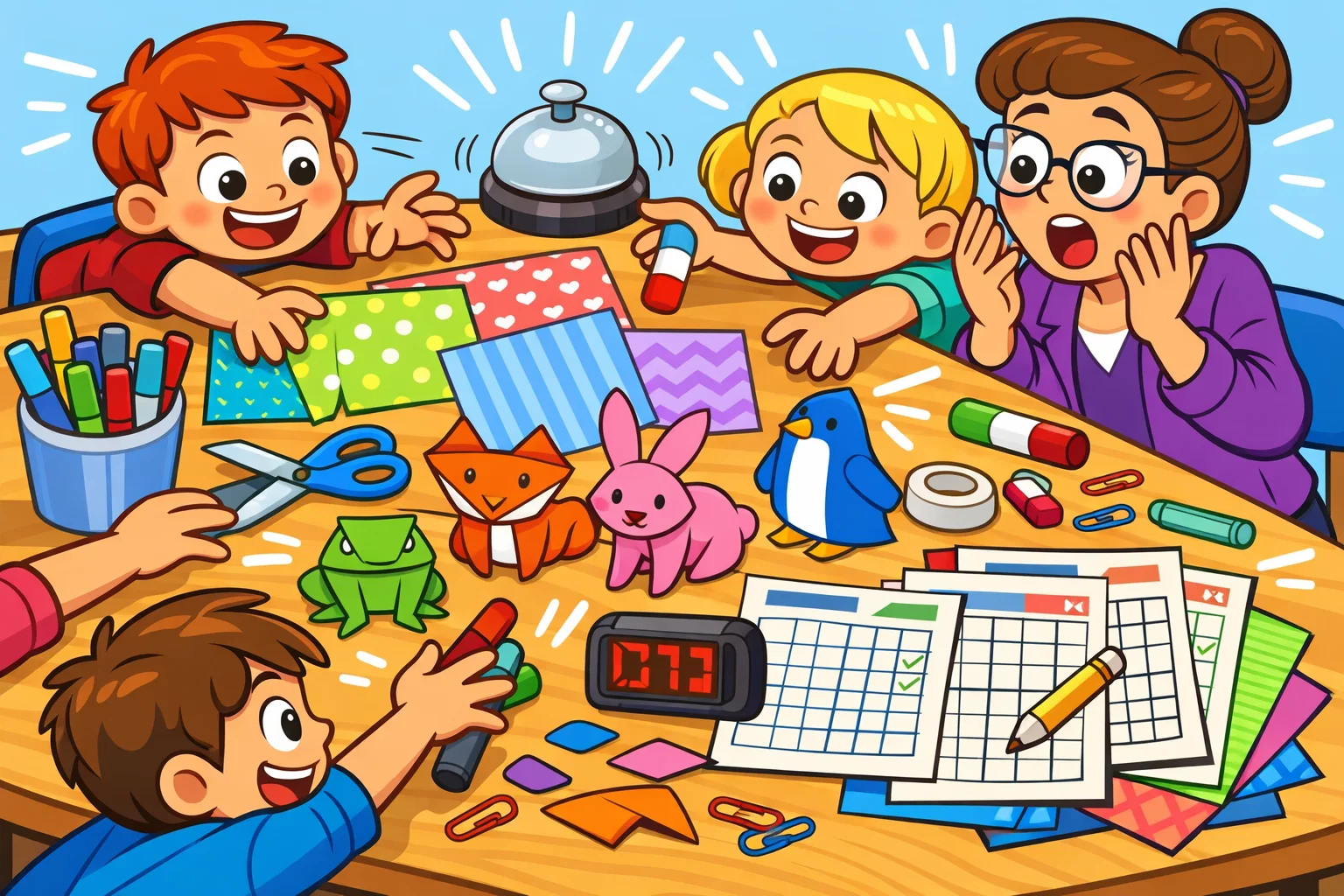
One of the best aspects of this fun science project is that it requires very little in the way of specialized equipment. Most of these craft supplies are likely already in your home or can be purchased cheaply at a local store. The goal is to create a variety of “prey” and “habitats” to test different types of animal camouflage.
Printable Camouflage Animals
You can easily find templates online for a butterfly, frog, or insect, or you can simply cut out small, uniform shapes from construction paper. It is crucial to have at least five or six different colors of these paper animals. It is recommended to include:
- High-contrast colors (Neon orange, bright red).
- Low-contrast colors (Forest green, earthy brown, tan).
- Patterned options (Scraps of wrapping paper or fabric scraps with spots or stripes).
Environment Background Materials
The background is just as important as the prey. To simulate different ecosystems, you can use:
- White rice in a large tray (simulating a light, textured background like sand).
- A green outdoor rug or a patch of grass.
- A multicolored floral tablecloth (simulating a complex jungle floor).
- A collection of real twigs, leaves, and stones brought in from outside.
Predator Tools
To make the “predator” role more official and to add a layer of fine motor skill development, provide your child with:
- Tweezers or clothespins (to act as a bird’s “beak”).
- A magnifying glass for “scouting” the area.
- A stopwatch or timer to add the pressure of a real hunt.
- A clipboard and paper for recording predator game results.
Predator Game Setup Steps
A successful experiment requires a clear structure. Whether you are a teacher or a parent, help your child by setting up a “controlled environment” where the rules are consistent. This ensures that the data you collect at the end is meaningful and that the lesson about how camouflage works is clear.
Game Area Preparation
First, define the “hunting grounds.” If you are working indoors, a large table or a specific section of the floor is ideal. If you are outdoors, use string or hula hoops to mark the boundaries of the habitat. It is important to choose a space that has some visual variety – a perfectly flat, monochromatic floor will make the game too easy and won’t demonstrate the effectiveness of concealing coloration.
Camouflage Placement Rules
The “Prey” (one participant) hides the paper animals while the “Predator” has their eyes closed. There are a few strict rules to ensure the experiment is valid:
- No physical covering: The animals must be in plain sight. They cannot be under a leaf or inside a fold of fabric. They are only allowed to hide using their colors and patterns.
- Even distribution: Don’t clump all the “easy” ones in one spot. Scatter them randomly across the environment.
- No vertical hiding: Unless you are using a 3D environment, keep the paper animals flat against the background to emphasize the visual blend.
Predator Role Assignment
Rotate roles after each round. Being the predator is exciting because it involves the “hunt,” but being the “evolver” (the one hiding the animals) is where the deep learning happens. When a child hides the animals, they are actively thinking about avoiding detection and selecting the best hiding places. This dual perspective is essential for understanding the co-evolution of predators and prey.
Predator Game Rounds Structure
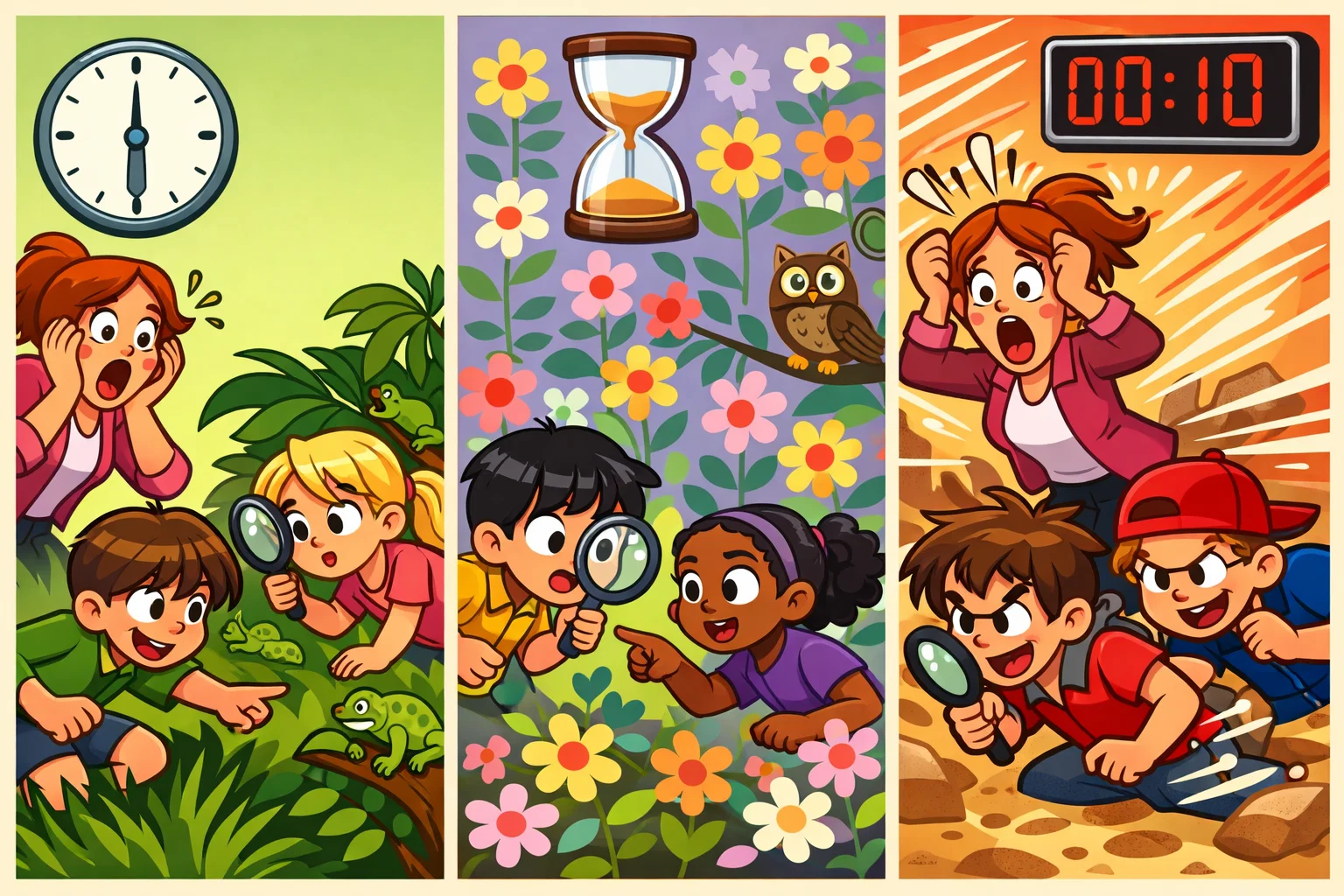
To show how adaptation occurs over time, the game should be played in rounds. This allows you to introduce the concept of “generations,” where only the survivors of the first round get to “reproduce” for the second.
Round One: Visual Search
Start with a simple environment, like a green cloth. Scatter 10 bright red paper “bugs” and 10 green paper “bugs.”
- The Hunt: Give the predator 15 seconds to collect as many as possible using their tweezers.
- The Outcome: Usually, the predator will quickly snatch up all the red ones.
- The Lesson: This demonstrates basic concealing coloration. The green bugs “survived” because they matched their surroundings.
Round Two: Pattern Challenge
Now, move to a more complex background, like a pile of leaves or a piece of patterned fabric scraps.
- The Hunt: Use paper animals that have stripes or spots.
- The Outcome: The predator will find it much harder to find the hidden prey because the patterns break up the animals’ outlines.
- The Lesson: This introduces disruptive coloration and shows how even “busy” patterns can be a form of good hiding.
Round Three: Speed Detection
In nature, a predator often only has a split second to strike.
- The Hunt: Reduce the time to 5 seconds. Use viceroy and monarch butterfly cutouts (if you have them) to introduce mimicry.
- The Outcome: In the rush, the predator might grab a “poisonous” monarch or avoid a “tasty” viceroy because they look so similar.
- The Lesson: This highlights how mimicry works to confuse predators, even when they are fast and hungry.
Recording Predator Game Results
In any fun science experiment, the data is the “proof.” By recording predator game results, you turn a game into a legitimate lab report. This step is crucial for older kids who are learning about data visualization and evidence-based conclusions.
Score Tracking Method
Use a simple table to track the “population” of your prey. After each round, count how many of each color were “eaten” and how many survived. This makes the concept of predation much more concrete.
| Prey Type | Start Number | Number Eaten | Number Survived | Survival Rate (% of original group) |
| Bright Red | 10 | 9 | 1 | 10% |
| Earthy Brown | 10 | 2 | 8 | 80% |
| Patterned | 10 | 4 | 6 | 60% |
Comparison Between Backgrounds
Ask the children to compare their findings across different “habitats.” Did the brown fur-colored paper survive better on the white rice or on the wooden floor? Why? This helps them understand that adaptation is always relative to the environment. An animal that is well-camouflaged in the jungle would be incredibly easy to spot in the desert.
Discussion Prompts
Ask your child open-ended questions to wrap up the experiment:
- “If you were a bird, which prey would you look for first?”
- “How did the timer change how you looked for the animals?”
- “Can you think of any different animals that look like something else, like a twig or a leaf?”
- “What would happen if the environment changed, like if it snowed and everything turned white?”
STEM Integration in Camouflage Experiment
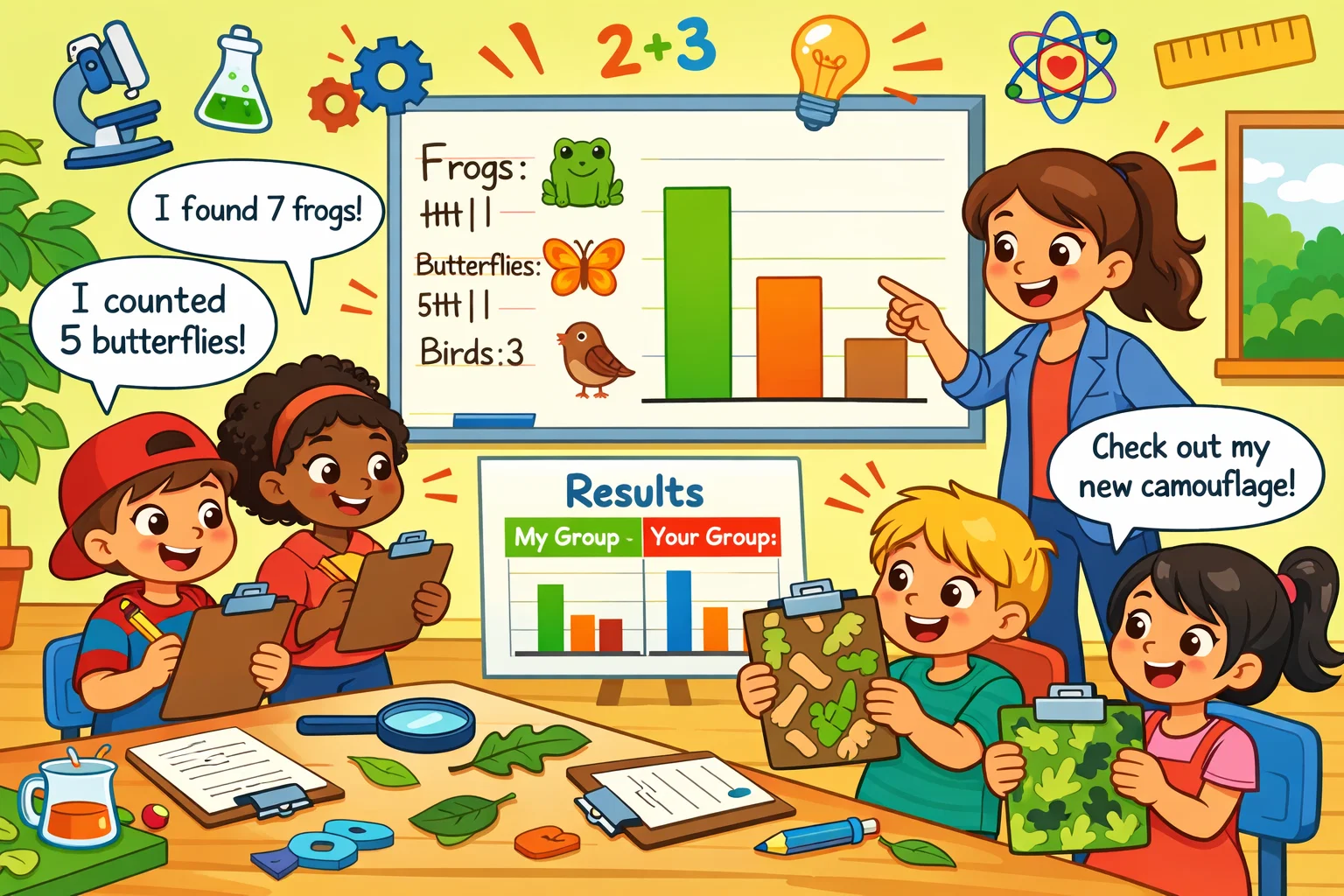
This activity is a powerhouse for STEM (Science, Technology, Engineering, and Math) learning. It moves beyond biology and touches on physics (light and color), math (ratios), and engineering.
Science Adaptation Concepts
The core of the game is animal adaptations. We aren’t just looking at color; we are looking at survival strategies. This is a great time to introduce the venomous coral snake and its non-venomous mimic, the scarlet king snake. Explain that the king snake “stole” the coral snake’s look to scare off predators. This is a high-level concept that children find fascinating because it’s like a biological “cheat code.”
Math Counting Patterns
For younger children, simply counting the survivors is great practice. For older students, have them create bar graphs or pie charts of the survival data. Comparing the percentage of “eaten” vs. “survived” prey is a practical application of probability and statistics.
Engineering Design Thinking
Challenge the kids to use engineering design to create the “Ultimate Camouflaged Creature.” Provide them with craft supplies, fabric scraps, and glue. They must look at a specific spot in the room and design an animal specifically to disappear in that exact location. This requires them to analyze texture, light, and pattern, similar to how designers create camouflage patterns.
Classroom Camouflage Lab Variation
If you are a teacher, this experiment is a fantastic way to get the whole class moving and collaborating. It can be adapted into a “Camouflage Lab” that fits perfectly into a 60-minute science block.
Group Rotation Format
Divide the class into small teams. Each team is a different “species” of bird with a specific “beak” (one team uses tweezers, another uses spoons, another uses their fingers). This adds a layer of natural selection – not only are we looking at which prey survives, but also which predator is the most efficient at finding the animals.
Time Management Tips
- Preparation (15 mins): Have students color their butterflies or insects.
- The Hunt (20 mins): Run three 5-minute rounds with transitions.
- Analysis (25 mins): Use the remaining time for students to fill out their lab reports and discuss the results as a group.
- Supervision: Ensure that students are moving safely and not pushing while trying to “catch” their prey.
Assessment Ideas
Instead of a quiz, have students write a “Nature Documentary Script.” They can describe the “Great Paper Butterfly Hunt,” explaining why certain species went extinct in the classroom while others thrived. This assesses their ability to communicate complex environmental science concepts in a creative way.
Home Camouflage Game Version
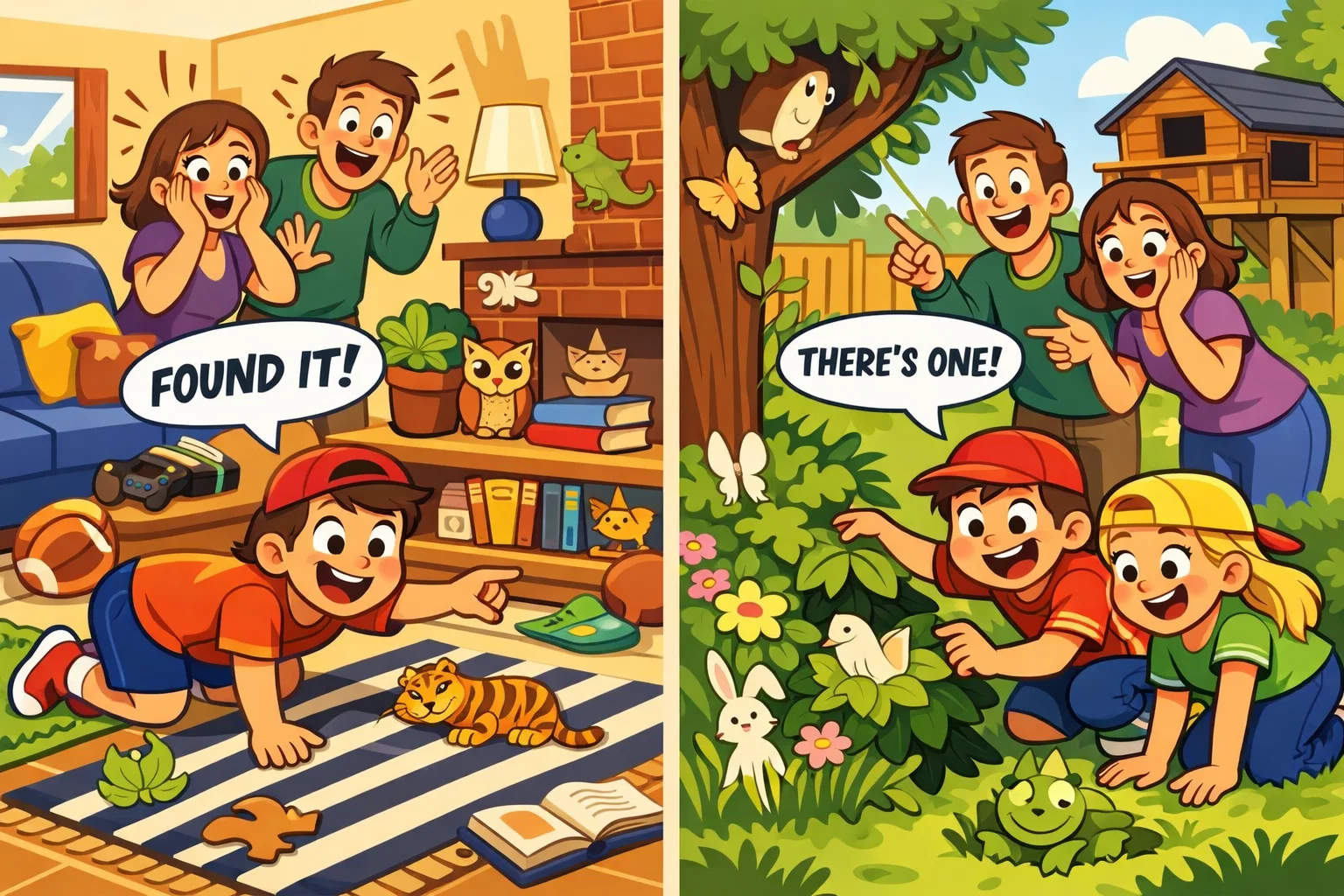
Parents can easily turn their homes into a laboratory for exploring camouflage. You don’t need a huge backyard; even a small apartment is full of interesting “habitats.”
Indoor Home Setup
Use common household items as your background. A pile of stuffed animals, a bookshelf, or a laundry basket full of colorful clothes are excellent hiding places. In one example, a green “paper worm” was hidden on a houseplant – it took the kids ten minutes to find it! This is a great way to keep kids engaged and learning without a screen.
Outdoor Nature Hunt
If you have access to a garden or park, take the game outside. This allows you to use real natural world elements like moss, bark, and dirt. You can even use white rice in a tray or contained area to show how “unnatural” colors stand out in a natural setting. Challenge your child to find actual camouflaged insects like grasshoppers or moths while you are out there.
Safety Guidelines
Always prioritize safety. If you are playing outdoors:
- Stay within designated boundaries.
- Remind children to be gentle with living organisms they might find.
- Provide constant supervision, especially if using small objects like beads or rice that could be a choking hazard for very young children.
Camouflage Game Video Resources
To supplement the hands-on learning, visual media can provide incredible examples of animal camouflage that you simply can’t replicate at home – like the color-changing skin of a chameleon or an octopus.
Short Explainer Video
Find a video that shows a “Time-Lapse” of a cuttlefish or a chameleon changing its colors and patterns. This helps children understand that while our paper animals stay one color, some real animals can match their surroundings in real-time.
Game Demonstration Video
Before you start, you might want to show a video of other children playing a similar predator game. This sets the expectations for the rules and shows them how much fun the “hunt” can be.
Reflection Video Activity
Encouraging children to “vlog” their results is a great way to build communication skills. Have them hold up their surviving paper butterfly and explain to the “audience” why it was so successful. “This butterfly lived because its stripe matched the shadow of the bookshelf!”
Common Camouflage Experiment Mistakes
Even the best-planned experiments can run into trouble. Here are a few things to avoid to keep the learning on track:
- Overcrowded Backgrounds: If you hide 50 items in a tiny shoe box, it becomes a “Where’s Waldo” puzzle rather than a lesson on how camouflage works. Give the items some space.
- Unequal Color Distribution: If you have 20 green items and only 2 red ones, the data will be skewed. Always start with equal numbers for a fair test.
- Skipping Reflection Step: The most common mistake is stopping once the “hunting” is over. The real learning happens when you ask your child to explain the “why” behind the results.
Age Adaptation for Predator Game
Preschool Version
For the youngest learners, keep it simple. Use large shapes and primary colors. Focus on the vocabulary: “Hide,” “Seek,” “Same,” and “Different.” Instead of tweezers, let them use their hands. The goal is simply to recognize that “same color” means “hard to see.”
Elementary School Version
This is the “sweet spot” for the full experiment. Introduce natural selection, the timer, and the data collection. This age group loves the competition and the chance to “engineer” their own prey.
Mixed Age Group Play
If you have children of different ages, let the older kids be the “Science Leads.” They can handle the timer and the data recording, while the younger ones focus on the “hunt.” This promotes sibling cooperation and allows everyone to participate at their skill level.