
11 Things to Know About What Your Child Will Study in Year 10

 Discover a Free Education Video App for Kids
Pastory uses AI to personalize educational video content based on your child’s interests and personality. Safe, engaging, and built for curious young minds. Sign up now to stay updated and enjoy early access with a free trial
Year 10 is the first year of Key Stage 4 and the start of the two-year GCSE program. Knowing what your child will study in Year 10 helps you support their subject choices, coursework, and exam preparation before the end of Year 11. English, Mathematics, and Science are compulsory for all students, while optional GCSE subjects shape the qualifications they work toward.
This guide covers the full Year 10 curriculum in the UK — from core subjects and GCSE options to study methods, school-directed pathways, and the academic routes that follow KS4.
Key Takeaways
- Year 10 is the first year of Key Stage 4, where students begin their two-year GCSE program.
- Core subjects — English, Mathematics, Science, and Physical Education — are compulsory for all Year 10 students.
- Students choose optional GCSE subjects that count toward their final qualifications at the end of Year 11.
- Year 10 includes coursework elements, internal exams, and mock tests alongside regular classroom learning.
- Subject choices in Year 10 influence Sixth Form options and longer-term post-16 education pathways.
Year 10 Key Stage 4 Overview
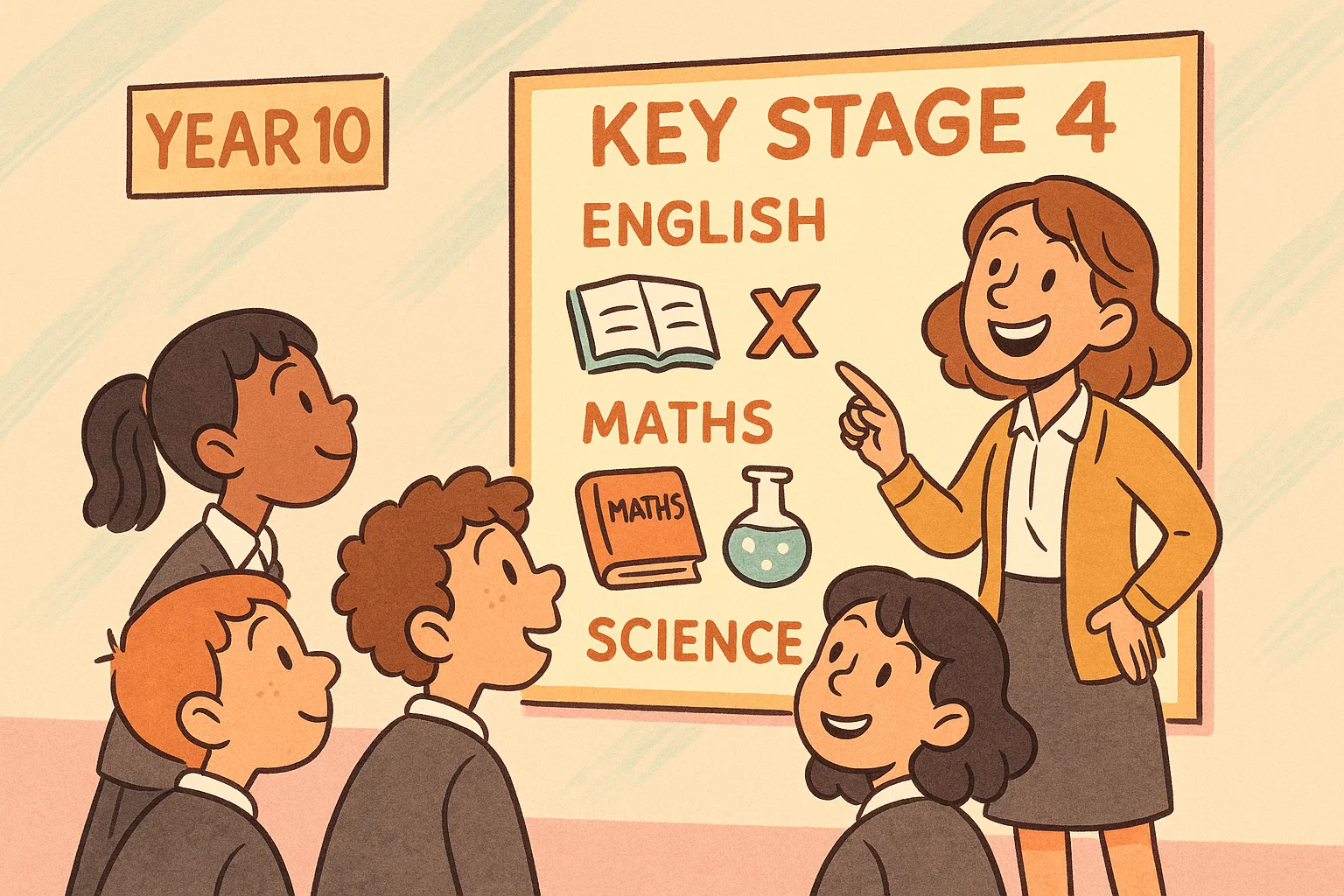
Year 10 is the official start of a student’s GCSE course journey. The general aim of this year is not just to begin covering the GCSE syllabus content, but to establish the strong problem-solving skills, knowledge, skills, and study routines necessary to manage their time well across multiple demanding subjects. Schools structure learning to ensure students can successfully navigate the increased depth and volume of material required for these national qualification exams.
KS4 Position in UK Education
Key Stage 4 encompasses Year 10 and 11, covering the ages of 14 to 16. It’s the mandatory phase of secondary education that directly precedes post-16 education, such as A-Levels or vocational qualifications. The entire stage is geared toward the final GCSE examinations, marking the main difference from Key Stage 3 (year 9 and earlier), which focuses on a wider range of subjects aimed at providing a comprehensive foundation.
- Key Stage 3 (KS3): Years 7, 8, and 9 (Ages 11-14). Broad curriculum, general exploration.
- Key Stage 4 (KS4): Year 10 and 11 (Ages 14-16). Focused GCSE studies, mandatory subjects, and personalized options.
- Post-16: Sixth form (A-Levels, IB, BTECs) or apprenticeships.
The UK education system uses this framework to ensure pupils follow the national curriculum and are assessed against consistent national standards before progressing.
Year 10 Learning Goals
The learning goals for a year 10 pupil are significantly more demanding than those in previous years, focusing on academic rigour and personal development.
- Exam Preparation: Systematically covering the first half of the GCSE syllabus for all chosen subjects, with an emphasis on applying key concepts.
- Deeper Subject Mastery: Moving beyond simple recall to deep subject knowledge and analytical thinking, requiring analytical and critical thinking.
- Independent Study Skills: Developing the ability to plan, organize, and execute self-directed study, homework, and revision outside of structured class time.
- Extended Assignments: Successfully completing longer coursework components or controlled assessments that often require research skills and complex project management.
- Develop Skills: Focusing on transferable skills such as reading and writing, clear presentation skills, and strong problem-solving.
Year 10 Assessments and Coursework
Assessment in year 10 is frequent and varied, serving as both a check-up (formative) and a gauge of final progress (summative). Schools use these assessments to provide invaluable feedback and project a student’s likely end of year 11 grade.
| Assessment Type | Purpose | Frequency | Impact on Final GCSE Grade |
| Internal Assessments/End-of-Unit Tests | To check the students’ understanding of specific topics; formative feedback. | Regularly (often weekly/fortnightly). | None directly, but informs predicted grades. |
| End of Year 10 Exams | To simulate the pressure of final exams and cover content from the entirety of the first GCSE year. | Annually, usually in the summer term. | None directly, but essential for planning targeted Year 11 revision. |
| Coursework/Non-Exam Assessment (NEA) | To assess practical/long-term skills (e.g., Art, Design and Technology, Computer Science projects). | Throughout Year 10 and 11. | Can contribute a significant percentage (e.g., 20-50%) to the final qualification. |
| Mock Exams | To trial exam technique, timing, and revision strategies. | Sometimes a mini-mock near the end of the year. | None directly, but crucial for measuring readiness. |
The move towards a 9-1 grading system in England means that students are focusing on achieving the highest numerical grades possible, where a Grade 4 is considered a standard pass and a Grade 5 is considered a strong pass.
Year 10 Core Subjects UK
All state school pupil in the UK, regardless of their chosen options, must study a set of core curriculum subjects that form the bedrock of their academic qualification. These compulsory subjects ensure a baseline level of literacy, numeracy, and scientific understanding.
English Language and English Literature
Students take two separate, yet complementary, GCSEs in English: English Language and English Literature. The goal is to enhance language skills, critical reading, and sophisticated writing.
- English Language GCSE: Focuses on reading and writing skills, analysing a range of fiction and non-fiction texts from different periods. Pupils learn to deconstruct how writers use language and structure to achieve their effects, and they practise composing their own non-fiction reading and writing (like articles, speeches, and letters) and imaginative writing.
- English Literature: Explores classic and modern literature. The core texts typically include a Shakespeare play (e.g., Macbeth), a 19th-century novel (e.g., Dickens’ A Christmas Carol), a modern text (e.g., An Inspector Calls), and a poetry anthology. This requires strong analytical skills to delve into themes, characterisation, and writer’s intent.
Mathematics
Maths is arguably the most vital core subject, as a good math qualification is a prerequisite for a vast majority of sixth form courses and apprenticeships. The GCSE syllabus focuses on developing problem-solving abilities and applying concepts across various domains.
Key areas of focus in year 10 often include:
- Algebra: Expanding, factorising, solving complex equations, and working with functions and graphs.
- Geometry: Trigonometry, circle theorems, and applying area and volume formulas.
- Statistics: Interpreting data, probability, and sampling.
- Number: Surds, indices, and advanced manipulation of numerical concepts.
Students will be entered for either the Foundation Tier (grades 1-5) or the Higher Tier (grades 4-9), a decision usually made by the subject teacher in consultation with the pupil and parents, based on their performance in Key Stage 3 and early Year 10 assessments.
Science (Separate or Combined)
All pupils must study Science, which is often taught as the three distinct disciplines of Biology, Chemistry, and Physics.
- Combined Science: This is the most common route, awarding two GCSEs (equivalent to two single qualifications). It covers the essentials of all three sciences.
- Separate Sciences (Triple Science): Students take individual GCSEs in Biology, Chemistry, and Physics, resulting in three qualifications. This option is generally recommended for those intending to study science subjects at A-Level, as it goes into greater depth and detail on the key concepts.
All science routes require practical assessments, ensuring students develop skills in experimental design and data analysis.
Physical Education Core
While most students do not take Physical Education as a full GCSE qualification, all are required to participate in compulsory Core PE lessons. Core PE focuses on lifelong fitness, health, and well-being, including an introduction to team sports and individual activities. The full GCSE PE is an optional subject that includes theoretical study of anatomy, physiology, and contemporary physical education issues, in addition to practical performance assessment.
Year 10 Optional Subjects (GCSE Choices)

The subjects a student chooses in Year 10 dramatically shape their academic direction for year 10 and year 11. Pupils typically select three or four optional subjects, in addition to the core subjects, allowing them to begin to specialise in areas of interest or align with potential career choices.
Popular GCSE Options
Schools offer a wide variety of subjects to ensure a broad and balanced curriculum, often grouping them to encourage variety, especially to meet the requirements of the English Baccalaureate (EBacc), which values a combination of English language and literature, math, sciences, a humanity subject (History or Geography), and a language GCSE.
| Subject Area | Common Options (Examples) | Typical Assessment Focus |
| Humanities | History, Geography, Religious Studies (RS), Sociology, Business Studies | Extended written analysis, source evaluation, case studies. |
| Creative Arts | Art & Design, Photography, Music, Drama | Practical portfolio, performance, coursework project, written critique. |
| Languages | French, Spanish, German, Mandarin | Listening, reading, writing, and speaking tests. |
| Technology | Computer Science, Design and Technology (DT), Food & Nutrition | Coding, practical product design, written examination on theory. |
Subject Requirements and Workload
When making their subject choices, students and parents must consider the nature of the workload. Some subjects are highly exam-focused (e.g., History, Math), while others rely heavily on long-term coursework or practical skills:
- Creative Subjects: Art, Design and Technology, and Drama often require a significant commitment to portfolio development and extended coursework project work, which is built up across year 10 and year 11. For example, in Art, the portfolio (Component 1) is typically 60% of the final grade.
- Modern Foreign Languages: A language GCSE (like French or Spanish) requires dedication to regular vocabulary practice and regular practice of the four skills: listening, speaking (often a controlled assessment with the subject teacher), reading and writing.
- Computer Science: This involves learning to compute through programming languages, understanding digital systems, and developing problem-solving logic, often with a non-exam assessment (NEA) component focusing on coding.
How Schools Support Choices
Making the right subject choices is critical. Schools provide structured guidance, understanding that these decisions influence A-Level suitability, university applications, and future career choices.
Support typically includes:
- Options Evenings: Presentations for pupils and parents detailing course content, assessment, and prerequisites.
- Careers Advice: Consultation with a careers advisor to link GCSE studies to post-16 and long-term education routes.
- Subject Teacher Consultations: Direct discussions with subject teachers to gain realistic feedback on a pupil’s aptitude and potential for success in their subject at GCSE.
Year 10 Curriculum Plans by Subject
To fully understand the demands of year 10, it helps to look at the specific content students will be able to cover. This deep dive into the GCSE course content demonstrates the significant step up in complexity from Key Stage 3.
Humanities (History and Geography)
Humanities subjects are vital for developing critical thinking, analysis, and the ability to evaluate different perspectives. They also satisfy the EBacc requirement.
- History: Focuses on specific historical periods and themes, such as the American West, Conflict and Tension in Asia, or Medicine through Time. The key skill is using evidence to form reasoned arguments and understanding the context of historical events.
- Geography: Typically split into physical and human geography. Physical geography covers topics like tectonic processes, coastal change, and weather hazards. Human geography explores urban issues, the global economy, and resource management (physical and human geography). The course is designed to help students learn to analyse global challenges and apply geographical skills.
STEM Subjects (Computer Science, Design, Engineering)
STEM (Science, Technology, Engineering, and Maths) options develop essential problem-solving skills and technological knowledge and skills crucial for a modern economy.
- Computer Science: Students learn how to compute, program, and understand the internal workings of digital systems. Key content includes algorithms, data representation, hardware/software, and the impact of computer science on contemporary British society.
- Design and Technology (DT): Requires creativity and practical application. Pupils work through the design process, from ideation to final prototyping, often specializing in areas like resistant materials, textiles, or product design. They learn about different materials, manufacturing processes, and the ethical/environmental impact of design. Learning about smart materials and sustainable design principles is a common theme.
Arts and Creativity (Art, Design, Photography, Drama, Music)
The creative subjects are invaluable for developing imagination, self-expression, and technical proficiency.
- Art, Design, Photography: These courses focus on developing technical skills, critical analysis of artists’ work, and building a strong, personal portfolio. The year typically involves skills-based workshops followed by an extended, sustained coursework project.
- Drama: Students study performance texts, theatrical practitioners, and techniques for creating and staging drama. A significant part of the course involves performance, often including a devised piece and an ensemble performance.
- Music: Students focus on three main areas: performing (solo and/or ensemble performance), composing, and listening/appraising various genres of music. The coursework project often includes both composition and performance recordings.
Languages (French, Spanish, German, Latin)
A language GCSE is highly valued by universities. The curriculum is designed to enhance a pupil’s linguistic ability and cultural knowledge and develop their communication skills.
- The focus is on applying vocabulary and grammar to real-world contexts across four skills: listening, speaking, reading, and writing.
- Topics often include identity, culture, jobs, travel, and environmental issues. For Latin or Classical Greek, the focus is primarily on translation skills and the study of classical civilization.
Year 10 GCSE Preparation
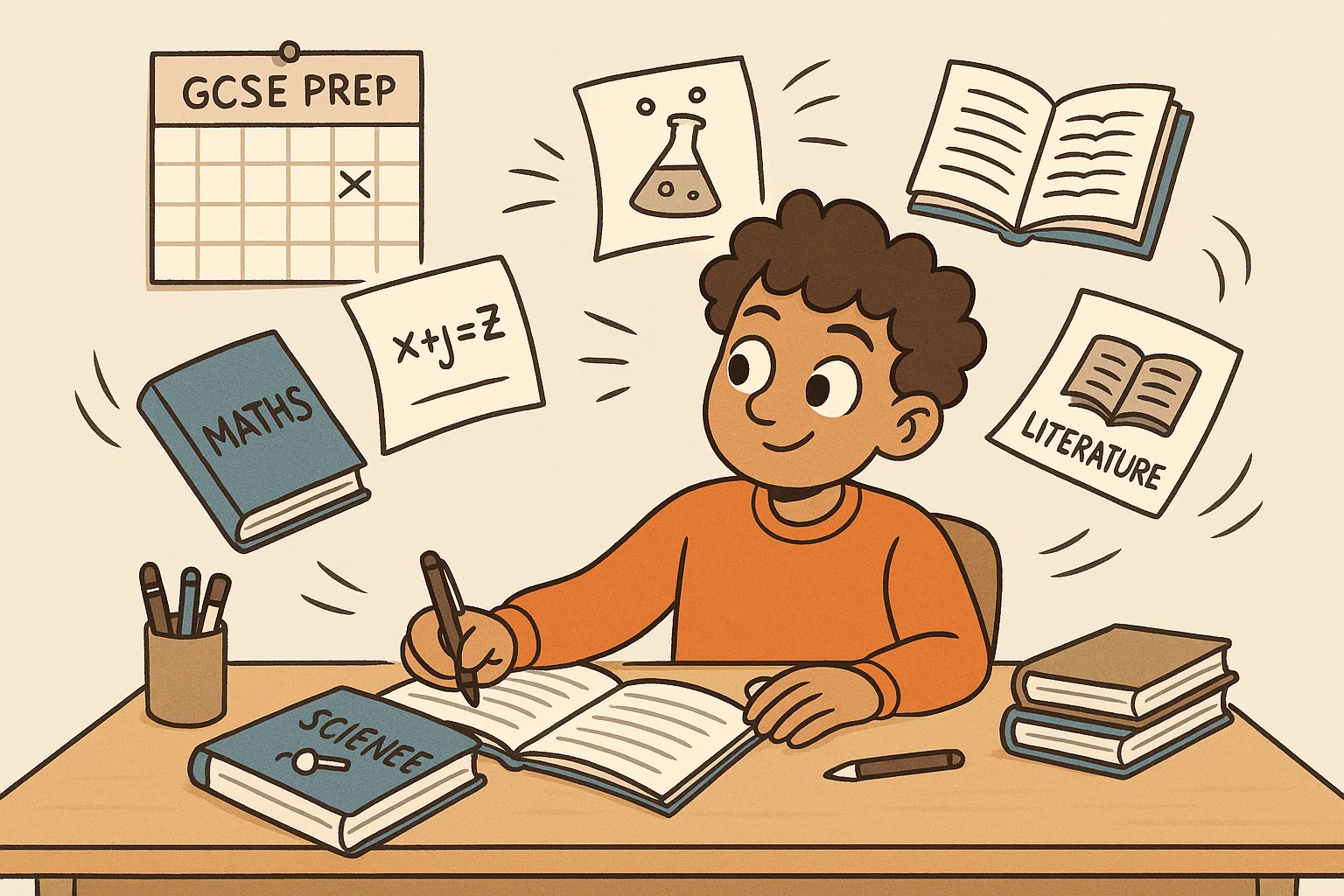
Year 10 is not just about learning content; it’s about forming the study habits that will determine success in year 11. It is the vital foundation year where students transition from being taught material to actively owning their learning process.
GCSE Coursework Elements
While many subjects have moved to linear, end-of-course exams, the Non-Exam Assessment (NEA) or coursework element remains crucial in practical and creative subjects.
- Marking Criteria: It is essential for a pupil to fully understand the specific marking criteria (provided by the exam board like Edexcel, AQA, or OCR) from the beginning of the GCSE course.
- Portfolios: Subjects like Art, Design and Technology, and Computer Science require maintaining a detailed, high-quality portfolio of work over the two years. This demands strong organizational skills and sustained effort, as opposed to last-minute revision.
Internal Exams and Mock Tests
The end of year 10 exams are the first major benchmark of a student’s ability to cope with the full GCSE examination environment.
Timing and Purpose: Held around June/July, these exams cover all content students learn during year 10. Their purpose is to:
- Identify strengths and weaknesses early.
- Provide realistic predicted grades for setting ambitious targets for year 11.
- Help students experience the full length and pressure of formal written exams.
Influence on Year 11 Planning: Poor results may prompt a discussion with the tutor or subject teacher about intervention strategies, or in rare cases, a review of tier-of-entry for subjects like Math and Science (e.g., from Higher Tier to Foundation Tier).
Study Techniques for Year 10
Establishing an effective independent learning and revision routine in year 10 is the best predictor of success in the end of year 11 final exams.
- Active Recall: Rather than simply re-reading notes, use flashcards, quiz yourself, or try to teach a topic to a parent/friend.
- Spaced Practice: Spread out revision sessions over longer periods rather than ‘cramming.’ A short review every week is more effective than a long one before an exam.
- Effective Note-Taking: Focus on distilling key concepts and processes. Use mind maps or the Cornell method.
- Manage Homework: Treat homework and class assignments as essential revision opportunities, especially in Maths where practice is paramount for embedding problem-solving skills and algebra.
Year 10 SDC Courses and School-Directed Pathways
Beyond the standard GCSE options, some schools offer School-Directed Curriculum (SDC) courses or non-examined subjects that enrich the academic program and support the development of a well-rounded pupil.
Classical Greek and Latin Options
While not offered everywhere, classical language GCSE options are highly valued for developing logic, deep reading and writing skills, and an understanding of foundational culture.
- Topics: Focus on translation skills, grammar, and a study of classical literature and history. These subjects appeal to students who enjoy detailed analysis and structured problem-solving.
- Value: Studying a classical language is often seen as excellent preparation for A-Levels in English, History, and Law.
Additional Music and Arts Programs
Many schools offer enrichment programs beyond the standard GCSE content, allowing a pupil to continue to develop their creative talents.
- Performance and Composition: Extended studies, often leading to graded external music exams or participation in large ensemble performance groups.
- Portfolio Enhancement: Extra-curricular art and design clubs that help students refine their techniques and build stronger evidence for their coursework project portfolio.
Design and Technology SDC Options
In some schools, pupils can engage in advanced, extended Design and Technology projects that allow them to explore specialized areas like engineering principles or advanced manufacturing techniques using smart materials. These are often designed to build upon the core curriculum and enhance practical and research skills.
Choosing Subjects in Year 10 UK
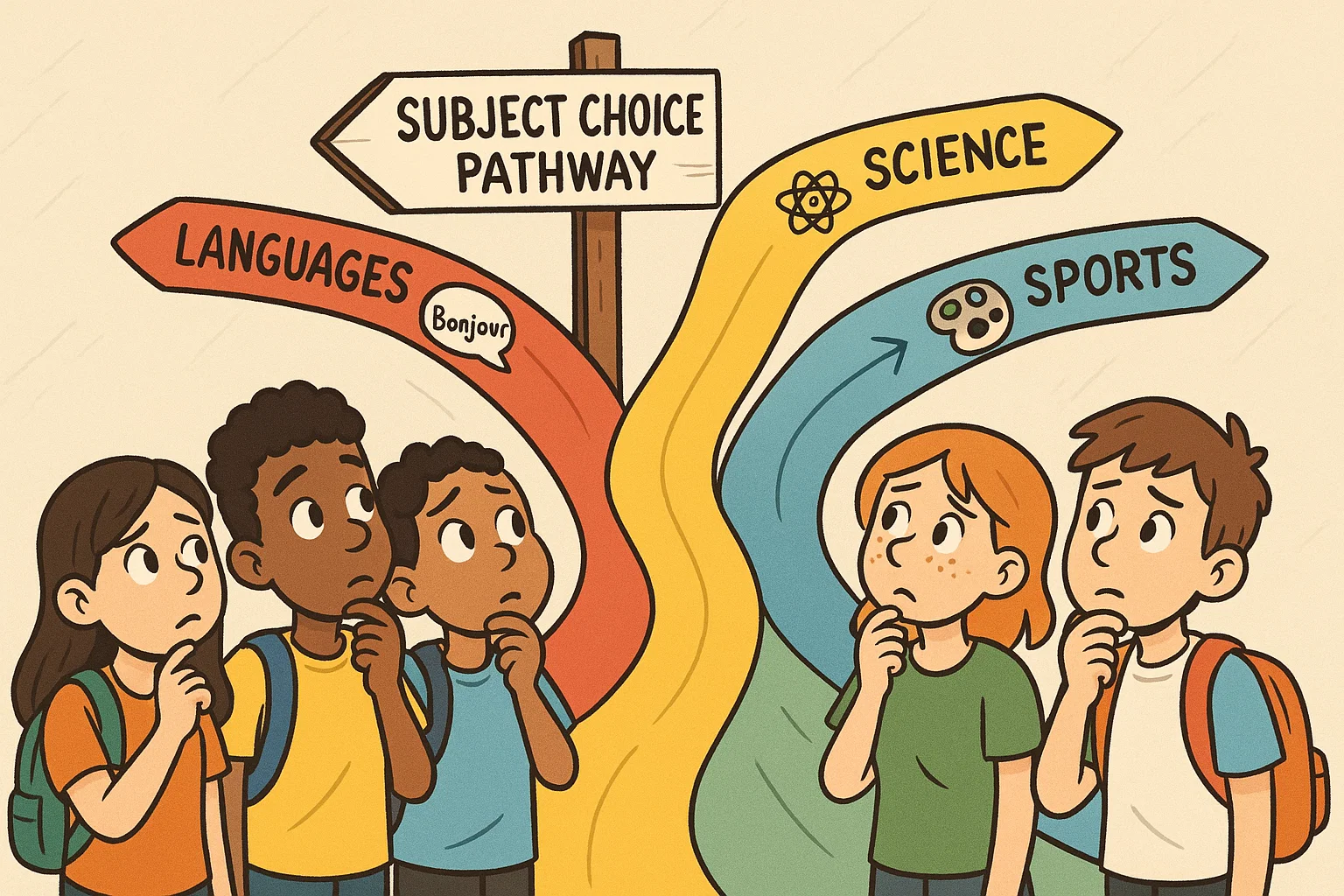
The decision of which subjects to choose in year 10 is perhaps the most significant academic choice a pupil and their parents will make during secondary school. It is an opportunity to tailor the core curriculum to individual strengths and future aspirations.
Choosing Subjects You Need
It is crucial to understand the link between GCSE subject choices and future academic and professional pathways.
- A-Levels/IB: Certain A-Level subjects have prerequisite GCSE grades. For example, to study A-Level Chemistry, you will almost certainly need at least a Grade 6 or 7 in Math and Science (either Combined or Separate Sciences).
- University Prerequisites: Although many universities primarily focus on A-Levels, high grades in core subjects (English and Maths) are almost always essential. Aspiring doctors or engineers will need Triple Science and often further math for a competitive application.
- The EBacc: Achieving the English Baccalaureate (a suite of GCSEs including a language and a humanity) demonstrates a strong, academic broad and balanced curriculum valued by many sixth form colleges and universities.
Choosing Subjects You Like and Are Good At
Motivation and aptitude are powerful drivers of high achievement. Students who choose subjects they genuinely enjoy are more likely to perform better.
- Enjoyment: If a subject sparks genuine curiosity, the pupil will be more intrinsically motivated to revise, complete their coursework, and delve into complex key concepts.
- Teacher Feedback: Honest conversation with the subject teacher provides the best gauge of a student’s natural strengths, particularly their subject knowledge and ability to apply problem-solving skills in that area.
What to Avoid When Choosing
Making a rational, informed decision is key. Avoid making subject choices based on fleeting or superficial reasons.
- Don’t follow friends: Classes are often shuffled for GCSE, and a subject that suits a friend may not align with your own strengths or future goals. Your focus should be on your qualification.
- Don’t choose based on a teacher: Subject teachers change. The quality of the course content and its relevance to your future is what matters.
- Don’t pick subjects that seem ‘easy’: The GCSE course is demanding across the board. Focusing on a subject you are naturally talented in or enjoy will lead to better results than a subject perceived as having less workload.
Interests and Aptitude
Self-reflection on your personality and preferred learning style should inform your choices:
- Do you like to compute and think logically? Computer Science or Further Math might be a good fit.
- Do you prefer practical, hands-on application? Design and Technology or GCSE PE may be more rewarding.
- Do you enjoy reading and critical debate? History, English Literature, or Geography will be strong choices.
How Students Learn in Year 10 UK
The shift in year 10 involves not just what students learn, but how they are expected to learn. The methodology is designed to enhance independent learning and analytical capacity.
Classroom Learning Methods
Teaching in year 10 and year 11 moves toward methods that require deeper engagement and application of knowledge and skills.
- Project-Based Learning (PBL): Often used in Science and Design and Technology, this approach involves solving a complex real-world problem over an extended period, requiring students to develop skills in research, collaboration, and presentation.
- Practical Experiments: Especially in Science, hands-on practicals are essential for verifying theory and students’ understanding of the scientific process.
- Analytical Group Work: Discussing complex texts or ethical dilemmas (e.g., in Religious Studies or English Literature) fosters the ability to form and articulate nuanced arguments.
Homework Volume and Revision Routines
The weekly workload increases significantly in year 10 as pupils begin their GCSE studies.
- A typical pupil might have up to two hours of focused homework and study per night. This is essential for consolidating key concepts and completing long-term assignments.
- A long-term revision routine should be established early, focusing on creating high-quality revision resources (e.g., summary notes, flashcards) for the end of the course.
Digital Tools and School Resources
Modern GCSE learning often relies on technology to support the curriculum:
- Online Learning Platforms: Schools use systems like Google Classroom or Firefly for distributing assignments, sharing resources, and setting remote tasks.
- Digital Textbooks: Access to specific exam board (like Edexcel) resources, past papers, and digital versions of textbooks supports independent learning.
- Research and Presentation Skills: Year 10 explicitly teaches students how to use the internet effectively for academic research and how to use digital media to enhance their presentation skills.
Support Links and Helpful Information
Navigating the complexities of Key Stage 4 requires access to reliable guidance and support. Parents and pupils should know where to find expert advice.
School and External Support
- Tutor: The form tutor is the primary point of contact for overall well-being, progress monitoring, and guidance on study skills.
- Subject Teacher: Best placed to provide feedback on specific academic performance and advice on tier-of-entry for GCSE math and science.
- SEN Provision: Special Educational Needs (SEN) support teams ensure that all pupils, including those with learning differences, have the necessary accommodations for assessments and independent learning.
- External Tutoring: Supplemental support, especially in core subjects like English and maths, can reinforce students’ understanding and build confidence.
Links to Additional Resources
For up-to-date and authoritative information, always refer to official sources:
- Official Curriculum Pages: The GOV.UK website contains the full details of the National Curriculum for Key Stage 4.
- GCSE Specifications: The websites of the main exam board (AQA, Edexcel, OCR, etc.) provide the exact, detailed content for every GCSE course, which can be invaluable for revision planning.
- Subject Guides: Many organizations and schools publish guides that detail the pathways from GCSE to A-Level and beyond.
More Useful Links
- Career Advice Services: Local government or national services often provide impartial advice on how qualification and subject choices impact future jobs and apprenticeships.
- Study Support Platforms: Reputable online platforms offer structured revision materials, video tutorials, and practice questions for the main core subjects and options.
- Qualification Frameworks: Understanding the Regulated Qualifications Framework (RQF) helps to put the GCSE qualification into the context of other vocational and academic awards.
Year 10 Academic Progression and Future Pathways
Year 10 is the first chapter of the GCSE story, and its successful completion is the essential springboard for the final, intensive year of study.
Transition to Year 11
The move from year 10 to year 11 involves a few major changes:
- Increased Workload: The remaining GCSE syllabus content is covered, and the focus shifts almost entirely to rigorous revision.
- Mock Exams: Full-scale mock exams become more frequent and consequential, as the results are often used for university and sixth form applications.
- Intensive Revision: The dedicated revision period begins, requiring independent learning and the application of proven study techniques to consolidate two years of knowledge and skills.
Sixth Form and Post-16 Options
Performance across year 10 and year 11 directly influences options post-16:
- A-Levels: These require the highest GCSE grades, often a minimum of 5 or 6 in the desired subject. A strong, balanced portfolio of GCSEs is crucial for competitive sixth form places.
- BTEC/Vocational Pathways: These courses focus on practical skills and work-related learning, often offering a direct route into apprenticeships or specific sectors. They still require solid grades in English and maths.
Long-Term Education Routes
The GCSE qualification is the first significant academic stepping stone, shaping the entire journey through the education system.
- University Direction: The subjects chosen in year 10 lay the groundwork for degree-level study. For example, a student interested in a highly competitive science degree must have demonstrated a high level of subject mastery and application through Separate Sciences at GCSE.
- Career Influence: While a specific GCSE may not dictate a career, the overall results and the combination of skills (e.g., analytical from History, problem-solving from Maths) demonstrate to employers the pupil’s foundational competence and work ethic.
FAQ Year 10 UK
What is Year 10 in the UK?
Year 10 is the first year of the two-year Key Stage 4 (KS4) program in the UK, where students begin their official GCSE studies. It involves studying core subjects and personally selected options, focusing on the specialized knowledge and skills required for the final exams at the end of year 11.
Age of Year 10 Students
Pupils in Year 10 are typically 14 to 15 years old at the start of the academic year (usually turning 15 during the course of the year).
US Grade Equivalents
Year 10 in the UK corresponds roughly to the beginning of High School in the US, generally equivalent to Grade 9 or Grade 10, depending on the US school system and specific curricula.
What Exams Are Taken in Year 10?
While the final, formal GCSE exams occur at the end of year 11, Year 10 students typically take a major set of internal exams or “end of year” exams to assess their progress. They also complete ongoing assessments and controlled assessments for any coursework components in their chosen subjects.
What Level is Year 10?
Year 10 is part of Key Stage 4 in the National Curriculum. The qualification level targeted at the end of year 11 (the GCSE grade 4-9) is broadly equivalent to Level 2 in the UK’s National Qualification Framework (NQF), signifying a good level of vocational and academic competence.

Take a short quiz to find out what your everyday choices say about your parenting style
When your child is curious about something new, what’s your instinct?
Take a short quiz to find out what your everyday choices say about your parenting style
“Can I download this app?” What happens next?
Take a short quiz to find out what your everyday choices say about your parenting style
When it comes to rules at home, which sounds most like you?
Take a short quiz to find out what your everyday choices say about your parenting style
If you could give your child one life skill today, what would you pick?
Take a short quiz to find out what your everyday choices say about your parenting style
Your child gets to choose what to watch. What would your ideal setup look like?
Take a short quiz to find out what your everyday choices say about your parenting style
Pick your parenting superpower ✨



