
Riddles for 9 Year Olds with Answers: Funny & Tricky Picks

 Discover a Free Education Video App for Kids
Pastory uses AI to personalize educational video content based on your child’s interests and personality. Safe, engaging, and built for curious young minds. Sign up now to stay updated and enjoy early access with a free trial
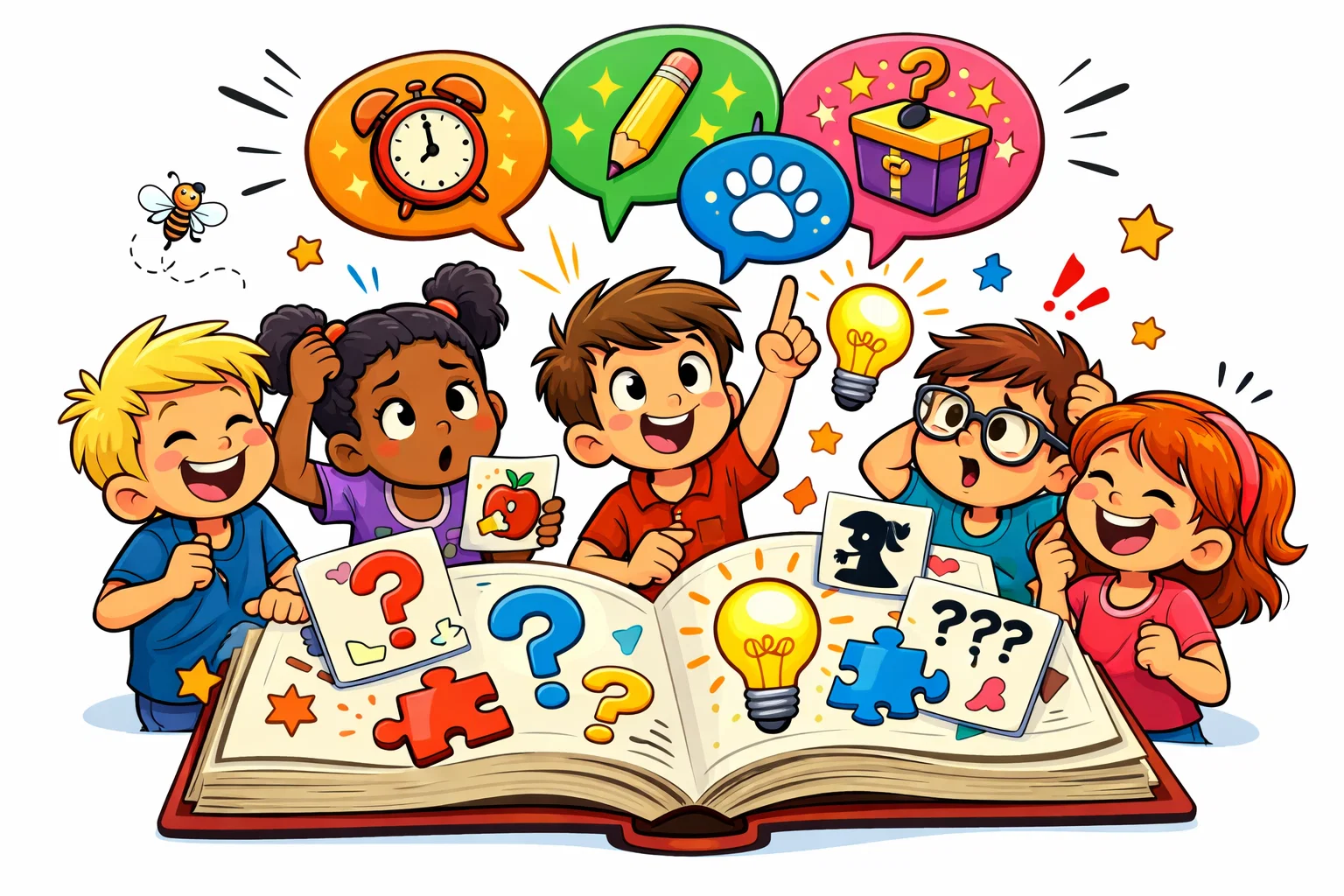
Looking for the perfect way to challenge kids and keep their young minds sharp? This collection of riddles for kids offers a mix of humor, logic, and creative thinking. Designed for the developmental stage of a nine-year-old, these fun puzzles include answers in parentheses, making them perfect for quick play at home, at school, or during long car rides.
What Makes Riddles Great for 9 Year Olds
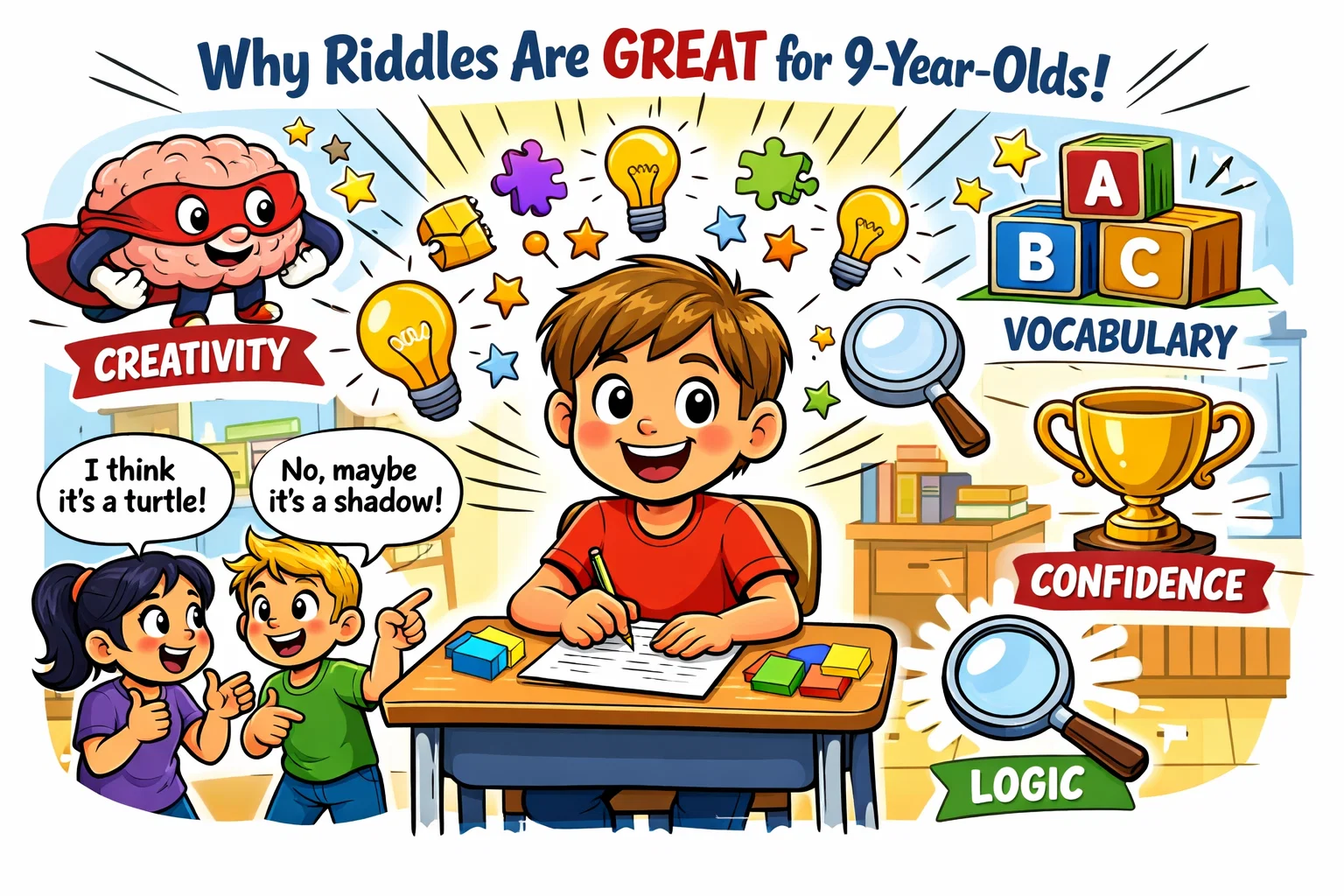
At age nine, children are often in a cognitive “sweet spot.” They have moved past purely literal thinking and are beginning to master the nuances of language, puns, and double meanings. Solving riddles at this age is not just a game; it can also support cognitive development and social bonding through healthy competition and shared laughter.
Skill Level for Age 9
Nine-year-old children are typically in fourth or fifth grade, where they can usually handle tricky riddles without too much frustration. The ideal puzzle for this group balances easy riddles that provide a quick confidence boost with hard riddles that require deeper analysis. Riddles can help children transition from concrete to more abstract reasoning.
Best Riddle Length for Fast Reading
To keep kids engaged, brevity is key. Short brain teasers consisting of one to three lines are most effective for maintaining the attention of a nine-year-old. This “quick-fire” format works well for digital reading and helps parents keep kids engaged during short transitions, such as waiting for a meal or riding in the car.
Answer Style Kids Like Most
Kids often enjoy answers involving tangible, everyday objects. Answers like shadow, name, hole, or clock are especially satisfying because children can visualize the solution immediately. This concrete connection helps build the problem-solving skills necessary for more advanced academic subjects.
Easy Riddles for 9 Year Olds with Answers
Starting with easy riddles is a good way to build momentum. It provides a “win” for the child, which encourages them to take on more tricky riddles later. These 25 picks are perfect for a mental warm-up.
Short Riddles
- What has to be broken before you can use it? (An egg)
- What has a neck but no head? (A bottle)
- What gets wetter the more it dries? (A towel)
- What has hands but cannot clap? (A clock)
- What goes up but never comes down? (Your age)
- What has one eye but cannot see? (A needle)
- What is full of holes but still holds water? (A sponge)
- What has a face but no eyes, nose, or mouth? (A clock)
First Riddles for Warm-Up
- I’m tall when I’m young, and I’m short when I’m old. What am I? (A candle)
- What has many needles but cannot sew? (A Christmas tree)
- What belongs to you, but others use it more than you do? (Your name)
- The more of this there is, the less you see. What is it? (Darkness)
- What can you catch but not throw? (A cold)
- What has a thumb and four fingers but no flesh or bone? (A glove)
- What has a head and a tail but no body? (A coin)
- What has legs but cannot walk? (A table)
Classic Easy Riddles Kids Know and Love
- I follow you around all day, but when the sun goes down, I go away. What am I? (Your shadow)
- What has keys but no locks and a space but no room? (A keyboard)
- What can you break, even if you never pick it up or touch it? (A promise)
- What starts with T, ends with T, and has T in it? (A teapot)
- What has words but never speaks? (A book)
- What runs but never walks, and has a mouth but never talks? (A river)
- What kind of cup can’t hold water? (A cupcake)
- I have cities but no houses, mountains but no trees. What am I? (A map)
- What kind of room has no doors or windows? (A mushroom)
Funny Riddles for 9 Year Olds with Answers
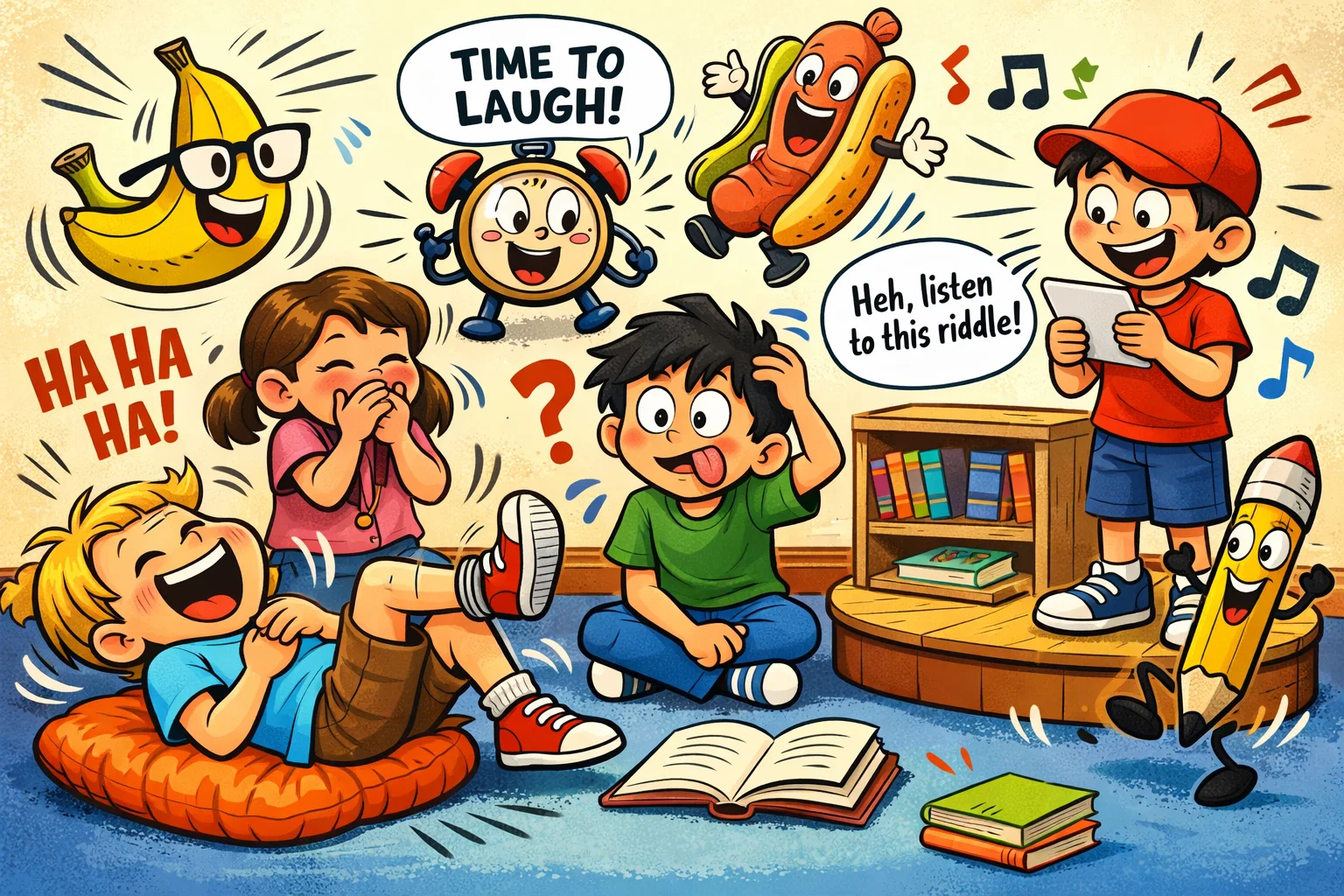
Humor is a powerful tool to help kids lower their stress and increase engagement. Funny riddles for kids are often the most popular because they give children a fun social “win” when shared with friends.
Silly Riddles
- Why did the teacher wear sunglasses to school? (Because her students were so bright!)
- What do you call a bear with no teeth? (A gummy bear)
- What building has the most stories? (The library)
- Why can’t a nose be 12 inches long? (Because then it would be a foot!)
- What do you call a sleeping dinosaur? (A dino-snore)
- What do you call a fake noodle? (An impasta)
- What did the zero say to the eight? (Nice belt!)
- Why are ghosts such bad liars? (Because you can see right through them!)
Laugh-Out-Loud Riddles
- What kind of tree can you carry in your hand? (A palm tree)
- Why did the golfer bring two pairs of pants? (In case he got a hole in one!)
- What do you call an alligator in a vest? (An in-vest-igator)
- What did the ocean say to the beach? (Nothing, it just waved)
- What has one eye but can’t see a thing? (A potato)
- Why did the student eat his homework? (Because the teacher said it was a piece of cake!)
- What do you call a pig that knows karate? (A pork chop)
- How do you make the number one disappear? (Add the letter G and it’s “Gone”)
Riddles Kids Can Retell to Friends
- What is a witch’s favorite subject in school? (Spelling)
- What has hair on its head but no brain? (A brush)
- Why did the computer go to the doctor? (Because it had a virus!)
- What do you call a dog that can tell time? (A watch dog)
- What do you call a fly with no wings? (A walk)
- Why did the cookie go to the hospital? (Because he felt crummy)
- What animal is the best at hitting a baseball? (A bat)
- What stays in the corner but travels around the world? (A stamp)
Tricky Riddles for 9 Year Olds with Answers
This section focuses on critical thinking and problem-solving skills. These tricky riddles use wordplay to lead the brain down one path before revealing a surprising logical twist.
Wordplay Riddles
- What month of the year has 28 days? (All of them)
- What word is spelled incorrectly in every dictionary? (Incorrectly)
- What begins with E, ends with E, but contains only one letter? (An envelope)
- Which is heavier: a pound of bricks or a pound of feathers? (They both weigh the same—one pound)
- What word has five letters but gets shorter when you add two more to it? (Short)
- If you drop a yellow hat in the Red Sea, what does it become? (Wet)
- What is at the end of a rainbow? (The letter W)
- What has four eyes but cannot see? (Mississippi)
Logic Twist Riddles
- If an electric train is traveling south, which way is the smoke blowing? (There is no smoke—it’s an electric train!)
- A girl fell off a 20-foot ladder but didn’t get hurt. How? (She fell off the bottom step)
- What can you pass to the person on your left without moving? (A ball or a baton)
- If you’re running a race and you pass the person in second place, what place are you in? (Second place)
- What can you hold in your left hand but not in your right? (Your right elbow)
- Imagine you are in a sinking boat surrounded by sharks. How do you survive? (Stop imagining!)
Second-Thought Riddles
- I have branches, but no fruit, trunk, or leaves. What am I? (A bank)
- What has many teeth but cannot bite? (A comb)
- What is always in front of you but can’t be seen? (The future)
- What can you break, even if you never pick it up or touch it? (Silence)
- The more you take, the more you leave behind. What am I? (Footsteps)
- What has a head and a tail but no body? (A coin)
- What has one horn but isn’t a unicorn? (A rhinoceros)
Hard Riddles for Smart 9 Year Olds with Answers
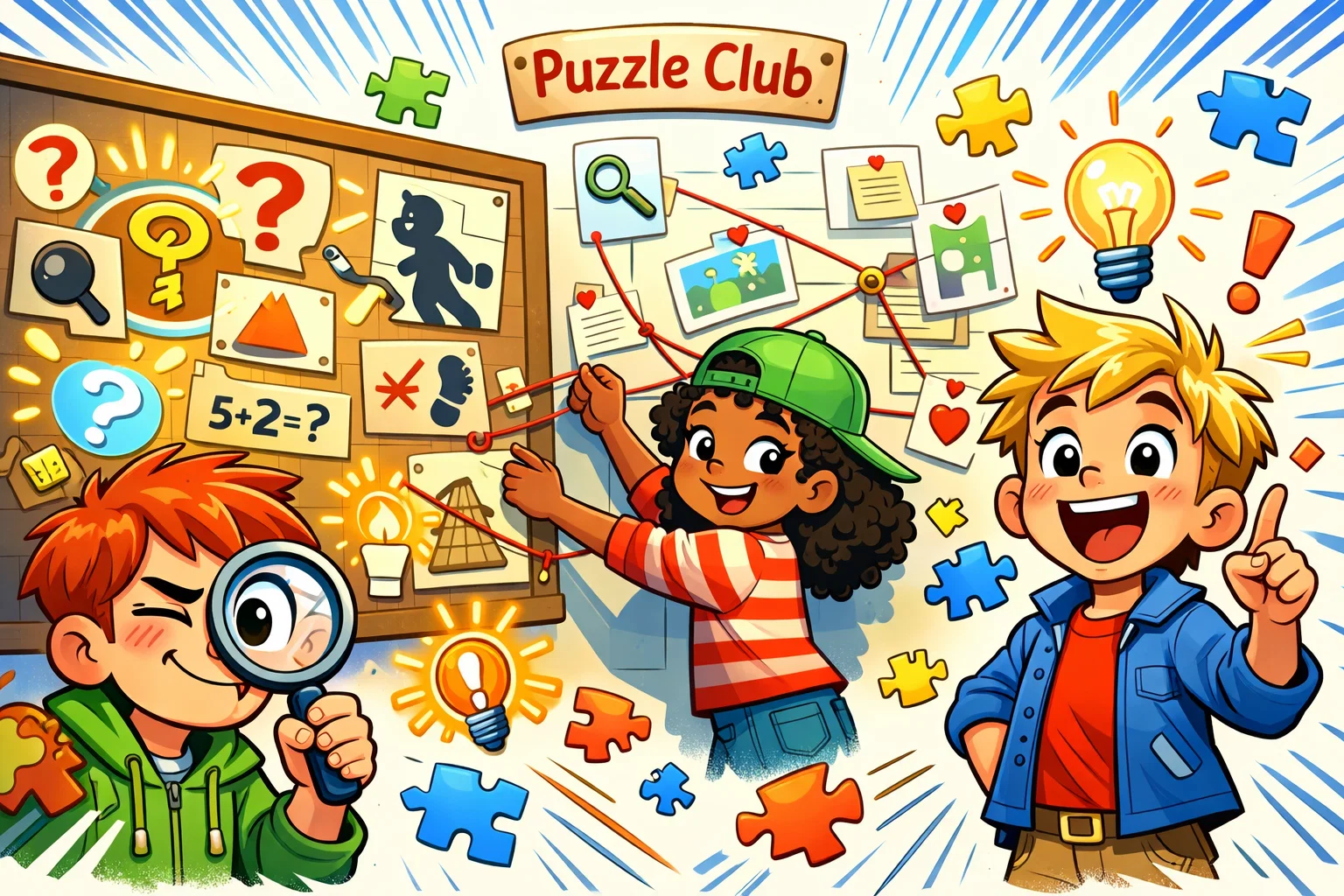
For children who are ready for a serious challenge, these hard riddles require lateral thinking. They are designed to get kids thinking by using descriptions that seem impossible at first.
Hard Riddles with Simple Answers
- I am light as a feather, yet the world’s strongest man can’t hold me for very long. What am I? (Breath)
- What is so fragile that saying its name breaks it? (Silence)
- What has a bed but never sleeps, and a mouth but never speaks? (A river)
- I have no life, but I can die. What am I? (A battery)
- The person who makes it doesn’t need it. The person who buys it doesn’t use it. The person who uses it doesn’t know it. What is it? (A coffin)
- I have cities but no houses, mountains but no trees, and water but no fish. What am I? (A map)
Brain Teasers for Clever Kids
- What can fill a room but takes up no space? (Light)
- If you have me, you want to share me. If you share me, you haven’t got me. What am I? (A secret)
- What comes once in a minute, twice in a moment, but never in a thousand years? (The letter M)
- What has one eye but cannot see? (A needle)
- What stays hot even if you put it in the refrigerator? (A pepper)
- What has a thumb but no fingers? (A mitten)
Lateral Thinking Riddles
- A man was walking in the rain. He was in the middle of nowhere. He had nothing and nowhere to hide. He came home all wet, but not a single hair on his head was wet. Why? (He was bald)
- What gets sharper the more you use it? (Your brain)
- A man calls his dog from the opposite side of the river. The dog crosses the river without getting wet, and without using a bridge or a boat. How? (The river was frozen)
- What is the only place where yesterday comes after today? (A dictionary)
- What has many keys but can’t open a single lock? (A piano)
Short Riddles for 9 Year Olds with Answers
Short-form riddles are a great way to fill small gaps in the day. These one-liners are perfect for quick reading and for keeping kids entertained in busy environments.
One-Line Riddles
- What has a face but no eyes? (A clock)
- What has a thumb but no hand? (A glove)
- What is full of holes but holds water? (A sponge)
- What kind of dog doesn’t bark? (A hot dog)
- What has a tail and a head but no body? (A coin)
Quick Riddles for Classroom Breaks
- What building has the most stories? (The library)
- What goes up when the rain comes down? (An umbrella)
- What has hands but cannot clap? (A clock)
- What gets wetter as it dries? (A towel)
- What has a neck but no head? (A bottle)
Fast Riddles for Car Rides
- What is easy to get into but hard to get out of? (Trouble)
- What belongs to you but is used more by others? (Your name)
- What has a head and a foot but no body? (A bed)
- What is orange and sounds like a parrot? (A carrot)
- What has 13 hearts but no other organs? (A deck of cards)
Animal Riddles for 9 Year Olds with Answers
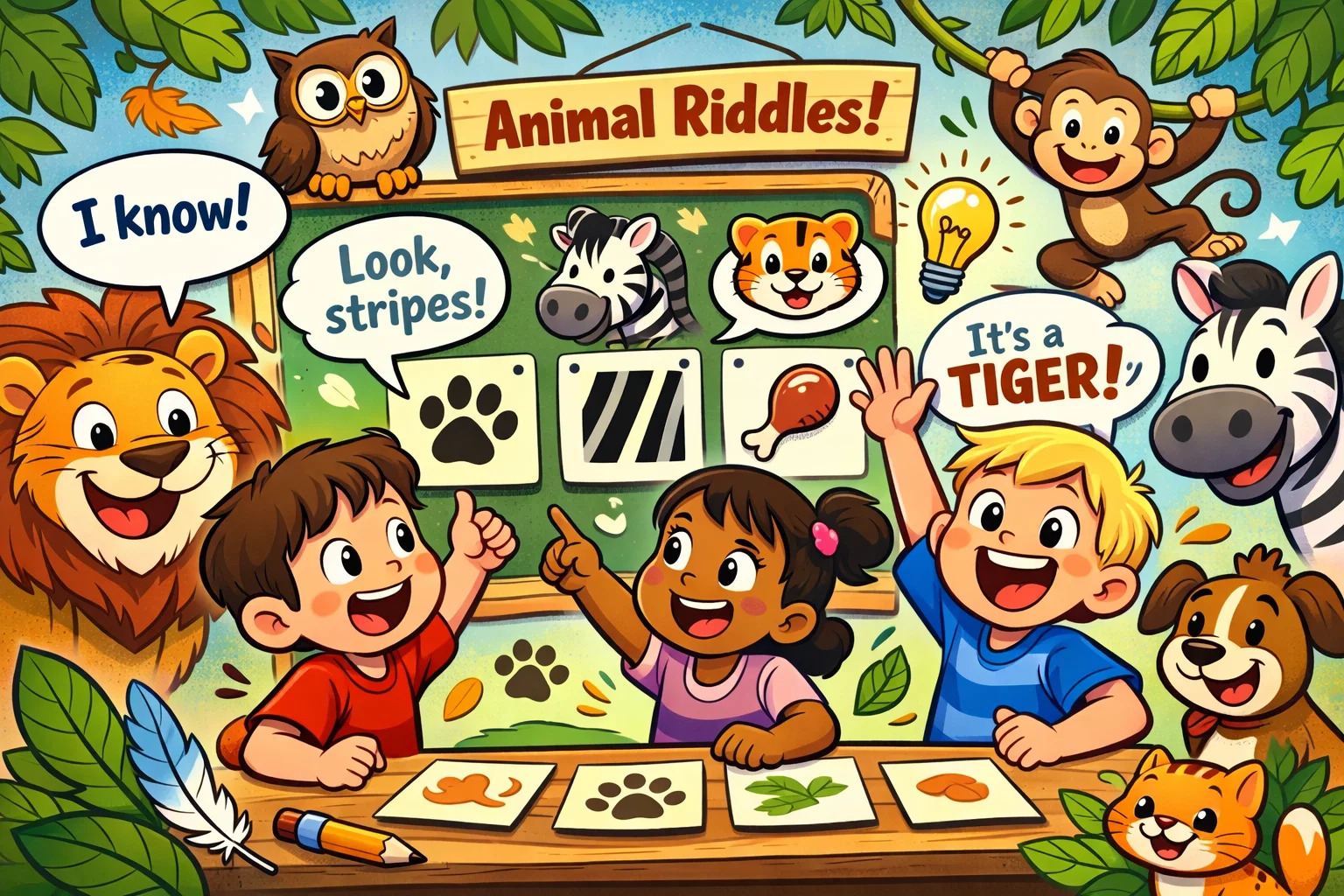
Animal riddles are a classic part of children’s wordplay and learning. They encourage kids to visualize physical traits and habitats, which can support observation skills and general knowledge about animals.
Farm Animal Riddles
- I have a pink tail and I love to play in the mud. What am I? (A pig)
- I give you milk and I have spots. What am I? (A cow)
- I wake the farm up in the morning with a loud crow. What am I? (A rooster)
- I have wool and I say “Baa.” What am I? (A sheep)
- I am a bird that can swim but cannot fly. I say “Quack.” What am I? (A duck)
Wild Animal Riddles
- I am the king of the jungle and have a large mane. What am I? (A lion)
- I am grey, have big ears, and a very long trunk. What am I? (An elephant)
- I have black and white stripes and look like a horse. What am I? (A zebra)
- I sleep upside down and use sound to find my way. What am I? (A bat)
- I have a long neck to reach the leaves on tall trees. What am I? (A giraffe)
Pet Riddles
- I purr when I’m happy and I love to chase mice. What am I? (A cat)
- I am man’s best friend and I love to go for walks. What am I? (A dog)
- I live in a bowl and I have scales. What am I? (A fish)
- I have long ears and I love to hop and eat carrots. What am I? (A rabbit)
- I store food in my cheeks and run on a wheel. What am I? (A hamster)
Math Riddles for 9 Year Olds with Answers
Math brain teasers for kids are a fun way to build number sense without the pressure of a test. These math riddles blend logic with basic arithmetic to improve thinking skills.
Number Riddles
- I am an odd number. Take away one letter and I become even. What number am I? (Seven—S-even)
- What can you put between a 7 and an 8 so that the result is greater than 7 but less than 8? (A decimal point—7.8)
- I am a number that is twice the sum of my digits. What am I? (18—because 1 + 8 = 9 and 9 × 2 = 18)
- Which is heavier: 10 pounds of gold or 10 pounds of air? (They weigh the same)
- How many sides does a circle have? (Two—the inside and the outside)
Counting Riddles
- If there are three apples and you take away two, how many apples do you have? (Two—the ones you took)
- A man has 17 sheep and all but 9 die. How many are left? (9)
- How many months have 28 days? (All 12 months)
- What are the only two numbers you can multiply to get the same answer as when you add them? (2 and 2—because 2+2=4 and 2*2=4)
- How many times can you subtract 5 from 25? (Once—after that, you are subtracting from 20)
Math Wordplay Riddles
- Why was the math book sad? (It had too many problems)
- What do you call a crushed angle? (A rectangle—”wrecked-angle”)
- What did the triangle say to the circle? (You’re pointless!)
- Why is the number six afraid of seven? (Because seven ate/eight nine!)
- Where do math teachers go on vacation? (Times Square)
School Riddles for 9 Year Olds with Answers
The school environment provides plenty of inspiration for riddles for kids. These are especially useful as classroom icebreakers or “brain breaks.”
Classroom Riddles
- I am full of stories but I never speak. What am I? (A book)
- I have a wooden coat and a lead heart. What am I? (A pencil)
- I get smaller the more I help you correct your mistakes. What am I? (An eraser)
- I have a face but no eyes, and I tell you when to leave. What am I? (The school clock)
- I have legs but cannot walk, and I help you do your work. What am I? (A desk)
Back-to-School Riddles
- I carry your books and wear two straps on my back. What am I? (A backpack)
- I am a box that holds your food so it stays fresh for lunch. What am I? (A lunchbox)
- I am a big yellow bus that takes you to school. What am I? (A school bus)
- I have 12 inches but no feet. What am I? (A ruler)
- I have many pages and you write your notes in me. What am I? (A notebook)
Reading and Word Riddles
- What has thousands of letters but no alphabet? (The post office)
- I am a book that tells you what words mean. What am I? (A dictionary)
- What has a spine but no bones? (A book)
- What letter is a drink? (The letter T)
- What starts with P and ends with E and has thousands of letters? (The Post Office)
Science Riddles for 9 Year Olds with Answers
Science-themed brain teasers help children explore concepts like gravity, light, and astronomy in a playful way.
Space Riddles
- I am a star that gives you light during the day. What am I? (The sun)
- I have rings around me and I am a giant planet. What am I? (Saturn)
- I change my shape every night but I never leave the sky. What am I? (The moon)
- We are millions of lights in the sky that you see at night. What are we? (Stars)
- I am the “Red Planet.” What am I? (Mars)
Nature Riddles
- I fall but I never get hurt. I pour but I have no pitcher. What am I? (Rain)
- I can be felt but not seen. I can blow down a house but have no hands. What am I? (The wind)
- I am white, fluffy, and I float in the sky. What am I? (A cloud)
- I have a trunk but no clothes, and many arms but no hands. What am I? (A tree)
- I am a giant body of salt water where sharks live. What am I? (The ocean)
Food Riddles for 9 Year Olds with Answers
Food riddles are universally understood and provide a great way to pass the time during family meals.
Fruit and Veggie Riddles
- I have eyes but cannot see, and I grow underground. What am I? (A potato)
- I am red, have seeds on the outside, and am very sweet. What am I? (A strawberry)
- I am orange, crunchy, and rabbits love me. What am I? (A carrot)
- I have a green skin and red inside with black seeds. What am I? (A watermelon)
- I have many layers, and if you peel them, I might make you cry. What am I? (An onion)
Snack Riddles
- I am a ring of dough with a hole in the middle. What am I? (A doughnut)
- I am a cold treat on a stick that melts in the sun. What am I? (A popsicle)
- I am a small cake in a paper cup. What am I? (A cupcake)
- I am a “dog” that you can eat at a baseball game. What am I? (A hot dog)
- I am white, crunchy, and you eat me at the movies. What am I? (Popcorn)
Holiday Riddles for 9 Year Olds with Answers
Holiday riddles add a fun seasonal element. They are excellent for holiday-themed parties or family gatherings.
Halloween Riddles
- I am orange, I have a carved face, and I glow at night. What am I? (A Jack-o’-lantern)
- I am white, I say “Boo,” and I can walk through walls. What am I? (A ghost)
- I fly on a broomstick and wear a pointy hat. What am I? (A witch)
- I spin a web to catch my dinner. What am I? (A spider)
- I have no skin, I’m made of bones, and I rattle. What am I? (A skeleton)
Christmas Riddles
- I have a red nose and I lead Santa’s sleigh. What am I? (Rudolph)
- I am made of snow, I have a carrot nose, and I melt in the sun. What am I? (A snowman)
- I am a green tree that you decorate with lights. What am I? (A Christmas tree)
- I am Santa’s little helper and I make toys. What am I? (An elf)
- You hang me by the chimney and hope I am filled with toys. What am I? (A stocking)
Best Riddles for Family Game Night
To get the most out of this list of riddles, consider turning them into a structured game.
Riddles for Home
Create a “Riddle Tournament” where the winner gets to choose the movie for the evening. Have one adult read the riddle, and the first child to shout the answer gets a point. This encourages active listening and quick problem-solving skills.
Riddles for Road Trips
Road trips can easily become boring for kids. Print out this guide and have one passenger read the riddles out loud. Since these riddles for kids are verbal, they help keep eyes off screens, which can reduce motion sickness.
Riddles for Birthday Parties
Integrate riddles into a scavenger hunt. Instead of telling the kids where to go, give them a puzzle. For example: “I have a handle and a door, and I keep your milk cold.” (The kids run to the refrigerator to find their next clue.)
Benefits of Riddles for 9 Year Olds
Beyond the fun, riddles can also offer educational benefits. Child-development theories, including Piaget’s stages of development, suggest that logical puzzles can support cognitive growth.
Critical Thinking
Riddles force children to question their initial assumptions. By solving riddles, they learn that a problem might have a non-obvious solution. This is a core component of critical thinking and problem-solving skills used in science and math.
Vocabulary Growth
Riddles are a great way to introduce new words and double meanings. When a child learns a pun, they are effectively learning two definitions for one word, which broadens their linguistic range.
Confidence and Social Fun
Successfully guessing a hard riddle can give children an immediate sense of satisfaction. It can build a child’s confidence and give them a positive way to interact with other kids.
How to Create Riddles with 9 Year Olds
Once your child has mastered these, encourage them to write their own.
Start with Answer
Choose a simple object, like a “pencil.”
Brainstorm Clues
List its physical attributes: yellow, wooden, has an eraser, and is used for writing.
Add Twist
Instead of saying “it has lead,” say “it has a lead heart.” Instead of “you write with it,” say “it gets shorter the more it works.”
Check Age Fit
Make sure the riddle is not so abstract that other children cannot solve it.
Write Final Version
“I am yellow and wooden with a lead heart. I get shorter the more I help you with your art. What am I?” (A pencil)
Tips for Choosing the Right Riddles for Age 9
To keep kids entertained without causing frustration, follow these three rules:
- Pick by Difficulty: Start easy to build confidence, then move to tricky riddles.
- Pick by Interest: Choose animal riddles for animal lovers or math riddles for numbers fans.
- Avoid Frustration: If they don’t get it after two hints, tell them the answer and explain the logic.
FAQ
What are the benefits of riddles for kids?
Riddles improve logic, vocabulary, and social confidence. They also help develop critical thinking and problem-solving skills.
Do riddles help with child development?
Yes, they can support cognitive development and help children move from more concrete to more abstract thinking.
How do riddles improve speech and vocabulary?
They introduce puns, homonyms, and metaphors, which can help expand language skills and vocabulary.
How can parents use riddles at home?
Use them during dinner, as bedtime brain teasers, or to turn chores into a game.
How can teachers use riddles in class?
Teachers can use them as “brain breaks” between subjects, as morning icebreakers, or as a way to introduce a new topic in science or math.
Which riddles work best for smart 9 year olds?
Many bright 9-year-olds enjoy hard riddles that involve lateral thinking and simple but non-obvious answers, such as “silence” or “the future.”

Take a short quiz to find out what your everyday choices say about your parenting style
When your child is curious about something new, what’s your instinct?
Take a short quiz to find out what your everyday choices say about your parenting style
“Can I download this app?” What happens next?
Take a short quiz to find out what your everyday choices say about your parenting style
When it comes to rules at home, which sounds most like you?
Take a short quiz to find out what your everyday choices say about your parenting style
If you could give your child one life skill today, what would you pick?
Take a short quiz to find out what your everyday choices say about your parenting style
Your child gets to choose what to watch. What would your ideal setup look like?
Take a short quiz to find out what your everyday choices say about your parenting style
Pick your parenting superpower ✨



