Animal Sound Games for Kids

 Discover a Free Education Video App for Kids
Pastory uses AI to personalize educational video content based on your child’s interests and personality. Safe, engaging, and built for curious young minds. Sign up now to stay updated and enjoy early access with a free trial
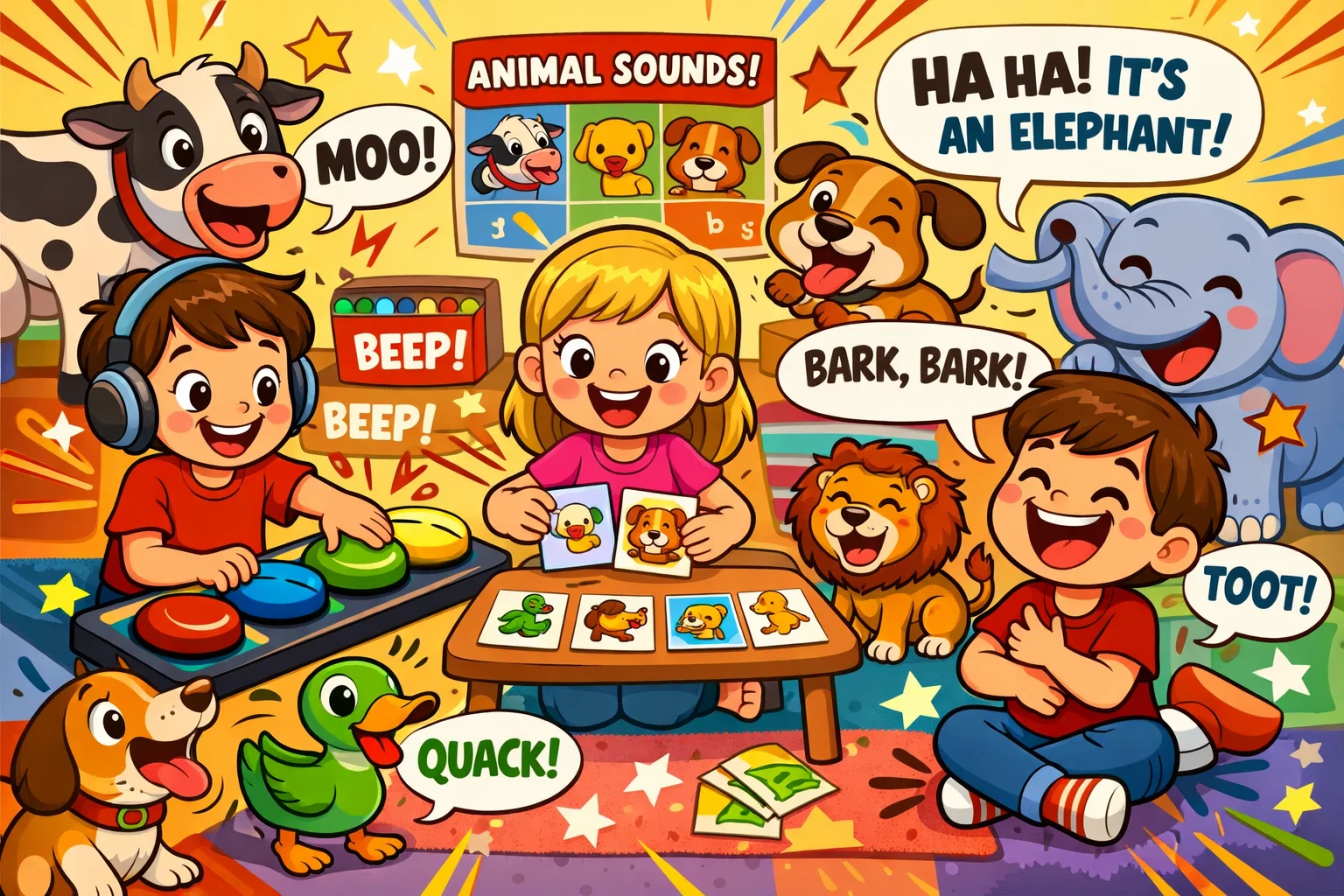
Educational play for young children often starts with familiar animal sounds. These interactive activities help children identify, match, and imitate the sounds different animals make. From digital quizzes to hands-on farm activities, these games support early childhood development through play.
By playing guessing games, young children can improve listening skills, build vocabulary, and strengthen memory. Whether played on a screen or offline, these activities provide a structured and engaging way to learn through play. This guide explores simple formats – including matching games, guessing games, and interactive quizzes – to help children build early developmental skills through play.
Guess Animal Sound Game
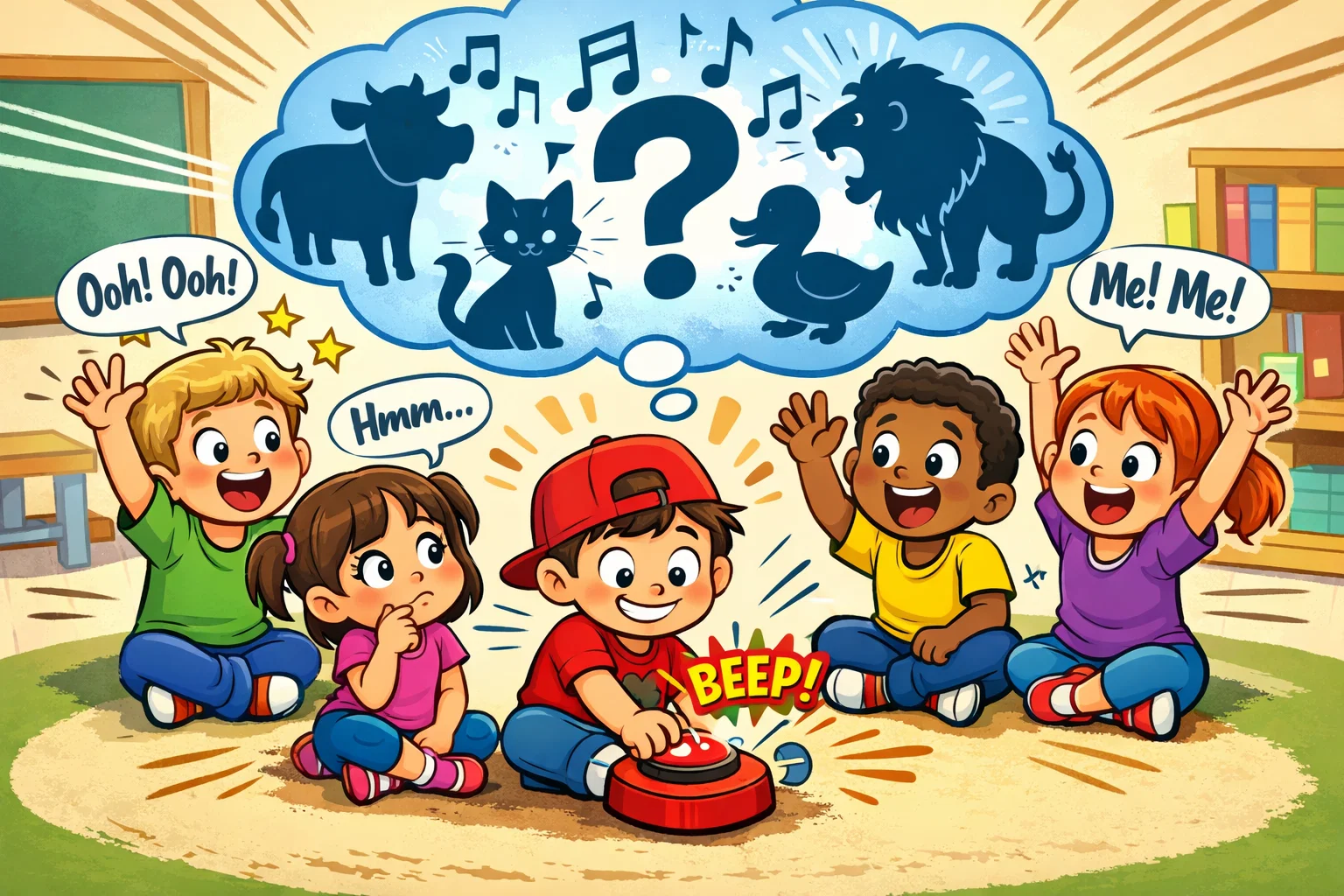
Guessing games are a simple and effective way to encourage listening-first learning. In this format, the child hears an animal sound and has to identify the animal before seeing the picture. This “listen, then reveal” format helps hold attention and encourages active thinking.
How Guessing Format Works
The game follows a simple four-step pattern. First, a parent, teacher, or app plays a clear animal sound for 5 to 10 seconds. Second, the child gets a few seconds to guess the animal. Third, the picture is revealed to give immediate feedback. Finally, the sound is played again while the picture is visible to reinforce the connection between what the child hears and what they see. This multisensory approach can support phonological awareness in toddlers by combining sound, image, and repetition.
Best Animals for First Rounds
Choosing the right difficulty level helps keep children motivated. Beginners usually do best when they start with pets and common farm animals, because these are often part of their everyday world.
- Dog: Barking is familiar and easy for most children to imitate.
- Cat: A clear “meow” is easy to recognize and repeat.
- Cow: A long “moo” is simple for toddlers to copy.
- Sheep: “Baa” adds variety and is easy for children to remember.
- Duck: Repetitive “quack” sounds are fun to hear and imitate.
Easy Rules for Home Play
A simple game at home requires very little preparation. Parents can use a phone, tablet, or speaker to play different sounds while laying out 5 to 10 picture cards.
- Listen: Play a recording from a hidden source to pique curiosity.
- Match: The child points to the correct card on the table.
- Reward: Use a “point” system or simple stickers for successes.
- Mini final: After five rounds, add a “lightning round” in which the child makes the animal sounds instead.
Classroom Version
The classroom version works especially well for social interaction. Teachers can divide children into teams, play a recording, and let each group take turns answering. Adding movement – such as asking the child to act like the animal after a correct guess – can make the activity more engaging and support kinesthetic learning. Group listening games can also help preschoolers practice turn-taking and listening to others.
Animal Sounds Matching Game
This format shifts the focus from open-ended guessing to matching sounds with pictures or words. It asks the child to connect one sound to one of several options, which makes it a good choice for preschoolers who are learning to compare and choose between answers.
Match Sound to Picture
In a sound-to-picture game, the child hears a recording and selects the correct animal from a grid of three or four images. This format is easier than open-ended guessing because it relies on recognition rather than recall, which is especially helpful for children ages 2 to 4. Using real photos instead of cartoons can help children connect the game to real animals more easily.
Match Sound to Animal Name
For older children ages 5 to 7, this version can also support early reading skills. Instead of selecting a picture, the child identifies the written word. This helps children connect spoken language, pictures, and written words, which supports early reading development. This approach uses both words and pictures, which can make new information easier to remember.
Printable Matching Ideas
Offline play is still an important part of balanced early learning. Parents can create printable sheets with farm animals and wild animals.
- Step 1: Lay out 6–8 printed cards on a flat surface.
- Step 2: The adult mimics the creature or plays a digital recording.
- Step 3: The child “swats” or picks up the correct card.
- Step 4: Sort the “found” creatures into categories like “forest” or “jungle.”
Timed Matching Challenge
The timed challenge adds a playful sense of competition and encourages faster responses. In this version, the participant attempts to match as many noises as possible within a 60-second window. This variation can work well for kindergarteners who enjoy tracking a high score and staying engaged for a little longer.
Animal Sounds Quiz
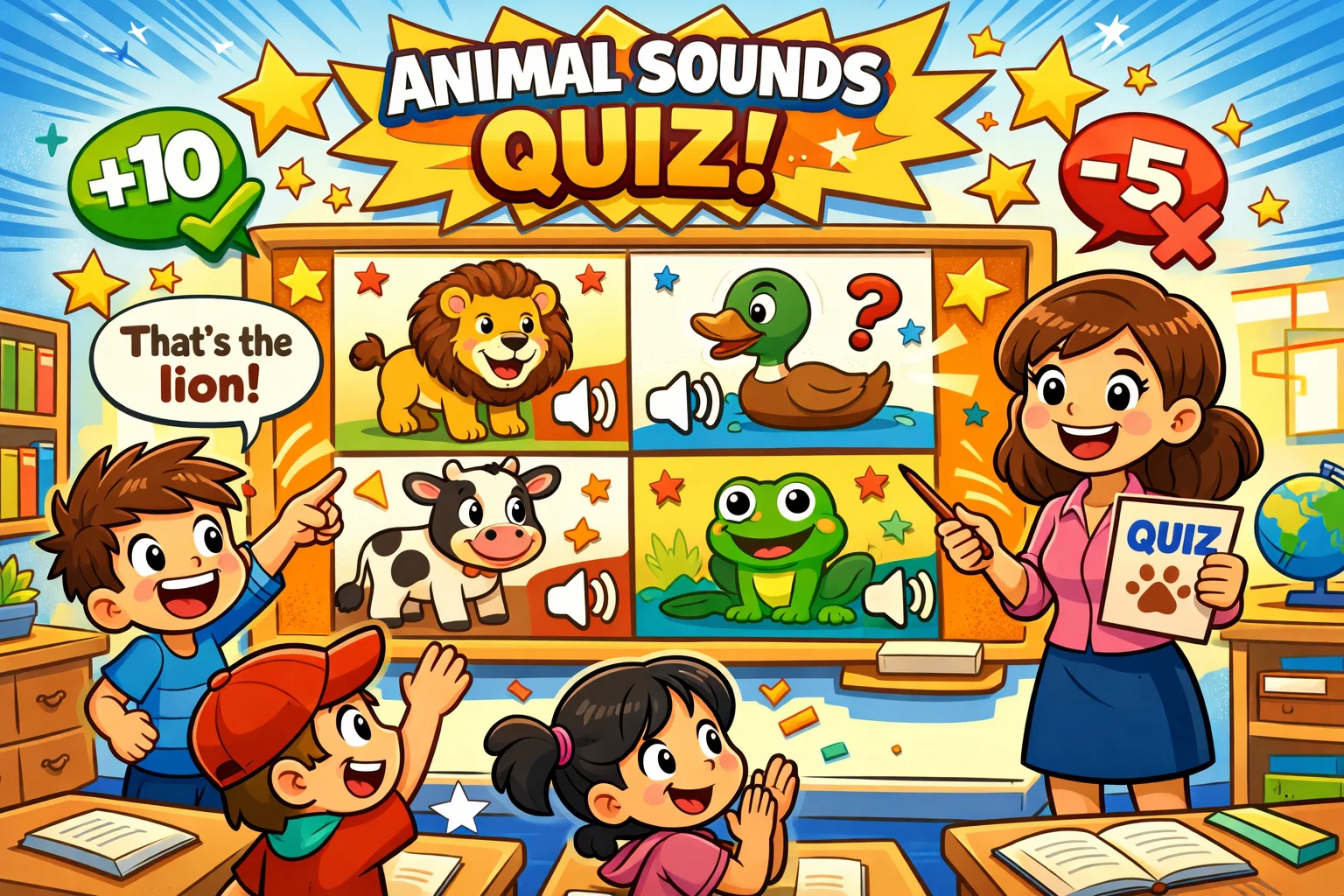
A structured quiz is a fun way to check what children have learned. Quizzes are popular because they give children a clear sense of progress and achievement.
Multiple Choice Quiz
This format usually presents one sound followed by three picture or word choices. It works especially well on a screen because the choices can be shown as large, easy-to-tap buttons. Interactive games work best when they give immediate feedback, so children can quickly see whether they were right or wrong.
True or False Sound Quiz
A true-or-false format simplifies the decision-making process.
| Statement | Vocalization Played | Correct Answer |
| “This is a cow.” | Moo | True |
| “This is a dog.” | Meow | False |
| “The horse says ‘neigh’.” | Neigh | True |
Quiz by Difficulty Level
To keep the play challenging, content should be categorized.
- Easy: Farm inhabitants and common pets (Dog, Cat, Pig).
- Medium: Common wild species (Lion, Elephant, Monkey).
- Hard: Less familiar animals and more challenging sounds, such as an owl, whale, or bee.
Quiz with Score and Reward
Adding a score system can make a simple learning activity feel more fun and motivating. Using digital stars or physical badges can encourage young children to play again. Repeating short activities over time helps children remember what they have learned.
Learn Animal Sounds with Fun and Free Educational Game
A free educational game gives parents an easy way to access useful learning content. The goal is to turn screen time into active learning through simple interaction.
Why Kids Love Tap and Listen Play
The tap and listen mechanic provides instant gratification. When a child taps a picture of a farm animal and immediately hears its sound, they learn about cause and effect. This kind of feedback is especially helpful for young children who are just beginning to use digital interfaces. Responsive back-and-forth interactions help young children learn and stay engaged.
Real Animal Sounds vs Cartoon Sounds
There is a significant difference between authentic recordings and stylized versions.
- Real recordings: Best for helping children recognize how animals sound in real life.
- Cartoon-style sounds are often more exaggerated, which may feel less overwhelming for very young children.
Short Play Sessions That Work Best
To prevent fatigue, experts recommend sessions of 5 to 10 minutes. Short sessions usually work best for young children, especially when the game is fast-paced and interactive. Keeping each session brief can help children stay engaged without becoming tired or overstimulated.
Skills Kids Build During Play
Participating in these activities helps develop a wide range of milestones.
- Listening: Telling similar sounds apart.
- Memory: Remembering which animal makes which sound.
- Vocabulary: Learning specific names of different species.
- Imitation: Copying animal sounds, which can support early speech and sound play.
Games by Animal Type
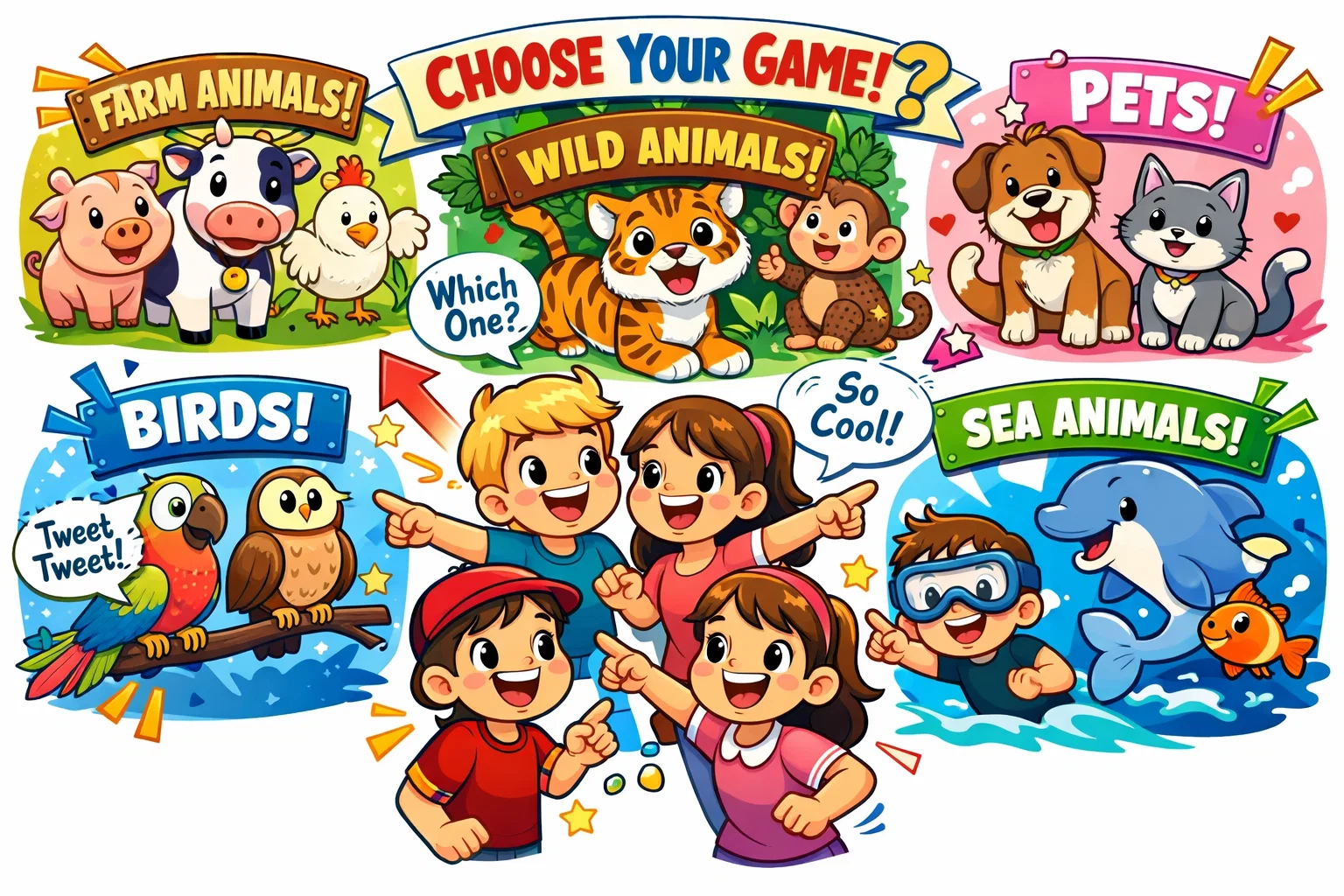
Organizing activities by category helps children group animals in meaningful ways. It also helps children build a clearer mental picture of the natural world.
Farm Animal Sounds Games
The farm is the most popular starting point. Species like the cow, sheep, duck, horse, and pig have distinct voices that are easy for young children to match. These animals are often the easiest starting point in an interactive quiz.
Wild Animal Sounds Games
Wild species introduce more complex auditory patterns. The roar of a lion or the trumpet of an elephant can be especially exciting for children ages 4 and up. These noises are often louder and more varied, which helps sustain attention.
Pet Animal Sounds Games
Pets provide a bridge to the child’s daily life. Identifying the bark of a dog or the chirp of a parrot helps children connect the game to everyday life.
Bird Sounds Games
Birds offer a specialized challenge. From the hoot of an owl to the song of a sparrow, these sounds can help children listen more carefully to small differences. Because many bird calls can sound similar, this category works well in more advanced rounds.
Sea Animal and Jungle Animal Sounds Games
Adding animals such as whales, dolphins, and monkeys keeps the game fresh and varied. This allows for the introduction of rare species, ensuring the child continues to learn about different global environments.
Games by Age
Matching the game to a child’s age helps keep the activity developmentally appropriate.
Animal Sounds Games for Toddlers
For toddlers (ages 1–3), the focus is on sensory exploration.
- Interface: Large, single tap targets.
- Content: High-contrast images of one or two familiar farm animals.
- Goal: Simple imitation and learning which animal makes which sound.
Animal Sounds Games for Preschoolers
Preschoolers (ages 3–5) are ready for cognitive challenges.
- Format: Guess the animal from three or four visual choices.
- Logic: Categorization (e.g., “Which one lives in the water?”).
- Activity: Matching animal sounds to photos in a grid.
Animal Sounds Games for Kindergarten
Kindergarten students (ages 5–6) can handle structured competition.
- Format: Multi-round quiz with scoring and timers.
- Complexity: Sound sequencing (for example, “Remember the order of these three sounds”).
- Skills: Speed, accuracy, and working memory.
Best First Animal Sounds by Age
| Age Group | Recommended Species | Developmental Focus |
| Toddlers (1–2) | Dog, Cat, Cow, Duck | Vocal Imitation |
| Preschool (3–4) | Pig, Horse, Lion, Monkey | Recognition & Naming |
| Kindergarten (5–6) | Owl, Wolf, Whale, Elephant | Categorization & Logic |
More Educational Games
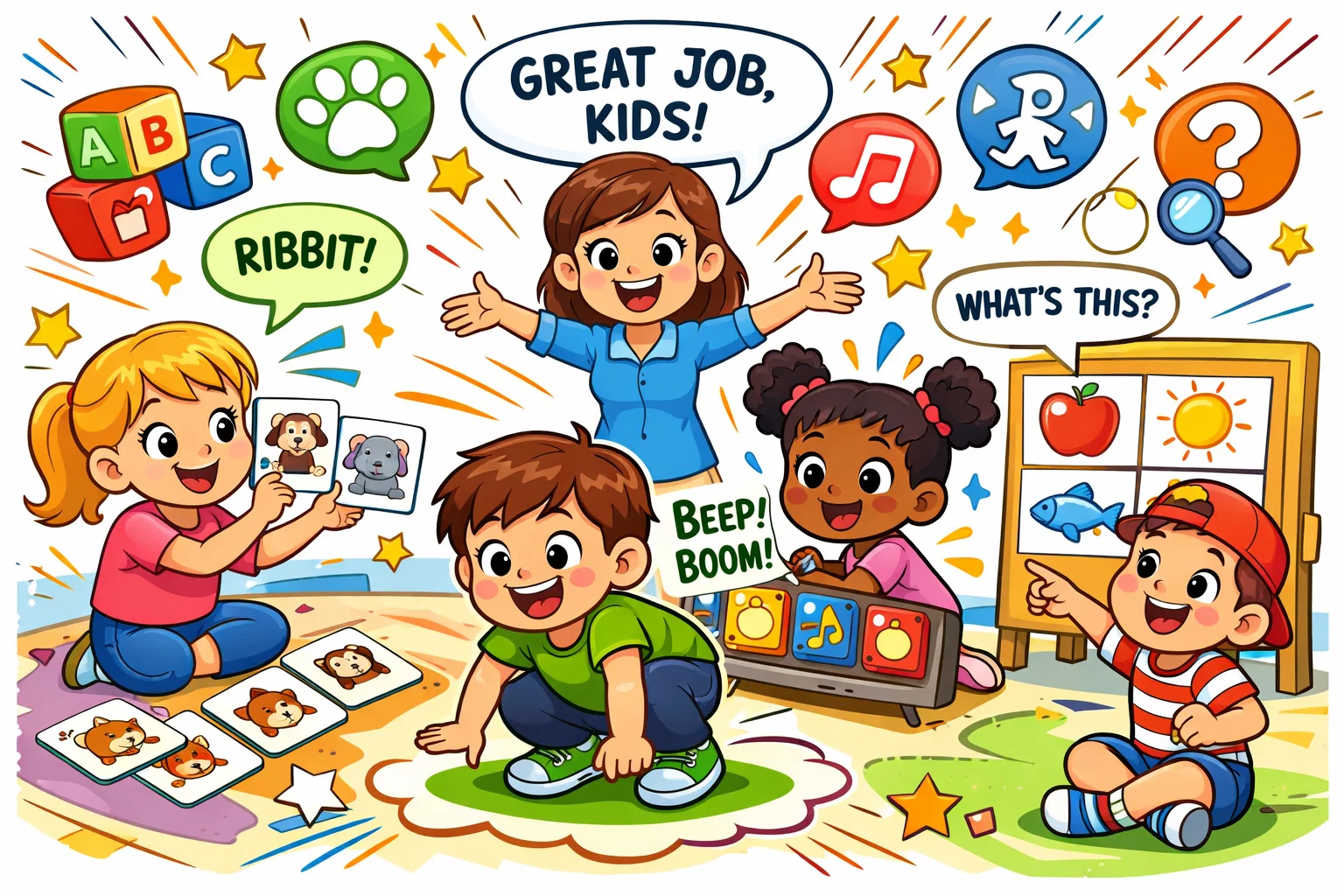
Once a child is confident with animal sounds, you can expand the game into related activities that build other skills too.
Animal Picture Guessing Game
This is a visual-only extension. Use blurred images or zoomed-in textures (like zebra stripes). The child identifies the animal based on visual clues, which can support observation and pattern recognition.
Animal Movement Game
To help burn off energy, transition into a movement game. When a sound is played, the child guesses the animal and then “hops like a frog” or “slithers like a snake.” This integrates gross motor skills with auditory learning.
Animal Name and Sound Cards
Flashcards with a photo, the written name, and the animal sound (for example, “cow” and “moo”) are useful for pre-reading activities. These can be used for both home and classroom drills.
Animal Sound Songs and Rhymes
Integrating music – such as “Old MacDonald” – provides a rhythmic framework for learning. Songs help with phonological awareness, as the repetitive nature of rhymes makes it easier for young children to predict and participate.
Best Ways to Play at Home and in Class
The way the game is used at home or in class can affect how engaging and effective it is.
No-Prep Home Game Ideas
Parents can play instantly with these ideas:
- Hidden Toy: Hide a plastic creature and make its noise. The child follows the sound to find the toy.
- The Silly Teacher: The parent makes a wrong noise (e.g., a cow saying “meow”), and the child must correct them.
Small Group Circle Time Ideas
In the classroom, circle time is a great format for group participation. Use a “talking stick”; whoever holds it must make a noise, and the rest of the group guesses the species. This encourages public speaking and social listening.
Screen-Free Animal Sound Activities
To reduce screen time, use a dedicated audio-cube or physical cards. You can also play a “Nature Scavenger Hunt” where you describe an inhabitant’s habitat and call, and the child has to find the corresponding toy in the room.
Ideas for Digital Play
For digital learning, choose platforms that offer a free educational game with a “Progress Score.” These features can give children a sense of achievement and help parents track which sounds their child already knows well.
Tips for Better Engagement and Longer Sessions
Sustaining a child’s attention requires a mix of variety and surprise.
Start with Familiar Sounds
Always begin with sounds the child already knows, such as a dog or cat. These “easy wins” build confidence and prime the brain for more difficult tasks.
Use Visual Reveal After Each Sound
The sense of mystery is often the most engaging part of the game. Always play the audio first and wait for the guess before showing the picture. This short delay builds curiosity and helps keep the child focused.
Repeat Sounds in Short Cycles
Repetition is essential. Instead of playing 20 different species once, play 5 creatures three times in a different order. This reinforces memory and helps the correct association stick.
Mix Easy and Hard Animals
Use a “sandwich” method: one easy farm animal, one more challenging sound, and then another easy pet sound. This balance keeps the challenge level optimal – neither boring nor discouraging.
Best Features to Include in Animal Sounds Games
Look for these features when choosing an animal sound game for your child.
Big Tap Targets and Simple Navigation
Young children lack fine motor control. The best games have large buttons and a simple one-tap interface. If a child has to navigate complex menus, they will lose focus on the learning objective.
Real Photos and Clear Audio
Trustworthy educational resources use high-fidelity, real recordings and crisp photographs. Poor-quality audio or unclear illustrations can confuse children and make real-life recognition harder.
Offline Play Option
An offline feature is essential for travel. Many good games let you download content, so play can continue even without an internet connection.
Safe and Kid-Friendly Design
Check that the app is safe, age-appropriate, and free from unnecessary external links. A quality tool should have no external links or unmoderated social features, focusing entirely on the educational content.
FAQ
What are animal sounds for kids?
They are educational activities where young children listen to, identify, and imitate the vocalizations of nature to build cognitive and language skills.
What animal sounds are easy to make?
The easiest for kids to make are the cow (“moo”), dog (“woof”), cat (“meow”), and duck (“quack”) due to their simple phonetic structures.
Should a 2-year-old know animal sounds?
Many toddlers begin identifying common farm species by age 2, but every child develops at their own pace. Play is the best way to encourage this milestone.
How do you play a guess-the-animal-sound game with toddlers?
Keep it simple: use 3–4 familiar cards, play the noise, wait for the guess, and provide plenty of praise when they choose the correct card.
Are animal sounds games good for preschoolers?
Yes, they are excellent for developing auditory attention, memory, and vocabulary, which are critical for school readiness.
Can animal sound games work in the classroom?
Absolutely. They are great for group settings where kids can work in teams to match noises or participate in an interactive quiz.
What animals should kids learn first?
Start with farm inhabitants and pets (Dog, Cat, Cow) because they are most likely to encounter these in books and their daily lives.
Are real animal sounds better than toy sounds?
Real recordings are better for scientific accuracy, while toy versions can be useful for very early engagement with the youngest learners.
Can kids play animal sounds games without a screen?
Yes. You can use physical toys, printed cards, or simply have an adult make the different noises for the child to identify.
How long should an animal sound play session be?
For young children, sessions should be short, typically 5–10 minutes, to ensure they remain engaged and don’t become fatigued.
Take a short quiz to find out what your everyday choices say about your parenting style
When your child is curious about something new, what’s your instinct?
Take a short quiz to find out what your everyday choices say about your parenting style
“Can I download this app?” What happens next?
Take a short quiz to find out what your everyday choices say about your parenting style
When it comes to rules at home, which sounds most like you?
Take a short quiz to find out what your everyday choices say about your parenting style
If you could give your child one life skill today, what would you pick?
Take a short quiz to find out what your everyday choices say about your parenting style
Your child gets to choose what to watch. What would your ideal setup look like?
Take a short quiz to find out what your everyday choices say about your parenting style
Pick your parenting superpower ✨