15 Best Toddler Games: Online, Sensory and Active Picks

 Discover a Free Education Video App for Kids
Pastory uses AI to personalize educational video content based on your child’s interests and personality. Safe, engaging, and built for curious young minds. Sign up now to stay updated and enjoy early access with a free trial
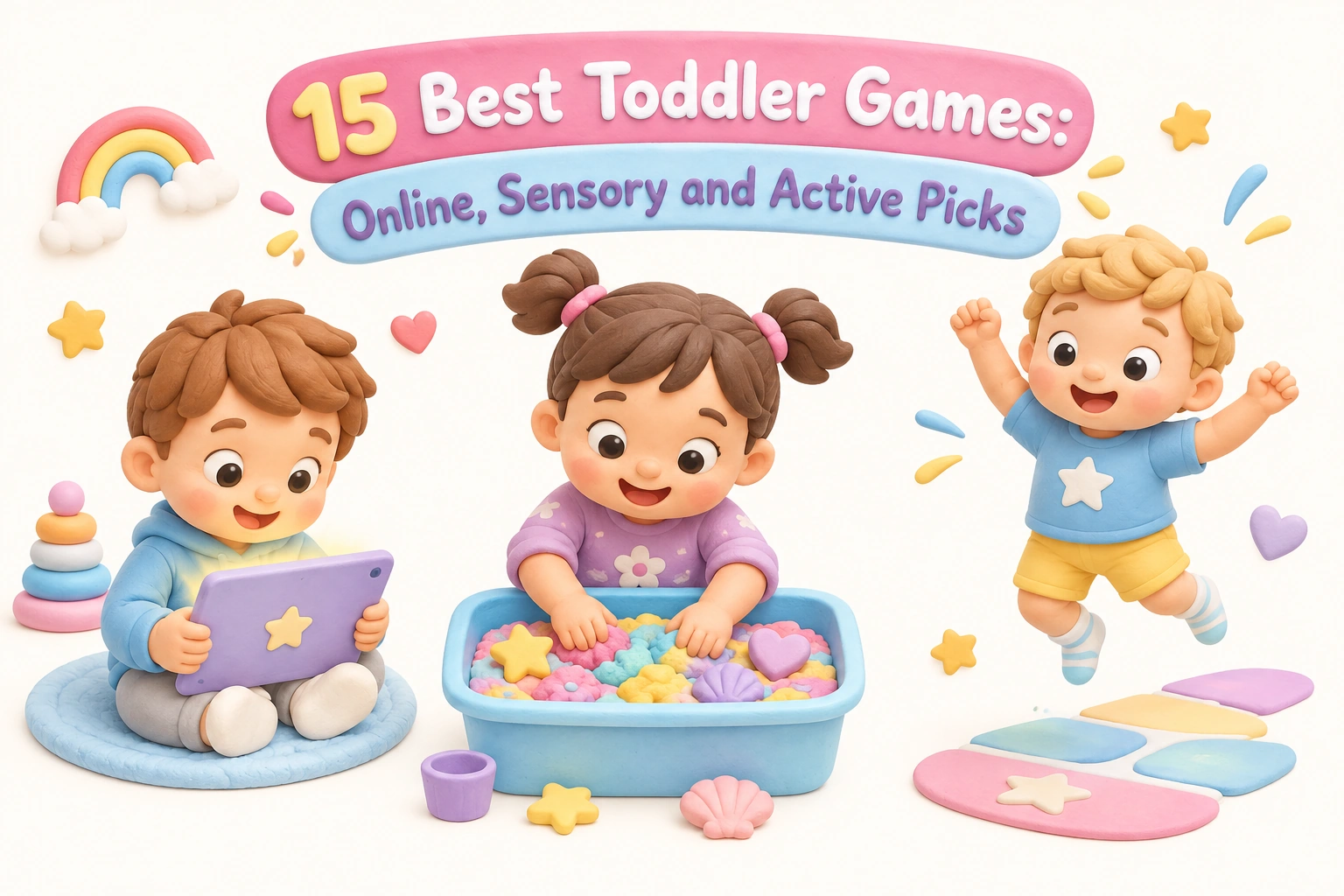
Choosing the right toddler games can feel overwhelming when every shelf, app store, and parenting forum offers a different opinion. The good news is that toddlers are naturally wired for play — and the right game, whether it lives on a screen, in a sensory bin, or in the middle of your living room floor, can meaningfully support early childhood development. This article covers 15 carefully selected games across three categories: online and digital, sensory, and active. Each pick includes a clear developmental rationale, age-range guidance, and practical notes for caregivers.
Key Takeaways
- Play-based learning is one of the most effective ways to support cognitive, physical, and social-emotional development in children aged one to three.
- The American Academy of Pediatrics (AAP) recommends avoiding screen-based media for children under 18–24 months (except video chat) and limiting digital use to one hour per day of high-quality co-viewed content for ages two to five.
- Sensory games and active games require no screens and often no equipment, making them accessible for most families regardless of budget or space.
- Cooperative games — those without a clear winner or loser — are far more developmentally appropriate for toddlers than competitive formats, which can be emotionally overwhelming at this stage.
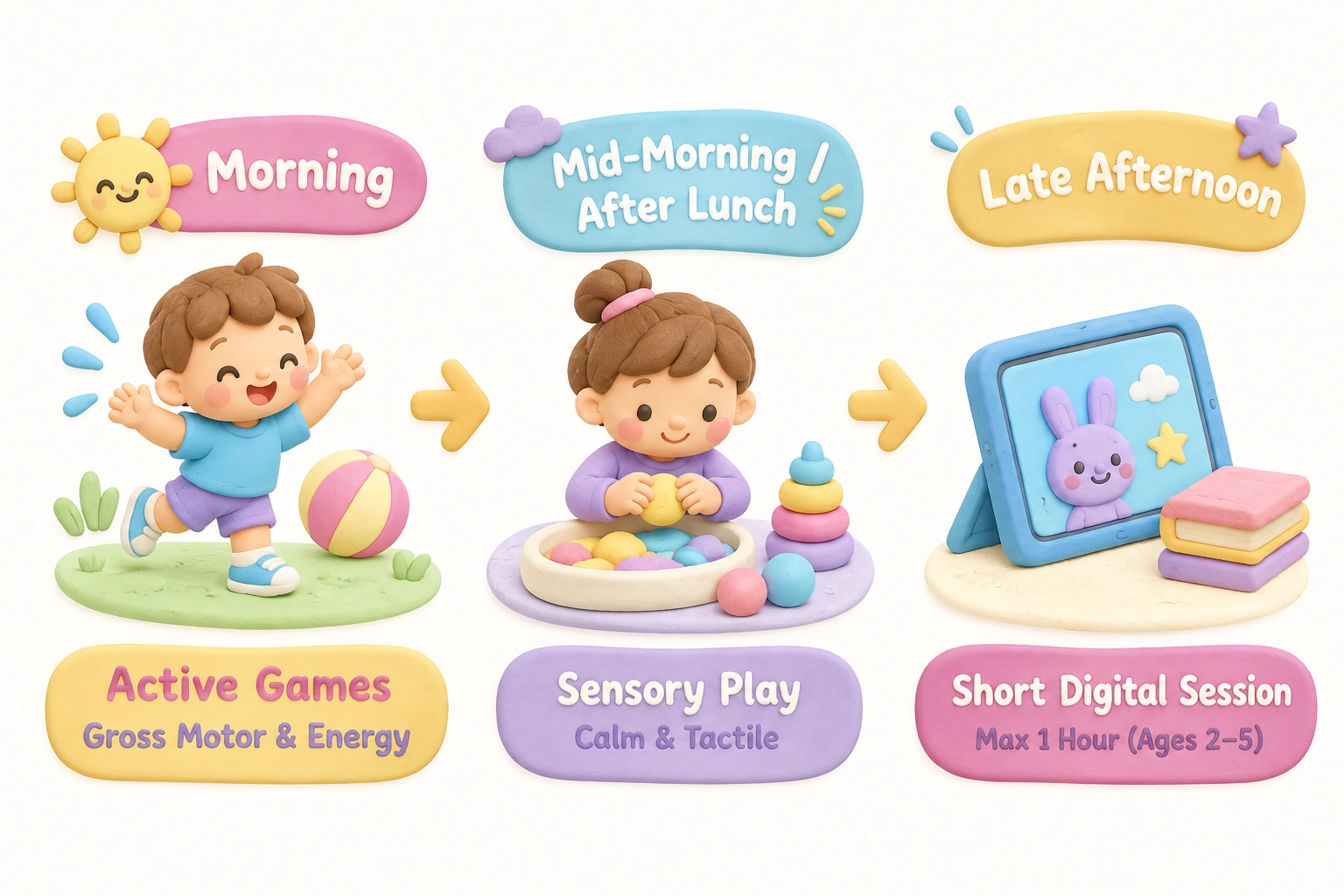
- Mixing game types across a day (active, then sensory, then a short digital session) can help match toddler energy cycles and prevent overstimulation.
Why Toddler Games Matter for Early Development
Between the ages of one and three, the brain is forming neural connections at a remarkable pace. Play is not a break from learning — it is the primary mechanism through which toddlers develop language, problem-solving, motor control, and emotional regulation. Research consistently supports play-based learning as a foundation for school readiness, and professional bodies including the AAP and the National Association for the Education of Young Children (NAEYC) emphasize that child-directed, hands-on play is irreplaceable at this stage.
Different types of games target different developmental domains. Active games build gross motor skills such as balance, coordination, and core strength. Sensory activities stimulate tactile processing, spatial awareness, and early scientific thinking. Educational games for toddlers — whether digital or physical — can support language development, color and shape recognition, cause and effect understanding, and early numeracy. No single game type covers every domain, which is why a varied approach across the day tends to produce the most holistic benefits.
One important nuance: toddlers have short attention spans by design. A two-year-old may engage deeply with one activity for five to ten minutes before naturally moving on. This is developmentally normal, not a sign of disinterest. Choosing age-appropriate toddler games means selecting activities that match this rhythm rather than demanding sustained focus beyond what the child’s stage supports.
Best Online Games for Toddlers
Digital games can support early childhood development when they are interactive rather than passive, ad-free, and used within recommended screen time guidelines. The five picks below are all designed for ages two to five, require no in-app purchases, and prioritize cause-and-effect interactions over passive video consumption. Whenever possible, co-viewing or co-playing with a caregiver significantly increases the developmental value of any digital session.
1. Khan Academy Kids
Khan Academy Kids is a free, ad-free toddler app covering literacy, numeracy, social-emotional learning, and creative activities for children aged two to eight. The app uses a cast of animal characters to guide children through drag-and-drop puzzles, matching games, and early reading exercises. Because the content is editorially curated rather than algorithm-driven, children are less likely to be funneled toward engagement-maximizing content that may not be developmentally appropriate. Khan Academy Kids is widely cited by pediatricians as one of the strongest free online games for toddlers in the digital space. Parental involvement during sessions — even briefly — can help reinforce vocabulary and concepts introduced in the app.
2. PBS Kids Games
PBS Kids Games offers a browser-based and app-based collection of free games featuring familiar characters such as Daniel Tiger, Curious George, and Peg + Cat. The games target color recognition, shape recognition, counting, and early problem-solving, and the platform carries no advertising. Because the characters are drawn from PBS programming that itself follows child development guidelines, the games tend to reinforce concepts children already encounter in the shows — a useful form of cross-media reinforcement when screen time is already in use. PBS Kids Games is suitable for ages two and up, with simpler interactions available for younger toddlers.
3. Pok Pok
Pok Pok is a subscription-based app designed around open-ended play rather than structured lessons. Children interact with digital toys — a set of blocks, a music maker, a drawing canvas — without being directed toward a correct answer. This design philosophy mirrors the principles of Reggio Emilia and child-led exploration, making it one of the few digital environments that genuinely supports imaginative play and intrinsic curiosity rather than reward-loop mechanics. Pok Pok is best suited for ages two to six and is particularly well regarded for children who find heavily structured apps frustrating.
4. Sago Mini World
Sago Mini World bundles a collection of gentle, narrative-driven mini-games for toddlers aged two to five. Each game involves simple interactions — feeding a character, building a snowman, decorating a cake — that develop hand-eye coordination and fine motor skills through tapping and dragging. The app is ad-free and designed with intentionally simple controls that match the motor capabilities of young toddlers. The calm pacing and absence of time pressure make it a good choice for winding down after more active play, though caregivers should still monitor total daily screen time.
5. Duolingo ABC
Duolingo ABC is a free, ad-free literacy app targeting children aged three to six. It introduces letter sounds, phonics, and early reading through short, game-like exercises that typically last two to three minutes each — a format well matched to toddler attention spans. The app tracks progress and adjusts difficulty gradually, which can support children at different points along the early literacy continuum. Duolingo ABC is most appropriate for children at the older end of the toddler range who are beginning to show interest in letters and words.
A Note on Screen Time Guidelines
The AAP recommends that children under 18 to 24 months avoid screen-based media other than video chat. For children aged two to five, the guidance is a maximum of one hour per day of high-quality content, ideally co-viewed with a caregiver who can help explain and extend what the child sees. These guidelines apply to all five digital picks above. No app, however well designed, should replace caregiver interaction, physical play, or unstructured exploration time.
Best Sensory Games for Toddlers
Sensory play engages the tactile, visual, auditory, and sometimes proprioceptive systems simultaneously, supporting sensory processing, language development, and early scientific thinking. The activities below require minimal equipment and can be adapted for different ages. A critical safety note: children aged one to two frequently mouth objects and materials. Each pick below includes a taste-safe indicator to help caregivers make informed choices.
6. Sensory Bin Exploration
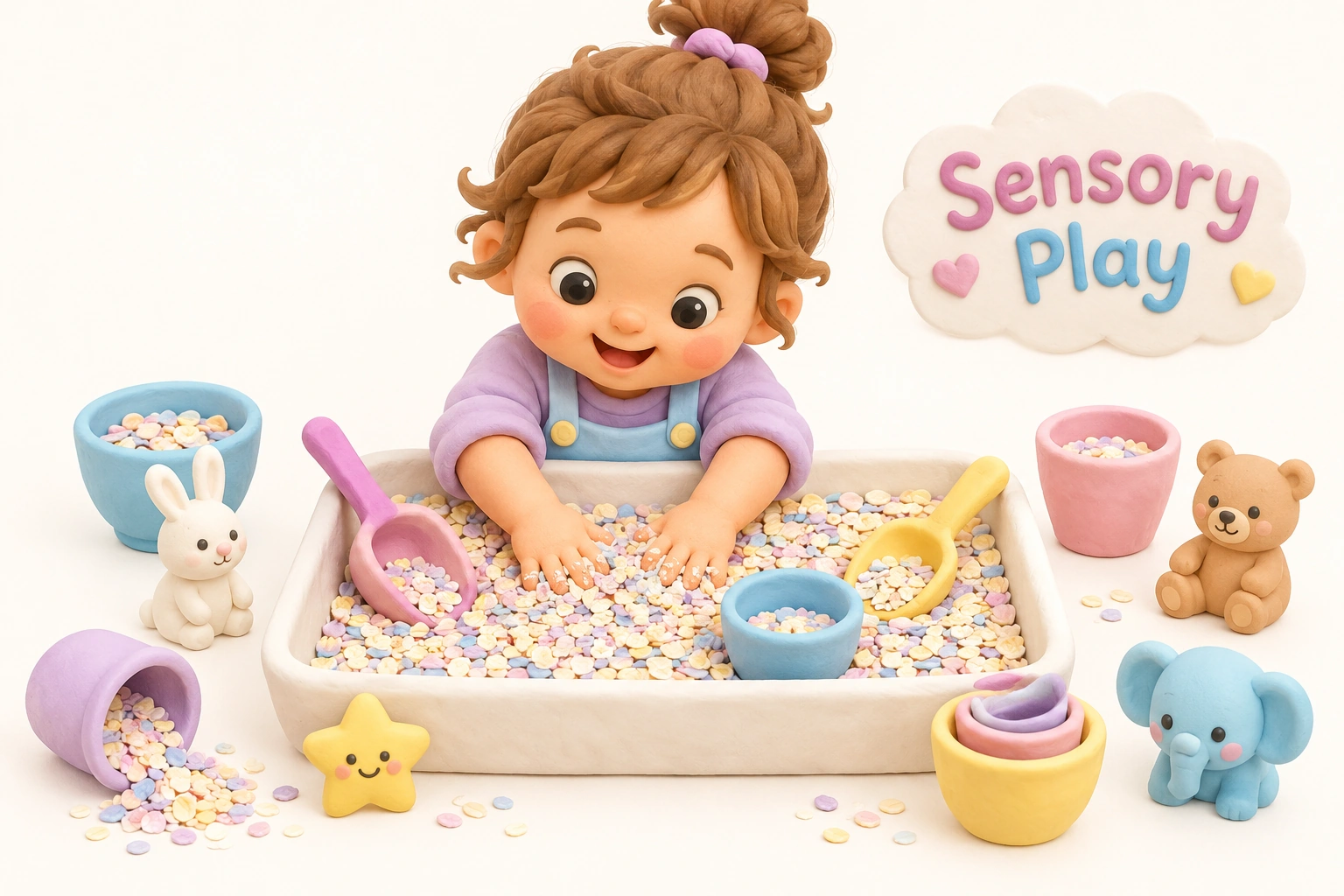
A sensory bin is a shallow container filled with a textured material — rice, dried pasta, kinetic sand, or water beads — along with small scoops, cups, and figurines for open-ended play. Sensory bins support tactile stimulation, fine motor skills (scooping, pouring, pinching), and early vocabulary as children describe what they feel and find. For children under two, use taste-safe fillers such as cooked pasta, oats, or water. Uncooked rice and dried beans are appropriate for children over two who no longer mouth objects. Sensory bin play is genuinely open-ended — there is no goal, no winner, and no correct way to engage, which makes it one of the most developmentally flexible activities on this list.
7. Oobleck
Oobleck is a non-Newtonian fluid made from cornstarch and water that behaves like a solid under pressure and a liquid when handled gently. Playing with oobleck introduces toddlers to basic cause-and-effect relationships in a visceral, memorable way — squeeze it and it hardens; relax your hand and it flows. Cornstarch and water are both taste-safe, making this activity appropriate for children from around 18 months with supervision. The sensory experience is intense and novel, which tends to hold toddler attention longer than many other activities. Expect mess; a plastic sheet under the play area is strongly recommended.
8. Texture Exploration Walk
A texture exploration walk involves setting up a series of surfaces for a toddler to touch, walk on, or press their hands into — bubble wrap, a damp sponge, a tray of sand, a piece of velvet, a smooth wooden board. This activity builds sensory vocabulary (rough, smooth, bumpy, soft), supports sensory processing development, and can be done entirely with household materials. It is taste-safe by design if caregivers choose appropriate materials, and it works well for children from around 12 months. The activity also introduces early comparative thinking as children begin to notice and describe differences between surfaces.
9. Water Play with Containers
Pouring, splashing, and transferring water between containers of different sizes is one of the most developmentally rich sensory activities available to toddlers. Water play supports fine motor skills, early mathematical thinking (more, less, full, empty), cause-and-effect understanding, and language development. It requires no special equipment beyond a shallow tub, a few cups, and a towel. Water play is taste-safe and appropriate from around 12 months with close supervision. Adding a few drops of food coloring to the water introduces color recognition and can extend engagement significantly.
10. Guess What’s Inside
In this tactile guessing game, a caregiver places familiar objects — a small ball, a spoon, a piece of fabric — inside a pillowcase or opaque bag and asks the toddler to reach in and identify the object by touch alone. This activity develops tactile discrimination, vocabulary, and early memory skills. It also introduces a gentle element of suspense and turn-taking, supporting social-emotional learning in a low-pressure format. The game is appropriate for children aged two and up, and it can be made progressively more challenging by using objects with subtler textural differences. All objects should be large enough to pose no choking risk.
Best Active Games for Toddlers
Gross motor development — the ability to control large muscle groups for walking, jumping, climbing, and throwing — is a central developmental task of toddlerhood. Active games support balance, coordination, core strength, motor planning, and body awareness. Many of the picks below require no equipment at all, making them practical for families in small spaces or on tight budgets.
11. Freeze Dance
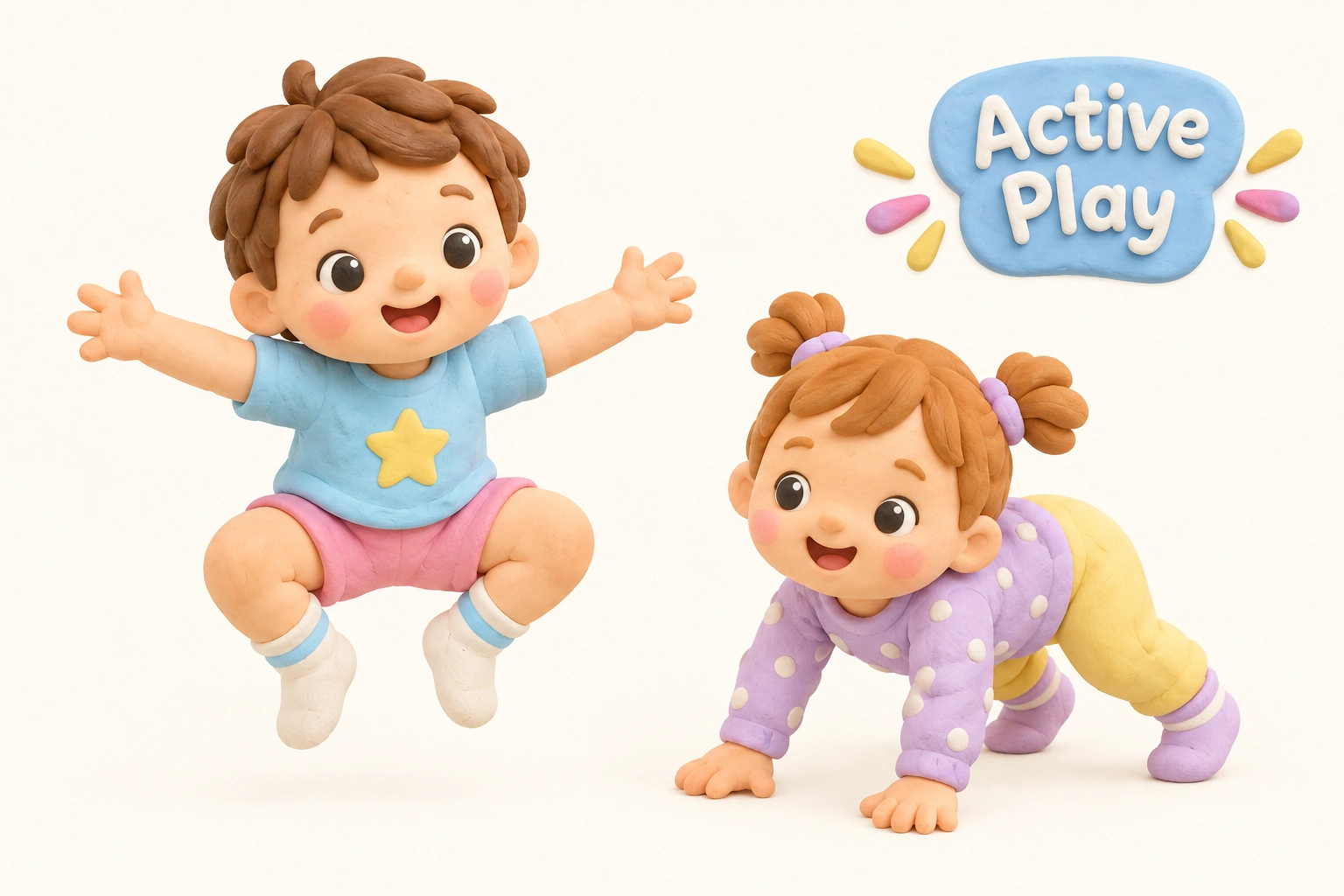
Freeze Dance is one of the most effective active toddler games for building listening skills and impulse control simultaneously. A caregiver plays music and the child dances freely; when the music stops, the child freezes in place. This simple structure requires toddlers to monitor an auditory cue, inhibit movement on demand, and restart movement when the signal changes — all of which engage the developing prefrontal cortex in age-appropriate ways. Freeze Dance requires no equipment, works in any space, and can be played with children from around 18 months. It is also naturally cooperative, with no winner or loser, making it emotionally appropriate for the toddler stage.
12. Animal Walks
Animal walks involve moving across the floor in the style of different animals: bear crawls (hands and feet, bottom in the air), frog jumps (squat and leap), crab walks (hands and feet, belly facing up), and duck waddles (squat and walk). Each movement pattern targets a different set of muscle groups and motor planning demands. Bear crawls build shoulder stability and core strength; frog jumps develop explosive leg power and landing control; crab walks challenge upper body strength and coordination. Animal walks require zero equipment, can be done indoors or outdoors, and are appropriate for children from around 18 months. Caregivers can join in, which adds a social dimension and models the movements clearly.
13. Indoor Obstacle Course
An indoor obstacle course built from couch cushions, pillows, painter’s tape lines on the floor, and low step stools gives toddlers a structured physical challenge that develops balance, coordination, spatial awareness, and motor planning. A simple course might involve crawling through a cushion tunnel, walking along a tape line, jumping off a low step, and tossing a soft ball into a laundry basket. The course can be adjusted in difficulty as the child’s skills develop, and building it together with the child adds a problem-solving and imaginative play dimension. Indoor obstacle courses are appropriate from around 18 to 24 months and can be extended with outdoor variants such as chalk pathways and puddle jumping when weather permits.
14. Balloon Volleyball
Balloon volleyball involves keeping an inflated balloon off the floor using hands, arms, or any body part — a toddler-friendly version of the classic game that moves slowly enough for young children to track and respond to. The activity builds hand-eye coordination, gross motor skills, and spatial awareness, and the unpredictable movement of the balloon introduces an element of novelty that sustains engagement. Balloon volleyball is appropriate for children from around two years old. Caregivers should supervise closely, as burst balloon fragments pose a choking hazard for young children; latex-free balloons are preferable for children with potential sensitivities.
15. Simon Says
Simon Says is a classic listening and body-awareness game in which a leader gives movement instructions — “Simon says touch your toes,” “Simon says jump three times” — and players must follow only when the instruction is preceded by “Simon says.” For toddlers, the competitive elimination element can be dropped entirely; the game works beautifully as a pure movement and listening activity without anyone being “out.” Simon Says builds body part vocabulary, listening comprehension, impulse control, and gross motor skills. It is appropriate from around two years old and can be played with a single child and one caregiver, making it one of the most flexible active games on this list. An outdoor variant involves calling out movements that use the surrounding environment — “Simon says run to the tree” — which adds spatial reasoning to the mix.
How to Sequence Games Across a Toddler’s Day
One practical gap in most toddler game guides is the question of how to order activities across a day to match a toddler’s natural energy cycle. A useful general framework is to move from high-energy active play in the morning, when toddlers are typically most physically energized, toward sensory play in the mid-morning or after lunch, when a calmer but still engaging activity suits the post-meal period, and then to a short digital session in the late afternoon if screen time is part of the family’s routine. This sequence — active, then sensory, then digital — tends to reduce overstimulation and makes transitions between activity types smoother.
Transitions themselves can be eased by giving a brief verbal warning before switching activities: “We have two more minutes of water play, then we’re going to dance.” Toddlers respond better to predictable transitions than to abrupt stops, and this simple practice also supports early time-awareness and emotional regulation.
How to Choose Age-Appropriate Toddler Games
When selecting any game for a toddler, the most useful questions to ask are: Does this match my child’s current motor and cognitive abilities? Does it require sustained attention beyond what my child can comfortably manage? Is it cooperative or competitive — and is my child ready for the emotional demands of competition? Does it require supervision, and can I provide it?
For children aged 12 to 18 months, the best games involve simple cause-and-effect interactions, large-scale physical movement, and sensory exploration with taste-safe materials. For two-year-olds, games that introduce turn-taking, color and shape matching, and basic rule-following become appropriate. Three-year-olds can begin to engage with simple cooperative board games, more complex obstacle courses, and digital games that involve early literacy or numeracy concepts. These are general developmental guidelines; individual children vary considerably, and a child’s interest and engagement are always the most reliable indicators of readiness.
Frequently Asked Questions
What are the best free online games for toddlers?
Khan Academy Kids, PBS Kids Games, and Duolingo ABC are among the strongest free, ad-free options for toddlers aged two and up. All three are available on multiple devices, require no in-app purchases, and are designed around interactive rather than passive engagement. Browser-based platforms such as PBS Kids Games can also be accessed without downloading an app, which is useful for families with limited device storage.
Are competitive games appropriate for toddlers?
Most developmental experts recommend avoiding games with a clear winner and loser for children under three, and using them cautiously with three-year-olds. Toddlers are still developing emotional regulation and may find losing deeply distressing in ways that undermine the enjoyment of play. Cooperative games — where all players work toward a shared goal — or games with no outcome at all (such as Freeze Dance or sensory bin play) are far more developmentally appropriate at this stage.
How much screen time is appropriate for toddlers?
The AAP recommends avoiding screen-based media for children under 18 to 24 months, with the exception of video chat. For children aged two to five, the guidance is a maximum of one hour per day of high-quality content, ideally co-viewed with a caregiver. These guidelines are designed to protect time for physical play, sleep, and face-to-face interaction, all of which are critical for early childhood development. Individual families may adapt these guidelines based on their circumstances, but the underlying principle — that screen time should be intentional, limited, and interactive rather than passive — is broadly supported by developmental research.
Which sensory materials are safe for children under two?
For children who still mouth objects and materials, taste-safe options include cooked pasta, oats, cornstarch-and-water oobleck, and plain water. Uncooked rice, dried beans, kinetic sand, water beads, and small figurines should be reserved for children who no longer mouth objects, typically around age two or older, and always used with close supervision. When in doubt, choose the simplest, most natural material and supervise actively throughout the activity.
Do toddlers need structured games, or is free play enough?
Both structured games and unstructured free play serve important developmental functions. Structured games introduce rule-following, turn-taking, and specific skill practice. Unstructured free play — where the child directs the activity without adult-imposed goals — supports creativity, intrinsic motivation, and self-regulation. A healthy daily routine for a toddler typically includes both. The games in this article are designed to be light in structure, leaving room for child-led exploration within a loose framework.
Can toddler games support language development?
Yes, many of the games in this article can support language development, though outcomes vary by child and depend heavily on caregiver involvement. Sensory play, in particular, creates natural opportunities for caregivers to introduce descriptive vocabulary — rough, smooth, heavy, empty — in a meaningful context. Active games like Simon Says build body-part vocabulary and listening comprehension. Digital games such as Khan Academy Kids and Duolingo ABC directly target early literacy. In all cases, a caregiver who talks with the child during play — narrating, asking questions, and responding to the child’s communication — amplifies the language benefit significantly.
Choosing the Right Mix of Toddler Games for Your Family
No single game type covers every developmental domain, and no single game will suit every child. The fifteen picks in this article are designed to give caregivers a practical starting point across three distinct categories — online, sensory, and active — so that a toddler’s day can include varied experiences that support physical, cognitive, and social-emotional growth together.
The most important factor in any toddler game is not the game itself but the quality of engagement surrounding it. A caregiver who plays alongside, narrates what is happening, responds to the child’s cues, and follows the child’s lead will consistently amplify the developmental value of even the simplest activity. Expensive apps and elaborate sensory setups are not prerequisites for meaningful play-based learning — a bowl of water, a balloon, or a pillowcase full of household objects can be just as rich an experience as any curated digital platform.
If you are unsure where to start, consider your child’s current interests and energy level, choose one game from each category to try this week, and observe which type of play your child gravitates toward most naturally. That preference is useful developmental information in itself — and it is the best guide to building a game repertoire that genuinely fits your child and your family’s daily life.

Take a short quiz to find out what your everyday choices say about your parenting style
When your child is curious about something new, what’s your instinct?
Take a short quiz to find out what your everyday choices say about your parenting style
“Can I download this app?” What happens next?
Take a short quiz to find out what your everyday choices say about your parenting style
When it comes to rules at home, which sounds most like you?
Take a short quiz to find out what your everyday choices say about your parenting style
If you could give your child one life skill today, what would you pick?
Take a short quiz to find out what your everyday choices say about your parenting style
Your child gets to choose what to watch. What would your ideal setup look like?
Take a short quiz to find out what your everyday choices say about your parenting style
Pick your parenting superpower ✨