Best Free Online Math Games for Elementary Students

 Discover a Free Education Video App for Kids
Pastory uses AI to personalize educational video content based on your child’s interests and personality. Safe, engaging, and built for curious young minds. Sign up now to stay updated and enjoy early access with a free trial
Finding quality free math games online that are genuinely free, age-appropriate, and actually useful for building math skills can feel surprisingly difficult. Many platforms advertise themselves as free but lock core features behind a paywall, display ads that are inappropriate for young children, or offer games that are entertaining without being educationally meaningful. This guide cuts through the noise with honest, research-informed reviews of the best platforms for elementary students, organized by what matters most to parents, caregivers, and classroom teachers: grade-level fit, skill coverage, cost transparency, device compatibility, and child safety.
Key Takeaways
- Several genuinely free, browser-based platforms offer curriculum-aligned math games for elementary students with no sign-up required and no download needed.
- Game-based learning can support math fact fluency, number sense, and engagement, but outcomes vary by child and are strongest when games complement — not replace — direct instruction and offline practice.
- Freemium platforms are not the same as truly free ones; understanding what is locked behind a paywall helps parents and teachers set realistic expectations.
- Device compatibility, ad safety, and data privacy practices differ significantly across platforms and are worth checking before introducing a site to young children.
- Screen time balance matters: even high-quality math games work best when used in focused, time-limited sessions alongside hands-on activities and caregiver involvement.
Why Math Games Can Support Elementary Learning
Research on game-based learning suggests that well-designed interactive math games can help reduce math anxiety, increase motivation, and provide the kind of immediate feedback that supports skill consolidation. When a child answers a problem and instantly sees whether they were right — and why — that feedback loop can reinforce understanding more efficiently than waiting for a graded worksheet to be returned. For elementary students in particular, who are building foundational number sense and arithmetic fluency, repeated low-stakes practice through games may help facts become automatic without the pressure that timed paper tests can create.
It is important to be clear about what the evidence does and does not show. Studies on digital game-based learning generally find positive effects on engagement and short-term skill gains, but effect sizes vary considerably depending on the quality of the game, how it is used, and the individual child. Games are most effective as a supplement to structured teaching rather than a standalone curriculum. A child who plays multiplication games for twenty minutes a day is unlikely to master the concept without also receiving explanation, worked examples, and varied practice in other formats. With that context in mind, the platforms below represent some of the strongest options currently available for elementary-age children.
Honest Platform Comparison: Truly Free vs. Freemium
One of the most common frustrations parents and teachers report is discovering that a platform described as free actually restricts the most useful features to paying subscribers. The table below summarizes the key practical details for the most widely used platforms, so you can make an informed choice before introducing a site to your child or classroom.
| Platform | Grade Range | Truly Free? | Sign-Up Required? | Ads? | Chromebook-Friendly? |
|---|---|---|---|---|---|
| Khan Academy | K–12 | Yes, fully free | Optional (recommended) | No | Yes |
| Math Playground | K–6 | Yes (some premium games) | No | Yes (filtered) | Yes |
| Hooda Math | K–12 | Yes, fully free | No | Yes | Yes (unblocked) |
| MrNussbaum | K–8 | Mostly free (premium tier) | No | Yes | Yes |
| Math Game Time | Pre-K–7 | Yes, fully free | No | Yes | Yes |
| PBS Kids Math | Ages 4–8 | Yes, fully free | No | No | Yes |
| Prodigy Math | 1–8 | Core math free; reports/extras paid | Yes | No | Yes |
| SplashLearn | Pre-K–5 | Limited free; subscription for full access | Yes | No | Yes |
| XtraMath | K–6 | Free for families and teachers | Yes | No | Yes |
| Math-Play.com | K–8 | Yes, fully free | No | Yes | Yes |
| Boddle | K–6 | Free core; teacher features paid | Yes | No | Yes |
Best Platforms by Grade Level
Different platforms are better suited to different developmental stages. The skills a kindergartner needs — counting, number recognition, basic shapes — are quite different from what a fifth grader is working on, such as fractions, decimals, and multi-step word problems. Matching the platform to the child’s current grade level and skill gaps makes a meaningful difference in how useful the experience is.
Kindergarten and Grade 1: Building Number Sense
For the youngest elementary students, the priority is number sense — understanding what numbers mean, how they relate to each other, and how basic addition and subtraction work. PBS Kids Math is one of the strongest options for this age group. It is completely free, contains no advertising, and uses familiar characters from PBS programming to make counting and early arithmetic feel approachable. Because it requires no sign-up and works in any browser, it is easy for parents to access at home without creating accounts. Khan Academy Kids, available as a free app for children aged two to eight, offers a structured, curriculum-aligned progression through early math concepts including counting, number recognition, and simple addition, with no ads and no paywall. For children who enjoy slightly more game-like environments, Math Game Time offers free browser-based games for pre-K through early elementary that cover counting, patterns, and basic operations alongside short instructional videos.
Grades 2 and 3: Addition, Subtraction, and Early Multiplication
Children in grades two and three are typically consolidating addition and subtraction facts and beginning to explore multiplication. Math Playground is particularly well suited to this range. It is browser-based, requires no sign-up, and offers a wide variety of games covering addition, subtraction, early multiplication, and logic puzzles. The site does display some advertising, but the ads are filtered for child-appropriateness. XtraMath is worth considering specifically for math fact fluency at this stage: it uses short, focused daily sessions to help children build speed and accuracy with addition and subtraction facts, and it is free for both families and teachers. Progress tracking is available through a parent or teacher account, which makes it easier to monitor which facts a child has mastered and which still need work. Prodigy Math uses an RPG-style adventure format that many children in this age range find highly motivating; the core math gameplay is free, though parent reporting tools and some cosmetic features require a paid membership.
Grades 3 and 4: Multiplication, Division, and Fractions
Upper elementary students working on multiplication, division, fractions, and place value have a strong set of free options. Hooda Math offers over a thousand browser-based games covering this full range of skills, works on Chromebooks without any download, and is specifically designed to function as unblocked math games on school networks — making it popular in classroom settings. MrNussbaum provides over a hundred math games with clear grade-level labeling, covering multiplication, division, fractions, geometry, and measurement. The site is largely free with an optional premium tier that removes ads and adds some additional content. Math-Play.com uses sports-themed game formats that can appeal to children who are less intrinsically motivated by math, covering multiplication, fractions, and decimals in a competitive game structure.
Grade 5: Decimals, Fractions, and Operations
Fifth graders working on decimals, equivalent fractions, multi-step operations, and introductory geometry benefit from platforms that offer more complex problem types. Khan Academy is the strongest fully free option at this level: it is a nonprofit platform with no advertising, no paywall, and a comprehensive curriculum-aligned progression from kindergarten through high school. Students can work independently at their own pace, and teachers or parents can set up free accounts to monitor progress. The adaptive difficulty of Khan Academy’s exercise sets means that the platform adjusts to the child’s current level rather than presenting a fixed sequence, which can help children who are working above or below grade level. Math Playground also extends into fifth-grade skills with logic puzzles and word problem games that support critical thinking alongside computation.
Best Platforms for Specific Math Skills
Sometimes the most useful approach is to match a platform to a specific skill gap rather than a grade level. If a child is struggling with a particular concept, targeted practice through a well-designed game can provide the repeated exposure needed to build confidence.
- Math fact fluency (addition, subtraction, multiplication, division): XtraMath, Math Playground, Hooda Math, Classic Math Games
- Fractions and decimals: Khan Academy, Math Playground, Math-Play.com, MrNussbaum
- Number sense and counting: PBS Kids Math, Khan Academy Kids, Math Game Time, SplashLearn (limited free)
- Logic puzzles and problem-solving: Math Playground, Hooda Math, Coolmath Games
- Geometry, measurement, and money: MrNussbaum, Math Game Time, Khan Academy
- Word problems: Khan Academy, Math Playground, Boddle
- Multiplication tables and speed drills: XtraMath, Hooda Math, Math-Play.com
What Teachers Should Know About Classroom Use
Several of these platforms are designed with classroom use in mind, not just independent practice at home. Understanding the difference helps teachers choose the right tool for different instructional contexts.
Khan Academy offers a free teacher dashboard that allows educators to assign specific exercises, monitor individual student progress, and identify which students may need additional support. This makes it genuinely useful for differentiated instruction rather than just free-choice practice time. XtraMath similarly provides a free teacher account with class-level progress tracking, making it easy to see which students have achieved fluency with specific fact sets. Boddle is designed specifically for classroom use, with a teacher dashboard, standards-aligned content, and no upsells directed at students — though some advanced teacher features require a paid plan.
For math centers or independent practice stations, Math Playground and Hooda Math work well because they require no sign-up, load quickly in a browser, and function reliably on school Chromebooks. Hooda Math is particularly valued in schools because its games are designed to work as unblocked math games on filtered school networks, which is a practical consideration that many lists overlook. MrNussbaum is another strong classroom option, with games organized by grade level and skill that teachers can direct students to without needing to set up individual accounts.
Ad Safety, Privacy, and What Parents Should Check
Child safety online extends beyond content appropriateness to include advertising practices and data collection. Parents and teachers introducing any platform to young children should check a few key things before regular use begins.
Platforms that are completely ad-free for children include Khan Academy, PBS Kids Math, Khan Academy Kids, XtraMath, Prodigy Math, SplashLearn, and Boddle. Platforms that display advertising — including Math Playground, Hooda Math, MrNussbaum, and Math Game Time — generally filter ads for child-appropriateness, but the level of filtering varies and parents may prefer to preview the ad environment before allowing independent use. Some platforms offer an ad-free experience through a paid subscription, which may be worth considering for regular classroom use.
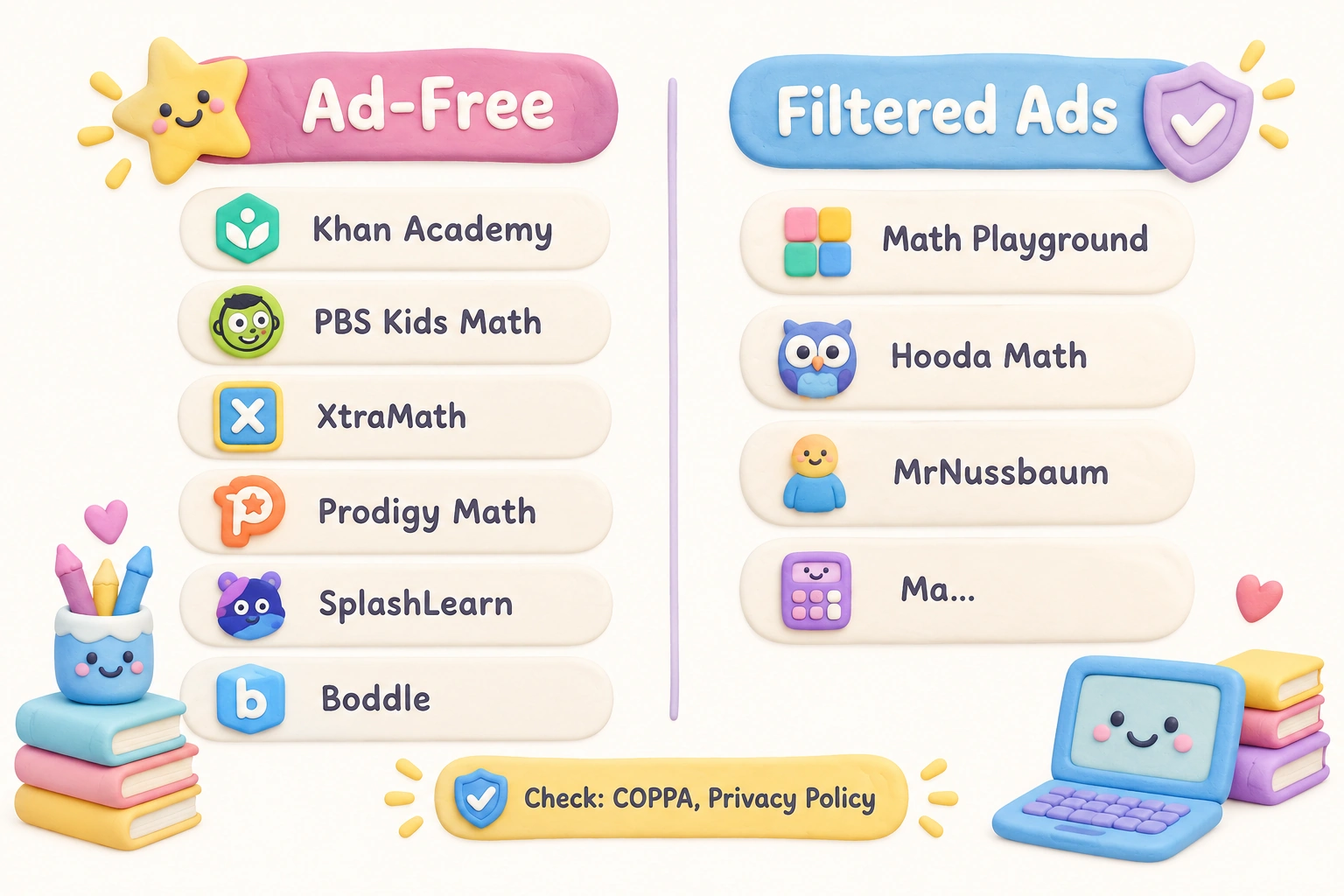
Regarding data privacy, platforms that collect student data should comply with COPPA (the Children’s Online Privacy Protection Act) in the United States. Most established platforms in this list state COPPA compliance, but it is worth reviewing each platform’s privacy policy, particularly for platforms that require account creation. Platforms that require no sign-up — such as Math Playground, Hooda Math, and Math-Play.com — collect minimal personal data by design, which some parents and teachers prefer.
Screen Time and Balance: How Long Is Enough?
Even the best free math games online are most effective when used in focused, time-limited sessions rather than extended open-ended play. The American Academy of Pediatrics recommends that parents prioritize the quality and context of screen time over rigid minute-counting for school-age children, but also encourages families to set consistent limits and ensure that digital activities do not displace sleep, physical activity, or face-to-face interaction.
For elementary students, sessions of fifteen to twenty minutes of focused math game play are generally more productive than longer sessions where attention and engagement tend to decline. It can help to set a clear purpose before a session begins — for example, practicing multiplication facts up to seven, or working on equivalent fractions — rather than allowing open-ended browsing across a platform. After a session, a brief conversation about what the child practiced or found challenging can reinforce learning and give parents useful insight into where their child may need additional support.
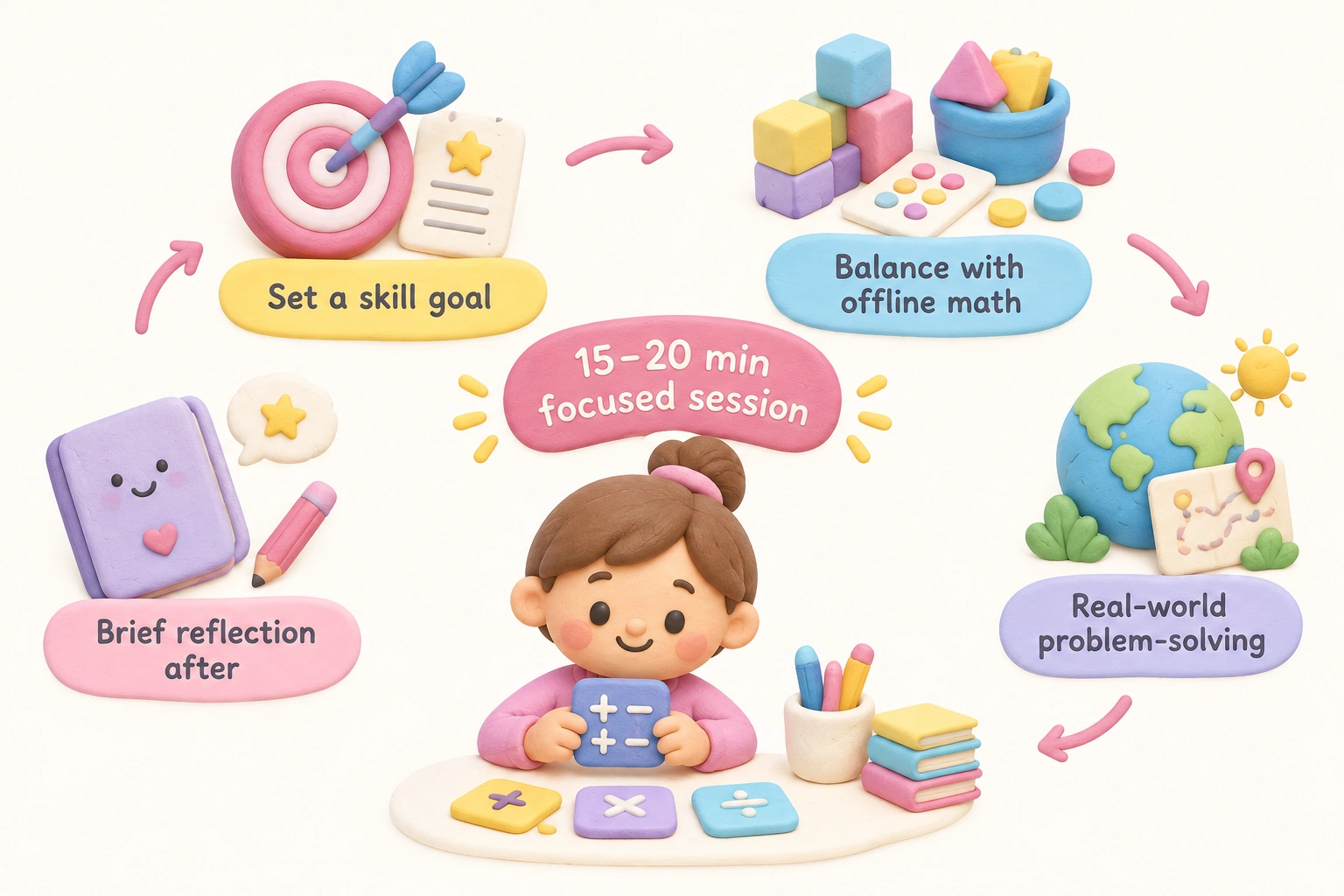
Math games work best as one component of a broader practice routine that also includes hands-on activities, mental math, and real-world problem-solving such as measuring ingredients, counting change, or estimating distances. Over-reliance on any single format — including high-quality digital games — can limit the flexibility and depth of a child’s mathematical understanding.
Frequently Asked Questions
Are these math games really completely free?
Some platforms are genuinely and fully free with no paywall — Khan Academy, PBS Kids Math, Hooda Math, Math Game Time, and Math-Play.com are among the strongest examples. Others, such as Prodigy Math, SplashLearn, and Boddle, offer meaningful free content but restrict certain features — particularly parent reporting, progress tracking, or additional game content — to paid subscribers. The comparison table earlier in this article summarizes what is and is not free on each major platform.
Do these games work on school Chromebooks?
Most of the platforms listed here are browser-based and Chromebook-friendly. Hooda Math is specifically designed to function as unblocked math games on school networks with content filters. Khan Academy, Math Playground, XtraMath, and MrNussbaum also work reliably on Chromebooks without any download or installation. If a school network blocks a particular site, Hooda Math and Math Playground are generally the most reliable alternatives.
Is it safe to let my child use these sites independently?
Suitability for independent use depends on the child’s age, the platform’s ad environment, and whether the site requires account creation. Fully ad-free platforms such as Khan Academy and PBS Kids Math are generally appropriate for independent use by elementary-age children. Platforms that display advertising are better suited to supervised or semi-supervised use, particularly for younger children. For any platform that requires account creation, parents should review the privacy policy and consider whether they are comfortable with the data collection practices before allowing independent access.
Can these games actually help with math anxiety?
Game-based learning research suggests that low-stakes, engaging practice formats may help reduce the performance anxiety some children experience with traditional math assessments. When a child can attempt a problem, receive immediate feedback, and try again without a grade attached, the emotional stakes are lower. However, math anxiety has multiple causes — including classroom environment, parental attitudes toward math, and prior negative experiences — and digital games alone are unlikely to resolve significant anxiety. If a child shows persistent distress around math, speaking with their teacher or a learning specialist is more appropriate than increasing game time.
Which platform is best for a child who is behind grade level?
Khan Academy is particularly well suited to children working below grade level because its adaptive difficulty allows students to work at their own pace without being locked into a specific grade’s content. A child in fourth grade who is still consolidating second-grade multiplication skills can work through the relevant Khan Academy exercises without the platform flagging them as behind. XtraMath is also useful for children who need to build basic fact fluency before they can engage confidently with more complex grade-level content.
Do any of these platforms offer content in languages other than English?
Khan Academy is available in multiple languages and is one of the strongest options for multilingual families or classrooms with English language learners. Some platforms, including Hooda Math, offer limited Spanish-language support. Parents and teachers working with multilingual students should check each platform’s language settings directly, as availability changes over time.
Are there printable resources to use alongside these games?
Several platforms pair online games with downloadable worksheets. Math Game Time and MrNussbaum both offer printable resources alongside their game libraries. Khan Academy’s exercise system can be printed in some formats. For families who prefer a blended approach — some screen-based practice and some paper-based work — combining a platform like Khan Academy or Math Playground with printable worksheets from Math Game Time can provide useful variety.
Choosing the Right Free Math Platform for Your Child
The best free math games online for any individual child depend on their current grade level, specific skill gaps, learning style, and the context in which they will be using the platform — at home independently, with a caregiver, or in a classroom setting. For most families, Khan Academy is the strongest starting point: it is fully free, ad-free, curriculum-aligned, works on any device, and covers every elementary math skill with adaptive difficulty and optional progress tracking. For children who need motivation through a more game-like environment, Math Playground or Prodigy Math may sustain engagement more effectively, with the understanding that Prodigy’s most useful parent-facing features require a subscription.
For classroom teachers, the combination of Khan Academy for structured independent practice and Hooda Math or Math Playground for math center rotations covers most elementary use cases without requiring any budget. Teachers who want progress tracking without a subscription should prioritize XtraMath or Khan Academy’s free teacher tools.
Whatever platform you choose, the most important factor is how the games are used rather than which specific site is selected. Short, purposeful sessions with a clear skill focus, followed by brief reflection or conversation, will produce better outcomes than longer sessions of undirected play. Math games are a genuinely useful tool in an elementary student’s learning toolkit — most effective when they are one part of a varied, balanced approach to building mathematical confidence and skill.

Take a short quiz to find out what your everyday choices say about your parenting style
When your child is curious about something new, what’s your instinct?
Take a short quiz to find out what your everyday choices say about your parenting style
“Can I download this app?” What happens next?
Take a short quiz to find out what your everyday choices say about your parenting style
When it comes to rules at home, which sounds most like you?
Take a short quiz to find out what your everyday choices say about your parenting style
If you could give your child one life skill today, what would you pick?
Take a short quiz to find out what your everyday choices say about your parenting style
Your child gets to choose what to watch. What would your ideal setup look like?
Take a short quiz to find out what your everyday choices say about your parenting style
Pick your parenting superpower ✨