Letter D Activity Ideas for Kids and Preschoolers

 Discover a Free Education Video App for Kids
Pastory uses AI to personalize educational video content based on your child’s interests and personality. Safe, engaging, and built for curious young minds. Sign up now to stay updated and enjoy early access with a free trial
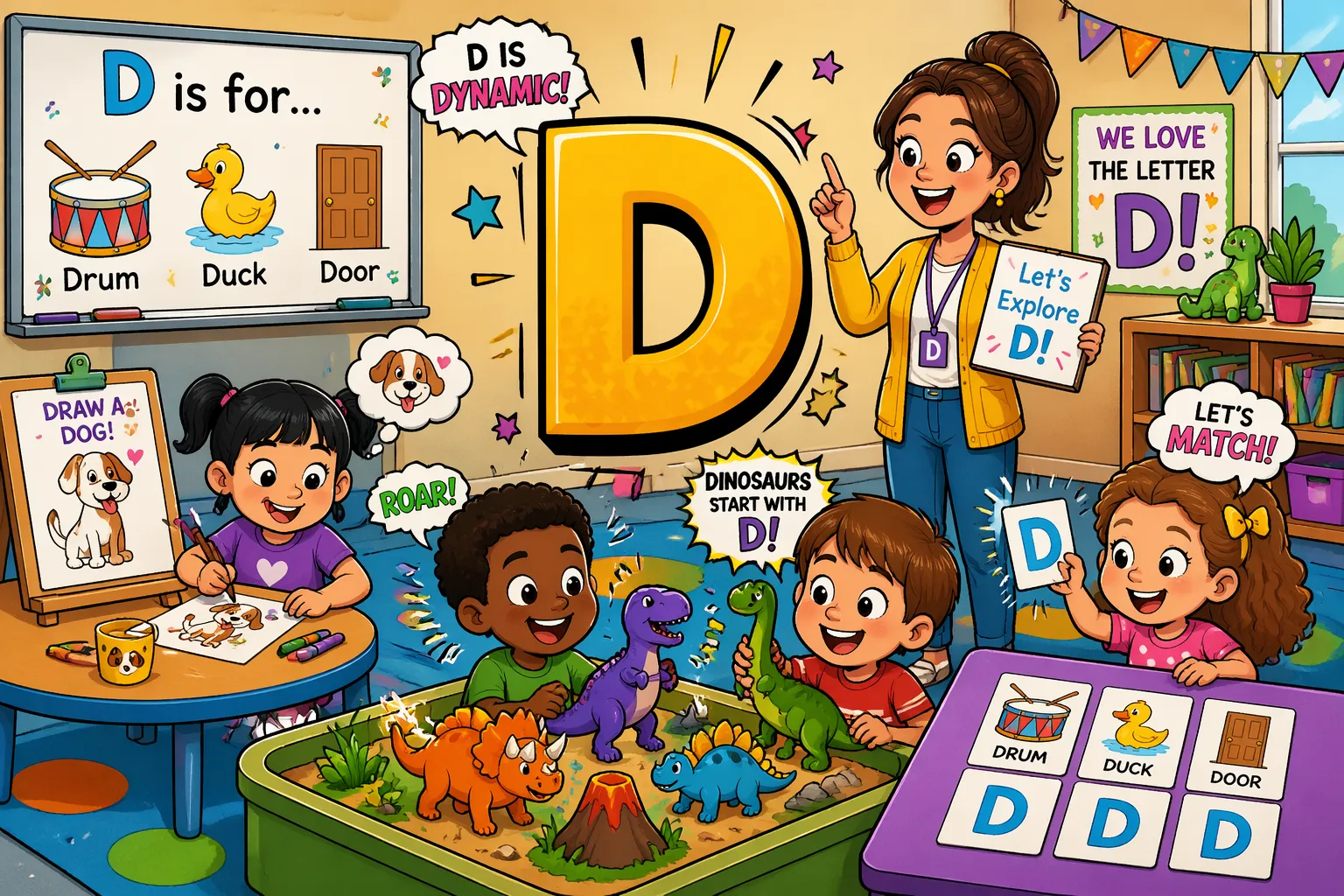
Teaching the alphabet is one of the most exciting milestones in early childhood education, and letter D activities offer a fantastic gateway into phonics, vocabulary, and early literacy. This guide covers fun, hands-on, and creative ways to introduce the D to toddlers and preschoolers — from simple crafts with construction paper to sensory bins and interactive games.
Whether you are a parent working at home or a teacher building lesson plans, these activities support letter recognition, formation, and phonemic awareness in age-appropriate ways that children genuinely enjoy.
Fun Letter D Activities for Kids
Play-based learning is one of the most effective approaches for building early literacy in young children. When preschoolers engage with letter D through games and movement, they form stronger connections between it and its sound — a process known as letter-sound association.
Dog’s Donut Maze
A Dog’s Donut Maze is a simple printed or hand-drawn activity where children guide a cartoon dog through a winding path to reach a donut. This activity builds problem-solving skills and spatial reasoning while keeping the letter D front and center. You can draw the maze on cardstock with a large “D” framing the path, so children are visually reinforcing it as they play. It works especially well as a quiet activity for preschool and pre-k classrooms.
Letter D Identification Challenge
Identification worksheets ask children to circle, color, or cross out every uppercase and lowercase D among a row of mixed alphabet letters. This activity strengthens visual discrimination — a skill that directly supports reading readiness. Including both uppercase D and lowercase d in the same exercise helps children understand that both forms represent the same letter and the same sound.
Spot the D in a Rhyme
Reading short rhymes aloud and asking children to clap, stomp, or hold up a card every time they hear a “D” sound is one of the most effective phonics activities for preschoolers. This approach develops phonemic awareness — the ability to identify individual sounds within words — which research from the National Reading Panel identifies as a key predictor of reading success. Use rhymes featuring words like “dog,” “duck,” “drum,” and “door” for maximum impact.
Match Uppercase and Lowercase D
Matching games using printed cards or digital tools help children connect “D” and “d” as a pair. Lay out several cards face down and ask children to find the matching pair. This simple activity builds visual recognition skills and reinforces the concept that letters have two forms — a foundational idea for early readers.
Animal-Themed D Maze
Combining animals like dogs, ducks, and dolphins with maze activities makes learning feel more like an adventure. Draw or print a maze where a duck needs to reach a pond, incorporating the shape of the letter D into the path design. Animal themes naturally motivate young learners and provide built-in vocabulary practice: the animals themselves are all objects that start with the letter D.
Scavenger Hunt
A letter D scavenger hunt sends children searching through books, classroom posters, labels, and household objects to find it wherever it appears. This activity reinforces letter recognition in a real-world context and teaches children that letters live everywhere — not just on worksheets. Give preschoolers a clipboard and let them make a tally mark each time they find a D.
Letter D Crafts and Hands-On Activities
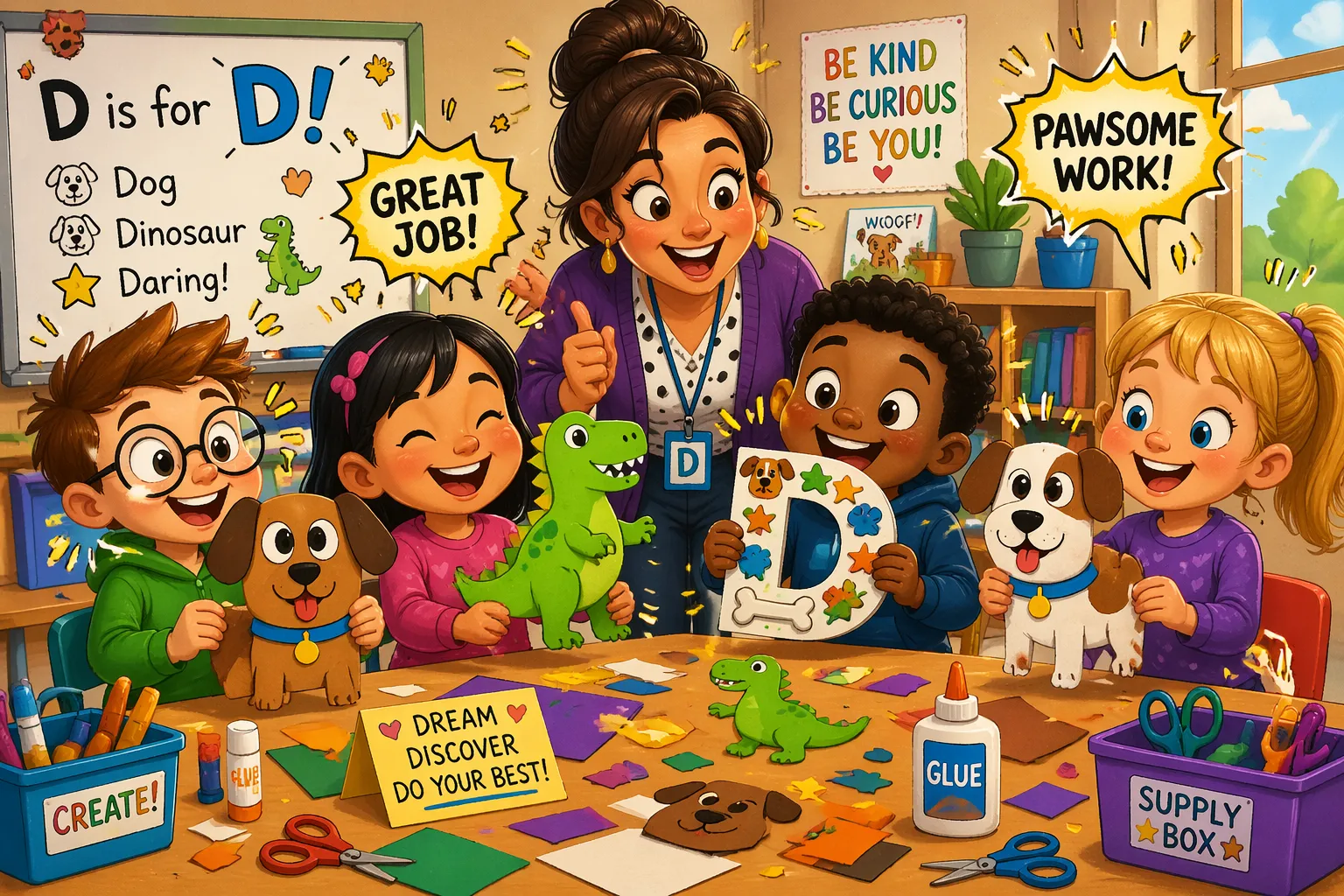
Hands-on activities engage a child’s fine motor skills while creating a physical, memorable connection to the letter being studied. Crafts that involve cutting, gluing, and shaping with materials like construction paper and playdough strengthen the small hand muscles that children will later use for handwriting. These projects are ideal for letter D week themes and work well as take-home pieces that spark conversation between children and their families.
Here are some of the most popular D crafts for preschoolers:
- D is for Dog Craft: Cut two large “D” shapes from brown construction paper and arrange them to form a dog’s body and head. Add googly eyes, a paper nose, and floppy ears. As children assemble the craft, repeat the phrase “D is for dog” to reinforce the letter-sound connection.
- D is for Donuts Craft: Cut circles from yellow paper or cardboard to form donut shapes. Children decorate them with dot marker “sprinkles” and then write or trace a large D in the center.
- D is for Duck Craft: Fold yellow paper plates into duck shapes and glue on an orange beak. Label each duck with a large uppercase or lowercase D.
- D is for Daisy Craft: Cut petal shapes from white construction paper and arrange them around a yellow circle center. Write D on each petal to practice forming the letter repeatedly.
D is for Dough Modeling
Playdough is one of the most versatile and developmentally rich materials in early childhood classrooms. Asking children to roll and shape playdough into the form of the letter D — starting at the top, curving down, and coming back up — directly practices letter formation and builds the muscle memory needed for writing it. This activity is suitable for toddlers as young as 2 and can be extended for older preschoolers by asking them to form both the uppercase D and the lowercase d.
Dots and Dot Marker Activities
Dot markers are a favorite tool in pre-k and preschool classrooms because they are easy for small hands to control. Provide children with a large outline of the letter D and ask them to fill it in with dots, either in a single color or in a rainbow pattern. This activity reinforces letter formation — specifically the idea that the D starts at the top, curves out to the right, and comes back down to meet the starting point — without the pressure of pencil tracing.
Letter D Sensory and Interactive Games
Sensory play supports memory formation by engaging multiple neural pathways at once. When children feel, see, and hear something simultaneously, the brain encodes the experience more deeply. For letter learning, this means that activities involving touch — such as tracing letters in salt or hiding them in a sensory bin — can be more effective than visual-only methods for many young learners.
Duck Sensory Bin and Water Play
Fill a shallow bin with water, plastic toy ducks, and laminated letter D cards. Children scoop out the ducks and match them to a letter D sorting mat. The combination of water play and letter recognition keeps engagement high, even for children who find structured worksheet activities frustrating.
To expand the activity, you can add small containers, spoons, or cups so children can pour, scoop, and transfer water while searching for hidden D cards. You can also include a mix of different letters and ask children to find only the D, turning it into a simple sorting challenge.
For added phonics practice, encourage kids to say the /d/ sound or name words like “duck,” “dog,” or “door” each time they find the correct letter. Adjust the difficulty by using uppercase only for beginners or mixing uppercase and lowercase for more advanced learners.
Salt Tray Letter Tracing
Pour a thin layer of salt or fine sand into a baking tray and ask children to trace the letter D with their finger. The tactile feedback from the salt helps reinforce the shape through touch. This is a particularly helpful activity for children who are struggling with handwriting or letter formation, as it removes the pressure of holding a pencil. For added engagement, use colored sand or add a light source beneath the tray.
Splash and Find Hidden D’s
Write the D in large, bold print on several waterproof cards or foam tiles and mix them with other letters in a water table or shallow bin. Children reach in, pull out a card, and call out whether it shows a D or another letter. This activity adds a physical, sensory dimension to letter recognition and is ideal for warm-weather outdoor play.
Letter D Learning Games and Worksheets
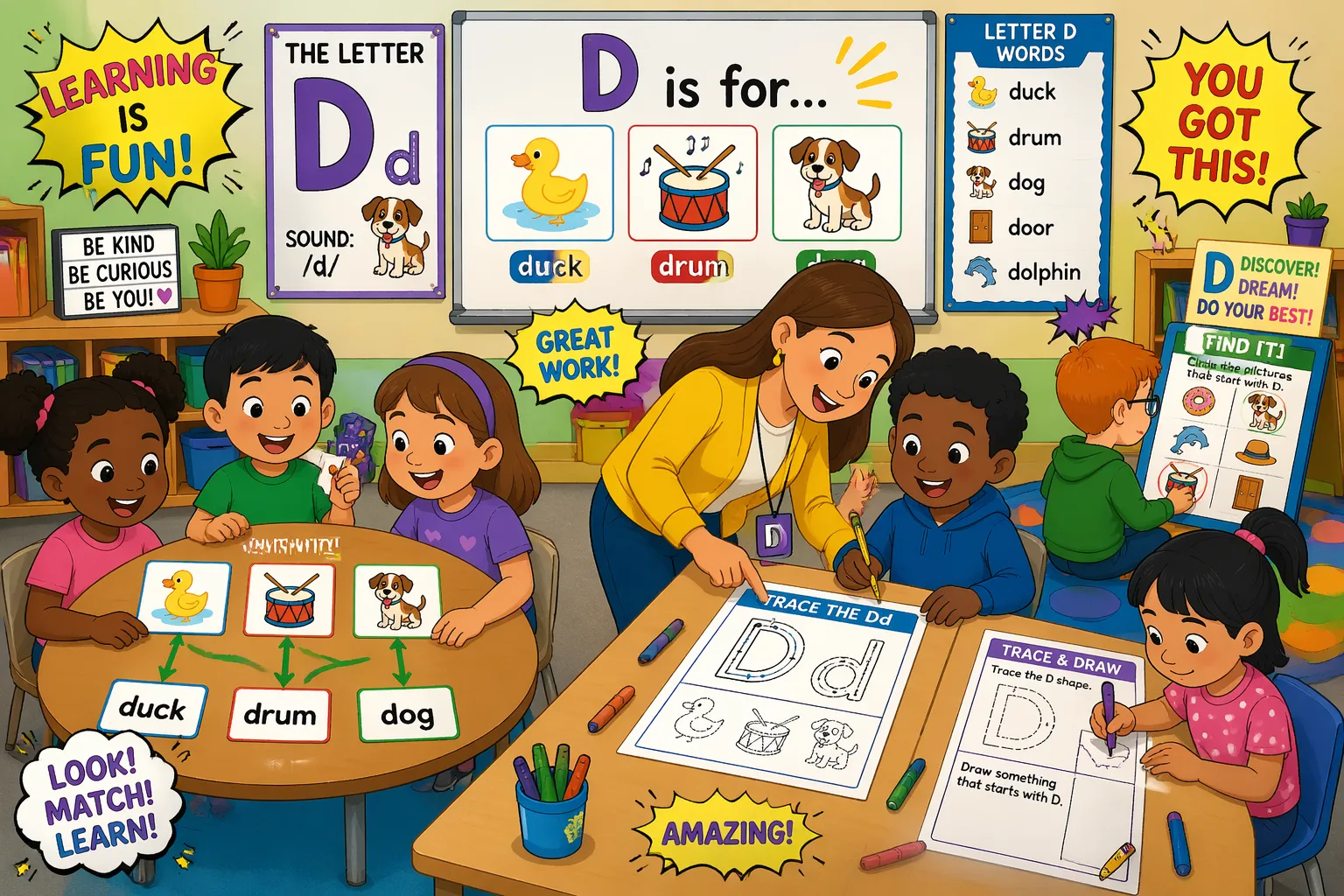
Structured activities complement hands-on play by giving children an opportunity to practice specific skills with clear targets. Letter D worksheets and printables are most effective when used after children have had time to explore it through physical play — treating the worksheet as a way to consolidate learning rather than introduce it.
Differentiating b and d
One of the most commonly confused letter pairs in early literacy is “b” and “d.” Both letters share the same basic shape — a vertical line paired with a curved bump — but the bump faces opposite directions.
Coloring exercises that highlight this difference are particularly effective: for example, coloring the curved part of “b” in blue and the curved part of “d” in a different color draws the child’s eye to the distinguishing feature. A useful hand trick is to ask children to hold both fists in front of them with thumbs pointing up — the left hand forms a “b” and the right hand forms a “d.”
Letter Tracing and Cut-and-Paste Activities
Tracing worksheets that ask children to trace the uppercase D and lowercase d in a sequence help develop handwriting muscle memory. For younger toddlers, dotted guidelines are more accessible than blank lines. Cut-and-paste activities, where children cut out letter D shapes and assemble them onto a page, add a craft element to structured practice and work well for children who find pencil-based tracing frustrating.
You can find free printables on superstarworksheets.com, teacherspayteachers.com, beginlearning.com, and other resources.
Beginning Sound Sorting
Provide children with a set of picture cards showing objects and animals, and ask them to sort the pictures into two groups: those that start with D and those that do not. This activity builds phonemic awareness and vocabulary simultaneously. Useful picture cards include: dog, duck, door, drum, dinosaur, dolphin, daisy, and donut — alongside distractor images like cat, ball, and sun.
Word and Vocabulary Activities
Building a child’s vocabulary around the letter D supports both literacy and language development. When children encounter activities repeatedly alongside meaningful words, they begin to associate the letter with its sound naturally. Vocabulary-focused activities also build the word bank that children draw on when learning to read and write.
Here are beginner-friendly words to use across letter D activities:
- Animals: dog, duck, deer, dolphin, donkey, dragonfly
- Foods: donut, dates, dumplings, dill
- Everyday objects: door, drum, desk, drawer, dish
D Word Hunt
Ask children to flip through picture books or alphabet printables and call out every word they spot that begins with D. Keep a running list on a whiteboard or poster to build a visible class vocabulary bank. Revisiting this list throughout letter D week helps children recall and consolidate new words.
All About Animals: Letter D Matching
Create a set of animal picture cards — dog, duck, deer, dolphin — and matching word cards. Children lay both sets face up and draw lines connecting each animal to its written name. This activity reinforces the connection between the letter D, its sound, and real-world vocabulary, which is a key element of building early literacy.
To extend the activity and make it more engaging, you can include additional variations and challenges such as:
- Sound sorting challenge – Ask children to say each animal name aloud and emphasize the beginning /d/ sound before matching.
- Memory flip game – Turn all cards face down and let children find matching pairs by memory.
- Category sorting – Separate animals into “starts with D” and “does not start with D” groups to reinforce phonics awareness.
- Drawing follow-up activity – Encourage children to draw their favorite “D animal” and label it with the word.
- Movement game version – Call out an animal and have children jump, clap, or act like that animal when they match it correctly.
These variations help strengthen vocabulary, improve sound recognition, and keep the learning experience interactive and playful.
Tips for Teaching Letter D Successfully
Consistency and variety are the two most important factors in helping preschoolers internalize new letters. Below are practical guidelines for parents and educators:
- Start with uppercase first. The uppercase D is visually simpler and appears more distinctively than the lowercase d, which is easily confused with b, p, and q. Establishing solid recognition of the uppercase form gives children a reliable anchor before introducing the lowercase.
- Connect the letter to real life. Point out the letter D on cereal boxes, street signs, and book covers. When children see that letters exist outside of worksheets, they understand that literacy is purposeful and relevant.
- Focus on the sound, not just the shape. Saying “D says /d/ like dog” every time the letter appears reinforces phonics over rote memorization. Children who understand sounds are better prepared for blending and reading than children who only recognize letter shapes.
- Adapt by age. For toddlers aged 2 to 3, keep activities to five minutes and focus on sensory play and crafts. For preschoolers aged 4 to 5, introduce worksheets, matching games, and sorting activities. For pre-k children approaching kindergarten, extend into writing the letter, identifying D words in books, and beginning sound sorting.
Repeating the same concept through different types of activities — crafts one day, sensory play the next, and worksheets after that — prevents boredom while building stronger retention.
Frequently Asked Questions
How do you teach letter D to preschoolers at home?
Start with everyday objects around the house — a door, a dish, a dog. Point to them, say the name, and emphasize the /d/ sound at the beginning. Incorporate short, playful activities like salt tray tracing or playdough letter formation into your daily routine, and read picture books featuring D words to build vocabulary naturally.
What are easy letter D activities for toddlers?
The simplest activities for toddlers require little or no prep: finger tracing on a large D drawn with a marker, a sensory bin with plastic ducks, or a sticker-filling activity where children press stickers inside a large D outline. Keep sessions brief — five to ten minutes — and follow the child’s interest rather than completing a set task.
How do you teach the difference between b and d?
Use visual anchors and hand tricks consistently. The “bed” trick works well for older preschoolers: the word “bed” looks like a bed when written out, with “b” as the headboard and “d” as the footboard. For younger children, coloring the bump of each letter in a distinct color — and always using the same colors — helps the brain register the difference automatically over time.
What words start with D for kids?
Beginner-friendly D words include dog, duck, door, drum, deer, dish, and daisy. These words are short, phonetically regular, and connected to objects children encounter daily, making them easier to remember and recognize.
Can letter D activities be done without any materials?
Absolutely. Verbal games, body movement activities, and storytelling require no supplies at all. Ask children to name as many D words as they can in one minute, play a “stop and freeze” game where they freeze when they hear a D word, or invite them to trace a giant letter D in the air with their arm. These no-prep activities work well as transitions between structured tasks throughout the school day.
Take a short quiz to find out what your everyday choices say about your parenting style
When your child is curious about something new, what’s your instinct?
Take a short quiz to find out what your everyday choices say about your parenting style
“Can I download this app?” What happens next?
Take a short quiz to find out what your everyday choices say about your parenting style
When it comes to rules at home, which sounds most like you?
Take a short quiz to find out what your everyday choices say about your parenting style
If you could give your child one life skill today, what would you pick?
Take a short quiz to find out what your everyday choices say about your parenting style
Your child gets to choose what to watch. What would your ideal setup look like?
Take a short quiz to find out what your everyday choices say about your parenting style
Pick your parenting superpower ✨