Fun Math Questions for Kids: Easy, Challenging and Engaging

 Discover a Free Education Video App for Kids
Pastory uses AI to personalize educational video content based on your child’s interests and personality. Safe, engaging, and built for curious young minds. Sign up now to stay updated and enjoy early access with a free trial
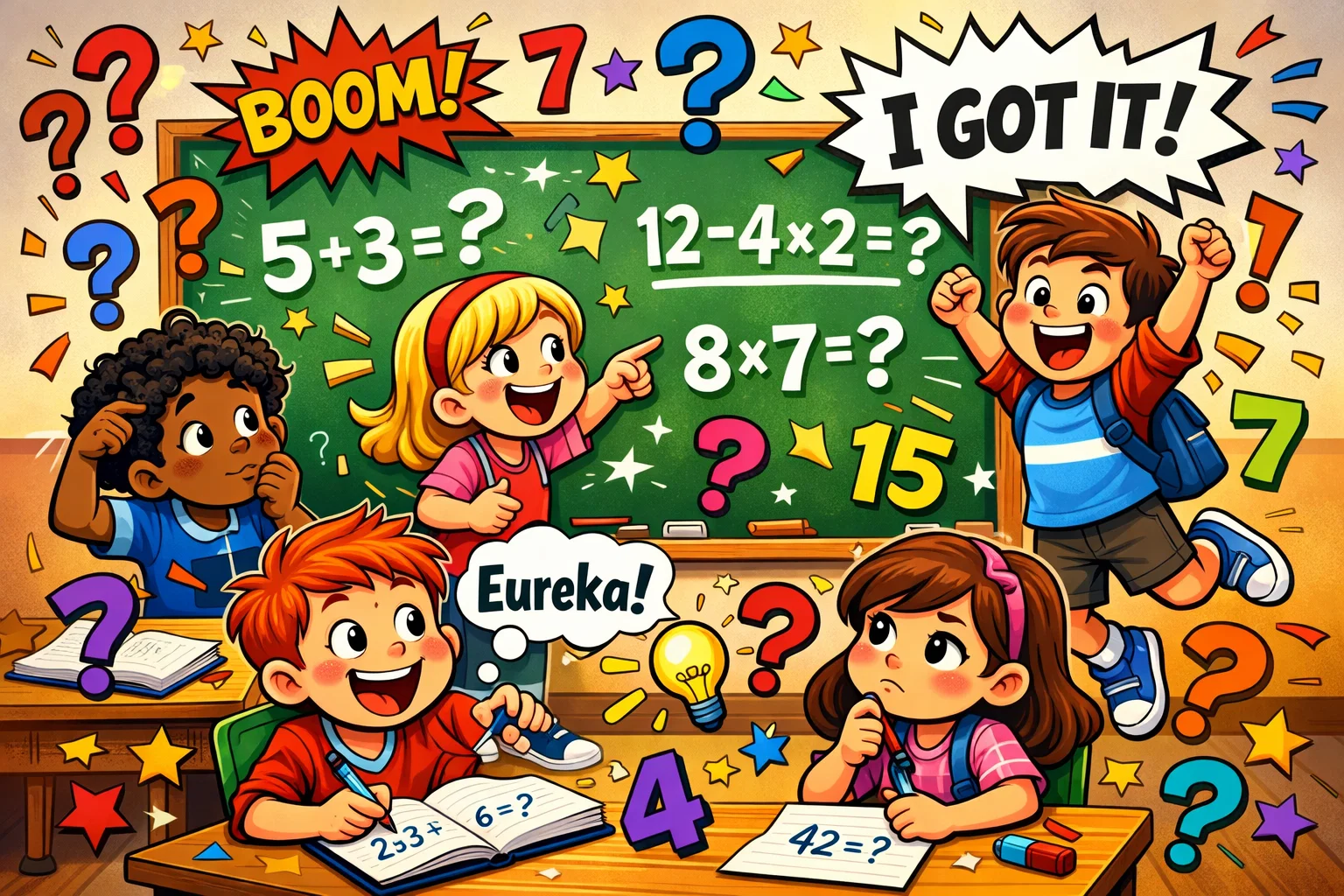
Math doesn’t have to feel like a chore. The right fun math questions can turn a reluctant learner into a curious problem-solver — one puzzle at a time. This guide covers a wide range of fun math problems, from easy warm-ups to hard brain teasers, along with real-life scenarios, geometry challenges, and practical tips for parents and teachers.
Whether you’re looking for classroom activities, homeschool exercises, or just a way to make learning enjoyable at the dinner table, these questions are designed to build confidence and sharpen mathematical thinking.
Fun Math Puzzles and Brain Teasers
Brain teasers and math puzzles are among the most effective tools for encouraging critical thinking in children. They shift the focus from rote memorization to genuine reasoning — which is where real mathematical understanding begins. Whether your child is just starting out or is already a confident learner, there’s a puzzle here to stretch their thinking.
Logic & Number Patterns
Great for building sequencing skills and logical reasoning.
- The Growing Sequence
- Puzzle: What comes next in this pattern: 2, 4, 8, 16, 32, __?
- Solution: Each number is doubled to get the next one. 32 x 2 = 64.
- Answer: 64
- The Seven Children
- Puzzle: Mr. Smith has 7 daughters. Each daughter has one brother. How many children does Mr. Smith have in total?
- Solution: All the daughters share the same single brother. 7 daughters + 1 brother = 8.
- Answer: 8
- Odd One Out
- Puzzle: Which number doesn’t belong in this group: 15, 25, 33, 40, 50?
- Solution: All the other numbers are divisible by 5 (they end in 0 or 5).
- Answer: 33
- The Magic Triangle
- Puzzle: I am a three-digit number. My tens digit is 5 more than my ones digit. My hundreds digit is 8 less than my tens digit. What number am I?
- Solution: If the tens digit is 9, the ones is 4 (9-5) and the hundreds is 1 (9-8).
- Answer: 194
- Reverse It
- Puzzle: What number stays the same even if you turn it upside down?
- Solution: The number 8 (and 0) look identical when flipped vertically.
- Answer: 8 (or 808)
Word Problems & Riddles
Perfect for practicing “math in the real world.”
- The Egg Basket
- Puzzle: You have a basket with 6 eggs. You give 6 people 1 egg each, but one egg is still in the basket. How?
- Solution: The last person was given the egg while it was still inside the basket.
- Answer: The 6th person took the basket with the egg in it.
- Snail’s Pace
- Puzzle: A snail is at the bottom of a 10-foot pit. Every day he climbs up 3 feet, but at night he slides back 2 feet. How many days will it take him to reach the top?
- Solution: On day 7, he reaches 7 feet. On day 8, he climbs 3 feet and hits the 10-foot mark before he can slide back.
- Answer: 8 days
- Age Gap
- Puzzle: When I was 6 years old, my sister was half my age. Now I am 70. How old is my sister?
- Solution: Half of 6 is 3, meaning the sister is 3 years younger. 70 – 3 = 67.
- Answer: 67
- The Bat and the Ball
- Puzzle: A bat and a ball cost 1.10 in total. The bat costs 1.00 more than the ball. How much does the ball cost?
- Solution: If the ball is 0.05, the bat is 1.05. Together they equal 1.10.
- Answer: 5 cents
- Apple Picking
- Puzzle: If there are 3 apples and you take 2, how many apples do you have?
- Solution: You took them, so you own them!
- Answer: 2
Quick Calculation & Geometry
Fast-paced puzzles to test mental math.
- The Heavy Pound
- Puzzle: Which is heavier: a pound of gold or a pound of feathers?
- Solution: A pound is a pound, regardless of the material.
- Answer: They weigh the same.
- The Handshake Problem
- Puzzle: There are 4 people in a room. If everyone shakes hands with everyone else exactly once, how many handshakes happen?
- Solution: Person A shakes with 3, Person B shakes with 2 more, Person C shakes with 1 more (3+2+1).
- Answer: 6
- Pizza Slices
- Puzzle: What is the maximum number of pieces you can cut a circular pizza into using only 3 straight cuts?
- Solution: By overlapping the cuts in the center and across each other, you create 7 sections.
- Answer: 7
- Grandmother’s Cookies
- Puzzle: A grandmother, two mothers, and two daughters went to tea. How many people went to tea?
- Solution: There is a grandmother, her daughter (who is also a mother), and that daughter’s daughter.
- Answer: 3
- The Dozen Check
- Puzzle: How many 9s are there between 1 and 100?
- Solution: Count them: 9, 19, 29, 39, 49, 59, 69, 79, 89, 90, 91, 92, 93, 94, 95, 96, 97, 98, 99 (99 has two!).
- Answer: 20
Fraction, Multiplication, and Geometry Problems
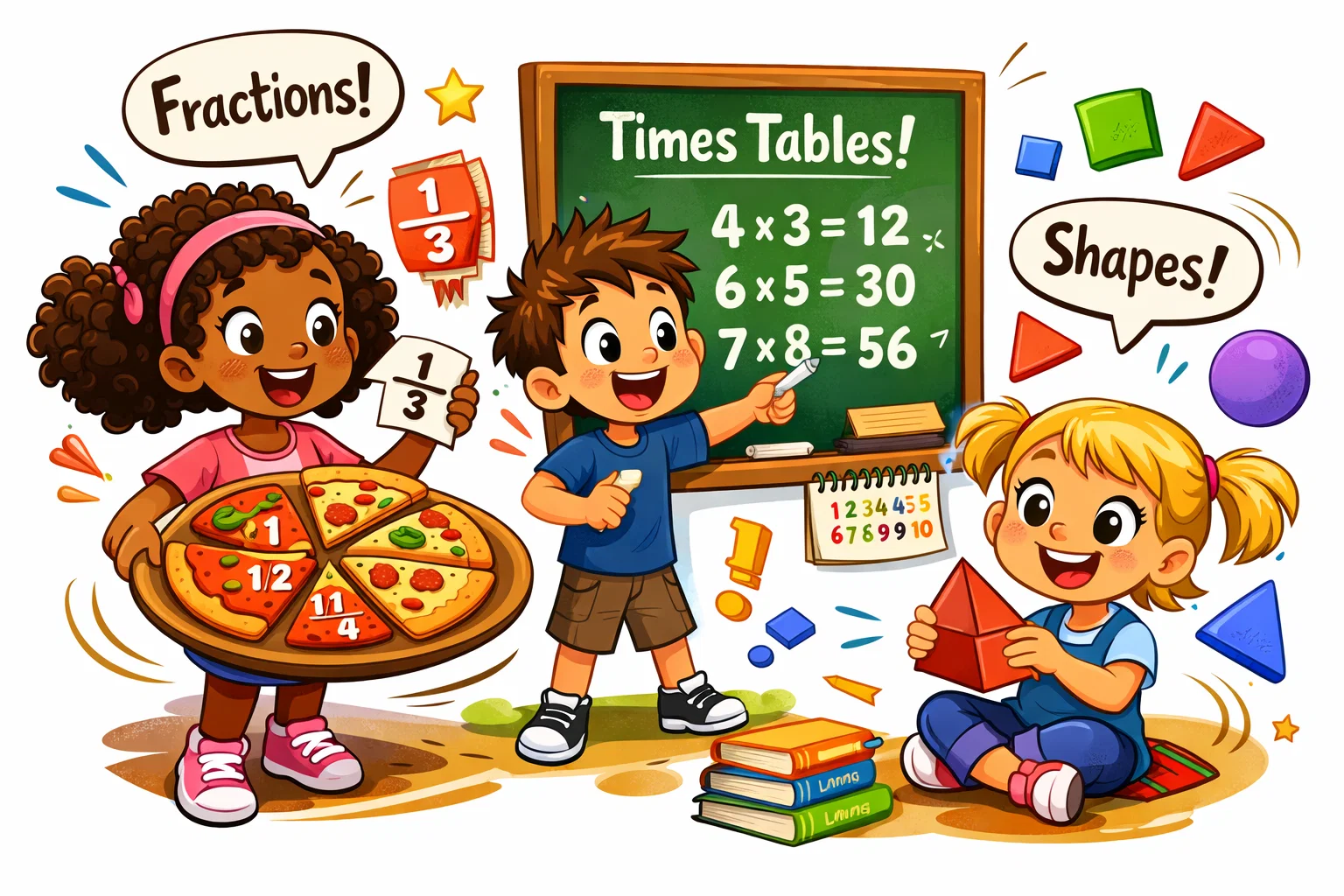
These sections cover three of the most foundational areas in primary school mathematics. Fractions, multiplication, and geometry each require a different kind of thinking — and each opens the door to more complex mathematics later on.
Fraction Action
Puzzles that test how well you can slice and dice numbers.
- The Pizza Party
- Puzzle: You have 2 identical pizzas. You cut the first into 4 equal slices and the second into 8 equal slices. If you eat 1 slice from the first and 2 slices from the second, which pizza did you eat more of?
- Solution: 1/4 is the same as 2/8. Both amounts represent a quarter of a pizza.
- Answer: You ate the same amount.
- The Halfway Mystery
- Puzzle: What number is exactly halfway between 1/4 and 3/4?
- Solution: Add them together (1/4 + 3/4 = 4/4 or 1) and divide by 2.
- Answer: 1/2 (or 2/4)
- The Fruit Basket
- Puzzle: A basket contains 12 fruits. 1/3 are apples and 1/4 are bananas. How many fruits are NOT apples or bananas?
- Solution: 1/3 of 12 = 4. 1/4 of 12 = 3. 12 – 4 – 3 = 5.
- Answer: 5
- The Vanishing Half
- Puzzle: If you have a chocolate bar and give away half, then give away half of what’s left, and then half of that, what fraction of the original bar do you have?
- Solution: 1/2 x 1/2 x 1/2 = 1/8.
- Answer: 1/8
- Quarter Time
- Puzzle: I am a fraction. My numerator is 2. My denominator is my numerator multiplied by 4. What am I in simplest form?
- Solution: The fraction is 2/8. When simplified, it becomes 1/4.
- Answer: 1/4
Multiplication Mind-Benders
Fast-thinking puzzles based on factors and multiples.
- The Double-Up Jar
- Puzzle: A magic jar starts with 1 penny. Every minute, the number of pennies inside doubles. How many pennies are in the jar after 10 minutes?
- Solution: Use powers of 2 (2 x 2 x 2… ten times). 2^10 = 1,024.
- Answer: 1,024
- Leg Count
- Puzzle: In a farmyard, there are 5 cows and 10 chickens. How many legs are there in total? (Do not count the farmer!)
- Solution: (5 cows x 4 legs) + (10 chickens x 2 legs) = 20 + 20.
- Answer: 40
- The “7” Trick
- Puzzle: What is the product of all the numbers on a telephone keypad (1, 2, 3, 4, 5, 6, 7, 8, 9, 0)?
- Solution: Anything multiplied by zero is zero.
- Answer: 0
- The Three Nines
- Puzzle: What is the largest number you can make using the digit 9 three times?
- Solution: Using multiplication or addition yields small numbers (9 x 9 x 9 = 729), but using an exponent creates a massive number (9^9^9). However, in standard digits, it’s 999.
- Answer: 999 (or 9^9^9 for advanced kids)
- The Square Room
- Puzzle: A square room is being tiled. If it takes 9 tiles to cover one side, how many tiles are needed to cover the entire floor?
- Solution: A square has equal sides, so 9 x 9 = 81.
- Answer: 81
Geometry Giants
Shape-shifting puzzles to test spatial awareness.
- The Corner Count
- Puzzle: A square table has 4 corners. If you saw off one corner in a straight line, how many corners does the table have now?
- Solution: The cut removes 1 corner but creates 2 new ones in its place.
- Answer: 5
- Triangle Trap
- Puzzle: How many triangles can you find in a square that has an “X” drawn from corner to corner?
- Solution: There are 4 small triangles and 4 larger ones made by combining two small ones.
- Answer: 8
- The Dice Roll
- Puzzle: On a standard 6-sided die, what do the opposite sides always add up to?
- Solution: 1+6, 2+5, 3+4 all equal 7.
- Answer: 7
- Fence Post Logic
- Puzzle: You want to build a square garden with 3 fence posts on each side. What is the minimum number of posts you need?
- Solution: Each corner post counts for two sides. 4 corners + 4 middle posts = 8.
- Answer: 8
- The Longest Side
- Puzzle: In a right-angled triangle, if the two short sides are 3cm and 4cm, how long is the longest side?
- Solution: Use the Pythagorean theorem (3^2 + 4^2 = c^2). 9 + 16 = 25. The square root of 25 is 5.
- Answer: 5cm
Problem-Solving Questions and Real-Life Scenarios
Applied math — where children solve problems connected to real situations — is one of the most powerful ways to deepen understanding. When a child sees that mathematics helps them figure out how long until lunch or whether they have enough money for a toy, the subject becomes genuinely meaningful.
Shopping & Money Matters
Puzzles that help kids handle “real world” math at the store.
- The Change Challenge
- Puzzle: You buy a toy for $7.35 and pay with a $10 bill. What is the fewest number of coins and bills you can receive as change? (Using quarters, dimes, nickels, and pennies).
- Solution: Change is $2.65. That is two $1 bills, two quarters, and one dime (2.00 + 0.50 + 0.10 + 0.05).
- Answer: 5 (Two $1 bills, 2 quarters, 1 dime, 1 nickel)
- The Bulk Buy
- Puzzle: A single juice box costs $1.50. A pack of 4 costs $5.00. Which is the better deal, and how much do you save per juice box?
- Solution: In the pack, each juice is $1.25 (5/4). The single is $1.50.
- Answer: The 4-pack is better; you save $0.25 per box.
- The Allowance Goal
- Puzzle: You want to buy a game that costs $60. You get an $8 allowance every week. If you already have $12 saved, how many more weeks must you save to buy the game?
- Solution: $60 – $12 = $48 needed. $48/$8 = 6.
- Answer: 6 weeks
- Sales Tax Surprise
- Puzzle: A hat costs $20. There is a “Buy One, Get One Half Off” sale. How much do you pay for two hats?
- Solution: First hat is $20. Second hat is $10 (20/2). Total is $30.
- Answer: $30
- The Lemonade Stand
- Puzzle: You spent $10 on lemons and sugar. You sold 20 cups of lemonade for $1 each. What is your total profit?
- Solution: Total earned is $20. Profit is earnings minus expenses ($20 – $10).
- Answer: $10
Travel & Time Management
Puzzles about getting from point A to point B on schedule.
- The Movie Marathon
- Puzzle: A movie is 125 minutes long. If it starts at 2:00 PM, what time does it end?
- Solution: 125 minutes is 2 hours and 5 minutes. 2:00 + 2 hours 5 mins = 4:05.
- Answer: 4:05 PM
- The Slow Commute
- Puzzle: You are riding your bike to a friend’s house 6 miles away. If you ride at a steady speed of 12 miles per hour, how many minutes will it take you to get there?
- Solution: 6 miles is half of 12 miles. So it takes half an hour (30 minutes).
- Answer: 30 minutes
- Time Zones
- Puzzle: Your cousin lives in a city 3 hours behind your time. If you call them at 10:00 AM your time, what time is it for them?
- Solution: 10:00 – 3 hours = 7:00.
- Answer: 7:00 AM
- The Gas Tank
- Puzzle: A car travels 30 miles for every gallon of gas. If the gas tank holds 10 gallons and is currently half full, how much farther can the car drive?
- Solution: Half full is 5 gallons. 5 gallons × 30 miles = 150 miles.
- Answer: 150 miles
- The School Bus
- Puzzle: The school bus picks up 3 kids at the first stop. At every stop after that, it picks up 2 more kids than the stop before. How many kids are on the bus after the 3rd stop?
- Solution: Stop 1: 3 kids. Stop 2: 3 + 5 = 8 kids. Stop 3: 8 + 7 = 15 kids.
- Answer: 15 kids
Kitchen & Measurement Scenarios
Using math to build, bake, and organize.
- Double the Recipe
- Puzzle: A cookie recipe calls for 3/4 cup of sugar. You want to double the recipe. How much sugar do you need?
- Solution: 3/4 + 3/4 = 6/4. This simplifies to 1.5 cups.
- Answer: 1.5 cups.
- The Tile Floor
- Puzzle: You are tiling a small bathroom floor that is 5 feet wide and 4 feet long. Each tile is 1 square foot. How many tiles do you need?
- Solution: Area = length × width. 5×4 = 20.
- Answer: 20 tiles
- Water Jug Riddle
- Puzzle: You have a 3-liter jug and a 5-liter jug. How can you measure exactly 4 liters?
- Solution: Fill the 5L jug. Pour it into the 3L jug (leaving 2L in the 5L jug). Empty the 3L jug. Pour the 2L into the 3L jug. Fill the 5L jug again. Pour from the 5L until the 3L is full (you only need 1L to fill it).
- Answer: You are left with exactly 4L in the 5L jug.
- The Pizza Cut
- Puzzle: You have 8 friends at a party. You want everyone to have 3 slices of pizza. If each pizza has 8 slices, how many pizzas do you need to order?
- Solution: 8 friends x 3 slices = 24 slices total. 24 / 8 = 3.
- Answer: 3 pizzas
- The Growing Plant
- Puzzle: A sunflower grows 2 inches every day. If it is 10 inches tall on Monday morning, how tall will it be on Friday morning?
- Solution: There are 4 full days of growth (Mon-Tue, Tue-Wed, Wed-Thu, Thu-Fri). 4 days x 2 inches = 8 inches. 10 + 8 = 18.
- Answer: 18 inches
Tips for Teachers and Parents
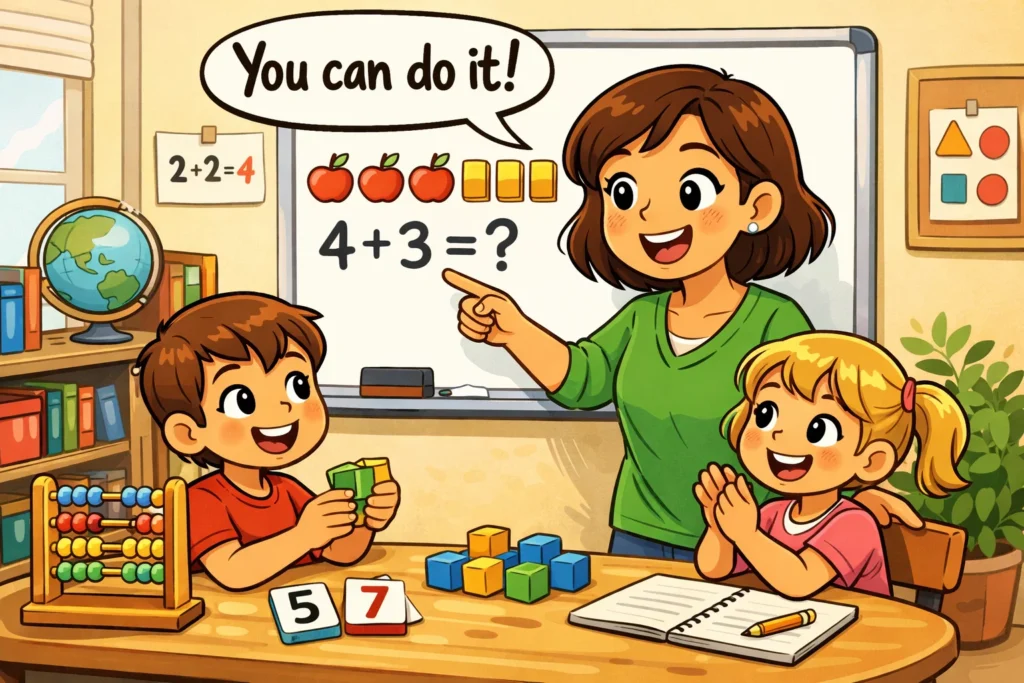
Knowing how to use fun math problems effectively is just as important as having good questions on hand. The way adults introduce, frame, and follow up on math activities makes a significant difference in how children experience mathematics.
How to Use Fun Math Questions Effectively
The most effective math practice combines low stakes with high engagement. Here are key principles to keep in mind:
- Start with what they know. Introduce questions that are slightly above a child’s current level — challenging enough to be interesting, but not so hard that they give up.
- Encourage thinking out loud. Ask children to explain how they arrived at their answer. This builds metacognitive skills and reveals gaps in understanding.
- Celebrate the process, not just the answer. Praise effort and strategy, not just correct results. This reduces math anxiety and builds lasting confidence.
Creating Interactive Math Activities
Group learning and playful formats help children engage more deeply with mathematical content. Consider these approaches:
- Math relay races: Divide children into teams and have each member solve one step of a multi-part problem before passing it on.
- Quiz-style games: Use a whiteboard or cards where children hold up their answers simultaneously — this keeps everyone engaged and takes the pressure off individual performance.
- Real-world missions: Set a weekly math challenge connected to daily life, such as calculating the best deal at the supermarket or figuring out how long a road trip will take at a given speed.
Adapting Questions for Different Skill Levels
The same core math question can be adjusted to suit a wide range of learners. A multi-step puzzle can be simplified by removing steps for younger children, or extended with extra constraints for advanced ones. Use this framework:
- Remove steps to simplify — for example, give one more clue in a riddle
- Add constraints to increase difficulty — such as requiring the answer to be a prime number
- Change the context to increase relevance — swap a train problem for a bicycle ride if that resonates more with the child
How to Help Kids Enjoy Math More
Enjoyment of mathematics is largely shaped by early experiences. Children who encounter math in low-pressure, curious, and playful settings at an early age are more likely to gain confidence and stay engaged as problems become more complex. A few practical strategies that consistently work:
- Make it a game whenever possible — even simple dice rolls can become arithmetic practice
- Tie math to something your child already loves, whether that’s cooking, sport, or building
- Avoid expressing your own negative feelings about math in front of children, as attitudes are contagious
- Focus on progress rather than comparison with peers
Math confidence grows steadily when children feel supported, challenged at the right level, and — most importantly — like they’re genuinely having fun along the way.
Encouraging Daily Math Practice Through Play
Daily math practice becomes far more effective when it feels like play rather than routine work. Instead of relying only on worksheets, incorporate math into games, challenges, and everyday activities that naturally spark curiosity. Simple actions like counting objects during a walk, solving quick riddles at the dinner table, or playing number-based games can turn small moments into valuable learning opportunities.
Gamified approaches—such as timed quizzes, reward systems, or friendly competitions—help maintain excitement and keep kids coming back for more. Variety is key: mixing puzzles, word problems, and interactive tasks prevents boredom and keeps the experience fresh. When math becomes part of play, it removes pressure, boosts confidence, and encourages a natural interest that supports long-term growth.
Frequently Asked Questions
What makes math questions fun?
Fun math questions tend to share a few key qualities: they feel like puzzles rather than tests, they connect to real life or storytelling, and they have a satisfying “aha” moment when the answer clicks. Riddles, mysteries, and questions with surprising answers tend to spark the most curiosity.
Where to find easy math questions with answers?
Several reliable sources offer well-structured math questions and answers for different age groups and grade levels:
- Khan Academy (khanacademy.org) — free, curriculum-aligned practice problems for all ages
- Math Playground (mathplayground.com) — interactive games and word problems
- Math-Drills.com — printable worksheets suitable for offline and homeschool use
- Brilliant.org — logic puzzles and challenges for more advanced young learners
How can math games help improve problem-solving skills?
Math games encourage active problem-solving skills and logical thinking by presenting challenges in a fun format. Players often need to analyze patterns, solve an equation, or decide how to subtract or combine numbers to reach a goal. This repeated practice strengthens core math skills without feeling like traditional math lessons.
What types of math topics should kids practice?
A balanced mix of topics like basic operations, decimal work, and early algebra helps build strong numerical foundations. Activities can include identifying the first digit, second digit, or even third digit in numbers, along with solving simple equations. If needed, a tutor can help tailor practice to match a child’s level and learning pace.
Take a short quiz to find out what your everyday choices say about your parenting style
When your child is curious about something new, what’s your instinct?
Take a short quiz to find out what your everyday choices say about your parenting style
“Can I download this app?” What happens next?
Take a short quiz to find out what your everyday choices say about your parenting style
When it comes to rules at home, which sounds most like you?
Take a short quiz to find out what your everyday choices say about your parenting style
If you could give your child one life skill today, what would you pick?
Take a short quiz to find out what your everyday choices say about your parenting style
Your child gets to choose what to watch. What would your ideal setup look like?
Take a short quiz to find out what your everyday choices say about your parenting style
Pick your parenting superpower ✨