

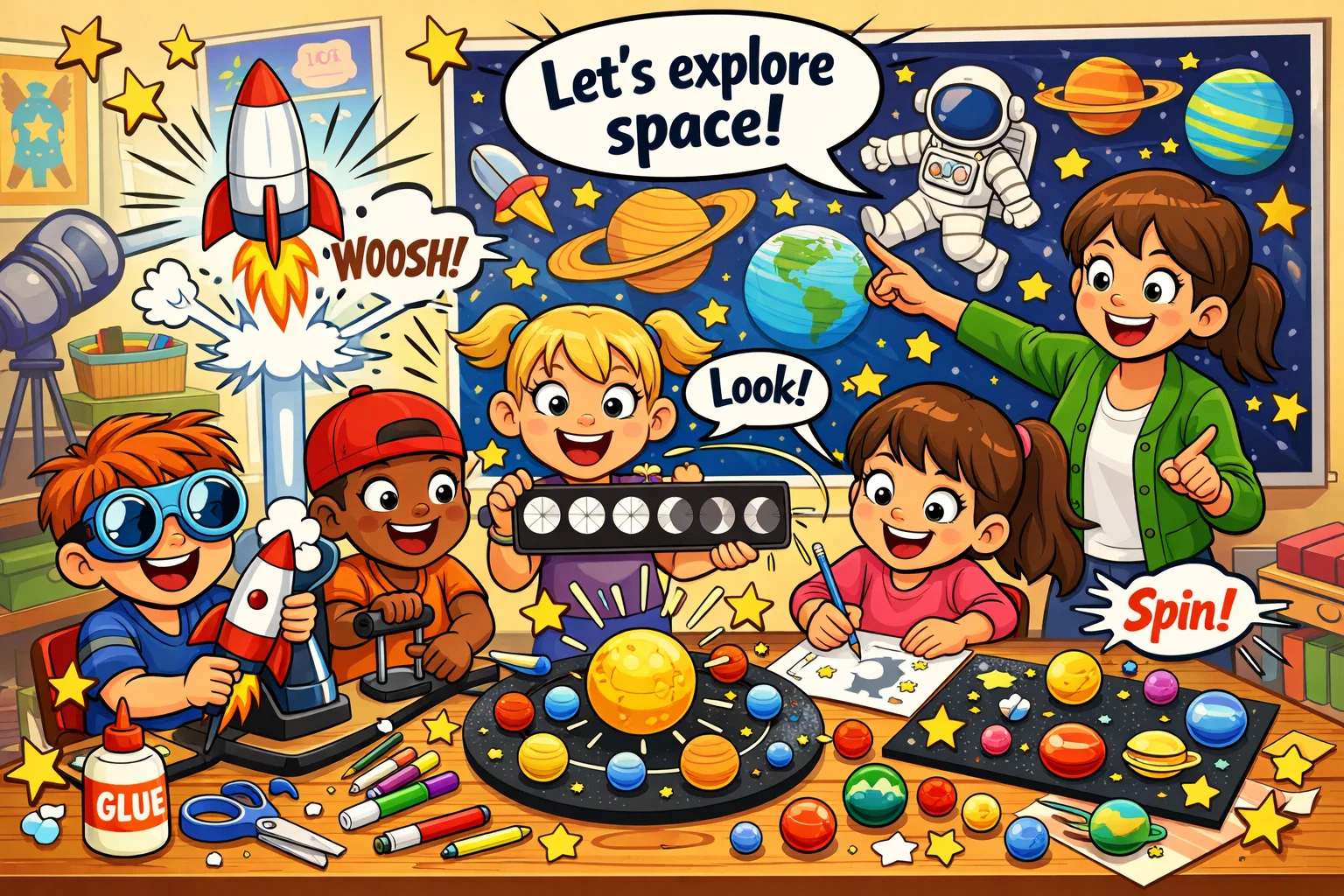
Igniting a child’s interest in the night sky and outer space is one of the most effective ways to build lifelong STEM skills. This comprehensive guide provides a curated collection of science experiments, engineering builds, and astronomy tasks designed for various age groups. Whether you are looking for a rocket craft for a toddler or a more complex solar system model for an elementary school student, these hands-on activities use simple household materials to teach real-world scientific principles. By engaging in these cosmic projects, kids develop critical thinking while exploring the wonders of the solar system, the stars, and life in space.
Benefits of STEM Astronomy Exploration for Kids
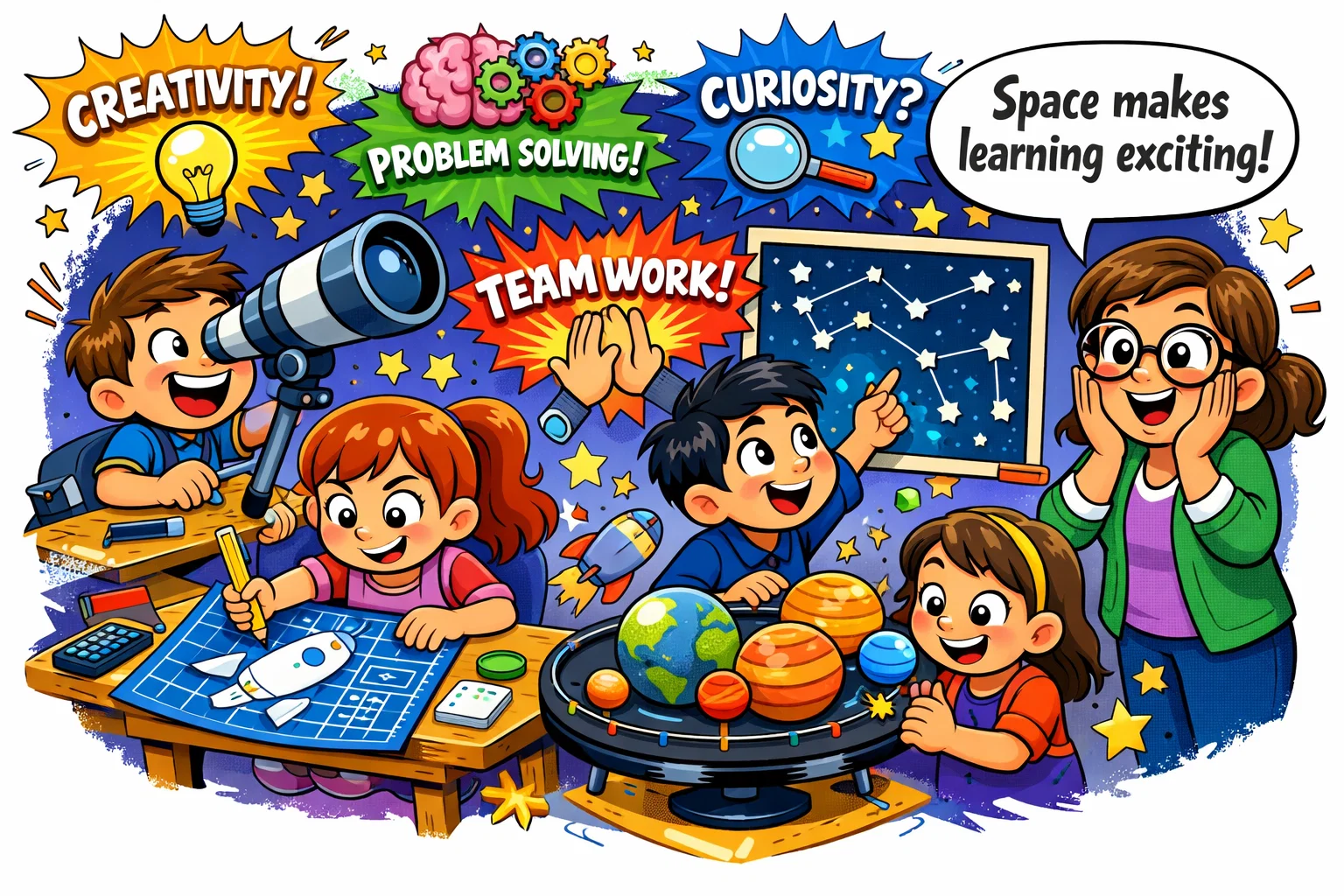
Engaging in space-themed activities fosters a natural sense of curiosity about the world beyond our planet. Earth and space science provides a rich context for developing observation and analytical skills. When children study the solar system, they aren’t just memorizing facts; they are learning to categorize, compare scales, and understand the physics of motion.
Innovation and Creative Problem-Solving Skills
Rocket builds and orbital challenges require children to predict, test, and refine their designs based on physical results. For example, a DIY aerodynamic rocket project allows a student to see how fin shape affects flight stability, leading to iterative improvements. This “trial and error” process is a cornerstone of engineering, teaching kids that failure is simply a data point on the way to a successful launch.
Educational experts often refer to this as the Engineering Design Process (EDP). Students who engage in iterative design challenges often strengthen their divergent thinking and problem-solving skills. By adjusting the nose cone of a rocket or the weight of a lunar lander, children internalize the relationship between variables and outcomes.
Hands-On Learning and Practical Skills
Hands-on activities ensure that kids will love learning because they are active participants rather than passive observers. Building a crater impact site with flour and cocoa powder allows a child to measure depth and diameter, translating abstract concepts into tangible data. Tactile learning can improve retention in science compared with textbook-only instruction.
When children use their hands to mold moon rocks or mix baking soda and vinegar for a chemical reaction, they are engaging their fine motor skills and sensory processing. This “learning by doing” approach supports healthy cognitive development by bridging the gap between abstract theory and physical reality.
Teamwork and Communication Skills
Group challenges, such as building a Mars rover or mapping constellations, require students to collaborate and present their findings. During a World Space Week event, children often work in “mission control” teams, necessitating clear communication and collective decision-making. These social-emotional benefits are just as vital as the technical knowledge gained during the educational unit.
In a classroom setting, these collaborative tasks mimic real-world teamwork in places such as the International Space Station or a space agency. Students learn to delegate roles – such as lead engineer, data recorder, or communications officer – ensuring that the final project, whether it’s a star map or a solar system model, reflects the combined effort of the team.
What Is Space Science
This field of study investigates the universe beyond Earth, including the Sun, the Moon, planets, and stars. For parents and teachers, it serves as an umbrella term covering astronomy, astrophysics, and aerospace engineering. It involves observing sky patterns, understanding Earth’s rotation, and developing the technology – like satellites and rockets – needed for exploration.
Core Astronomy Topics for Kids
Foundational activities usually begin with observable phenomena that kids love. Key topics include:
- Day and Night: Understanding how Earth’s rotation creates light and dark cycles.
- Moon Phases: Tracking the lunar cycle from New Moon to Full Moon using phases of the moon charts.
- The Solar System: Identifying the eight planets and their unique attributes.
- Gravity and Craters: Exploring how objects move and how impacts affect planetary surfaces.
- Sun and Moon: Recognizing the relationship between our closest celestial neighbors and their influence on tides and light.
Space Exploration Topics for STEM Lessons
As students progress, STEM activities shift toward the “how” of space travel. This includes studying the International Space Station (ISS), how astronauts survive in microgravity, and the mechanics of a rocket launch. Lessons often highlight the work of a space agency like NASA to provide real-world context for robotic missions to the moon or Mars.
By examining the life of an astronaut aboard the International Space Station, children learn about life-support systems, water recycling, and the biological effects of microgravity. These topics introduce high-level concepts like chemistry and biology through the lens of adventure and discovery, making complex information more digestible for young minds.
Skills Kids Build Through Galactic Projects
Cosmic projects are designed to meet specific STEM outcomes through measurable actions.
- Measuring: Calculating the distance between planets in a scaled solar system model.
- Modeling: Creating a 3D representation of a constellation to understand perspective and star patterns.
- Recording: Using a moon journal to document changes over a 28-day period.
- Analyzing: Comparing the results of a chemical reaction activity to determine which design or reaction produces the strongest effect.
Educational Activities and Ideas
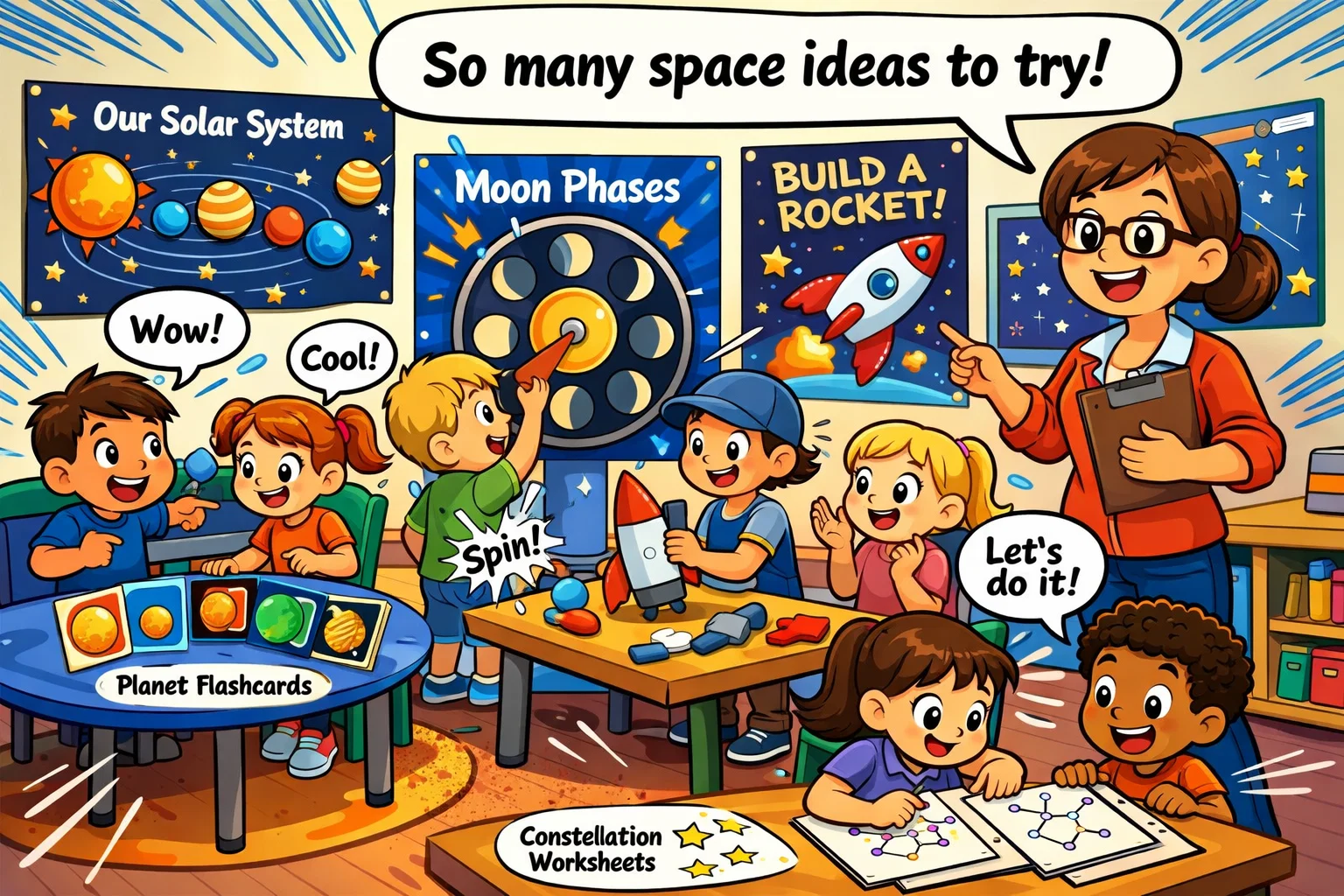
The most effective lessons on space are organized by developmental stage and learning goals. By grouping activities into logical categories, educators can ensure that the level of difficulty matches a child’s fine motor skills and cognitive ability.
How to Sequence a Space Unit
A successful educational unit follows a logical progression of “Near to Far.”
- Earth-Based: Day/night cycles and shadow tracking.
- The Moon: Phases of the moon, lunar geography, and moon craters.
- The Stars: Identifying star patterns, constellations activity, and the night sky.
- The Solar System: Planet order, size comparisons, and orbits around the sun.
- Human Flight: Rockets, astronaut life, and the international space station.
Activities for Preschool and Kindergarten
For preschoolers, focus on sensory play and high-contrast visuals. Galaxy slime or moon sand (made from flour and oil) provides a tactile way to discuss the textures of the universe. Matching games featuring planets or free printables with large astronaut figures help build vocabulary without overwhelming the learner with complex physics.
At this age, the goal is familiarity rather than mastery. Using glow-in-the-dark stars on the ceiling or playing with printable space stickers allows children to become comfortable with the names of celestial bodies. Activities should be short, visually stimulating, and focused on basic shapes and colors found in the galaxy.
Activities for Elementary Kids
Elementary students thrive on engineering challenges and data collection. At this stage, kids will love creating a chemical reaction using baking soda and vinegar to “launch” a film canister. These projects should include an observation element, such as a worksheet to record how high the craft flew or how the moon’s appearance changed over a week.
| Activity Type | Best Age | Key Skill | Materials Needed |
| Galaxy Sensory Bin | 3–5 | Fine Motor | Rice, Glitter, Stars |
| Constellation Art | 5–8 | Pattern Recognition | Black Paper, Chalk |
| Bottle Rockets | 8–12 | Physics / Engineering | Soda Bottle, Cork, Pump |
| Eclipse Modeling | 9+ | Spatial Reasoning | Flashlight, Two Balls |
Activities for Home, Classroom, and Homeschool
The beauty of space-themed learning is its versatility. For a homeschool unit, a parent might spend a whole month on the solar system, while a classroom teacher might use a space unit during Space Week to cover core science requirements. Hands-on space activities can be adapted into learning centers where students rotate between a fine-motor craft and a digital planetarium tour.
Sun, Day and Night Activities
Understanding Earth’s rotation is an important first step in Earth and space science. These easy space tasks help children visualize why the Sun appears to move across the sky.
Day and Night Rotation Model
To demonstrate day and night, use a globe (or a large ball) and a flashlight in a darkened room. The flashlight represents the Sun, while the ball represents Earth. As the child slowly rotates the ball, they can see how one side enters “night” while the other experiences “day,” providing a clear visual of earth’s rotation. This simple model is an effective way to explain why day and night occur.
Shadow Tracking and Sundial Challenge
This hands-on task uses the Sun to tell time. Place a stick vertically in the ground and mark the position of its shadow every hour on a sunny day. Kids will love seeing how the shadow moves and changes length, which directly links the Sun’s position to the time of day. This is an early lesson in earth science and historical timekeeping.
Sun Facts and Safe Observation Activities
Add safe ways to explore sunlight, warmth, shadows, and solar energy without direct viewing. Using safe observation activities – such as comparing warmth in sunlight and shade or building a simple solar oven – can help demonstrate the Sun’s energy. Discussing how the Sun is at the center of our solar system and how all the planets orbit the Sun helps reinforce basic ideas about gravity and motion.
Night Sky Activities and Constellations
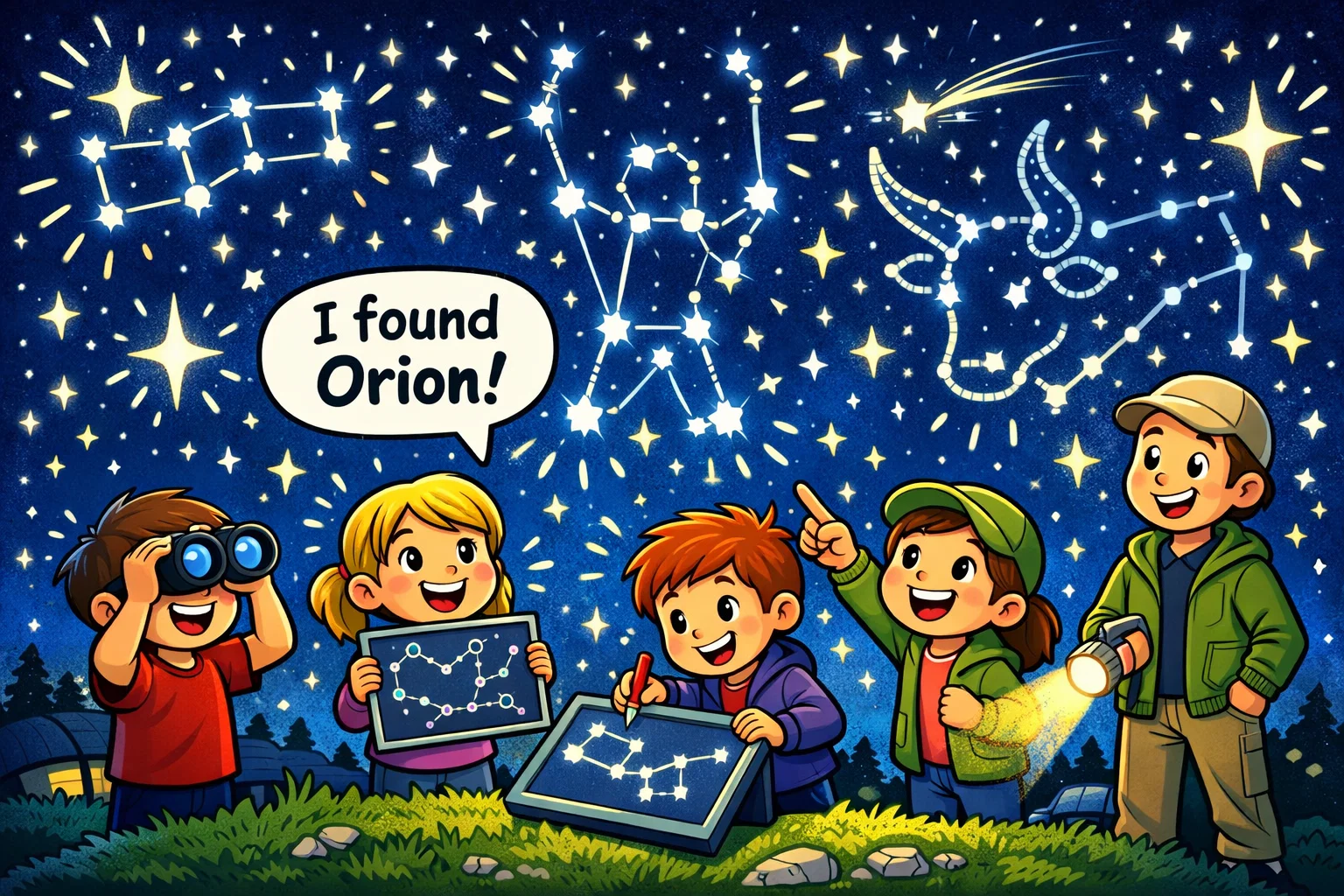
Exploring the starry heavens encourages children to look up and identify patterns in the sky. This section focuses on astronomy and the stories we tell about the stars.
Meteor Shower Watching
When a meteor shower is predicted, it’s a perfect time to celebrate space exploration. Families can plan an observation session with blankets and a star map. Encourage kids to log sightings in a worksheet or journal. This activity teaches patience and observation, as children wait to see “falling stars” streak across the sky.
Pipe Cleaner Constellations
A constellation activity using pipe cleaners and beads is excellent for developing fine motor skills. Children can follow a free printable map of Ursa Major or Orion, sliding “star” beads onto the pipe cleaner and bending it to match the shape. This tactile build makes abstract star patterns much easier to memorize and helps them make a star map they can hold.
Sky Science and Star Maps
Using printables or digital apps, teach children how to navigate the night sky. Identifying the North Star (Polaris) helps them understand direction and navigation. These lessons provide practical navigation skills that have been used by explorers for thousands of years, bridging the gap between history and science.
Night Sky Journal
Encourage children to keep a journal for one month. Each night, they should record the date, the current phases of the moon, and any visible planets. This practice builds consistency and teaches the scientific method through long-term observation. They can even sketch the Moon, bright planets, or visible constellations if they have access to a telescope or binoculars.
Solar System and Space Models
Creating a solar system model helps children understand the vastness of the universe and the diversity of the planets.
Create a Solar System Model
There are several ways to build stem models:
- Hanging Mobile: Use painted foam balls to represent planets and hang them in order.
- Scaled Poster: Draw the planets to scale to show how massive Jupiter is compared to Earth.
- Clay Planets: Use different colored clay to represent the surfaces of the rocky and gaseous worlds.
This project-based approach allows for discussion of the lunar surface, the rings of Saturn, and the extreme temperatures of Venus.
Moon Phases Simulation
Using chocolate sandwich cookies is a classic way to teach moon phases. By scraping away the white cream, kids can recreate the Waxing Gibbous, Full Moon, and Waning Crescent. This hands-on learning experience is both educational and delicious, making it a favorite for space week. It helps kids visualize the lunar cycle in a way a diagram cannot.
Moon Phases Cellphone Projector
For a high-tech space twist, create a simple projector using a cardboard tube and transparency film. Draw the phases of the moon on the film and shine a phone light through it onto a wall. This turns a bedroom into a mini planetarium and helps children explore the science of light and shadow in a memorable way.
High-Interest Science Experiments
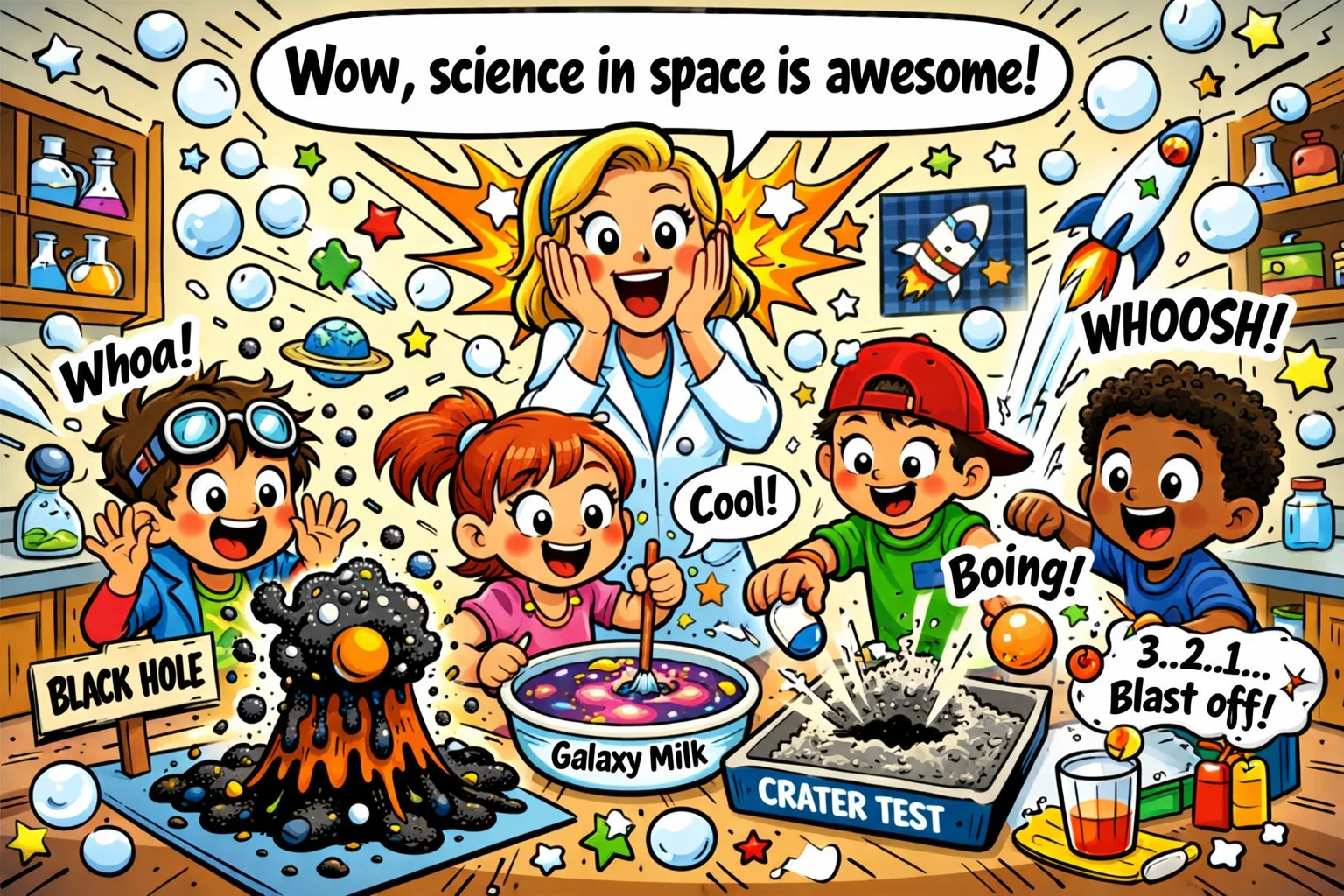
These experiments use “magic” moments to anchor complex concepts like chemical reactions or surface tension.
Starry Night Skittles Experiment
Place Skittles in a circle on a white plate and pour warm water over them. The colors will bleed toward the center, creating a starry effect. This visually exciting opener is great for discussing how light and color diffuse in a nebula or across a galaxy. It requires no specialised equipment and is quick to set up, making it practical for busy parents.
Black Hole–Inspired Fizzing Experiment
Describe a dramatic reaction-based project that uses a black hole theme. By mixing baking soda with black food coloring and adding vinegar, children see a bubbling chemical reaction. This activity can be used to teach cause and effect, gas release, and pressure while keeping the child engaged through a dramatic visual effect.
Lunar and Solar Eclipse Activity
Modeling an eclipse requires only a few balls and a flashlight. By aligning the “Sun” (flashlight), “Earth,” and “Moon” in a straight line, kids can see how one body blocks the light of another. This hands-on demonstration helps kids visualize how eclipses happen and how the positions of the Sun, Earth, and Moon affect what we see.
Moon Crater Impact Test
Fill a tray with flour and top it with a thin layer of cocoa powder. Have kids drop different sized “meteors” (marbles or rocks) into the tray. The resulting moon craters reveal the white “subsoil” (flour) underneath, mimicking how real crater impacts work on the lunar surface. This is one of the most popular STEM space activities because it is both messy and educational.
Space STEM, Circuit Building and Engineering Challenges
For a more advanced engineering challenge, kids can step into the shoes of engineers to design vehicles and communication tools.
DIY Aerodynamic Rocket
Using paper and tape, kids can design a rocket craft to see which shape flies best. Focus on fin shape, weight balance, and the nose cone. By having children build several versions and compare them, they learn about aerodynamics and the physics of flight.
Simple Rocket Launchers
Describe straw, balloon, or stomp launcher options. A straw rocket is a quick win: simply tape a paper tube (closed at one end) over a straw and blow. This demonstrates how a burst of force can launch a vehicle. Adjusting the launch angle helps kids understand how engineers plan trajectories for rockets and spacecraft.
Motorized Space Thaumatrope
A thaumatrope is an optical toy that blends two images into one when spun. Kids can draw an astronaut on one side and a moon on the other. When spun rapidly, the astronaut appears to be standing on the moon. This adds an element of physics and motion to a simple art project.
Space STEM Story Challenge
Provide a mission scenario: “The Mars rover is stuck in a crater! Use these three items to save it.” This type of STEM activity combines storytelling with critical thinking. It encourages kids to use what they have learned through hands-on space activities to solve “real-world” problems in a fun, imaginative way.
Creative Space Art Projects
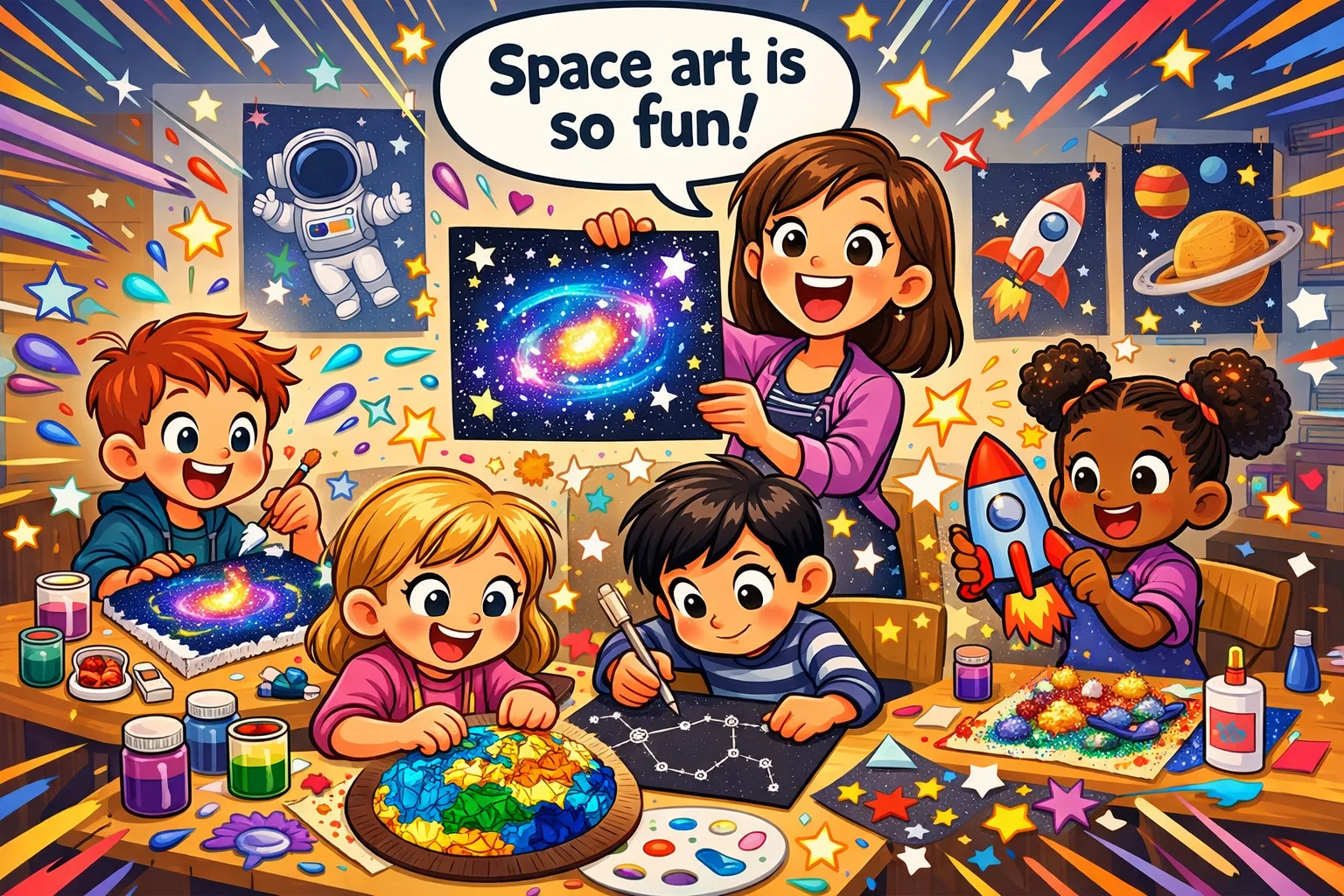
Art allows children to process scientific facts through a creative lens. This helps prevent the unit from becoming too data-heavy and keeps engagement high.
Galaxy Space Art
Use watercolor paints or chalk pastels to create a swirling galaxy. Splattering white paint over the dark background creates a “starfield.” This space-themed art project is visually stunning and reinforces the idea that the universe is full of different colors and gases.
Planet Texture Art
Different planets have different textures. Use salt to create the “icy” surface of Neptune, or sand to create the “rocky” terrain of Mars. This hands-on art reinforces the visual and physical differences between the planets in the solar system.
Set Up Space Camp Week
A space camp week is a fantastic way to immerse students in a space unit.
Daily Mission Schedule
- Monday: Rocket design and launch.
- Tuesday: The Moon and lunar exploration (making moon rocks).
- Wednesday: Solar system exploration and planet models.
- Thursday: The Stars and constellations activity.
- Friday: Life as an astronaut on the international space station.
Space Camp Challenges
Include a “Rover Build” using recycled materials or a “Moon Phase” cookie challenge. These space-themed activities build toward a final “Mission Success” celebration where kids can show their projects to parents or other students.