Water Cycle Experiment for Kids in a Bag

 Discover a Free Education Video App for Kids
Pastory uses AI to personalize educational video content based on your child’s interests and personality. Safe, engaging, and built for curious young minds. Sign up now to stay updated and enjoy early access with a free trial
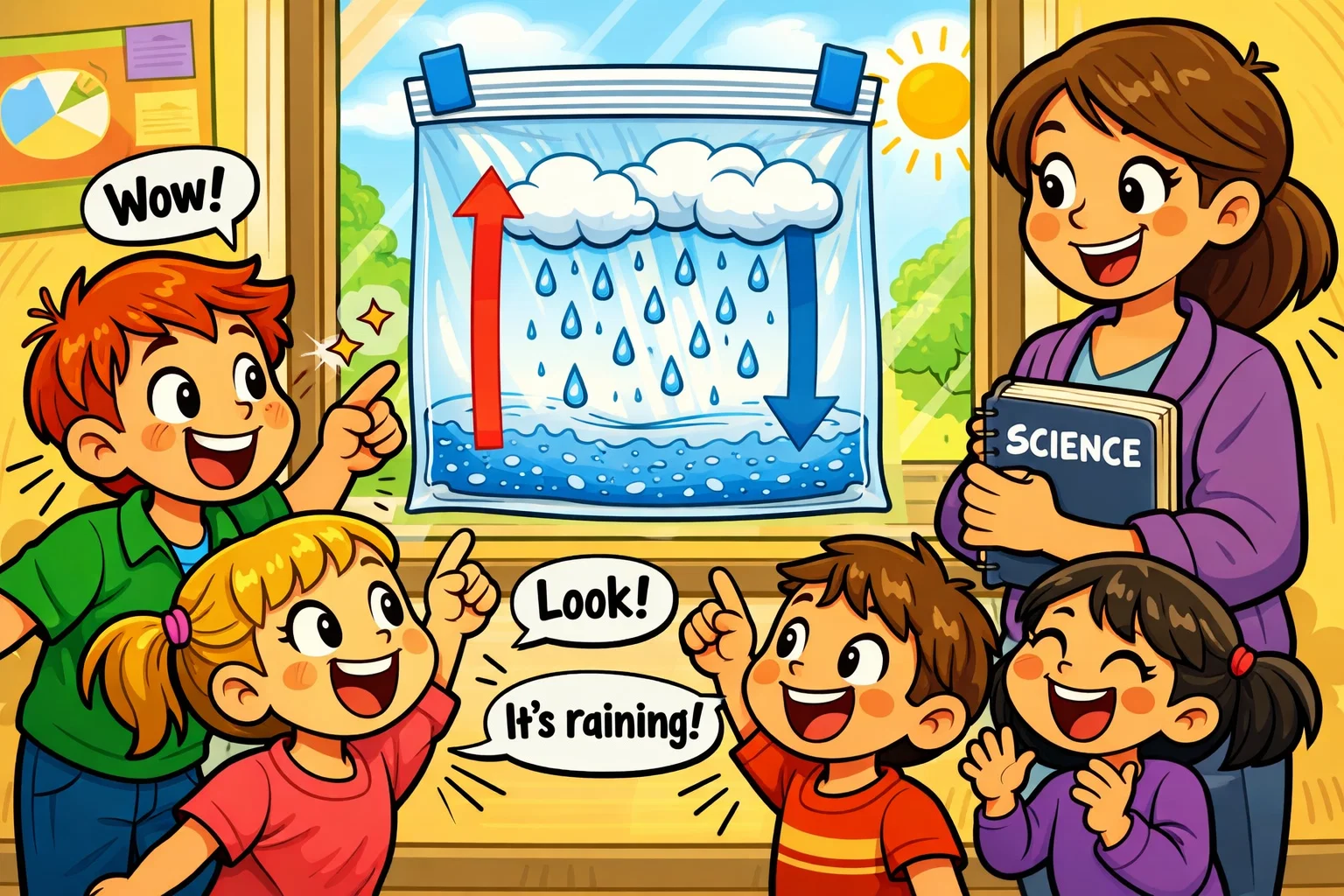
If you are looking for a way to make abstract meteorological concepts tangible for young learners, the water cycle in a bag experiment is an absolute gold standard. This simple science activity transforms a common household item into a dynamic learning laboratory. It allows children to witness the “invisible” movements of moisture, turning abstract terms like evaporation and condensation into a visual story they can track right on their kitchen window.
For parents and educators, this experiment is a win-win. It requires virtually zero specialized equipment, costs pennies to set up, and provides a continuous learning opportunity that lasts for days. In this guide, you will learn how to set up this hands-on water cycle project, the science that makes it work, and how you can use it to spark a lifelong curiosity about the natural world in your children or students.
Water Cycle in a Bag Science Activity
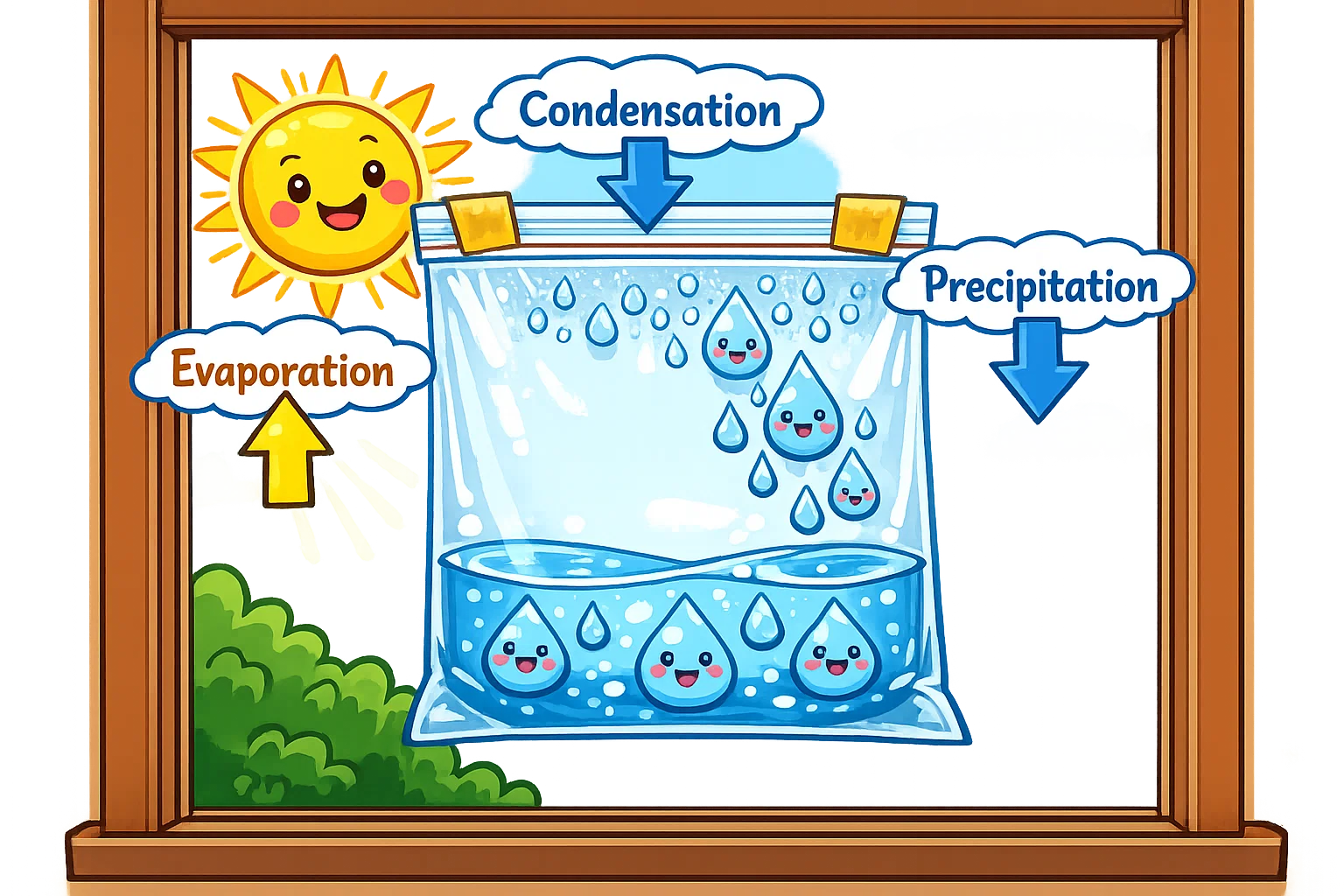
The water cycle in a bag experiment is a brilliant way to model the Earth’s water systems on a micro-scale. At its core, the experiment uses a sealed plastic bag to create a “closed system.” When placed on a sunny window, the sun’s energy mimics the way the sun heats the Earth’s ocean water and land surfaces.
Inside the bag, you will see a mini water cycle model come to life. As the liquid warms up, it changes states, moving from a liquid to a gas and back again. This visual representation is powerful because, in the real world, the global circulation of moisture is often too vast or too slow to observe in a single glance. Here, the boundaries of the plastic bag contain the action, allowing kids to see droplets form and fall, simulating the same basic processes that create weather.
Learning goals for kids
Engaging in science activities like this one helps children develop a robust set of cognitive and academic skills:
- Observation: Kids learn to notice subtle changes, such as the transition from clear plastic to a foggy appearance.
- Cause-and-Effect: They begin to understand that heat (the sun) leads to movement (evaporation).
- Scientific Vocabulary: This is a great activity to introduce terms like states of matter, water vapor, and precipitation.
- Curiosity and Inquiry: It encourages kids to ask “why” and “how,” which is the foundation of the scientific method.
Best age range for experiment
The beauty of this science project is its adaptability.
- Preschoolers (Ages 3-5): At this age, the focus is on the “magic” of the moisture appearing and disappearing. It’s a sensory experience where they can touch the droplets through the plastic.
- Elementary Students (Ages 6-10): This is the “sweet spot.” Students can record data in a worksheet, draw the stages of the water cycle, and explain the science behind the transitions.
- Middle School / Homeschool (Ages 11–13): Older kids can use the setup to study variables, such as how different temperatures or the volume of liquid affect the rate of the cycle.
Why bag method works for kids
The cycle in a bag experiment is often preferred over glass jar models for several reasons. First, the plastic bag is unbreakable and safe for little hands. Second, it is two-dimensional when taped to a window, making it much easier for a child to draw on and label. Most importantly, it offers high visibility; the thin plastic allows the mist to be seen clearly as it begins to stick to the sides before it eventually falls back as “rain.”
Materials Needed for Water Cycle in a Bag
To make a water cycle in your own home, you likely already have everything you need in your pantry.
Basic household supplies
- Ziploc-style plastic bag: Heavy-duty freezer bags work best as they hold their shape against the glass.
- Water: About 1/4 cup of warm water to speed up the initial process.
- Permanent Marker: To draw a sky and label the different sections of the bag.
- Clear Packing Tape: To secure the setup firmly to a window.
Optional materials for extended activity
- Blue food coloring: Adding a few drops of blue food coloring helps the pool at the bottom look like the sea and makes the “rain” easier to see.
- Printable labels or a worksheet: For kids to document their observations.
- Plastic wrap: Can be used if you want to try a variation involving a bowl, though the bag is generally superior for window mounting.
Safety notes for kids
While this is a simple science task, keep these tips in mind:
- Supervision: An adult should handle the taping to ensure the contents don’t fall and create a mess.
- Marker Safety: Use permanent markers in a well-ventilated area, or have the adult do the drawing.
- Spill Prevention: Ensure the seal is closed completely before taping it up. One small gap can prevent the water vapor from accumulating.
Step by Step Water Cycle in a Bag Experiment
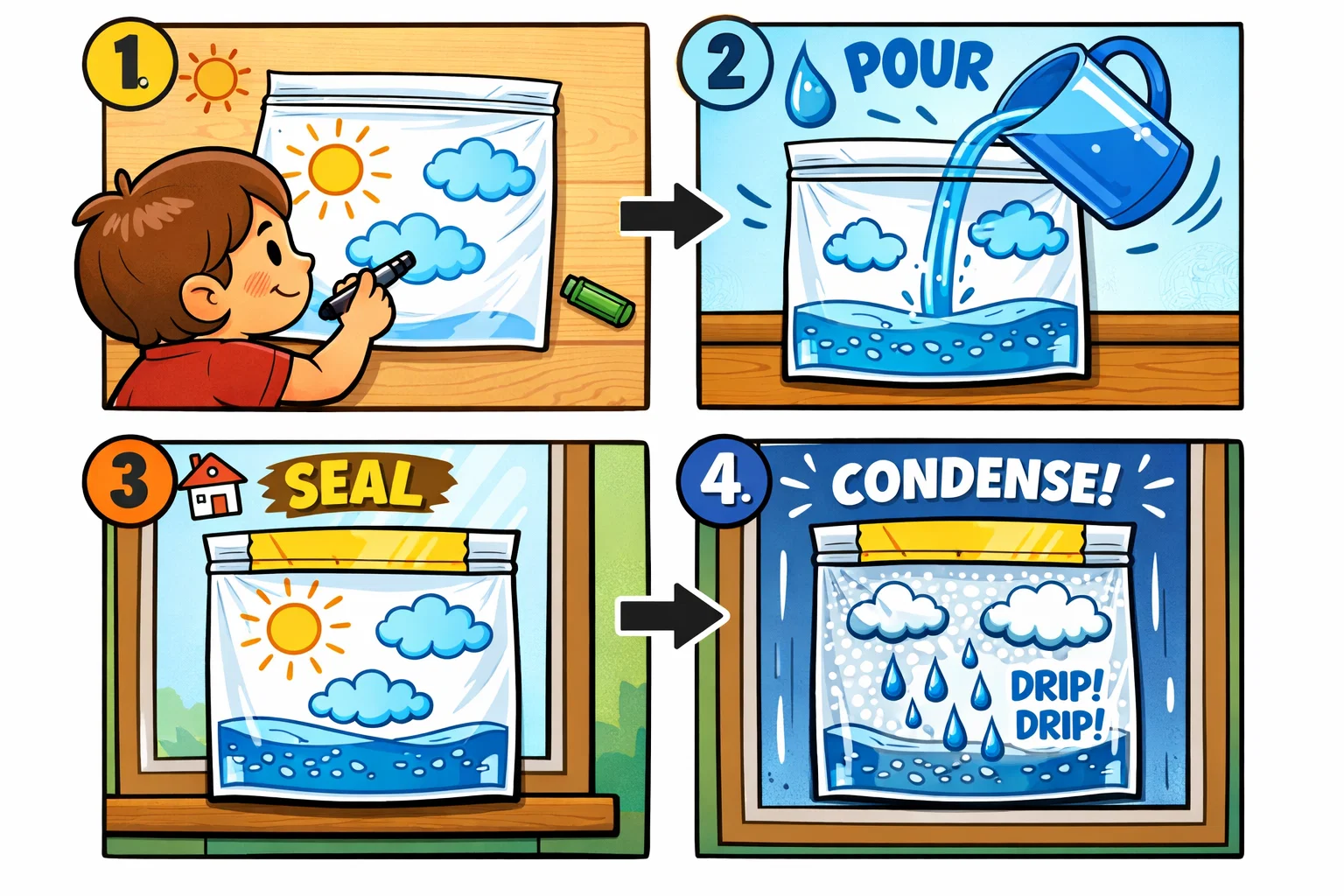
Follow these steps to ensure your water cycle bag experiment is a success.
Step 1: Bag decoration
Before adding any liquid, use your marker to draw a sky on the top half of the plastic. Draw a sun in one corner and some clouds in the center. At the bottom, you can draw wavy lines to represent the ocean or a body of water. Label the top “Condensation,” the middle “Precipitation,” and the bottom “Evaporation/Collection.”
Step 2: Adding water to bag
Carefully pour the warm water into the bag. You only need a limited amount of water – filling the bottom about 2–3 cm (1–2 inches) deep is plenty. If you are using blue food coloring, add two or three drops of the dye now. This helps the child distinguish between the “ocean” at the base and the invisible water (vapor) that will soon rise.
Step 3: Sealing and positioning bag
Press as much air out of the bag as possible and seal it tightly. Use a long strip of packing tape to hang the bag on a sunny window. The sun heats the contents more effectively if the window gets direct afternoon light.
Step 4: Observation period
Now, the patience begins! Check the bag every hour. Within a short time, you will notice the side of the bag becoming cloudy. Over the next 24 hours, you’ll see larger droplets forming. This is an engaging science moment – have your child tap the plastic gently to see how the moisture falls back to the bottom.
Water Cycle Stages Shown in Bag Experiment
This science activity model perfectly illustrates the different stages of the water cycle as it happens in nature.
| Stage | What Happens in the Bag | Real World Equivalent |
| Evaporation | The sun heats the liquid, and it turns into a gas. | The sun warms oceans and lakes. |
| Condensation | Invisible water vapor cools and forms droplets on the plastic. | Vapor cools in the atmosphere to form clouds. |
| Precipitation | Moisture becomes heavy and water falls back down. | Rain, sleet, hail, or snow. |
| Collection | The fluid gathers at the bottom of the bag. | Liquid gathers in oceans or becomes groundwater. |
Evaporation inside bag
As the sun’s energy hits the plastic bag, the liquid molecules begin to move faster. Eventually, they evaporate and turn into water vapor. In the bag, you won’t see the vapor itself, but you will notice the level of the pool might slightly decrease as it moves upward.
Condensation on bag surface
When the vapor hits the cooler plastic (cooled by the air outside the window), it loses energy and turns back into a liquid. This process is followed immediately by condensation. You will see this as a “fog” or mist sticking to the sides of the container.
Precipitation inside bag
As more and more condensed water accumulates, the droplet size increases. Once the moisture becomes too heavy to stay attached to the side, gravity takes over. The liquid falls back to the bottom, simulating a form of rain.
Collection and repeat cycle
The liquid that has fallen back now joins the original pool. In nature, this fluid might soak into the ground or run over the soil, but in our mini water cycle model, it simply waits to be heated again so the cycle can restart.
Science Behind Water Cycle in a Bag
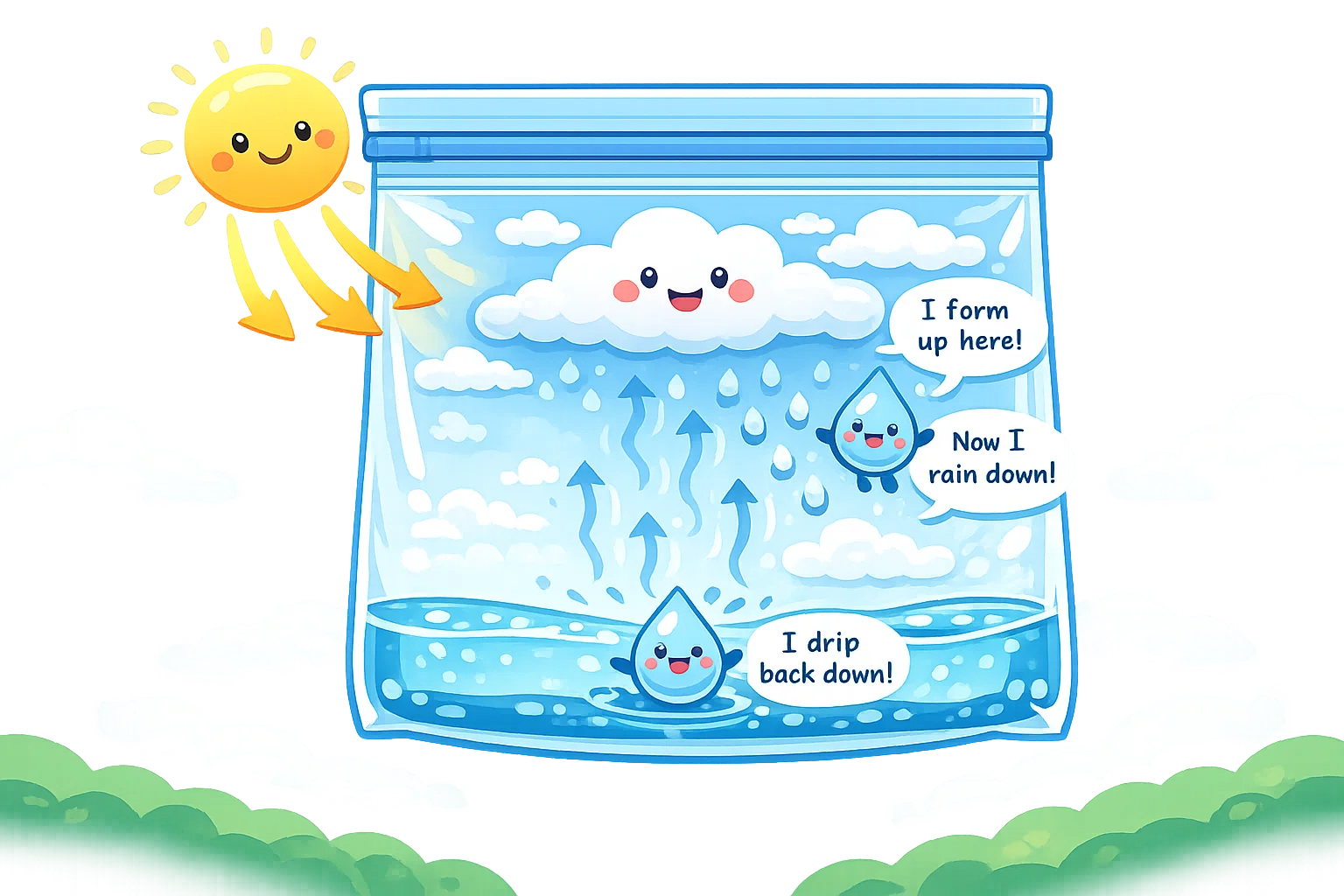
Understanding the science behind this experiment involves looking at energy and systems. Water (H₂O) is one of the few substances that naturally exists on Earth in all three states: solid, liquid, and gas.
Heat energy role
The entire cycle in a bag activity is driven by energy. Without the sun, the contents would remain stagnant. The thermal energy breaks the molecular bonds of the fluid, allowing it to rise. This mimics how the global weather system is powered by solar radiation.
Closed system demonstration
This is a limited amount of water that never leaves the bag. This demonstrates the law of conservation of mass – the matter isn’t being “created” or “destroyed”; it is simply changing form. Over time, the total amount of water on Earth remains relatively constant.
Connection to real world water cycle
You can explain to kids that the moisture they see in the bag is doing exactly what the oceans do. The real water cycle provides the fresh hydration that animals and plants need to survive. As the liquid evaporates, it leaves behind impurities (like the food coloring or salt in the sea), which is why rain is fresh even if it comes from ocean water.
Water Cycle Experiment Variations for Kids
Water cycle bag with food coloring
Using blue food coloring is a favorite water cycle tweak. Interestingly, you may notice that as the liquid evaporates and condenses, the droplets on the side of the bag are clear, not blue! This is because only the H2O turns into a gas, leaving the dye molecules behind.
Water cycle bag without sunlight
Try placing one bag in a sunny window and another in a dark closet. This experiment allows kids to compare the results. They will quickly see that without heat, the fluid evaporates much more slowly, or may not occur at all.
Classroom group activity version
Teachers can give each student their own bag to personalize. This is a great activity for a lesson plan because it allows for 20+ “mini-worlds” to be compared. Some bags might be in a draftier part of the room, leading to different levels of condensation.
Common Mistakes During Water Cycle Bag Experiment
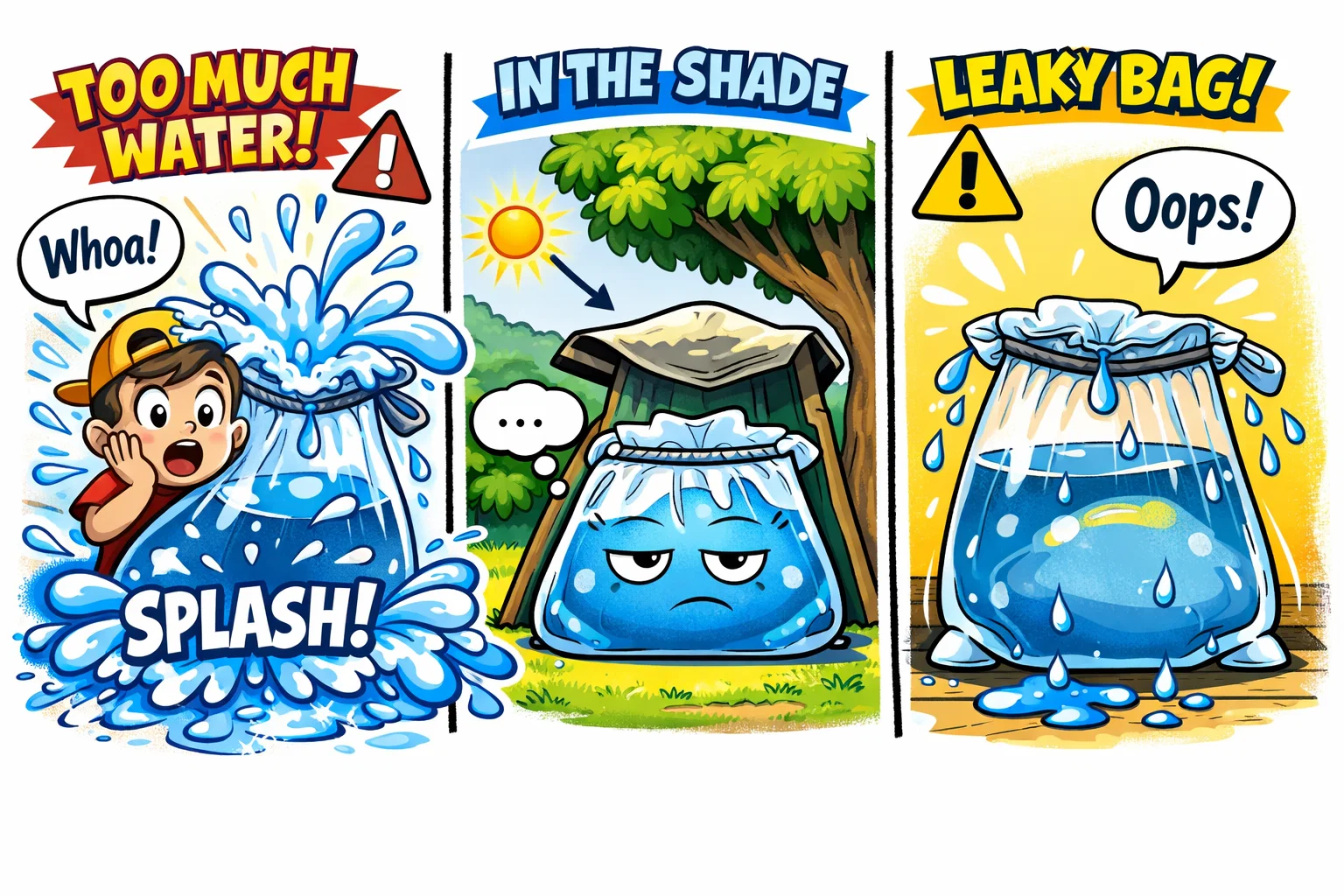
- No condensation appearing: This usually happens if there isn’t enough of a temperature difference. If it’s a cloudy day, the sun heats the bag less. Try using a warmer fluid initially to jumpstart the process.
- Leaking from bag: Always double-check the seal. If the bag is heavy, use extra tape on the corners so it doesn’t peel away from the window.
- Experiment not changing: Science takes time! If you don’t see results within the first hour, wait for the afternoon sun to hit the plastic directly.
Water Cycle Experiment Questions for Kids
To make this a truly hands-on learning experience, use these prompts:
Observation questions
- “Where do you see the most droplets – at the top or the bottom?”
- “What does the ‘cloud’ on the plastic bag feel like when you touch it from the outside?”
- “Is the liquid at the bottom still the same color as when we started?”
Prediction questions
- “What do you think will happen if we move the bag to the refrigerator?”
- “If we add a larger volume, will it evaporate faster or slower?”
Discussion prompts
- “How does the moisture get from the ocean to the clouds in the sky?”
- “Why is the water cycle experiment important for the animals and plants in our garden?”
Water Cycle in a Bag for School and Homeschool
This water cycle project fits perfectly into any STEM lesson focused on earth science or weather. It covers several Next Generation Science Standards (NGSS), particularly those regarding the roles of this substance in Earth’s surface processes.
STEM lesson integration
You can pair the bag experiment for kids with a printable weather log. Students can track the “weather” inside their bag over a week, noting when it is “cloudy” (condensation) or “rainy” (precipitation).
Time required for lesson
- Setup: 10–15 minutes.
- Observation: 24–48 hours for a full cycle.
- Cleanup: 2 minutes.
Simple Water Cycle Experiments Related to Bag Method
If your child is interested in science and wants more, try these:
- Water cycle in a bottle: Similar to the bag, but uses a 2-liter bottle. It’s a bit more stable but harder to hang on a window.
- Mini water cycle model craft: Use a large bowl with a small cup of liquid in the center, covered in plastic wrap. Place a small stone over the cup to create a “slope” for the rain to follow.
- Rain cloud experiment: Use shaving cream on top of a jar to represent clouds, and drop food coloring through it to show how clouds get heavy before they rain.
Frequently Asked Questions About Water Cycle in a Bag
How long does the water cycle bag experiment take?
You will usually see the first signs of condensation within 30 minutes to an hour if placed in a sunny window. A full cycle, where the moisture falls back as rain, typically takes 24 hours.
Can the experiment work indoors?
Yes! As long as you have a window that receives sunlight or a nearby heat source (like a safe distance from a radiator), the mini water cycle model will function perfectly.
Can kids experiment independently?
Elementary-aged children can do almost all of it. Younger children will need help with the plastic bag seal and the tape.
The water cycle is the journey water takes as it circulates from the land to the sky and back again.
By setting up a water cycle in a bag, you aren’t just doing a craft; you’re providing a window into the way our planet breathes. It’s a simple, profound way to show that even a small droplet is part of a much larger, magnificent story.
Take a short quiz to find out what your everyday choices say about your parenting style
When your child is curious about something new, what’s your instinct?
Take a short quiz to find out what your everyday choices say about your parenting style
“Can I download this app?” What happens next?
Take a short quiz to find out what your everyday choices say about your parenting style
When it comes to rules at home, which sounds most like you?
Take a short quiz to find out what your everyday choices say about your parenting style
If you could give your child one life skill today, what would you pick?
Take a short quiz to find out what your everyday choices say about your parenting style
Your child gets to choose what to watch. What would your ideal setup look like?
Take a short quiz to find out what your everyday choices say about your parenting style
Pick your parenting superpower ✨