Light and Shadow Experiments for Kids: How Shadow Shape Changes with Distance (KS2 & Year 6)

 Discover a Free Education Video App for Kids
Pastory uses AI to personalize educational video content based on your child’s interests and personality. Safe, engaging, and built for curious young minds. Sign up now to stay updated and enjoy early access with a free trial
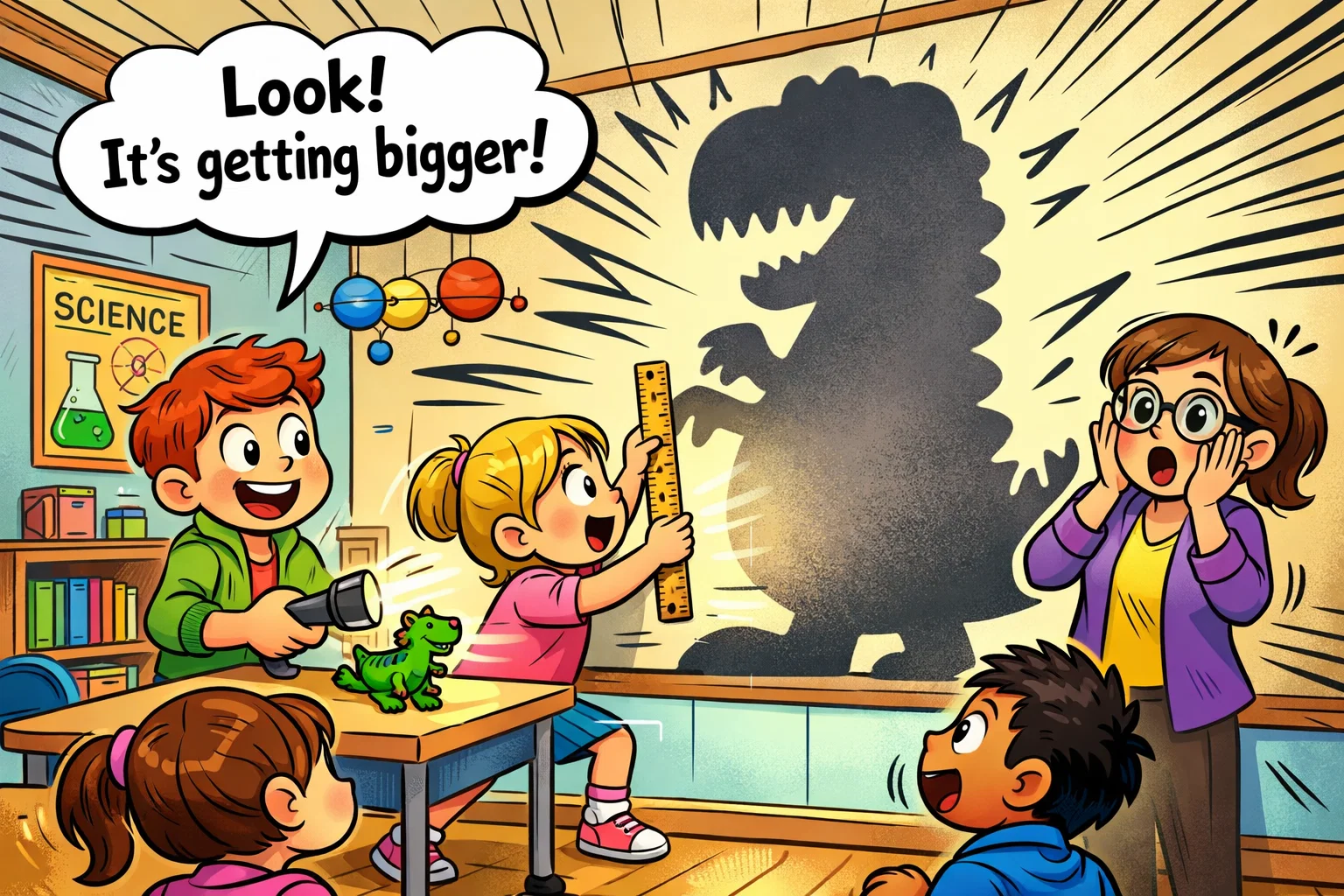
Exploring light and darkness is one of the most accessible ways to spark a child’s curiosity about the physical world. By simply adjusting the gap between a light source and an object, children can witness the immediate, almost magical way a shadow changes in size and clarity. These hands-on investigations provide a foundational understanding of how light travels in straight lines, a core concept in KS2 science and early physics.
In this guide, we will dive into a structured shadow investigation activity suitable for home or the classroom. Using everyday materials like a torch, a ruler, and an opaque object, kids will learn to predict, measure, and explain the behavior of these projections. Whether you are a teacher looking for year 6 lesson inspiration or a parent wanting to help children explore STEM at home, these experiments make the invisible properties of light visible and engaging.
Introduction to Shadow Investigation Activity
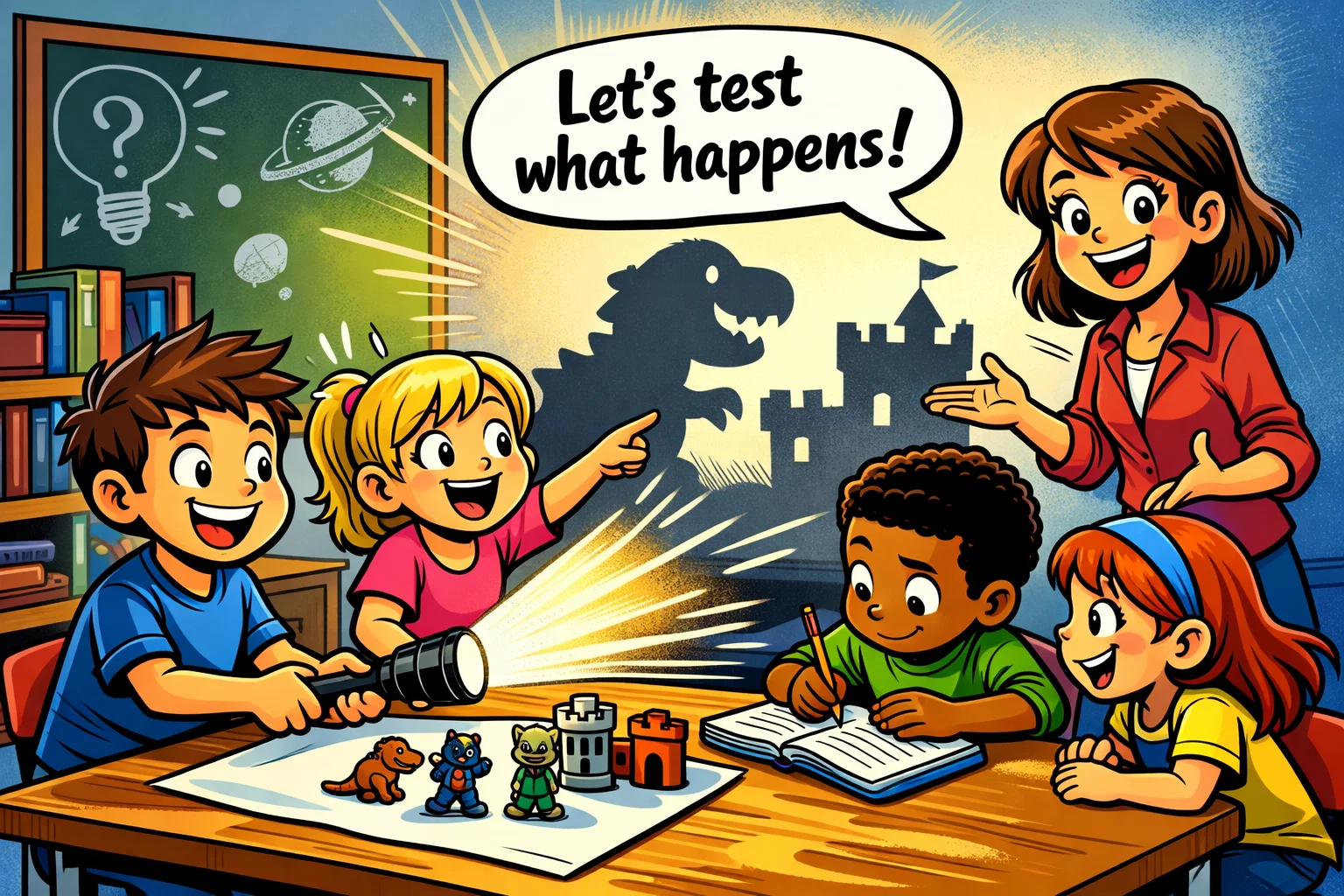
Why is experimenting with the distance of a source of light so effective? It’s because it offers instant feedback. When a child moves a flashlight closer to a toy, the object’s shadow responds instantly, growing into a giant silhouette on the wall. This cause-and-effect relationship is the “hook” that leads to deeper scientific inquiry into how light interacts with objects.
Through these activities, children move beyond just “playing” and start “investigating.” They begin to ask why a dark shape forms and how they can manipulate it. By changing the distance between the torch/lamp and the object, they engage with the idea that light moves in a specific way, allowing them to create shadows they can control and measure.
Why Light Source Distance Matters
The physics behind a silhouette depends heavily on the geometry of emission. When an opaque object blocks light, it creates a region of darkness. Moving the torch closer increases the angle at which the light spreads, meaning more light is blocked, resulting in a larger shadow shape. Conversely, moving the light source further away from the object causes the shadow to shrink and its edges to become more defined. This introduces the concept of proportional change—a key bridge between science and mathematics.
Learning Goals for Kids
By the end of these experiments, students should be able to:
- Identify that light travels in a straight line.
- Explain that shadows form when an opaque object blocks light.
- Predict how the size of the shadows will change as the distance from the light source varies.
- Demonstrate improved observation skills and the ability to record data in a table.
- Understand the difference between light and dark zones.
Age Range and Skill Level
While kids of all ages can enjoy shadow play, the complexity of the investigation should be tailored to their developmental stage:
- Early Years/KS1: Focus on the magic of shadows and simple shadow play. Use words like “bigger” and “smaller” to describe the dark outlines.
- Lower KS2 (Years 3-4): Start measuring the size of a shadow with rulers and introducing terms like opaque and transparent.
- Upper KS2 (Years 5-6): Conduct a formal shadow experiment with variables, constants, and data graphing to track how photons are obstructed.
What Is a Shadow and How It Forms
To understand these dark projections, we first need to understand the science of light. Visible light is emitted from a light source, such as the sun or a bulb. The most important thing for kids to remember is that light travels in straight lines. It does not bend around corners or pass through opaque obstacles.
Definition of Shadow
A shadow is an area of darkness where light has been blocked. It is not a “thing” in itself, but rather the absence of light. When a non-transparent object blocks light, the area directly behind that object remains dark because the light can travel no further.
Three Essential Ingredients
To create a shadow, you always need three specific components:
- A Light Source: This provides the beam of light (e.g., a torch, the sun, or a lamp).
- An Object: Something to block light from passing (like your hand or a toy).
- A Surface: Somewhere for the dark shape to fall upon (a wall, the floor, or a piece of paper).
Opaque, Translucent, Transparent Materials
How different materials block light determines the “quality” of the projection. We can categorize items by how they interact with incoming rays:
- Opaque: These materials (like wood or metal) obstruct all brilliance. An opaque object creates the darkest, most distinct outlines.
- Translucent: These allow some light to pass, creating a faint or blurry patch (like wax paper) because the rays are scattered.
- Transparent: These allow almost all light to pass through (like clear glass), meaning they rarely cast a shadow at all.
Natural and Artificial Light Sources
In KS2 science, we differentiate between the sun (natural) and flashlights (artificial). While we can’t move the sun, we can observe how dark shapes move as the Earth rotates. Indoors, we have the advantage of being able to move the light source manually, which is perfect for a controlled investigation into the behavior of the beam.
Equipment for Light Source Distance Experiment
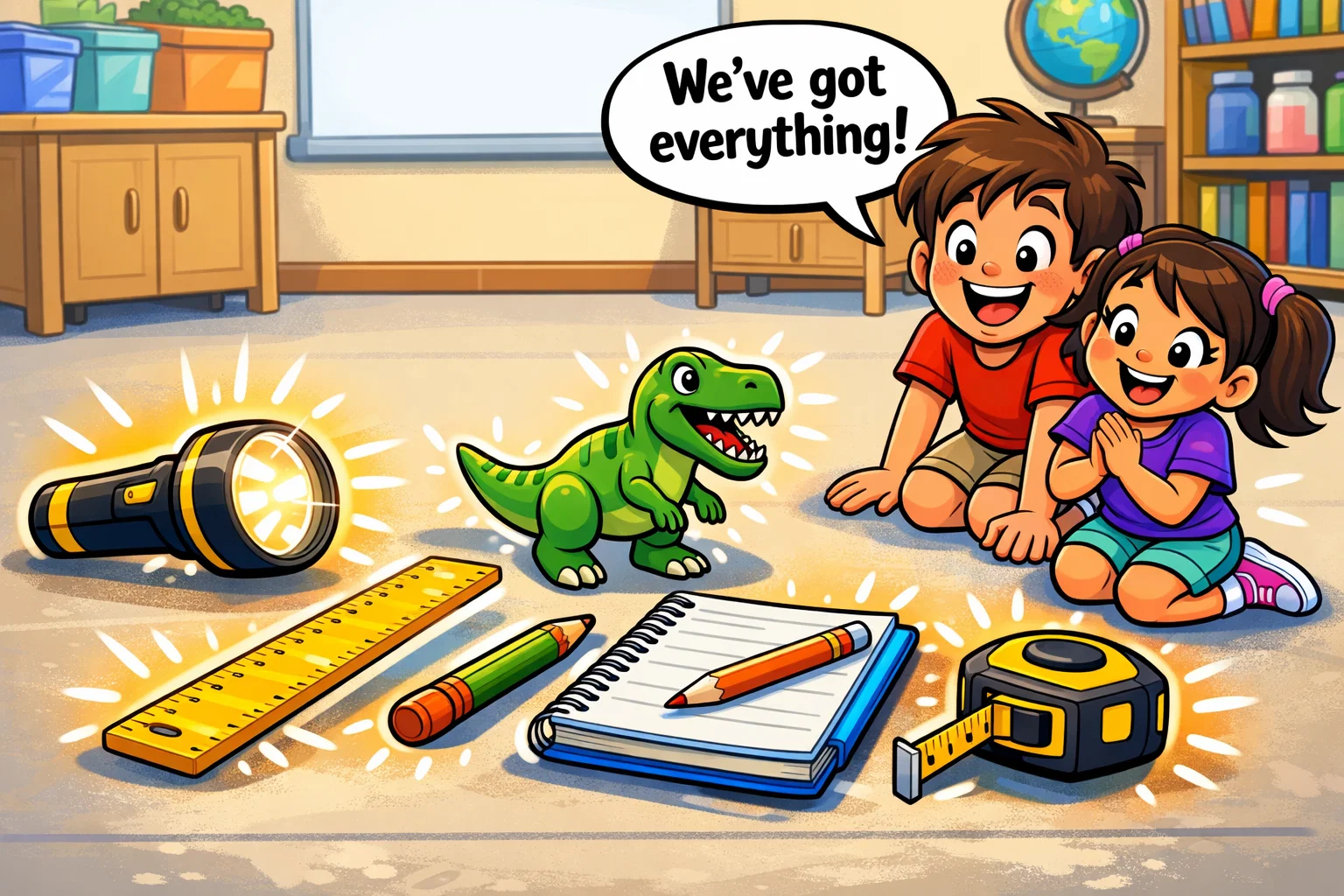
You don’t need a high-tech lab to explore shadow science. Most of these items are likely already in your kitchen or junk drawer.
Basic Materials List
| Item | Purpose |
| Torch or Desk Lamp | The primary source of light. |
| Small Opaque Object | A plastic dinosaur or brick to block light. |
| White Paper or Wall | The surface where you will trace the shadow. |
| Ruler or Tape Measure | To measure the distance and the height of the shadow. |
| Masking Tape | To mark positions on the floor or table. |
Safety and Supervision
- Hot Bulbs: If using a desk lamp, remind children not to touch the glass, as it can get quite hot.
- Eye Safety: Never point a strong beam of light or laser directly into anyone’s eyes.
- Batteries: Ensure battery compartments on torches are secure.
Setting Up Investigation Space
For the best results, you need a room that can be made dark. Close the curtains or wait until evening. Place your “screen” (the white paper) against a flat wall. Use masking tape to create a “track” on the table so you can move your light source back and forth in a straight path.
How to Investigate How Shadows Change with Distance
Follow these steps to conduct a reliable shadow experiment. This process helps kids learn the scientific method: Aim, Hypothesis, Method, Results, and Conclusion.
Step 1: Position Object and Surface
Place your opaque object a set distance (e.g., 20cm) away from the wall. This object should remain stationary throughout the experiment to ensure a fair test. Your light source should be pointed directly at the item, ensuring the rays hit the center.
Step 2: Move Light Source Closer
Slowly move the torch toward the object. You will notice that as the distance from the light source decreases, the shadow size increases. The object is blocking more of the radiance that is spreading out from the origin.
Step 3: Move Light Source Further Away
Now, move the torch further away from the object. As the distance increases, the size of a shadow will shrink. You might also notice the outline becomes “sharper” or has more defined edges because the incoming rays are becoming more parallel to each other.
Step 4: Measure and Record Results
Use your ruler to measure the height of the projection it casts at different intervals (e.g., at 5cm, 10cm, 15cm, and 20cm away). Recording these numbers is vital for older kids to see the mathematical relationship between distance and the blocked beam.
Step 5: Compare Predictions with Results
Before you started, did you think the dark patch would get bigger or smaller? Comparing your initial idea that light behaves a certain way with the actual data is how real scientists work!
Measuring Shadows and Recording Data
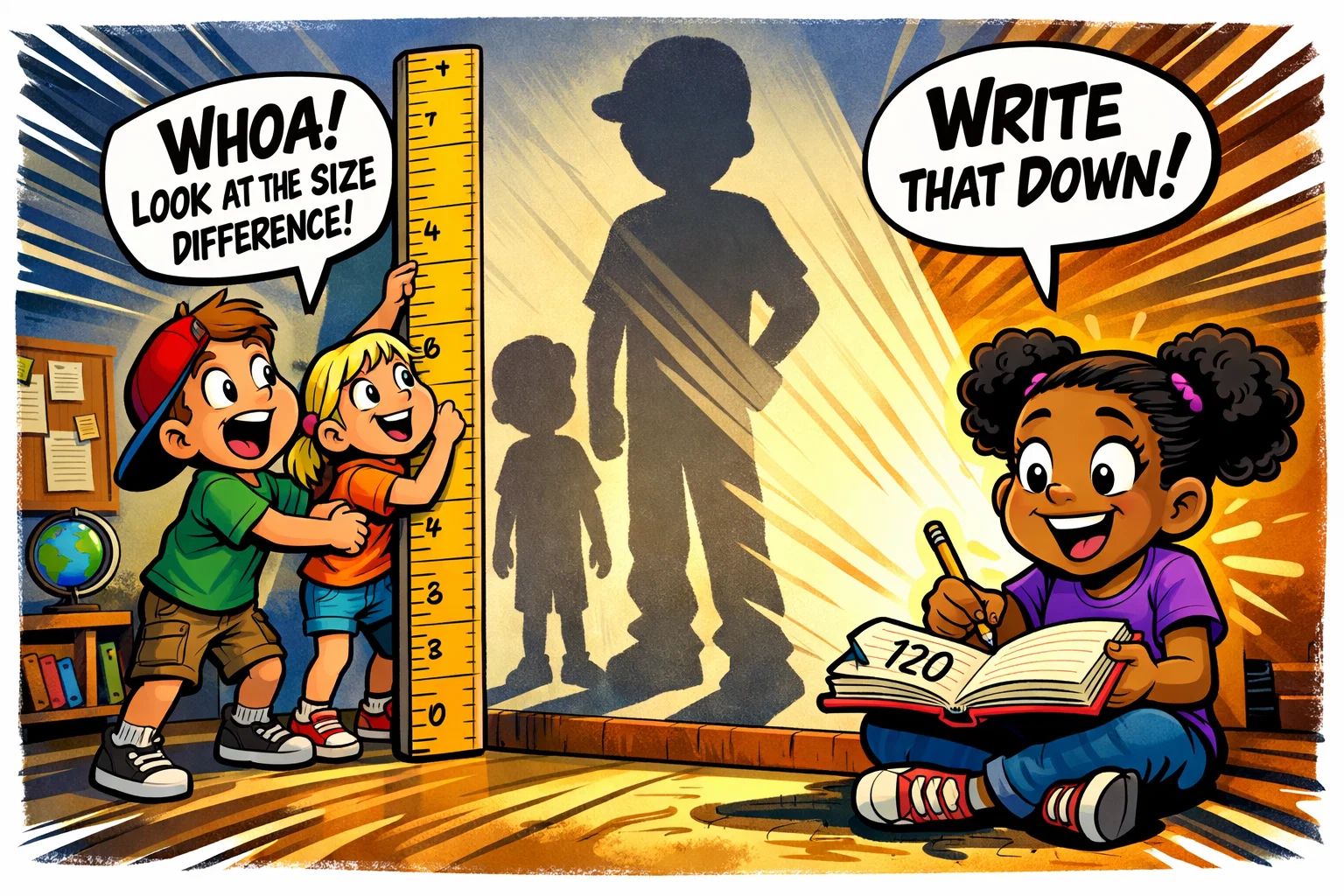
Integrating math into shadows and light lessons helps solidify the concept of proportionality. In year 6, students are often expected to use diagrams and graphs to explain why shadows change.
Creating Data Table
A simple table helps organize thoughts.
| Distance of Source (cm) | Height of Projection (cm) | Observation (Sharp/Blurry) |
| 5 cm | 25 cm | Very Blurry |
| 10 cm | 15 cm | Blurry |
| 15 cm | 10 cm | Sharp |
| 20 cm | 7 cm | Very Sharp |
Graphing Distance and Shadow Size
Once the table is filled, help children plot these points on a graph. The X-axis should be the “Distance from the Light Source” and the Y-axis the “Height of the Silhouette.” This visual representation clearly shows that as distance increases, size decreases—an “inverse relationship.”
Introducing Scale and Ratio Concepts
For a more advanced investigation, you can discuss how the shape and size of the projection are related to the object. If the outline is exactly double the size of the object, what does that tell us about the distance? This is a great way to introduce multiple light sources and how they cast multiple shadows.
Outdoor Shadow Investigation with Sunlight
While indoor experiments offer control, the sun provides a grander scale for seeing how dark shapes move across the sky.
Human Sundial Activity
On a sunny day, have a child stand in the same spot at 9:00 AM, 12:00 PM, and 3:00 PM. Use chalk to trace the shadow of their feet. They will see that their shadow changes significantly throughout the day as the angle of the sun shifts.
Why Shadows Change During Day
Outlines are longest in the early morning and late afternoon because the sun is at a low angle. Midday shadows are the shortest because the sun is directly overhead. This is a perfect way to use the idea that light travels in straight lines to explain the Earth’s rotation relative to the solar rays.
Seasonal Shadow Changes
The tilt of the Earth also means that different shadows are cast in winter versus summer. In winter, the sun never reaches as high in the sky, so shadows remain longer even at noon because the illumination hits at a shallower angle.
Indoor Shadow Play Activities
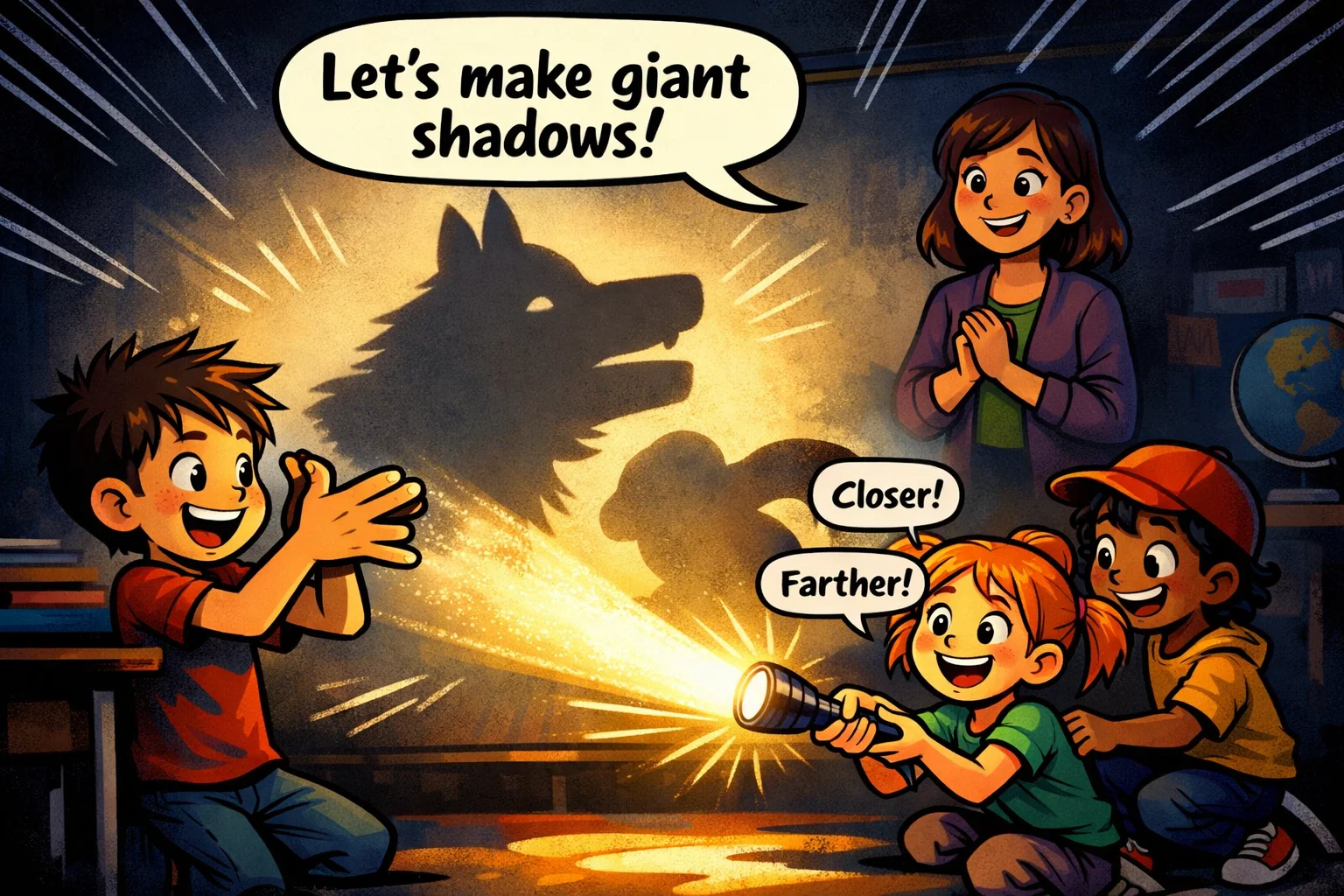
Science doesn’t always have to be about rulers and graphs; it can also be about shadow art and creativity.
Shadow Puppet Theatre
Making shadow puppets is a classic way to explore shadow behavior. By creating silhouettes with their hands or cardboard cutouts, children can perform stories. They will quickly learn that to make a “dragon” look bigger and scarier, they need to move their hands closer to the source of light.
Shadow Sculptures and Portrait Tracing
Try a shadow portrait! Have a friend sit sideways (profile) while you shine a beam onto them. Trace the shadow onto a piece of paper taped to the wall. This is a beautiful way to see how the shadow has the same shape as the object but can be manipulated in size.
Manipulating Shadows with Multiple Light Sources
What happens if you use two torches? You will cast multiple shadows! If you use colored filters over the torches, you can even create colored shadows. This happens because each beam of light is being blocked by the object, but the “dark” area of one projection is being partially illuminated by the other colored source.
Advanced Shadow Concepts for Curious Minds
For those ready to dive deeper into the properties of light, we can look at the structure of the shadow itself.
Umbra and Penumbra
Not all parts of a dark area are equally dark.
- Umbra: The darkest, central part where the light source is completely blocked.
- Penumbra: The lighter, outer fringe where the light source is only partially blocked.
Angle of Light and Shadow Length
The result depends on the angle just as much as the distance. A low angle (like a sunset) creates a long, stretched shadow shape, while a high angle (like a ceiling lamp) creates a short, squat shape.
Common Misconceptions About Shadows
Many children (and some adults!) believe a shadow is a reflection. It’s important to clarify: a reflection of light is light bouncing off a surface (like a mirror), whereas these dark areas are the absence of brilliance. Another myth is that they are “stuck” to us; in reality, a shadow forms when an opaque object enters a path of photons, and it can be cast onto any surface at any distance.
Tips for Parents and Teachers
Facilitating a fun shadow lesson requires a balance of instruction and freedom.
- Asking Guiding Questions: Instead of telling them what will happen, ask, “What do you think will happen if I move the torch closer?” or “Why is the outline getting blurry?”
- Encouraging Open-Ended Exploration: Let them find different materials around the house. Will a glass of water block the light? What about a piece of lace?
- Documenting Discoveries: Use a phone to take photos of their shadow sculptures. Creating a journal where they can trace a plant’s outline at different times of day is a great long-term project.
Assessment and Reflection Questions
To wrap up your shadow investigation, ask these questions to gauge understanding:
- Why does an outline get bigger when the bulb gets closer? (Because the object blocks a larger angle of the light from a source.)
- How can you make a projection smaller? (Move the object away from the light source or move the bulb further away from the object.)
- Which material makes the darkest outline? (Opaque materials, because they don’t allow any light to pass.)
- How do we know light travels in straight lines? (Because the dark areas have the same shape and size as the objects that block them; if photons could curve, they would fill in the dark space.)
Silhouettes are more than just dark patches on the ground; they are a gateway to understanding the properties of light and the geometry of our universe. By encouraging children to experiment with a simple torch and a bit of curiosity, you are helping them build the critical thinking skills they will use for a lifetime.
FAQ
What materials are needed for a shadow experiment?
You mostly need a source of light (like a torch), an opaque object (like a toy), a surface (like a wall), and a way to measure (like a ruler).
What is the best age for a light source distance experiment?
While simple shadow play is great for toddlers, the formal experiment of measuring how shadows change with distance is best suited for KS2 students (ages 7-11).
How do I explain shadow size change to a child?
Explain that light travels in a straight line from the torch. When the torch is close, the object acts like a big “shield” that blocks a lot of the brilliance. When the torch is far away, the light spreads less across the object, so the object blocks less of the area, making the shadow size smaller.
How can I make the experiment more educational?
Introduce the idea that light behavior can be predicted. Have them write a “hypothesis,” record their measurements in a data table, and then create a shadow art project to show the creative side of science.
How do different variables affect how shadows form?
The way shadows change in appearance is the result of a dynamic interaction between physics and geometry. A shadow changes its size and position depending on the distance and angle of the light source. When an object blocks light, the shadow it casts appears sharper if the light source is small and far away. In educational activities for kids, we often use simple ray diagrams to explain why shadows appear larger or smaller; these diagrams show how light rays travel from the source, are blocked by an object, and then form a shadow on a surface.
Furthermore, the concepts of light dictate that the resulting shadow will depend on the intensity and color of the source. For instance, white light is actually a combination of all colors, and using colored filters can show how light affects the color and appearance of shadows. Understanding how an object is positioned relative to the light path allows students to see how shadows transform a simple 2D surface into a complex pattern of light and dark areas.
Can we use shadow play to learn about the properties of light?
Absolutely! Integrating a playful shadow session into learning makes complex physics accessible. Through shadow puppetry or a simple game where children try to step on each other’s shadows. If you want to create shadow art, you can experiment with different objects to cast shadows that overlap, showing how multiple light sources can create overlapping shadows and a sense of depth. For a more engaging shadow project, you might try a shadow portrait where you project light onto a friend’s face to trace their silhouette.
This type of simple shadow play teaches that “opaque” means light cannot pass through, which is why the silhouette is so dark. By exploring various types of shadows, such as the umbra and penumbra, children learn why some shadows appear soft and blurred while others look sharp and distinct. These hands-on experiences help students better understand the fundamental principles of light and optics.

Take a short quiz to find out what your everyday choices say about your parenting style
When your child is curious about something new, what’s your instinct?
Take a short quiz to find out what your everyday choices say about your parenting style
“Can I download this app?” What happens next?
Take a short quiz to find out what your everyday choices say about your parenting style
When it comes to rules at home, which sounds most like you?
Take a short quiz to find out what your everyday choices say about your parenting style
If you could give your child one life skill today, what would you pick?
Take a short quiz to find out what your everyday choices say about your parenting style
Your child gets to choose what to watch. What would your ideal setup look like?
Take a short quiz to find out what your everyday choices say about your parenting style
Pick your parenting superpower ✨