Fun Learning Activities for Kindergarteners: 50 Play-Based Ideas Kids Love

 Discover a Free Education Video App for Kids
Pastory uses AI to personalize educational video content based on your child’s interests and personality. Safe, engaging, and built for curious young minds. Sign up now to stay updated and enjoy early access with a free trial
Providing a rich environment for early childhood education requires a careful balance between structured instruction and play-based learning. For kindergartners, the world is a laboratory where every cardboard box can become a rocket ship and every bead can become a tool for early math.
This guide gives parents and educators 50 practical, age-appropriate, hands-on learning activities designed to help children build early literacy, math, physical, social, and emotional skills. With simple materials and a playful approach, you can create a foundation for lifelong learning that feels like pure fun.
Key Takeaways
- Play-based learning is one of the most effective ways to support cognitive, physical, social, and emotional development in early childhood.
- Fine motor skills and gross motor coordination are important building blocks for writing, movement, and classroom readiness.
- Sensory play and hands-on learning can improve memory, problem-solving, and language development.
- Daily routines and everyday activities offer natural learning moments for phonics, counting, shapes, and social skills.
- Effective at-home learning activities do not require expensive materials; many can be done with recycled or household items.
Fast Overview
Kindergartners are natural explorers with a deep sense of wonder. Guidance from the National Association for the Education of Young Children (NAEYC) emphasizes that play is central to young children’s development and learning. When children learn through active engagement rather than passive listening, they develop a deeper understanding of the world around them.
Skills Covered
The activities in this guide support a broad range of developmental milestones.
- Literacy: Alphabet recognition, phonics, vocabulary, and storytelling.
- Math: Counting, number sense, patterns, sorting, and shape identification.
- Physical Development: Fine motor skills, hand strength, balance, and coordination.
- Social Development: Cooperation, taking turns, communication, and social-emotional learning.
- Science: Observation, prediction, cause and effect, and sensory exploration.
Best Activity Mix
A successful learning routine includes different types of activities to prevent fatigue and keep children engaged. A balanced day might include quiet table tasks, sensory play, storytelling, music, creative art, and vigorous outdoor movement.
This variety gives children multiple ways to engage through seeing, listening, moving, creating, touching, talking, and experimenting.
Materials Needed
You do not need expensive kits to make learning fun. Most fun, easy activities use low-cost supplies.
- Art Supplies: Paper, crayons, markers, child-safe scissors, glue, and paint.
- Manipulatives: Blocks, beads, dice, buttons, counters, and magnetic letters.
- Recyclables: Cardboard boxes, paper towel tubes, bottle caps, egg cartons, and containers.
- Sensory Bases: Sand, water, rice, dry pasta, beans, play dough, and shaving cream.
- Household Items: Muffin tins, measuring cups, clothespins, spoons, bowls, and tape.
Play-Based Learning Benefits for Kindergarten Development
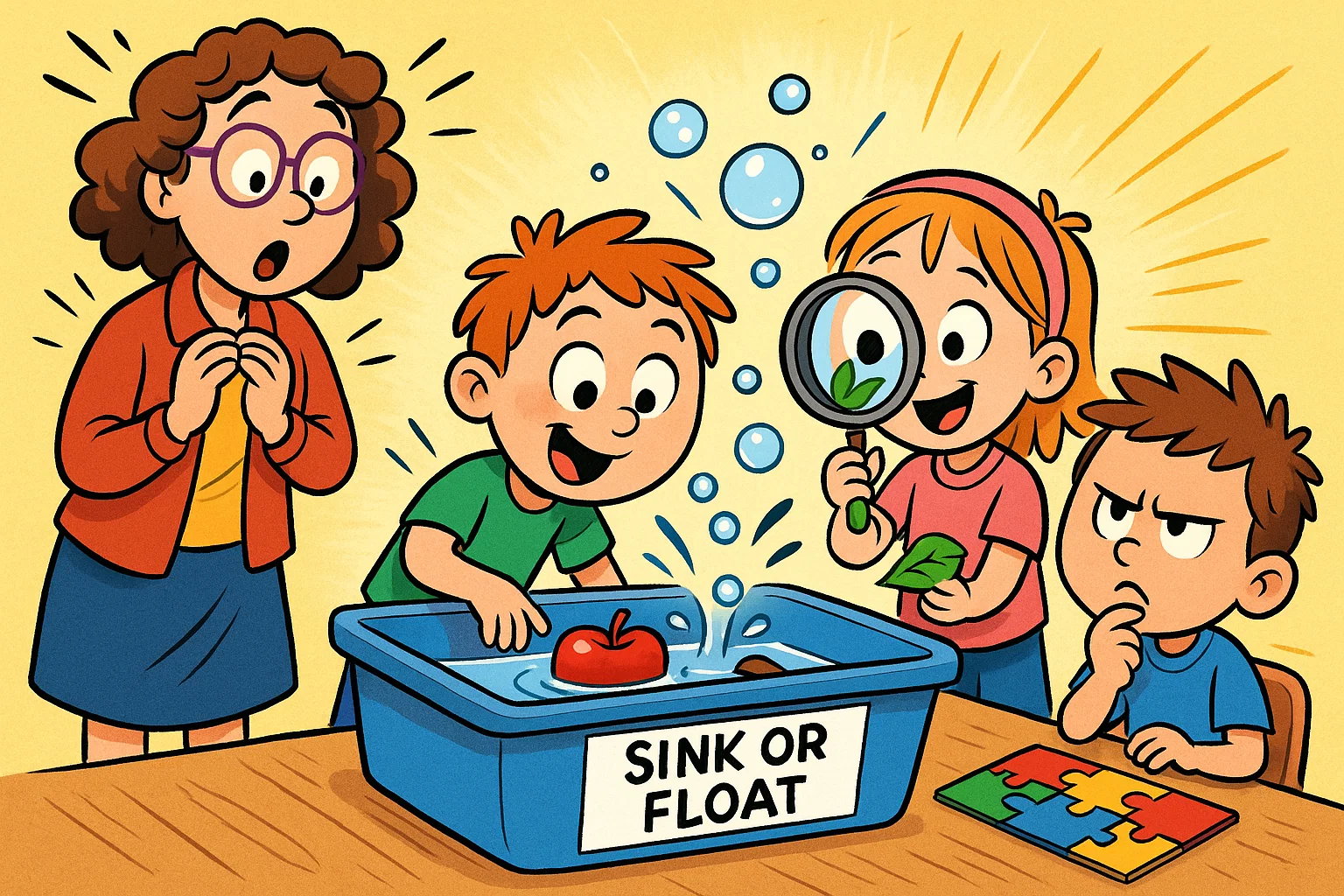
Play-based learning is not just a break from “real” work; it is the work of childhood. The American Academy of Pediatrics (AAP) states that play is essential to development because it contributes to children’s cognitive, physical, social, and emotional well-being.
How Children Learn Through Play
When children learn through play, they engage in a low-stress environment that encourages curiosity and risk-taking. Play is one of the best ways for children to develop problem-solving skills without fear of failure.
Whether children are building a tower, pretending to run a store, or playing a movement game, they are testing ideas, observing outcomes, and refining their understanding of cause and effect.
Essential Life Skills Built Through Play
Interactive learning games foster social skills such as cooperation, patience, listening, and taking turns. During social interaction, children learn the nuances of communication and the importance of respecting others’ ideas.
These activities help bridge the gap between individual play and the collaborative routines of a kindergarten classroom.
Thinking Skills Built Through Play
Hands-on learning activities stimulate executive function skills such as focus, memory, flexible thinking, and logic. Sorting beads by color, creating alphabet patterns, or building with blocks all require children to plan, compare, remember, and adjust.
These learning activities are a great way to start developing the mental flexibility children will need for more complex subjects later on.
Friendship Skills and Emotional Growth
Social-emotional learning is a cornerstone of early childhood education. Activities like emotion charades, group games, and pretend play help children name their feelings, recognize others’ emotions, and practice empathy.
These activities make learning how to handle conflicts, share materials, and communicate needs a natural part of daily play.
Fine Motor and Gross Motor Growth
Physical development is closely linked to academic readiness. Strengthening fine motor skills through play dough, bead threading, cutting, drawing, and building prepares the small muscles in the hands for writing.
At the same time, gross motor activities like jumping, climbing, balancing, and running build coordination and core strength. These skills help children feel more comfortable during classroom activities that require sitting, listening, moving between stations, and participating in group routines.
Learning Toolkit for Hands-On Kindergarten Activities
Before diving into specific activities, it is helpful to set up a simple learning toolkit for young learners. Having the right materials and setup makes it easier to support your child’s development consistently.
Essentials: Supplies to Get First
To make learning accessible, keep a bin of basic supplies ready. Useful items include:
- Magnetic letters
- Safety scissors
- Washable glue
- Crayons and markers
- Construction paper
- Dice
- Counters or buttons
- Picture books
- Play dough
- Painter’s tape
These items make it easy to set up at-home learning activities at a moment’s notice.
Open-Ended Materials
Open-ended materials can be used in many different ways. A cardboard box can become a house, a car, a puppet theater, or a rocket ship. A bowl of buttons can be used for counting, sorting, patterning, or pretend play.
These loose parts encourage children to use their imagination and build cognitive flexibility.
Budget-Friendly Supplies
You can help your child build important skills with items from your kitchen or recycling bin.
- Muffin tins: Perfect for sorting, counting, and matching.
- Clothespins: Excellent for strengthening fine motor skills.
- Dry pasta: Useful for counting, patterns, threading, or sensory play.
- Bottle caps: Great for letter matching, sorting, and simple math games.
- Paper towel tubes: Helpful for building, marble runs, and pretend play.
Safe Activity Setup
Always make sure learning spaces are safe. Use washable, non-toxic supplies and keep small objects away from children who still put items in their mouths.
A clear workspace helps reduce frustration. It is also helpful to establish a simple cleanup routine so children can practice responsibility and organization.
Learning Centers
Organizing your space into centers helps children develop independence. Even at home, a dedicated reading corner, art tray, block area, or small sensory bin lets children choose what to explore.
This sense of choice increases engagement and helps young learners become active participants in their own learning.
Sensory Learning Activities for Kindergartners
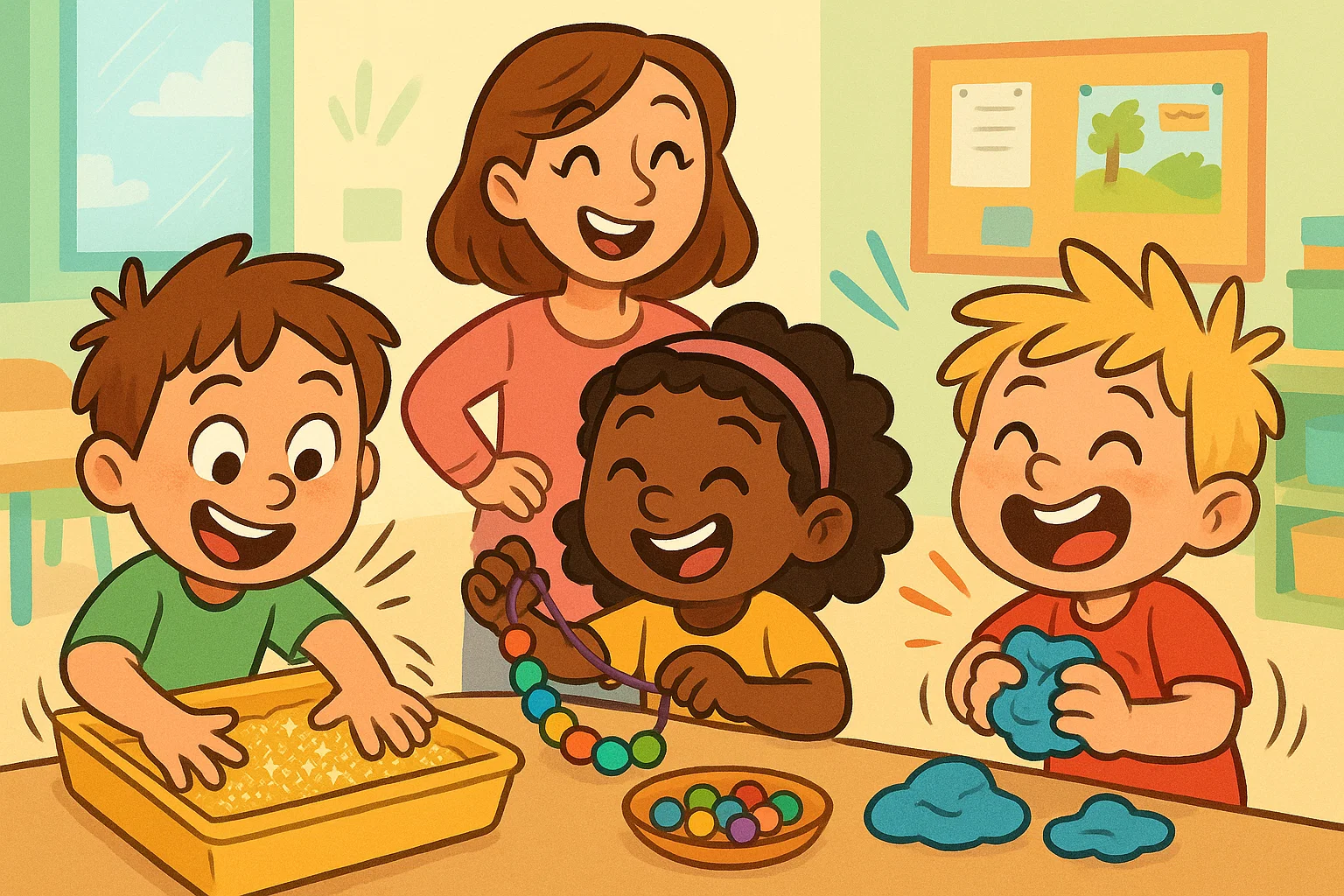
Sensory play is foundational because it helps children explore how the world works through touch, sight, sound, and movement. These activities often feel like pure fun, but they are deeply educational.
1. Sand Play
Sand is a versatile medium for literacy and math. Hide magnetic letters in a bin of sand and ask your child to find them, name them, and say their sounds.
You can also invite children to trace letters, numbers, or shapes in the sand with their fingers. This sensory experience helps create a strong mental map of letter and number forms.
2. Water Play
Water play is a perfect early science activity. Provide measuring cups, spoons, and containers of different sizes. Ask your child to predict which container will hold more water.
Use words like “heavy,” “light,” “full,” “empty,” “more,” and “less” to build vocabulary and early math understanding.
3. Play Dough
Play dough is one of the best tools for developing fine motor skills. Rolling, pinching, squeezing, and sculpting strengthen children’s hands.
Children can also use play dough to build letters, numbers, shapes, animals, or pretend food. This turns creative play into a literacy, math, and motor-skills activity.
4. Texture Bins
Create bins filled with rice, beans, cotton balls, dry pasta, or fabric scraps. Add small toys or letter cards and ask your child to find specific items.
This activity builds tactile discrimination and descriptive language. Encourage children to describe what they feel using words like “smooth,” “rough,” “soft,” “bumpy,” “cold,” or “grainy.”
5. Sensory Writing Practice
Instead of using paper, let your child draw letters in a tray of salt, sand, flour, or shaving cream. Call out a letter or sound and invite them to write it with their finger.
This hands-on approach turns repetitive writing practice into an engaging sensory activity.
6. Calming Sensory Bottles
Fill clear plastic bottles with water, glitter, beads, sequins, or small buttons. Seal the bottles tightly and let children shake them, watch the objects move, and observe how they settle.
These bottles are a great way to start a conversation about emotions. They also give children a visual tool for practicing self-regulation.
7. Ice Excavation
Freeze small toys, alphabet beads, or plastic animals in a block of ice. Give children warm water, droppers, and spoons so they can “excavate” the items.
This fun challenge teaches patience and introduces basic physics concepts such as melting, temperature, and cause and effect.
8. Sink or Float Experiment
Gather various household objects and a tub of water. Ask children to predict whether each item will sink or float, then test the objects one by one.
This activity helps children practice making predictions, a key part of early scientific thinking.
| Object | Prediction | Result |
| Plastic toy | Float | Float |
| Metal spoon | Sink | Sink |
| Cork | Float | Float |
| Rock | Sink | Sink |
Creative Art, Music, and Movement Activities
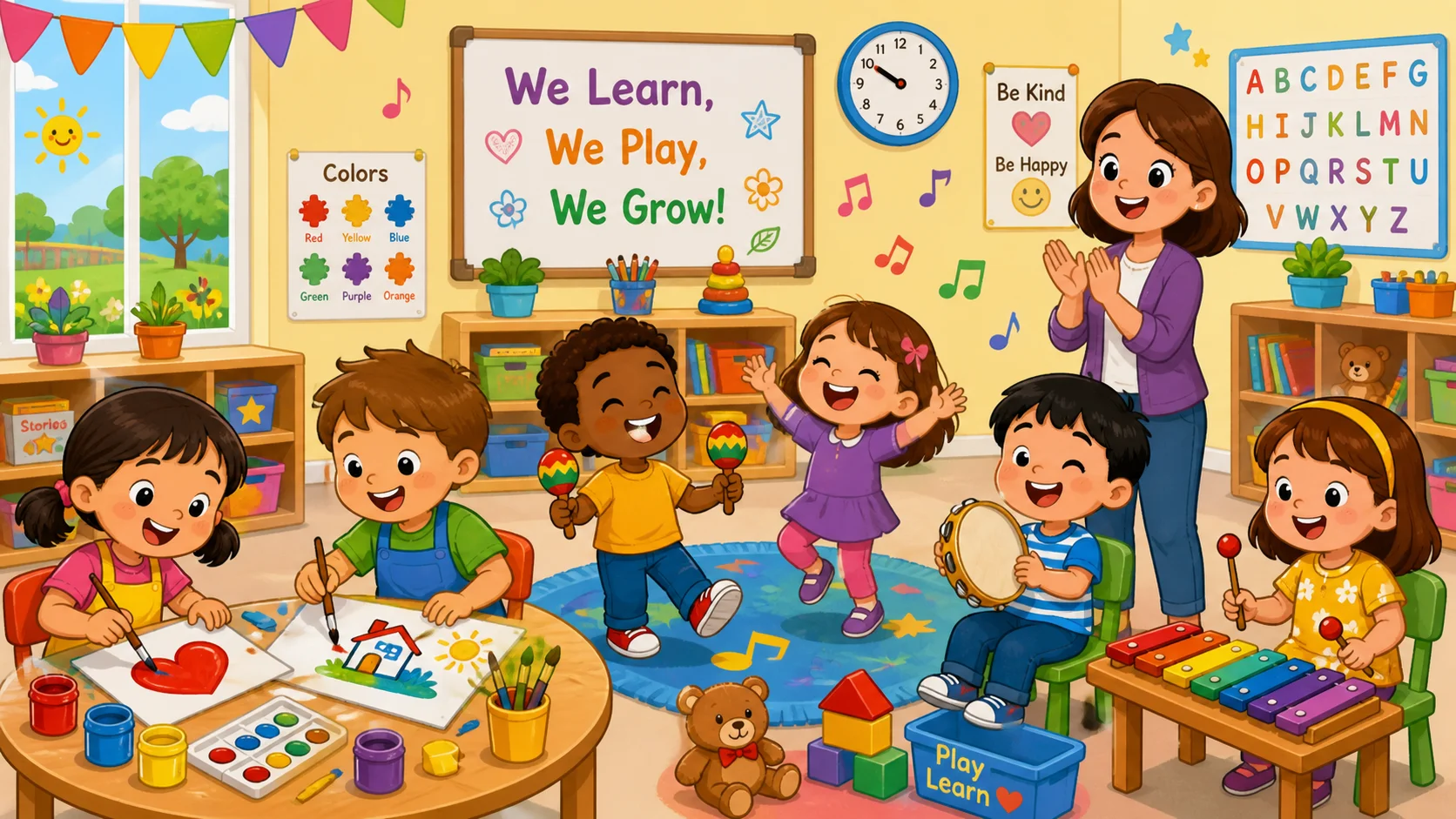
Integrating the arts into daily activities makes learning more expressive and engaging. Art, music, and movement help children communicate ideas, develop coordination, and build confidence.
9. Drawing and Painting
Art is more than making pretty pictures; it helps children communicate ideas. Encourage your child to draw scenes from favorite picture books or paint how a character might feel.
This supports reading comprehension, vocabulary, creativity, and emotional expression.
10. Easy Open-Ended Art Projects
Focus on process art, where the experience is more important than the final product. Offer materials such as sponges, torn paper, string, stamps, cotton swabs, and textured objects.
These projects let children experiment without the pressure to make something perfect.
11. Literary Arts and Crafts
After reading a story, create a craft connected to it. Children might make a character mask, build a setting from blocks, or draw a new ending.
Making a character mask helps children build empathy and develop a love of reading.
12. DIY Musical Instruments
Make simple shakers from beans and plastic bottles, drums from containers, or guitars from tissue boxes and rubber bands.
These activities make patterns, rhythm, and sound exploration more concrete. They also support listening skills and early math thinking.
13. Music, Dancing, and Singing
Play music and have a freeze dance party. When the music stops, children freeze in place. You can add challenges such as “freeze like a triangle” or “freeze on one foot.”
Action songs and chants can use movement and repetition to reinforce letter names, sounds, counting, and memory.
14. Pattern Bracelets
Use beads to make bracelets with repeating color patterns. Start with simple patterns like red-blue-red-blue, then move to more complex ones like red-yellow-blue-red-yellow-blue.
Making bead bracelets reinforces color patterns, concentration, and fine motor skills. Children also get a wearable piece of art to enjoy afterward.
15. Collage Sentences
Cut pictures from magazines and ask children to choose images they can arrange into a story. They might pick a dog, a park, a ball, and a sunny sky, then tell a sentence or short story about the pictures.
This interactive activity helps children move from visual cues toward oral storytelling and early writing.
Dramatic Play and Imaginative Activities
Dramatic play lets children rehearse real-life situations while building social skills, vocabulary, confidence, and problem-solving abilities.
16. Dress-Up and Role Play
Provide a bin of old clothes, hats, scarves, bags, and simple props. Role-playing as a doctor, teacher, chef, firefighter, or shopkeeper helps children practice social scripts and expand their vocabulary.
This type of play also builds confidence and imagination.
17. Doll and Character Play
Use dolls, stuffed animals, or small figures to act out everyday problems, such as sharing a toy, feeling left out, or asking for help.
This is a great way to teach conflict resolution in a low-pressure, playful setting.
18. Community Helper Roles
Set up a pretend grocery store, post office, vet clinic, restaurant, or fire station. These activities introduce the concept of community and create opportunities to practice math through buying, selling, sorting, and counting.
Children also learn new vocabulary connected to jobs, tools, places, and routines.
19. Pretend Cooking
Use toy food, empty containers, recipe cards, and kitchen tools to practice sequencing. Let your child pretend to cook a meal by following steps in order.
This builds logical thinking, language, counting, and independence.
20. Cardboard Box Creations
A large cardboard box can be one of the most versatile toys. Turning it into a castle, rocket ship, car, cave, or puppet theater encourages planning, creativity, and problem-solving.
Children can decorate the box, assign roles, and invent stories around their creation.
21. Storytelling Charades
Ask children to act out a story, animal, job, or emotion without using words. Other players guess what they are showing.
Acting out a story or emotion without words helps children develop nonverbal communication skills and emotional awareness.
Literacy Activities for Letters, Phonics, and Reading
Building literacy does not have to feel like a chore. Games are an effective way to introduce the sounds and symbols of language.
22. Letter-Sound Scavenger Hunt
Give your child a letter sound and ask them to find an object in the house that starts with that sound. For example, for /b/, they might find a ball, book, or banana.
This connects phonics to the real world and helps children understand that sounds are part of everyday language.
23. Phonics Play
Use magnetic letters on the fridge or a baking sheet to build simple words. Start with short words like “cat,” “sun,” “dog,” or “map.”
Help children stretch the sounds out loud as an early step toward independent reading.
24. DIY Story Stones
Paint or draw simple images on stones, such as a tree, moon, dog, house, star, or boat. Place the stones in a bag and let children pick one at a time.
Children can use each stone to decide the next plot point in a made-up story, which boosts creativity and oral language skills.
25. Interactive Storytelling
Read a book but stop before the end. Ask, “What do you think happens next?” Then finish the story and compare the child’s prediction with the actual ending.
This builds prediction skills, comprehension, and a deeper love of reading.
26. DIY Storybooks
Fold paper to make a simple book. Even if children cannot write yet, they can dictate the story while providing the illustrations.
You can write their words underneath each picture. This helps children see themselves as authors and understand the connection between spoken and written language.
27. Vocabulary Treasure Hunt
Hide word cards or picture cards around the room. Ask children to find them and name what they see.
For an added challenge, ask them to use each word in a sentence. This fun activity keeps children moving while they build vocabulary.
28. ABC Hopscotch
Draw the alphabet on the sidewalk with chalk. Call out a letter; when the child finds it, they hop on it and say the sound it makes.
You can also call out words and ask children to hop to the first letter of each word.
Math, Counting, Shape, and STEM Activities
Foundational math in kindergarten focuses on number sense – understanding what numbers represent. These activities help children connect numbers, shapes, and patterns to real objects and experiences.
29. Outdoor Math Hunt
Nature provides endless opportunities to practice math skills. Count petals on a flower, compare the sizes of rocks, sort leaves by color, or look for groups of objects.
This makes learning at home – or in the yard – feel like an adventure.
30. Fraction Pizza Craft
Use paper plates to make pretend pizzas. Children can decorate them with paper toppings, then cut or fold them into halves or quarters.
This introduces the idea of parts of a whole in a playful, visual way.
31. Dice Game
Dice games are excellent for subitizing – the ability to recognize a quantity without counting each dot.
Roll a die and ask children to say the number quickly. Then have them clap, jump, or place that many counters on a mat.
32. Roll and Count
Roll a die and place that many beads, buttons, or counters on a ten-frame or piece of paper.
This hands-on activity links the numeral to a physical quantity and strengthens one-to-one correspondence.
33. Counting Songs
Songs like “Five Little Ducks,” “Five Green and Speckled Frogs,” or “Ten in the Bed” use rhythm and rhyme to teach counting, subtraction, and number order.
Encourage children to use their fingers or small toys as they sing.
34. Number Freeze
Dance to music and pause when the music stops. Hold up a number card, and ask the child to freeze, show the number with their fingers, or find that many objects.
This combines number recognition, movement, and quick thinking.
35. Shape Hunt
Go on a shape search around the house, classroom, or playground. Look for circles on clocks, rectangles in doors, triangles on signs, and squares in tiles.
Finding shapes in the real world helps children develop spatial awareness.
36. Shape Yoga
Challenge children to make simple shapes with their bodies. They can make a line by stretching tall, a circle by curling up, or a triangle with their arms.
Children can also work with a partner to form larger shapes. This incorporates gross motor skills into geometry.
Science, Nature, and STEAM Investigations
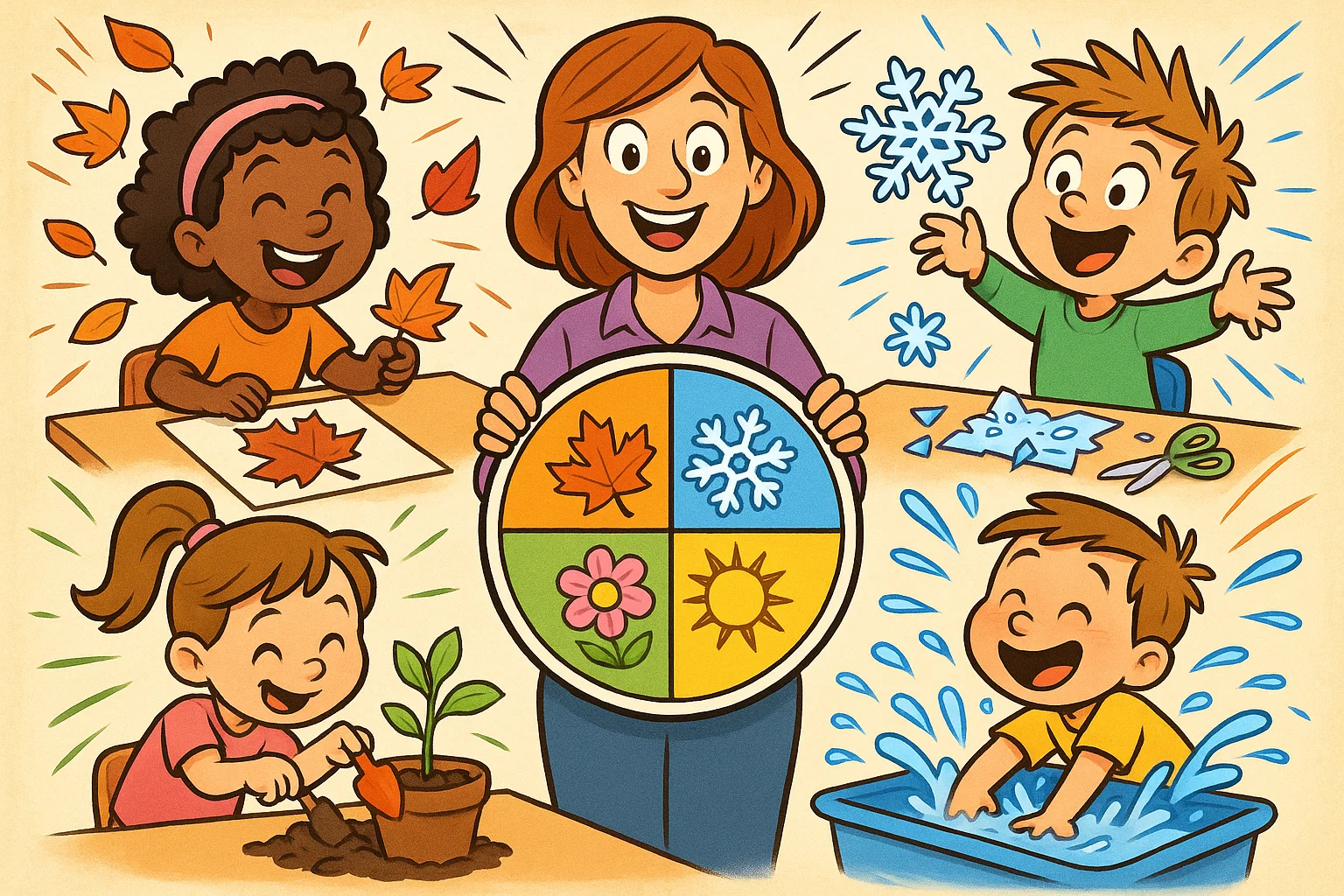
Science activities for kindergartners should focus on observation, curiosity, and simple cause-and-effect questions.
37. Nature Play
Sorting leaves by color, observing how an ant moves, or comparing different rocks develops a sense of wonder.
This at-home activity requires no equipment other than a magnifying glass, although a notebook for drawing observations can make it even richer.
38. Science Diorama
Use a shoe box to create a habitat. Children can build a home for a toy polar bear, desert lizard, ocean animal, or forest creature.
This helps children learn about different environments, animal needs, and the relationship between living things and their habitats.
39. STEM Investigations
Build a ramp for toy cars using books, cardboard, or blocks. Change the height of the ramp and observe how far the car travels.
This is a classic early physics experiment that introduces speed, distance, slope, and cause and effect.
Fine Motor, Gross Motor, and Social-Emotional Activities
A child’s physical development and emotional health support academic readiness. These activities help children build hand strength, coordination, self-control, confidence, and emotional awareness.
40. Fine Motor Art and Craft Activities
Activities like threading pasta onto yarn, peeling stickers, cutting paper strips, or using tweezers to move pom-poms build the grip children need for handwriting.
These activities also support concentration and hand-eye coordination.
41. LEGO Fine Motor Activities
Building with small blocks develops precise fine motor control. Challenge your child to build the letter L, the number 3, a bridge, a tower, or a simple pattern out of bricks.
This combines creativity, problem-solving, and hand strength.
42. Classic Group Games for Self-Control
Games like Simon Says and Red Light, Green Light help teach inhibitory control – the ability to stop an impulse and follow a rule.
These games also support listening skills, attention, and body awareness.
43. Emotion Charades
Write or draw simple emotions on cards, such as happy, sad, angry, surprised, scared, or proud. Children take turns acting out each emotion while others guess.
This helps children recognize facial expressions, body language, and emotional vocabulary.
44. Feelings Faces
Give children paper plates, crayons, yarn, stickers, or craft supplies and ask them to create different feeling faces.
Afterward, talk about when someone might feel that way. This supports emotional awareness and empathy.
45. Kindness Jar
Place an empty jar in the classroom or at home. Each time a child does something kind, add a pom-pom, button, or bead to the jar.
This makes positive behavior visible and encourages children to notice kindness, cooperation, and helpfulness.
46. Indoor Obstacle Course
Use pillows, tape, chairs, tunnels, cushions, and soft objects to create a simple obstacle course. Children can crawl, jump, balance, step over objects, and follow directions.
This builds gross motor coordination, planning, listening, and body control.
47. Balance Beam Walk
Place painter’s tape on the floor in a straight, zigzag, or curved line. Ask children to walk along the line slowly, heel to toe.
For an extra challenge, ask them to carry a beanbag, stuffed animal, or small object while balancing.
48. Balloon Keep-Up
Blow up a balloon and challenge children to keep it in the air without letting it touch the floor.
This simple game supports hand-eye coordination, teamwork, movement, and persistence.
49. Animal Walks
Invite children to move like different animals. They can hop like frogs, crawl like bears, waddle like penguins, stretch like cats, or stomp like elephants.
Animal walks build strength, coordination, imagination, and vocabulary.
50. Calm-Down Corner
Create a small calm-down space with pillows, books, sensory bottles, soft toys, and emotion cards. Teach children that the space is for calming their bodies, not for punishment.
This helps children practice self-regulation and learn strategies for managing big feelings.
Spot Learning During Play
As a parent or teacher, your role is to notice the learning happening in the moment. Children often build important skills during activities that look simple on the surface.
When you see a child doing any of the following, you are seeing early childhood education in action:
- Sorting blocks: Math, classification, and logical thinking.
- Negotiating who goes first: Social skills, patience, and communication.
- Describing a drawing: Literacy, vocabulary, and self-expression.
- Balancing on one foot: Gross motor development and body awareness.
- Pretending to cook: Sequencing, language, and imaginative play.
- Building a tower: Problem-solving, planning, and early engineering.
- Retelling a story: Memory, comprehension, and oral language.
- Naming feelings: Social-emotional learning and self-awareness.
Final Thoughts
By focusing on play-based learning, you help children learn more than facts; you help them develop the curiosity and confidence to explore the world for years to come.
With simple materials, a supportive environment, and a playful mindset, everyday moments can become powerful learning opportunities for kindergartners.
Frequently Asked Questions
How do you teach kindergartners to read?
Reading begins with phonological awareness – the ability to hear and work with sounds in words. Read together daily, play rhyming games, point out letters in everyday places, and use phonics games to connect letters with sounds. The goal is to make reading feel natural, playful, and meaningful.
What kindergarten math activities work best?
Hands-on learning works best. Use real objects such as snacks, buttons, blocks, toy animals, or counters for counting, sorting, comparing, and simple addition.
Games make numbers feel tangible rather than abstract.
Which fun learning activities require no prep?
Quick no-prep ideas include:
I Spy: Focus on colors, shapes, letters, or beginning sounds. Follow the Leader: Include movements like hopping, crawling, clapping, or balancing. Story Retell: Ask children to tell you about their day, a favorite book, or a favorite movie. Counting Walk: Count stairs, cars, trees, birds, or windows. Rhyme Time: Say a word and ask children to think of words that rhyme with it. Shape Search: Look for circles, squares, triangles, and rectangles around the room.
How can playful learning help get my child ready for the first day of school?
Playful learning is one of the best ways to build crucial school-readiness skills before the first day of school. Through play-based learning, children practice listening, following directions, taking turns, asking for help, and managing small transitions. Many preschool and child care routines already use this approach because it feels natural to young children. A simple game like lining up stuffed animals, packing a pretend backpack, or acting out a morning routine can help kindergartners feel more confident and ready for school. These activities for children support social, emotional, and practical skills, but also help reduce anxiety because the learning feels like play.
What are the best learning activities for kindergarten at home?
The best learning activities for kindergarten are fun and easy to set up with materials you already have at home. Counting snacks, sorting buttons, drawing letters in sand, reading picture books, or building shapes with blocks are all simple ways to support learning at home. These activities for kindergarteners are fun and educational because they help kids learn through movement and play rather than worksheets alone. Games are the perfect way to reinforce early math, phonics, vocabulary, and problem-solving in a low-pressure setting. Each activity is designed to match a young learner’s natural curiosity and help your child develop confidence throughout their learning journey.
Take a short quiz to find out what your everyday choices say about your parenting style
When your child is curious about something new, what’s your instinct?
Take a short quiz to find out what your everyday choices say about your parenting style
“Can I download this app?” What happens next?
Take a short quiz to find out what your everyday choices say about your parenting style
When it comes to rules at home, which sounds most like you?
Take a short quiz to find out what your everyday choices say about your parenting style
If you could give your child one life skill today, what would you pick?
Take a short quiz to find out what your everyday choices say about your parenting style
Your child gets to choose what to watch. What would your ideal setup look like?
Take a short quiz to find out what your everyday choices say about your parenting style
Pick your parenting superpower ✨