
Canton Schwyz School Curriculum Guide: Education System in Switzerland

 Discover a Free Education Video App for Kids
Pastory uses AI to personalize educational video content based on your child’s interests and personality. Safe, engaging, and built for curious young minds. Sign up now to stay updated and enjoy early access with a free trial
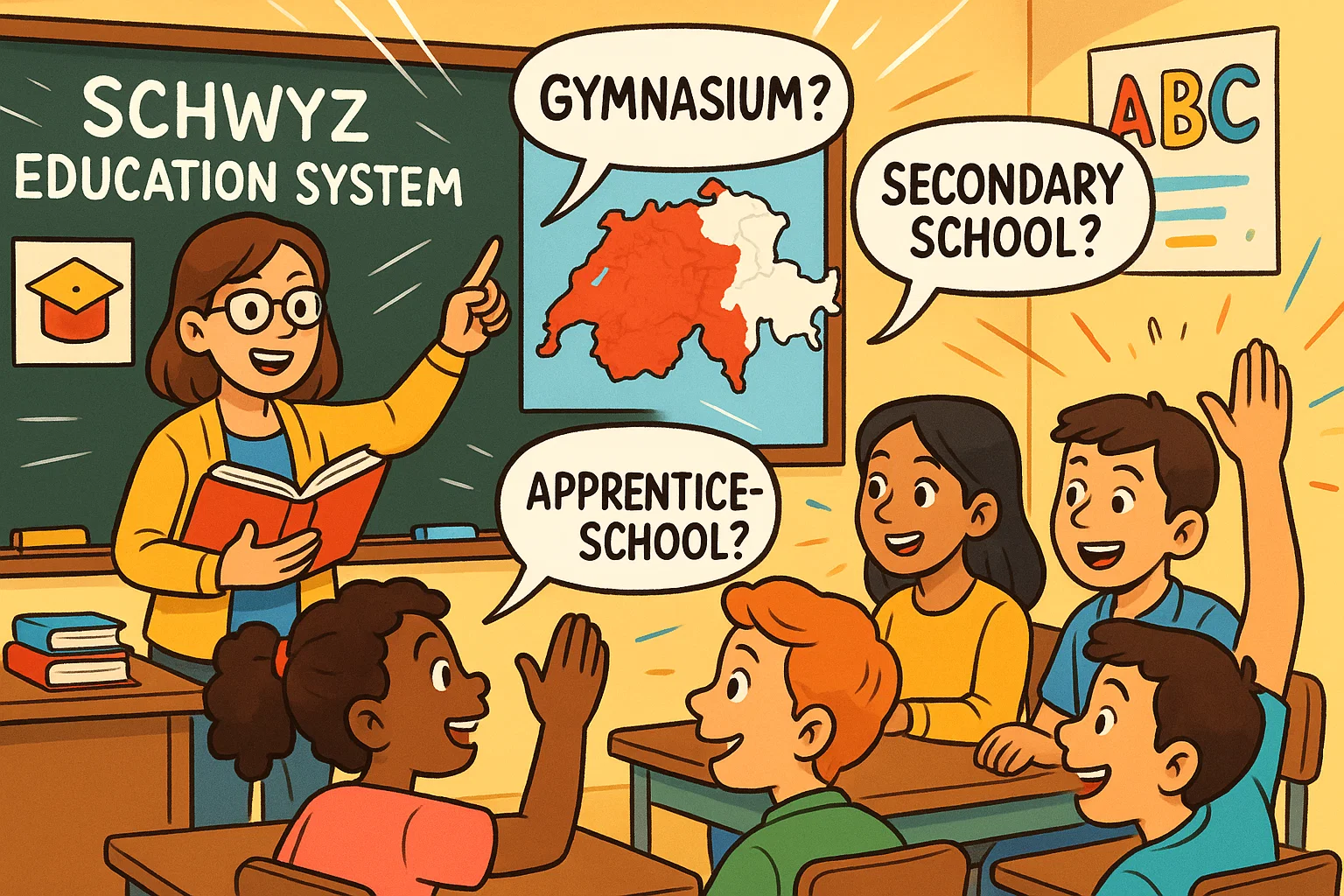
School education in Switzerland is highly decentralized: each of the 26 cantons has primary responsibility for compulsory school education, including legislation, funding structures, and curriculum implementation. For parents, expat families, international students, and researchers, understanding Switzerland’s school system requires looking at the specific canton in question.
Canton Schwyz operates its own public school system, with cantonal rules on the calendar, language instruction, curriculum implementation, and lower-secondary placement. While national and inter-cantonal frameworks align core goals, day-to-day schooling can vary from one canton to another.
This guide explains how the curriculum in Canton Schwyz works and helps families compare state schools, private and international schools, and the main pathways from primary school to the upper secondary level.
Key Takeaways
- Cantonal Governance: Canton Schwyz follows the Swiss compulsory education model, while curriculum implementation, holiday schedules, and many administrative policies are managed at cantonal and local levels.
- Structured Stages: Schooling generally includes kindergarten, primary school, lower secondary school, and several post-compulsory pathways at the upper secondary level.
- Language of Instruction: German is the main language of instruction in public schools in Canton Schwyz.
- Broad Curriculum: The curriculum covers languages, mathematics, natural sciences, social studies, the arts, physical education, digital skills, and career preparation.
- Diverse Options: Depending on cantonal rules and approval requirements, families may consider public schools, private schools, international schools, or homeschooling.
- Permeable Pathways: Lower-secondary placement influences upper-secondary options, but students can still move between vocational and academic routes through later transitions.
Schwyz Curriculum Snapshot
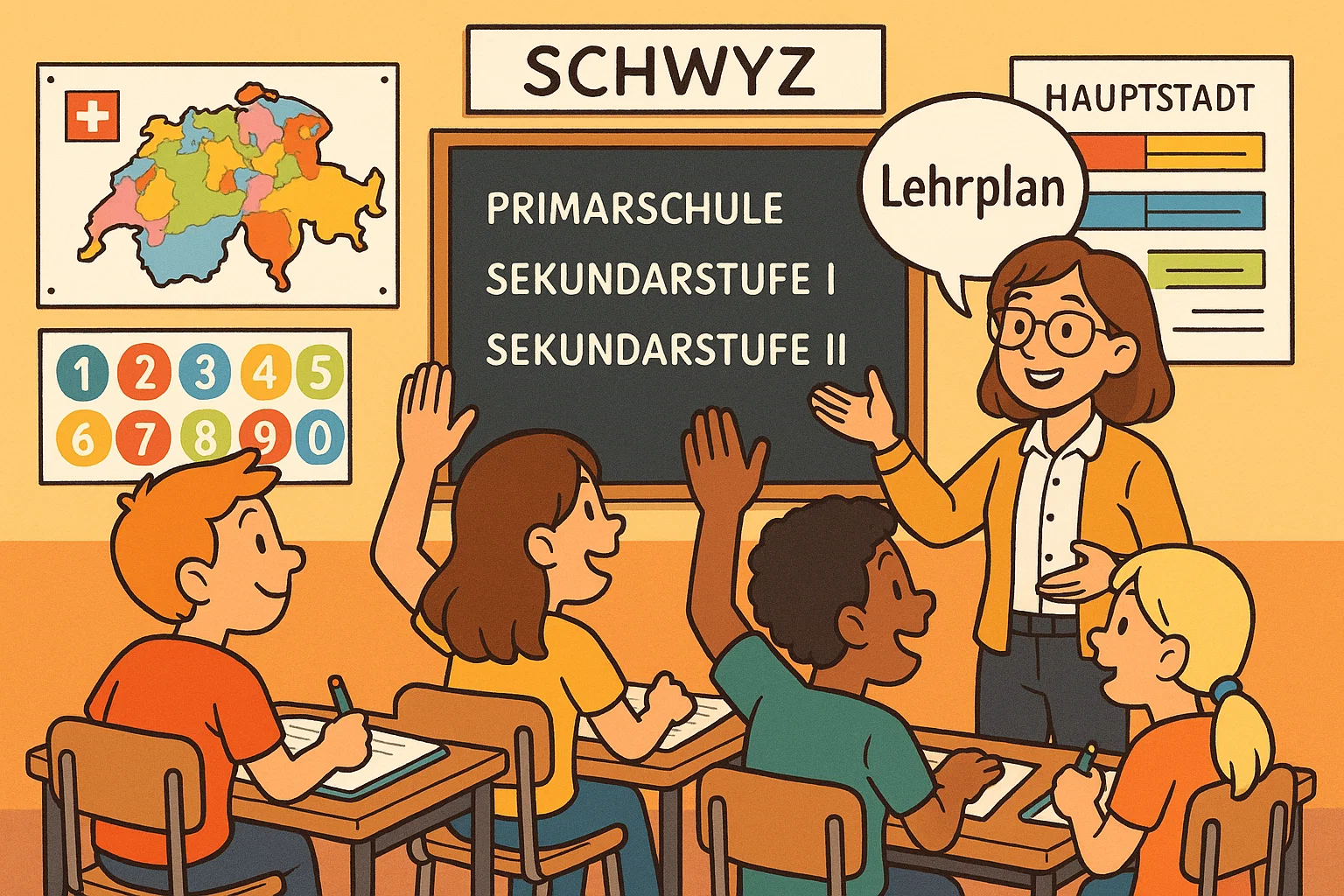
The curriculum in Canton Schwyz is designed to balance local educational priorities with the broader demands of Swiss society and the labour market. As part of the Swiss public school system, it focuses on core academic competencies, social integration, and language proficiency.
Parents comparing schools in Switzerland will find that Schwyz follows shared Lehrplan 21 goals while retaining cantonal and municipal implementation. This means that students work toward broadly aligned educational objectives, while teaching still reflects local administrative structures and community needs.
Compulsory education in Schwyz is designed to develop core academic skills, critical thinking, creativity, and social-emotional competencies through a structured progression of subjects. The curriculum takes a holistic approach to child development, combining academic learning with physical education and the arts. This balance helps young learners stay engaged and develop the flexibility needed for later educational choices.
By understanding the progression from primary years through lower secondary school, families can better anticipate the expectations placed on students. The Swiss system is designed to be permeable, meaning that early placement decisions do not necessarily lock a student into one lifelong career path. Instead, it provides multiple transition points that allow students to continue along academic, vocational, or hybrid pathways.
Parent Decision Points
Expat and local parents face several important decisions when navigating school education in Switzerland. The first major decision is whether to choose the local public school system or a private or international institution. Public schools support local integration and German-language learning without tuition fees, while international schools may offer continuity in English or global curricula such as the International Baccalaureate.
Language support is another important consideration for families moving to Schwyz. Non-German-speaking children entering public primary school are typically supported through German as a Second Language provision, often known as DaZ. Parents should consider whether their child’s age, language background, and emotional readiness fit the demands of learning a new language while keeping up with academic subjects.
The final year of primary school is also a major transition point because lower-secondary placement is prepared at this stage. Teacher assessments and recommendations can influence a student’s later access to academic or vocational pathways. Parents should work closely with teachers to make sure placement decisions reflect the child’s current academic level, learning needs, and longer-term goals.
Student Pathway Summary
A student’s educational journey in Schwyz follows a structured progression with several academic and vocational options. The process begins with kindergarten and continues through compulsory education into upper-secondary and tertiary pathways.
| Stage | Typical Age | Main Focus | Possible Next Step |
| Kindergarten | 4–6 | Social, motor, language, and early learning development | Primary school |
| Primary level | 6–12 | Core skills in German, mathematics, foreign languages, sciences, arts, and movement | Lower secondary school |
| Lower secondary level | 12–15 | General education, career orientation, and lower-secondary profiles | VET, baccalaureate route, specialised programmes, or transition options |
| Upper secondary level: VET | From around 15 | Apprenticeship-based vocational education and training | Labour market, higher professional education (PET), or universities of applied sciences with additional qualifications |
| Upper secondary level: academic or specialised route | From around 15 | Academic or professionally oriented education | Universities, universities of applied sciences, teacher education, or other tertiary options |
| Tertiary level | Usually after upper secondary | University, applied sciences, higher professional education, or teacher training | Advanced qualifications and professional careers |
This structure shows how the Swiss system supports both vocational and academic routes, with opportunities for further study and labour-market entry in both pathways.
Education in Switzerland
The Swiss education system is decentralized, and the Swiss Conference of Cantonal Ministers of Education (EDK) coordinates education policy rather than acting as a centralized national ministry. Under the Swiss federal system, the cantons have primary authority over compulsory education, including school organization, placement models, and holiday schedules.
This decentralization explains why schooling can differ when a family moves from one canton to another, for example from Zurich to Schwyz.
Compulsory Education
Compulsory education in Switzerland lasts for 11 years, typically covering children from around age 4 to 15. In Canton Schwyz, this period begins with two mandatory years of kindergarten, followed by six years of primary school and three years of lower secondary education.
Attendance at public compulsory schools is free. National coordination is handled through cantonal and federal bodies, while the State Secretariat for Education, Research and Innovation (SERI) is especially relevant for post-compulsory education, research, innovation, and vocational education and training.
Post-Compulsory Education
After compulsory education, most young people in Switzerland continue into upper-secondary education. More than 90% of young people in Switzerland acquire an upper-secondary certificate or diploma, either through vocational education and training or general education.
This level is split into two main branches: general education, which includes baccalaureate schools and specialized schools, and vocational education and training (VET). Upper-secondary programmes generally last three to four years and lead to recognized qualifications that shape a student’s next education or career options.
Special Features of the Swiss Education System
A defining feature of education in Switzerland is permeability. Students can move between academic and vocational pathways through additional qualifications, bridge programmes, or examinations. The system is also anchored by the dual-track model, which combines classroom instruction at a vocational school with paid workplace training at an approved training company.
This system is widely respected and is often cited as one reason for Switzerland’s strong school-to-work transition.
| Feature | Swiss Public School System |
| Funding | Cantonal and municipal funding |
| Permeability | High; students can move between vocational and academic pathways through additional qualifications, bridge programmes, or examinations |
| Language Focus | Local official language, another national language, and English |
| VET Participation | Around two-thirds of young people entering upper-secondary education choose VET pathways |
Cantonal School Systems
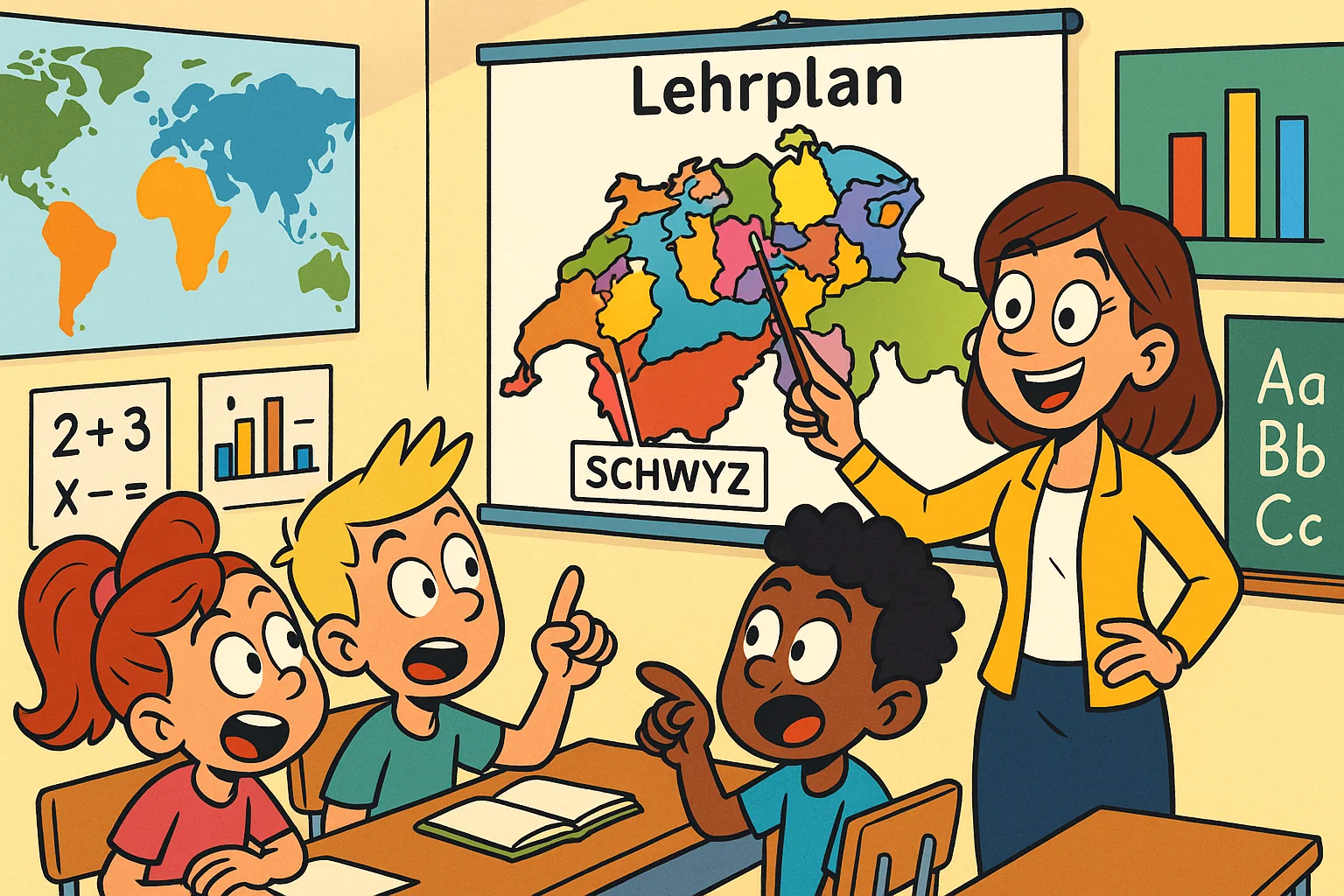
Because the cantons are responsible for implementing educational mandates, the exact method of delivering the curriculum is localized. Canton Schwyz uses its cantonal version of Lehrplan 21, the curriculum framework developed for German-speaking and multilingual cantons to harmonize core educational goals.
Despite this harmonization, Canton Schwyz retains authority over many aspects of implementation, including school organization and cantonal regulations.
Canton Schwyz Education Authority
The Amt für Volksschulen und Sport, the cantonal Office for Public Schools and Sport, oversees key aspects of public school administration in Canton Schwyz. This authority supports the implementation of cantonal educational law, supervises public school structures, and provides guidance on matters such as curriculum, special educational needs, and school operations.
Local municipalities and districts manage school infrastructure, transport arrangements, and operational matters within their areas.
Lower Secondary School Models
Swiss cantons may use different lower-secondary models, including separated, cooperative, and integrated models. These models describe how students are grouped and taught after primary school.
In Canton Schwyz, lower-secondary placement is commonly described through profiles such as Profile A, Profile B, and Profile C. Older terms such as Sekundarschule and Realschule may still appear in some contexts, but families should check the current terminology and placement criteria with the relevant local school authority.
Separated Model
In a separated lower-secondary model, students are grouped into distinct, performance-based school types or profiles for core academic subjects. This structure aims to align teaching pace and academic expectations with students’ learning needs.
Cooperative Model
In a cooperative lower-secondary model, students may remain in mixed classes for some subjects while being taught at different performance levels in core subjects such as German, mathematics, and foreign languages. This structure supports social cohesion while still allowing targeted academic differentiation.
Integrated Model
In Switzerland more broadly, some cantons use integrated lower-secondary models, where students remain in heterogeneous classes and teachers differentiate instruction within the classroom. This model should be clearly distinguished from the specific lower-secondary structure used in Canton Schwyz.
Structure of the Swiss School System
The Swiss education system moves from play-based early learning to increasingly specialised academic and vocational pathways. Each phase builds on the previous one and helps students develop the skills needed for further education, training, and work.
Preschool Education in Switzerland
Preschool education, known locally as kindergarten, marks the formal start of compulsory education for children in Canton Schwyz at around age 4. The curriculum at this early stage focuses on social-emotional development, motor skills, language development, and learning through structured play.
This play-based approach supports children’s social, motor, language, and cognitive development while preparing them gradually for primary education.
Primary School Education in Switzerland
Primary education in Schwyz spans six years and generally includes children from around age 6 to 12. The primary level builds core competencies in German literacy, mathematics, foreign languages, and natural and social sciences.
A classroom teacher may remain with the same group for several years, which can support continuity, observation, and individualized guidance.
Secondary School Education in Switzerland
Swiss secondary education is divided into lower secondary education, which completes compulsory education, and upper secondary education, which usually follows from around age 15.
Lower secondary education focuses on general learning and career orientation, while the upper secondary level branches into vocational, specialised, and academic pathways. This structure allows students to begin aligning their education with their interests, strengths, and future plans.
Curriculum in Canton Schwyz
The public curriculum in Canton Schwyz is based on Lehrplan 21, a competency-oriented framework that sets out what students should know and be able to do across the three cycles of compulsory education.
This competency-oriented approach emphasizes the application of knowledge and skills, while assessment still includes grades, teacher observation, and formal evaluations.
| Cycle | Years | Main Stage |
| Cycle 1 | Kindergarten to Grade 2 | Early learning and lower primary |
| Cycle 2 | Grades 3 to 6 | Primary education |
| Cycle 3 | Grades 7 to 9 | Lower secondary education |
Curriculum Structure
The Schwyz curriculum is organized into six main subject areas and includes cross-curricular modules and themes such as media and ICT, vocational orientation, and education for sustainable development.
Teachers use the curriculum framework to plan lessons and translate learning objectives into classroom activities and assessments. Each subject area describes competencies that students develop progressively over the course of compulsory education.
Subjects and Skills Taught
Students in Schwyz engage with a broad range of subjects designed to develop academic, practical, creative, and social skills.
- Languages: German literacy, English as the first foreign language from Grade 3, and French as the second national language from Grade 5.
- Mathematics: Numeracy, problem-solving, geometry, measurement, and applied mathematical thinking.
- Nature, Humans and Society: Science, social studies, geography, history, ethics, religions, and cultural communities.
- Arts and Design: Visual arts, music, and textile or technical design.
- Movement and Sport: Physical education, movement, and sport, with health-related topics addressed where they are part of the curriculum.
- Cross-Curricular Modules: Media and ICT, vocational orientation, and education for sustainable development.
Curriculum Assessment
Assessment within the Schwyz curriculum relies on a combination of formative evaluations and summative assessments. These may include teacher observation, written work, portfolios, class participation, projects, and graded tests.
Formal numerical grades are introduced during primary education and generally use the Swiss grading scale from 1 to 6, where 6 represents the highest performance and 4 represents sufficient mastery. Grades, teacher observations, assessments, and parent-teacher discussions all contribute to monitoring progress and informing lower-secondary placement recommendations.
Language of Instruction
German is the main language of instruction in public schools in Canton Schwyz. Foreign-language lessons are taught according to the cantonal curriculum, with English introduced from Grade 3 and French from Grade 5.
For expat families, integration into the local system usually requires sustained German-language learning, supported by German as a Second Language (DaZ) provision where applicable. Public institutions provide targeted language support to help non-German-speaking students build the language skills needed to follow the curriculum.
Primary Education in Canton Schwyz
Primary education in Schwyz is closely linked to local communities, with children generally attending classes near their place of residence. This local structure can support children’s independence, and many children walk or cycle to class where routes and family circumstances allow.
Public Primary School in Schwyz
Public primary schools are funded through cantonal and municipal resources, so resident families do not pay tuition fees during compulsory education. Enrolment is usually arranged through the local municipality or school authority based on the family’s registered address.
Public institutions follow the cantonal curriculum, which supports continuity when families move within the canton.
Private Primary Institutions in Schwyz
Private primary institutions are available in or near Canton Schwyz and may appeal to families seeking alternative pedagogical models, such as Montessori or Waldorf, or specialised language environments.
These institutions charge tuition and operate independently of municipal placement, though they must still meet cantonal authorization requirements. This authorization helps ensure that the curriculum aligns with core educational objectives.
Primary Curriculum Subjects
At the primary level, the curriculum emphasizes foundational learning and gradually moves from the play-oriented focus of kindergarten toward more structured academic work.
| Years | Main Focus |
| Grades 1–2 | German literacy, foundational mathematics, arts, movement, and early social learning |
| Grades 3–4 | Continued German and mathematics, first foreign language English, local geography, nature and society topics, and media skills |
| Grades 5–6 | Continued English, introduction of French, broader history and geography topics, basic media literacy, arts, sport, and preparation for lower secondary education |
This gradual increase in complexity helps children build strong foundations before taking on additional subjects and languages.
Secondary Education in Canton Schwyz
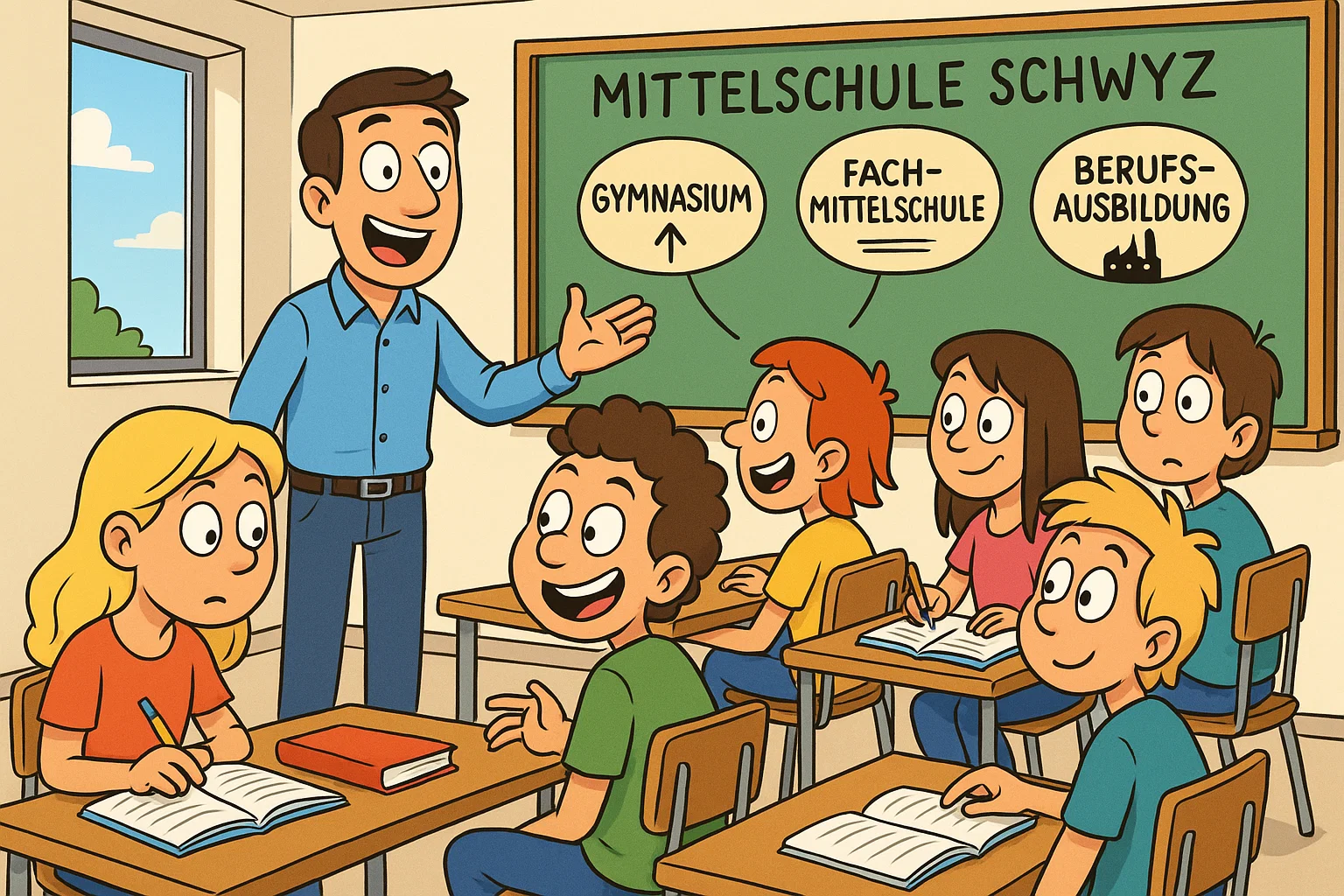
Secondary education in Canton Schwyz shapes students’ later academic and vocational options through performance-based lower-secondary placement and a strong focus on career orientation.
This framework aims to place students in learning environments that match their academic needs, interests, and future education options.
Public Lower Secondary Education in Schwyz
Public lower secondary education spans Grades 7 through 9 and serves as the final phase of compulsory education. The curriculum increases academic expectations and often involves more subject-specific teaching.
A core focus of Cycle 3 is career orientation, including self-assessment, information about professions, and, in many cases, trial apprenticeships (Schnupperlehren). This helps students prepare for post-compulsory choices such as vocational education and training, baccalaureate routes, specialised programmes, or transitional options.
Upper Secondary Education in Schwyz
Upper-secondary options available to students from Schwyz include vocational education and training, baccalaureate routes, and specialised programmes. Students may need to meet admission requirements, including entrance examinations, to enter an academic or specialised upper secondary school.
Alternatively, many students enter the vocational education sector, combining workplace training with targeted instruction at a regional vocational institution.
Streams of Secondary Education
Lower-secondary placement in Canton Schwyz is commonly organized through profiles. Families should verify the exact terminology, admission criteria, and local implementation with the relevant authority.
| Profile or Pathway | General Description | Typical Orientation |
| Profile A / Advanced Requirements | Designed for students who meet higher academic requirements | May prepare for further academic education or demanding vocational routes |
| Profile B / Basic Requirements | Designed for students who meet the basic requirements of Lehrplan 21 | Often prepares students for vocational pathways, with further education still possible depending on performance |
| Profile C / Orientation toward Basic Requirements | Intended for students with learning difficulties who benefit from smaller learning groups, individual support, and a practical orientation | Prepares students for suitable vocational or transitional pathways |
Students aiming for Gymnasium or another Mittelschule must meet the relevant academic and admission requirements.
Additional Secondary Topics
The weekly lower-secondary timetable consists of lesson periods rather than clock hours. Study periods, project work, and career-orientation activities vary by institution and timetable.
Grades and records become more important at lower secondary level because they can influence applications for apprenticeships and further education. Counselling and career guidance are integrated into this stage to help students make informed decisions about upper-secondary pathways.
Vocational Education and Training Schools
Vocational education and training (VET) is one of Switzerland’s main post-compulsory pathways, with around two-thirds of young people entering VET after compulsory education.
This pathway allows teenagers to combine paid workplace training with school-based learning and work toward a federally recognized qualification.
VET Curriculum
The VET curriculum functions through a coordinated dual system that divides learning between a training company and a vocational school. Students typically spend three to four days per week at a training company, gaining practical experience under qualified supervision.
The remaining one to two days are spent at a vocational school, where students study vocational theory and general education subjects.
Importance and Impact
The Swiss dual-track system is internationally recognized for linking vocational training closely with labour-market needs. Graduates of a VET programme earn a federally recognized qualification that gives them access to the labour market as qualified professionals.
By earning the Federal Vocational Baccalaureate (Berufsmaturität), VET graduates can access universities of applied sciences and, in some cases, further academic pathways.
Employer and School Cooperation
The VET pathway relies on cooperation between the Confederation, the cantons, and professional organizations, with SERI playing a key federal role. Cantons help supervise training and operate vocational schools, while professional organizations define occupation-specific training content.
This cooperation helps keep vocational training aligned with labour-market needs and technological change.
Baccalaureate Schools in Switzerland
Academic baccalaureate schools, commonly known as Gymnasien or Kantonsschulen in German-speaking Switzerland, are designed for students preparing for university-level study.
Their primary objective is to prepare students for higher education at Swiss universities, federal institutes of technology, and other university-level institutions.
Gymnasium Curriculum
The curriculum at a Swiss Gymnasium is rigorous and includes a broad range of core subjects alongside specialized options selected by the student.
Over the course of four to five years, students complete advanced coursework in languages, mathematics, sciences, humanities, and social sciences, depending on the school and programme. In addition to regular assessments, students complete an independent Matura project (Maturaarbeit), usually involving written research and a presentation or defence.
Assessment and Graduation
Graduation from a baccalaureate school leads to the Swiss Maturity Certificate (Matura) after students meet the required school-based and examination standards.
The Matura generally gives access to Swiss universities and the federal institutes of technology, although some programmes may have additional admission restrictions. Grading in the Gymnasium track is demanding, and students must meet promotion criteria to continue successfully.
International Recognition
The Swiss Matura is widely recognized internationally, although admission requirements vary by country, university, and programme. Graduates may apply to universities abroad, but admission conditions depend on the institution and the chosen field of study.
This international recognition can make the Gymnasium path attractive to families considering university options outside Switzerland.
Upper Secondary Specialized Schools
Upper-secondary specialized schools, known as Fachmittelschulen (FMS), offer school-based general education with a stronger professional orientation than the Gymnasium route.
Specialized School Curriculum
The FMS curriculum provides general education alongside professional orientation in selected fields. Students choose a professional field or specialization, with possible options including:
- Health or natural sciences, which may prepare students for further study in areas such as nursing, physiotherapy, or medical technology.
- Social work or pedagogy, which may lead toward teacher education, social work, or related fields.
- Communication, media, or design, depending on the school and programme.
Career Preparation
An FMS programme combines classroom-based general education with practical elements such as internships, projects, or field-specific learning, depending on the programme.
This structure can suit students interested in fields such as health, social work, education, communication, or design. The course of study typically lasts three years and leads to a specialized school diploma.
Transition Options
Graduates of an FMS can choose to complete an additional year to earn a Specialized Baccalaureate (Fachmaturität). This credential can open pathways to universities of applied sciences and universities of teacher education, depending on the chosen field and admission requirements.
The FMS pathway reflects the flexibility of education in Switzerland, giving students a professionally oriented school-based route into further education.
International Education Options in Switzerland
For families living temporarily in Switzerland, international schools can provide an alternative to the local cantonal public education system. These institutions can reduce language-transition challenges by offering English-language or international curricula.
International Schools in Switzerland
International schools operate as private institutions, requiring families to navigate individual admissions criteria, enrollment procedures, and tuition fee schedules.
These schools often have multicultural student communities and may offer smaller classes or specialized academic support. However, they may provide fewer opportunities for deep immersion into local Swiss culture and the German language, which expat families should weigh against their long-term relocation plans.
International Baccalaureate in Switzerland
The International Baccalaureate (IB) framework is widely offered across Swiss international schools, including the Primary Years Programme (PYP), Middle Years Programme (MYP), and Diploma Programme (DP).
The IB curriculum emphasizes global perspectives, interdisciplinary learning, and personal development, using its own assessment framework alongside international examinations. This can make the IB a practical choice for internationally mobile students who may move countries before completing secondary education.
International Schools Near Schwyz
Families living in Canton Schwyz are more likely to consider international schools in the Lake Zurich area, Canton Zug, or nearby regions than schools in western Switzerland.
Schools such as the Inter-Community School Zurich (ICS) or the International School of Zug and Luzern (ISZL) may be relevant options depending on commute, admissions availability, curriculum fit, and family priorities. Some regional international schools offer school transport, but families should check routes, availability, and fees directly with each school.
Support for Children with Special Educational Needs in Switzerland
The Swiss public education system prioritizes the integration of children with special educational needs into regular mainstream classrooms whenever appropriate. This inclusive approach aims to keep children with physical, developmental, or learning needs in local mainstream settings while providing additional support where required.
Special Educational Needs Support in Schwyz
In Canton Schwyz, support for children with special educational needs may involve the local school, school leadership, specialist teachers, and the School Psychological Service, depending on the level of support required.
Following assessment, support may include services such as speech therapy, psychomotor therapy, remedial teaching, or other specialist measures.
Inclusive Classroom Support
Mainstream public school classrooms in Schwyz may use a range of inclusive strategies to support diverse learners.
- Individual Support Plans: Tailored learning goals and support measures designed to match the child’s needs and learning pace.
- Classroom Accommodations: Adjustments such as additional time, adapted tasks, or approved assistive tools where appropriate.
- Co-Teaching Models: Specialist teachers may support lessons alongside the class teacher where this model is used.
- Social Integration: Measures to support participation in class activities, breaks, school trips, and the wider school community.
Parent Steps for Support
To seek specialized support in the Schwyz public school system, parents should begin with the class teacher and school leadership, who can guide them through the appropriate assessment or referral process.
- Initiate Teacher Consultation
Schedule a formal meeting with the class teacher to discuss observed learning barriers, behavioural patterns, and initial classroom support. - Request a Formal Evaluation
If concerns persist after initial school-level support, ask the school administration about the process for formal assessment or referral. - Gather Independent Documentation
Compile relevant medical records, pediatric reports, prior psychological assessments, or previous school support plans. - Attend a Multi-Disciplinary Case Meeting
Meet with teachers, school leaders, specialists, and, where appropriate, psychological services to review assessment findings and agree on support measures. - Implement and Review the Support Plan
Implement the agreed accommodations and review progress at intervals agreed with the school and specialists.
Changing Schools in Switzerland
Relocating between school settings in Switzerland requires careful planning because of cantonal differences. Families should check school curriculum alignment, language requirements, and placement deadlines before moving.
Moving to Schwyz from Another Canton
Families moving to Schwyz from another Swiss canton should register promptly with their new municipality and check the local registration deadline. Placement is then arranged through the local school authority.
Because Lehrplan 21 covers German-speaking and multilingual cantons, many core goals are aligned, although language sequencing, assessment, and lower-secondary placement can still vary. For example, a child moving from a canton with a different foreign-language sequence may need short-term support to catch up with the new class.
Moving from International to Public Education
Moving from an English-language international institution into the public school system in Schwyz can be a major linguistic adjustment.
Authorities will review the child’s age, records, and language level to determine placement and arrange German-language support where needed. Parents should anticipate an initial period of social and cognitive adjustment as the child builds fluency in the local language of instruction.
Moving from Public to Private Education
When a family chooses to leave the public school system for a private or international institution, they should formally inform the local school authority.
The new provider will usually request transcripts or records from the previous institution and take responsibility for future reporting. Parents should verify whether the chosen curriculum preserves pathways back into Swiss public schools or later Swiss tertiary options.
Parental Involvement in School Education in Switzerland
Swiss public schools value a structured and cooperative relationship between parents and teachers. Parents are not expected to manage classroom work, but cooperation at home is important for children’s learning and development.
Parent-Teacher Meetings
Formal parent-teacher meetings (Elterngespräche) are typically scheduled during the year to discuss academic progress, behaviour, and social development.
Teachers usually present observations directly and constructively, and parents are expected to work with the school team on any learning, behavioural, or social concerns.
Homework and Home Support
The Schwyz curriculum uses homework to reinforce concepts introduced during lessons and to build independent study habits.
Parents are advised to establish structured home routines and provide a quiet environment where children can complete assignments independently. Rather than doing the work for the child, parents should encourage organization, time management, and a constructive attitude toward difficult tasks.
Community Participation
Public schools often foster community integration through information evenings, sports days, festivals, and parent associations.
Many municipalities have parent forums that collaborate with leadership on extracurricular activities, safety campaigns, or community events. For expat families, participating in these activities can be a useful way to build local connections.
Financial Aid and School Costs
The financial obligations associated with school education in Switzerland depend on whether a family uses the public school system or chooses private, fee-paying options.
Public School Costs
Public compulsory education in Switzerland is tax-funded, so there are no tuition fees for resident children at state schools.
Families may still pay for items such as supplies, excursions, camps, meals, childcare, or extracurricular activities, depending on local rules. Many municipalities provide after-school care or lunch options, with fees often depending on family income and local regulations.
Private and International Fees
Private and international schools charge tuition fees that vary by grade level, curriculum, location, and provider.
Annual tuition fees in the Lake Zurich and Zug regions can be substantial, so families should check current fee schedules directly with each institution. Fees may exclude enrolment deposits, transport, meals, uniforms, extracurricular activities, and external examination fees.
Scholarships and Grants
Canton Schwyz operates a public grant system designed to provide financial aid to eligible students pursuing post-compulsory upper-secondary or tertiary education.
These public scholarships are generally need-based and assess factors such as parental income and assets to help eligible students continue their education. Some private or international schools may offer scholarships or hardship bursaries, but availability, criteria, and application requirements vary widely.
International Recognition
Swiss educational credentials are well regarded internationally, reflecting the country’s strong education and training system.
Swiss Certificates Abroad
The Swiss Academic Maturity Certificate (Matura) is widely recognised by universities and education authorities, although admission requirements vary by country, institution, and programme.
Similarly, Swiss VET qualifications are valued by many employers, particularly in sectors familiar with the Swiss dual-training model.
IB Diploma Recognition
The International Baccalaureate Diploma is widely recognised by universities worldwide, but admission requirements vary by country, university, and programme.
Because the IB uses an international assessment framework, many admissions offices can compare applicants across school systems more easily. This can make the IB useful for families who expect another international move before university.
Career Pathway Recognition
The Swiss approach to professional education and training can support international career mobility, especially in sectors that recognise Swiss vocational qualifications.
Swiss professionals with advanced federal qualifications may be competitive for management or technical specialist roles, especially when their practical training is relevant to the employer’s sector.
Future Trends in Swiss Education
The Swiss education sector continues to evolve to meet the changing demands of a digital and multilingual society while preserving its core structural values.
Digital Skills in the Curriculum
Lehrplan 21 has integrated media, ICT, and basic digital competencies into compulsory education in Canton Schwyz.
Students learn age-appropriate digital skills, including media literacy, online safety, and basic computational thinking. This focus encourages students to become more active and responsible users of technology.
Multilingual Learning
Switzerland’s commitment to multilingualism remains a defining feature of its school system. Public schools continue to develop foreign-language teaching so that students can use another national language and English in real-life contexts.
This multilingual competence can give Swiss graduates an advantage in international study, work, and mobility.
Career Readiness
Modern updates to the secondary curriculum emphasize lifelong learning, adaptability, collaboration, communication, and digital skills as technology and labour-market needs change.
By linking education providers with vocational training companies and professional networks, the Swiss system helps students enter the workforce with practical skills and adaptability.
Conclusion
Understanding the curriculum in Canton Schwyz requires familiarity with both cantonal autonomy and the Swiss system of lower-secondary placement and post-compulsory pathways.
The public school system offers free, high-quality, and locally integrated education focused on German-language fluency, core academic competencies, and balanced child development. International options can provide continuity for mobile families who need English-language or globally recognised curricula.
By understanding the progression from primary school to specialised upper-secondary routes, parents can make informed decisions that align with their child’s abilities, needs, and long-term educational goals.
Main Curriculum Takeaway
The Schwyz curriculum provides a modern education shaped by the Lehrplan 21 competency framework and implemented through cantonal and local administration.
The system offers respected academic and vocational pathways, allowing students to pursue university-oriented study, vocational training, or later transitions between the two.
Best Next Step for Families
Families living in or moving to Canton Schwyz should contact the local education administration (Schulverwaltung) for their registered address to start the enrolment process.
Families should request official curriculum information and ask about German as a Second Language (DaZ) support if needed.
Final Parent Checklist
- Confirm Municipality: Verify your local district based on your official residential registration.
- Collect Records: Compile transcripts, vaccination records, and language certificates from your child’s previous provider.
- Assess Language Needs: Evaluate whether your child requires German-language support.
- Compare Pathways: Balance the benefits of local public integration against international curriculum continuity.
- Review Secondary Options: Familiarize yourself with Schwyz lower-secondary profiles and the requirements for Gymnasium or other upper-secondary pathways.
- Plan Transitions Early: Connect with administrators, career counsellors, or admissions officers before major school transitions.
FAQ
How long does school last in Switzerland?
In Switzerland, compulsory school education lasts 11 years in most cantons. It usually begins with two years of kindergarten, followed by six years of primary school and three years of lower secondary education. After that, students move to the upper secondary level, where they choose between vocational education and training, an academic route, or a specialized school pathway.
Is education compulsory for all children in Switzerland?
Yes. Education is compulsory for children living in Switzerland, and this applies throughout Switzerland regardless of nationality or native language. Families usually enrol their children through the local municipality or school authority. In Canton Schwyz, children generally attend state schools close to their registered address unless the family chooses an approved private or international option.
What happens in the final year of primary school in Canton Schwyz?
The final year of primary school is an important transition point because teachers, parents, and school authorities prepare for lower-secondary placement. A student’s academic performance, learning behaviour, and overall development help determine the most suitable lower-secondary profile. This placement can influence later access to academic high schools, vocational pathways, or other upper-secondary school options.
What are the main types of education after compulsory school?
After compulsory school, students in Switzerland can choose from several types of education. The most common pathway is vocational education and training, where students combine workplace learning with vocational school. Other students continue at academic high schools, specialized schools, or other upper secondary school programmes. Switzerland also offers later transition routes, so students are not necessarily locked into one pathway permanently.
Can Swiss students combine school with an apprenticeship?
Yes. Many Swiss students choose vocational education and training, which allows them to combine school with an apprenticeship. In this model, students usually spend part of the week at a training company and part of the week at a vocational school. This is one of the defining features of Switzerland’s education system and is widely respected by employers.



